
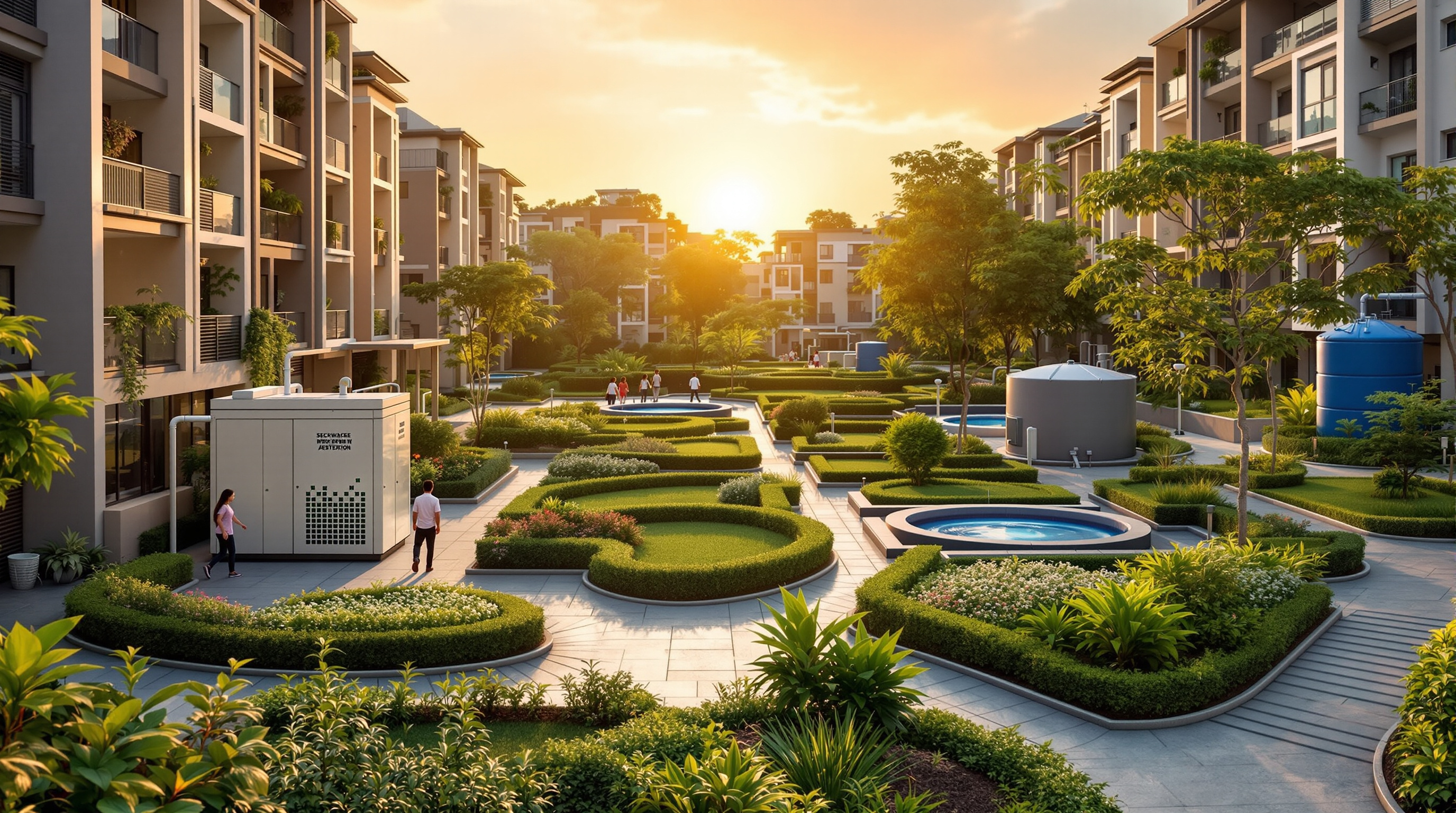
Water-Positive Buildings: The Role of STPs
What "water positive" actually means, how treated STP water, rainwater harvesting and groundwater recharge combine to get a building there, and how to measure the balance credibly in the Indian context.
"Water positive" has become one of the most-used phrases in Indian green-building marketing — and one of the least understood. A developer's brochure claims it; an RWA is told the campus already is one; a consultant promises to certify it. But strip away the slogan and a hard question remains: does the building actually return more usable water to its site and its neighbourhood than it takes from fresh supply? For most buildings the honest answer is "not yet" — and the single biggest lever that closes the gap is the Sewage Treatment Plant.
This guide sets out what water positivity really means, the three systems that deliver it, and — the part most brochures skip — how to measure it in a way that would survive an audit.
A building is water positive when, over a full year, the usable water it generates and returns — through treated-sewage reuse, rainwater capture and genuine groundwater recharge — exceeds the fresh water it imports. It is an annual balance, not a one-day headline.
What "water positive" actually means
Three related terms get used loosely, so it helps to separate them:
- Water efficient — the building simply uses less fresh water than a conventional one (low-flow fixtures, smart metering). Necessary, but not positive.
- Water neutral — over a year, fresh-water import is fully offset by water the building recycles and recharges. Net zero.
- Water positive — the building goes past neutral: it returns more usable water to the site and aquifer than it draws in.
The distinction matters because certification bodies and buyers increasingly ask for the harder claim. Under IGBC and GRIHA, credits reward on-site reuse, rainwater harvesting and reduced municipal dependence — the same levers that, pushed far enough, tip a building from efficient to positive. If you are chasing rating points, the green-building water credits guide maps how these systems translate into scored credits.
The three systems that get you there

No single intervention makes a building water positive. It is the arithmetic of three flows working together.
1. STP reuse — the largest and most reliable lever
A well-run STP recovers roughly 80–85% of a building's indoor water consumption and turns it into water fit for flushing, landscape irrigation, cooling towers and washing. This is the biggest and most dependable contribution to the balance, because — unlike rain — sewage is produced every single day the building is occupied. A campus that flushes its toilets with fresh municipal water is quietly throwing its best water asset down the drain. Redirecting that flow via a dual-plumbing toilet-flushing line is usually the highest-return move on the whole path to positivity. If you have not sized or costed the plant yet, start with the STP cost estimator.
2. Rainwater harvesting — seasonal but powerful
Rooftop and surface runoff, captured and either stored for direct use or routed to recharge, adds a large seasonal volume — concentrated in a few monsoon months in most of India. The design tension is between storage (usable now, but tank-limited) and recharge (unlimited, but returned to the aquifer rather than the tap). The two systems are complementary: treated STP effluent covers the steady daily demand, rainwater covers the monsoon surplus and tops up groundwater. Getting the split right is exactly what the rainwater–STP integration calculator is for.
3. Groundwater recharge — the "positive" in water positive
Recharge is what usually carries a building past neutral into positive territory. Surplus treated water and harvested rain, directed into recharge wells and pits, replenish the shared aquifer. Crucially, credible recharge must be genuine — percolating into permeable strata, not quietly overflowing to a storm drain. Auditors increasingly want evidence: recharge-well logs, borewell-level trends, soil percolation data. Overstated recharge is the most common reason a "water positive" claim collapses under scrutiny.
Putting the balance together
Water positivity is an accounting exercise. In simplified form:
Fresh water in (municipal + tanker + borewell) must be less than usable water returned (treated water reused on site + rainwater used + genuine recharge).
Here is how the flows typically stack up for a mid-sized residential campus:
| Flow | Direction | Typical share of balance | Reliability |
|---|---|---|---|
| Municipal + tanker + borewell supply | In (fresh demand) | The number to beat | Daily |
| STP treated-water reuse | Returned | 45–60% of the offset | Daily, year-round |
| Rainwater harvested & used | Returned | 15–30% | Seasonal (monsoon) |
| Groundwater recharge | Returned | 15–30% | Seasonal + surplus |
| Fresh-water demand reduction (low-flow fixtures) | Reduces "in" | 5–15% | Continuous |
The shares are illustrative, not universal — a Bengaluru IT park and a Rajasthan hotel will look very different. What holds everywhere is the structure: STP reuse does the daily heavy lifting; rainwater and recharge supply the seasonal surplus that pushes the balance positive. To model your own numbers before committing to a design, the water-balance calculator is the right starting point, and the green-building water-score calculator translates the result into a rating-oriented score.
How to measure it honestly

A claim is only as good as its meter. The common failure modes are worth naming plainly:
- Counting design capacity, not actual reuse. An STP rated for 400 KLD that reuses only 150 KLD is not delivering 400 KLD of offset. Measure the water that is actually piped back into use, not the nameplate.
- Double-counting recharge and reuse. The same litre cannot be both reused for flushing and recharged. Track them as separate, non-overlapping flows.
- Ignoring evaporation and system losses. Cooling-tower drift, filter backwash and line losses are real; a rigorous balance subtracts them.
- Averaging away the dry season. Rainwater is monsoon-heavy. A building can be water positive over the year yet import heavily in March — so report the annual figure honestly, and check whether daily demand is met in the lean months.
Practical measurement rests on separate flow meters on each stream — fresh inlet, STP reuse line, rainwater supply and recharge structures — logged monthly and reconciled over twelve months. This is where IoT metering genuinely helps: continuous sub-meter data replaces the annual guess with a live ledger. The emerging toolkit of IoT STP monitoring and smart water infrastructure is maturing fast, though it is worth being clear-eyed — most Indian campuses today still run on manual monthly readings, and that is perfectly adequate to substantiate a claim if done consistently. Treat AI-driven prediction and digital twins as helpful accelerants, not prerequisites.
Where STP performance decides the outcome
Because treated-water reuse is the load-bearing flow, the water-positive claim ultimately depends on the STP running reliably at design quality. A plant that trips, produces off-spec water the landscape team refuses to use, or sits half-commissioned quietly demolishes the balance. Reliable reuse depends on sound technology choice — whether MBR, MBBR or SBR suits your footprint and reuse quality — and on disciplined operation and maintenance. In that sense, water positivity is less a certificate than an operating commitment: the arithmetic only works while the plant works.
The bottom line
A water-positive building is not a slogan on a hoarding — it is a twelve-month balance in which STP reuse, rainwater harvesting and honest recharge together return more usable water than the building imports. The STP is the anchor because it delivers the largest, most reliable daily flow; rainwater and recharge supply the seasonal surplus that tips the scales; and rigorous, separately metered measurement is what turns a marketing phrase into a defensible claim.
For the wider picture of how these flows close the loop across a city, read the urban water circular economy guide, and browse the full Sewage Treatment Plants library to go deeper on any single system in the chain.
Export this guide
Related Guides — Deep-dive reading
Circular Water Management for Buildings & Cities: The Closed-Loop Guide
How to stop treating water as a one-way flow and design a closed loop — treat, reuse, recharge, repeat — with a sewage treatment plant at its core, for Indian buildings, campuses and cities.
Sewage Treatment PlantsRooftop Water Recycling Integration in Homes: One Non-Potable System from Rain and Greywater
How to combine rooftop rainwater harvesting with greywater and STP reuse into a single non-potable water system — the storage, dual plumbing, controls and seasonal logic that make two sources behave like one reliable supply.
Sewage Treatment PlantsSTP for IT Parks & Campuses: Central-Plant Design, Reuse & Redundancy Guide
How to plan a campus-scale sewage treatment plant for a multi-building IT park in India — the daytime flow pattern, the right technology, sizing for a central plant, and a reuse network feeding landscape, flushing and cooling towers.
Sewage Treatment PlantsRelated Tools — Try Free
Rainwater Tank Sizer
How big should your rainwater tank be? Computes annual harvest, recommended tank capacity in litres, water-bill savings, and payback — for 10 Indian cities.
RWH CalculatorGreen Building Water Score Calculator
Score a building's water efficiency 0–100 from treated-water reuse, rainwater harvesting, low-flow fixtures and metering, with an IGBC/GRIHA-style rating and your biggest improvement lever.
SustainabilityRainwater + STP Integration Calculator
Combine rooftop rainwater harvesting with STP treated-water reuse to estimate the total non-potable water your building can supply in KL per year.
Water Calculator