
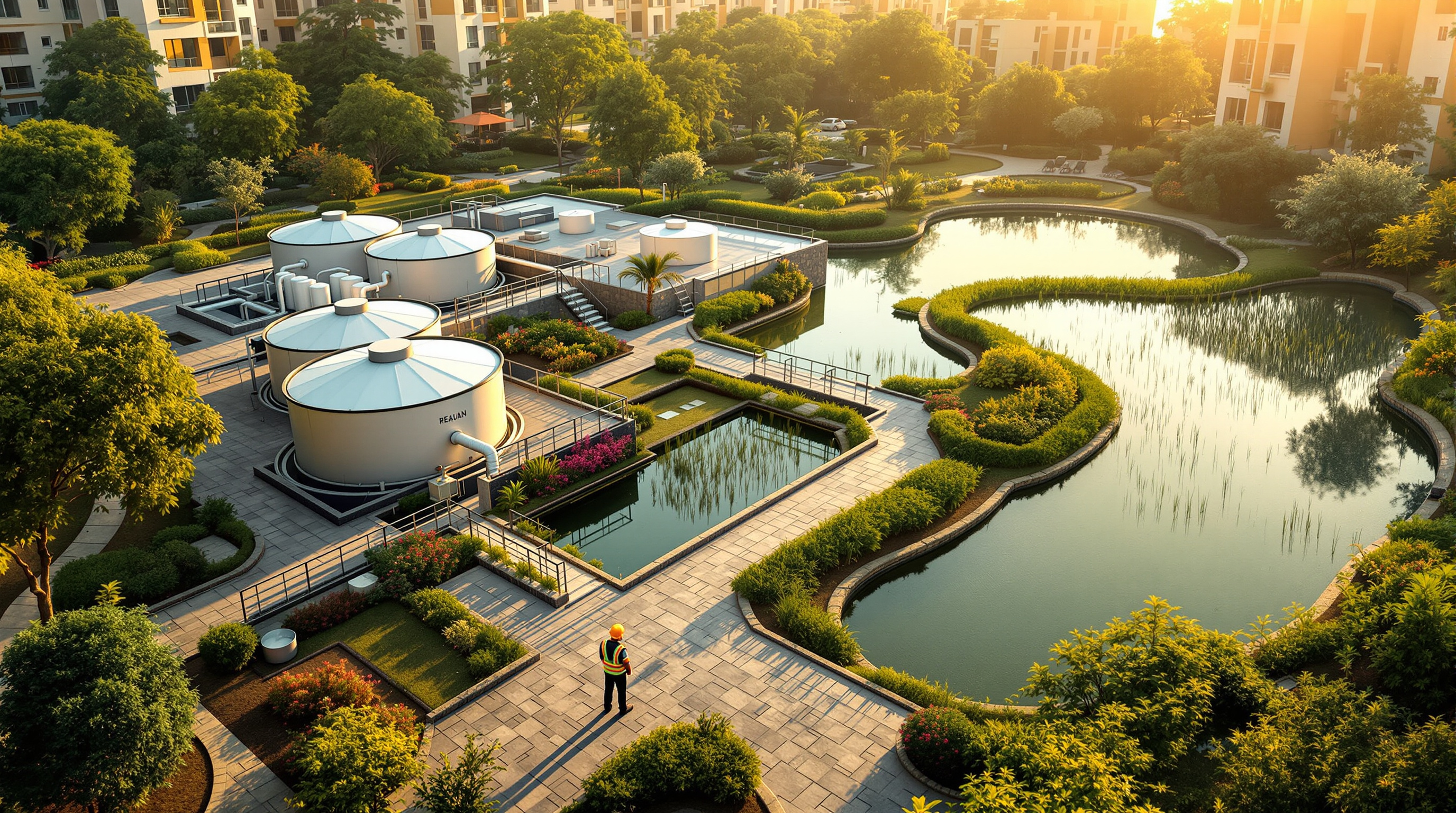
Circular Water Management for Buildings & Cities: The Closed-Loop Guide
How to stop treating water as a one-way flow and design a closed loop — treat, reuse, recharge, repeat — with a sewage treatment plant at its core, for Indian buildings, campuses and cities.
For most of the last century, water in a building moved in a straight line: it arrived from a borewell, a tanker or a municipal main; it was used once; and it left as sewage down a drain, gone forever. That line worked while water was cheap and plentiful. In today's Indian cities — where borewells run dry, tankers cost a fortune, and pollution boards refuse to let a single drop of untreated sewage leave your plot — the straight line is broken.
Circular water management is the answer that replaces it. Instead of a line, you design a loop: water is treated, reused, recharged, and returned to service again and again, so that far less freshwater ever needs to enter and far less waste ever needs to leave. This guide explains what a closed-loop building water system actually looks like, how a sewage treatment plant sits at its heart, and how to move your own project — a tower, a campus, or a whole neighbourhood — from a wasteful line to a resilient circle.
A linear building drinks fresh water once and spits it out as sewage. A circular building treats that sewage back into a resource and drinks the same water many times over — only topping up the small fraction it truly loses.
What "circular" means for water
The circular economy has a simple premise: nothing is waste, everything is a resource in the wrong place. Applied to water, it collapses into four verbs you can design around.
- Treat — clean every stream of used water on site, to a defined, reusable quality, rather than discharging it.
- Reuse — put that treated water back to work for every purpose that does not need drinking-grade water.
- Recharge — return the surplus, and the harvested rain, into the ground to refill the aquifer you draw from.
- Repeat — close the loop so the cycle runs continuously, month after month, shrinking your freshwater intake to a trickle.
This is the same logic the urban water circular economy applies at city scale — but it starts, brick by brick, inside individual buildings. A city becomes water-circular only when its buildings do.
The four streams a circular building manages
A linear building sees one input (fresh water) and one output (sewage). A circular building sees four distinct flows and treats each as an asset:
| Water stream | Where it comes from | Where it goes in a loop |
|---|---|---|
| Freshwater | Municipal main, borewell, tanker | Drinking, cooking, bathing — the irreplaceable uses only |
| Greywater | Basins, showers, washing | Light treatment, then flushing and irrigation |
| Blackwater | Toilets, kitchens | STP, then flushing, landscape, cooling towers |
| Rainwater | Roofs, paved areas | Storage for reuse, and recharge to the aquifer |
The art of circular water management is routing these four streams so the treated and harvested water covers every non-potable demand, leaving freshwater to do only what nothing else can.
The STP: the engine of the loop
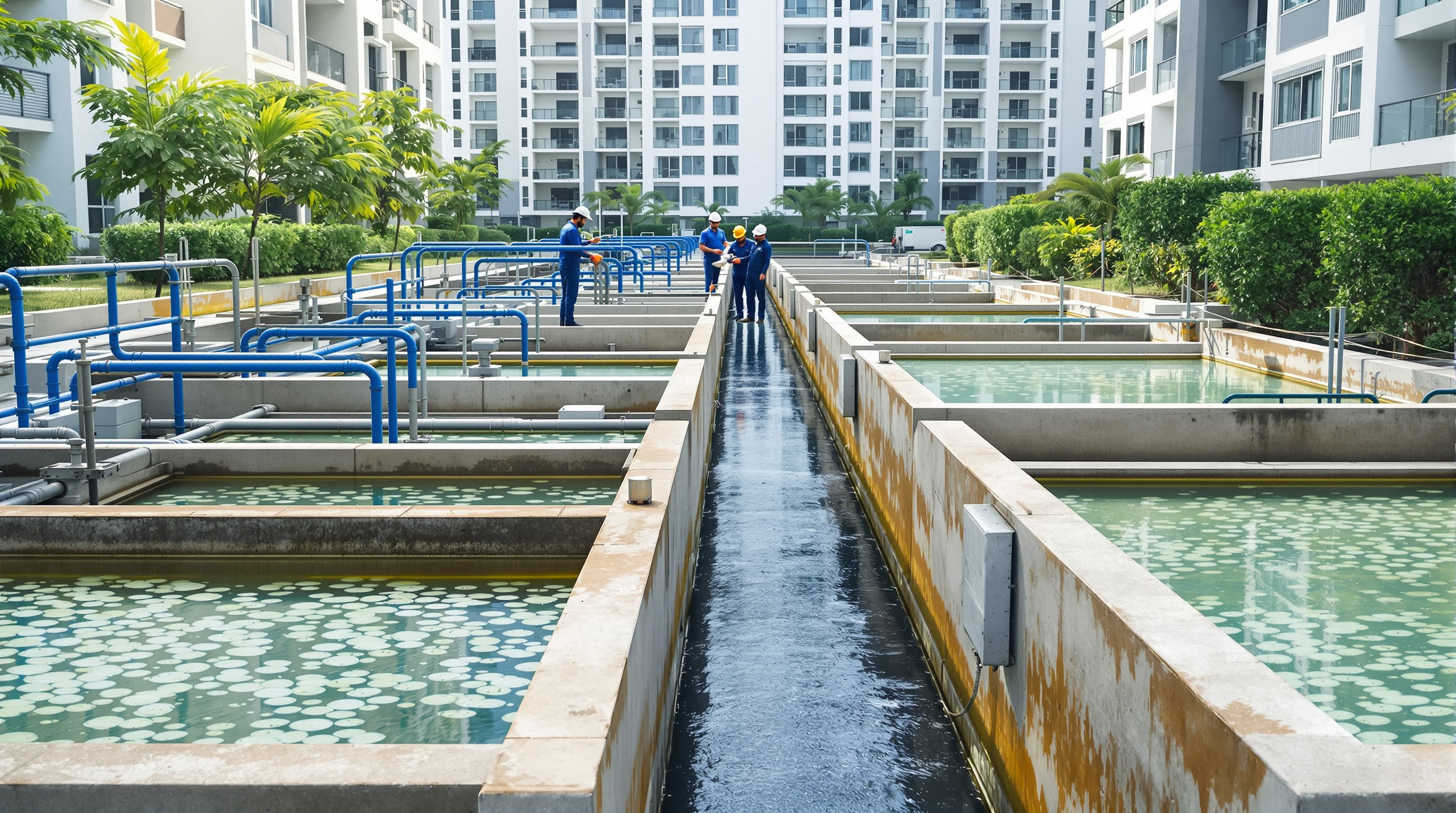
You cannot have a circular building without treating its wastewater on site, and that is precisely what a sewage treatment plant does. It is the engine that turns the "waste" half of the loop back into the "resource" half. Without an STP, blackwater is a dead-end; with one, it becomes the largest single source of reusable water on your plot — which is exactly why every modern building needs an STP.
A well-run STP recovers roughly 80–85% of the water a building consumes, discharging almost nothing. The treated effluent typically feeds:
- Toilet flushing, through a separate dual-plumbing line — usually the single biggest reuse, and covered in depth in our guide to treated water for toilet flushing.
- Landscape and garden irrigation, via drip lines that shrug off slightly higher nutrient levels.
- Cooling towers in air-conditioned commercial buildings, a large and thirsty demand.
- Common-area washing of driveways, basements and vehicles.
- Groundwater recharge, sending the balance back into the aquifer.
Which treatment technology you choose — MBBR, SBR or MBR — shapes how clean and how reliably reusable that water is. MBR, for instance, produces an effluent clean enough for the most demanding reuse, at a higher capital and energy cost. The STP technology selector is a quick way to match a technology to your reuse ambitions.
Closing the loop: reuse plus recharge plus rain

An STP alone recycles sewage, but a truly circular system links it to rainwater. Rain harvested from roofs and paved areas does two jobs: it stores cleanly for direct reuse, and its surplus recharges the ground you pump from. When you integrate the two — sizing recharge pits, storage and treated-water reuse together — you approach the ideal of a water-positive building, one that puts back at least as much water as it draws.
Getting the proportions right is a numbers exercise, not a guess. Three tools do the arithmetic:
- The water balance calculator reconciles your total demand against reuse, rain and recharge, and shows how much freshwater the loop still needs.
- The rainwater–STP integration calculator sizes the rain half of the loop against your treated-water supply.
- The green building water score calculator translates all of it into the credit language of certification.
The regulatory and green-rating tailwind
Circular water is not only good engineering — in India it is increasingly the law and the reward. The CPCB and state pollution boards mandate on-site treatment and reuse for most medium and large developments, and the STP regulations in India spell out the discharge and reuse norms your effluent must meet. Green-rating systems push in the same direction: both IGBC and GRIHA award substantial points for wastewater treatment, reuse and recharge, and our guide to green building water credits maps exactly which circular measures earn them.
The payoff is threefold. You cut the freshwater and tanker bills that a linear building pays every month; you earn the certification points that lift a project's value; and you insulate the building against the water cuts that increasingly disrupt Indian cities. You can put a rupee figure on the treatment side of that with the STP cost estimator and on the carbon side with the carbon savings calculator.
Where the "smart" layer fits — honestly
There is loud talk of AI, IoT and digital twins running tomorrow's water loops, and the direction is real: sensors that flag a failing blower before effluent quality slips, and models that predict demand so pumps run at the cheapest hours. But be clear-eyed about maturity. Today, IoT monitoring of flow, energy and key quality parameters is genuinely useful and widely deployable. AI-driven optimisation and full digital twins remain early-stage for most Indian STPs — promising, worth piloting, but not yet a substitute for a competent operator and a well-designed plant. Treat the smart layer as an amplifier of a sound loop, not a rescue for a badly designed one.
The bottom line
Circular water management is a change of mindset before it is a change of hardware: stop seeing water as something you buy once and throw away, and start seeing it as something you keep in circulation. Treat every drop on site, reuse it for everything that does not need to be drunk, recharge the surplus back into the ground, and repeat the cycle indefinitely. The STP is the engine, rainwater is the top-up, and recharge closes the ring.
From here, two natural next steps. To go deeper on the city-scale picture, read the urban water circular economy. And to design your own loop, start in the sewage treatment plants guide library and run your numbers through the water balance calculator — the single sheet that tells you how close your building already is to closing the circle.
Export this guide
Related Guides — Deep-dive reading
STPs and the Urban Water Circular Economy: How Reuse Closes the City Water Loop
How decentralised sewage treatment and treated-water reuse turn a building's wastewater into a resource — cutting freshwater demand, ending pollution at source, and pointing the way to a genuinely water-circular Indian city.
Sewage Treatment PlantsWater-Positive Buildings: The Role of STPs
What "water positive" actually means, how treated STP water, rainwater harvesting and groundwater recharge combine to get a building there, and how to measure the balance credibly in the Indian context.
Sewage Treatment PlantsGreywater vs Blackwater Explained (And Why It Matters for Reuse)
The used water your building produces is not all the same. Separating the lightly dirty water from the truly foul water is the single trick that makes on-site water reuse cheap, safe and practical — explained in plain language, with no engineering background assumed.
Sewage Treatment PlantsRelated Tools — Try Free
Green Building Water Score Calculator
Score a building's water efficiency 0–100 from treated-water reuse, rainwater harvesting, low-flow fixtures and metering, with an IGBC/GRIHA-style rating and your biggest improvement lever.
SustainabilityRainwater Tank Sizer
How big should your rainwater tank be? Computes annual harvest, recommended tank capacity in litres, water-bill savings, and payback — for 10 Indian cities.
RWH CalculatorSTP Technology Selector
Weight your priorities — footprint, effluent quality, cost, power and simplicity — and get a scored recommendation between Extended Aeration, MBBR, SBR and MBR.
Selector