
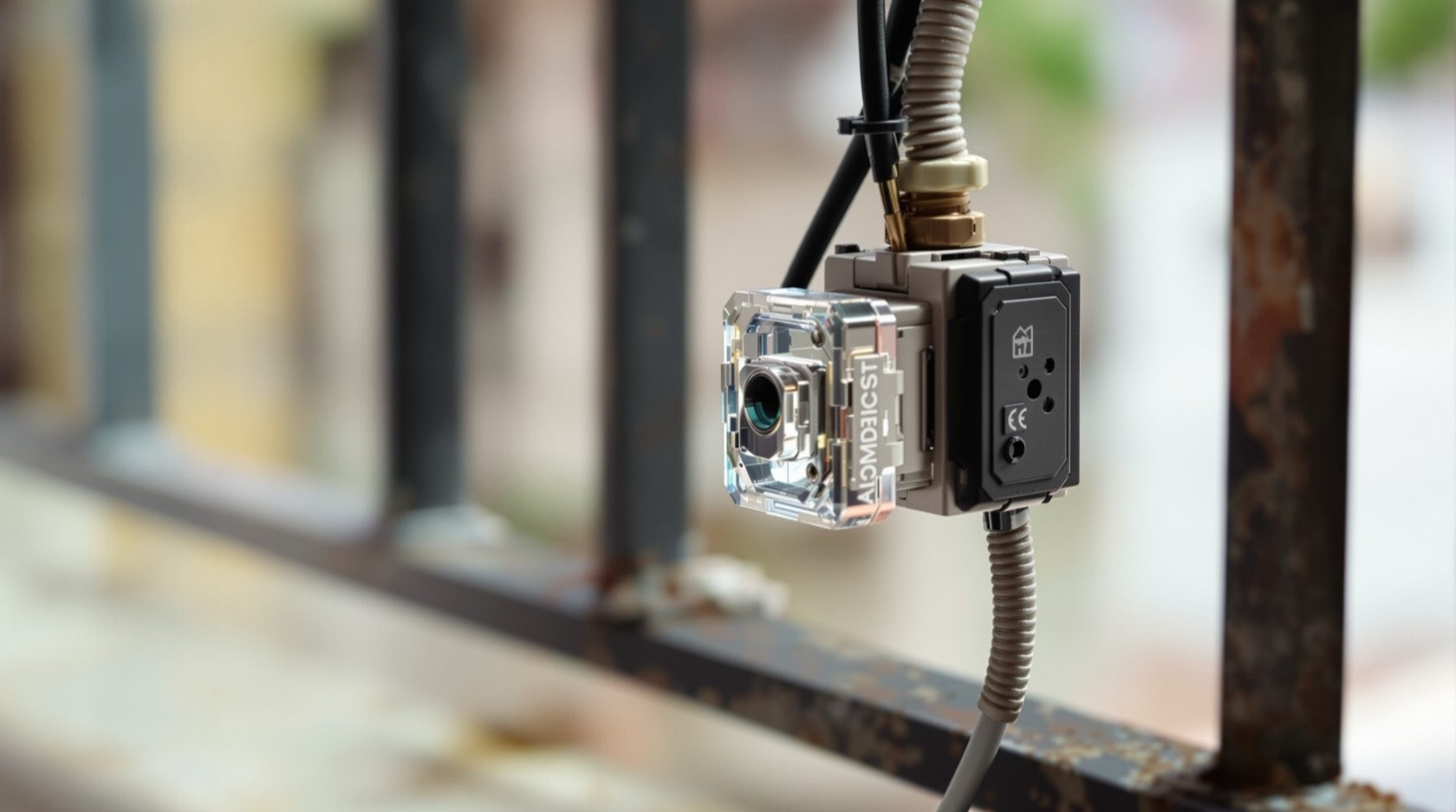
Shock Sensors in India (2026): Catching the First Blow to a Door, Window or Safe
How a shock sensor senses a sudden impact, how it differs from a vibration sensor, where it adds value beside a door or window contact, and how to tune out ordinary knocks in an Indian home.
A door contact tells you the moment a door is opened. But by then the door is already open — the lock has been forced, the frame splintered, the intruder halfway in. What if you could be warned one step earlier, at the very first kick or blow, while the door is still shut? That is exactly the job of a shock sensor.
A shock sensor reacts to a sudden, sharp physical impact — someone kicking, hammering, prying or ramming a door, window, grille, wall or safe. It sits alongside the complete burglar-alarm picture as an early-warning detector: the alarm fires on the blow itself, before the barrier gives way. This guide explains how the little inertia element inside actually works, the important difference between a shock sensor and a vibration sensor, where a shock sensor earns its place in an Indian home, and how to tune it so an ordinary knock, a slamming door or the monsoon wind rattling a grille does not set it off.
Scope & safety. This guide helps you choose, place and set the sensitivity of a shock sensor — all of which a homeowner can plan. Sticking or screwing a small self-contained sensor onto a door, window frame or safe you can reach is fine. Anything that runs cable back to a panel, ties into the mains, or works at height belongs to a licensed installer or electrician. A sensor must never obstruct a fire-escape route, and any camera used to verify an alert records personal data under the Digital Personal Data Protection Act, 2023. This is educational guidance, not legal advice.
How a shock sensor works
Inside the small plastic block is a tiny mechanical or electronic element that is exquisitely sensitive to sudden movement. In simple units it is an inertial mass — a small weight held in place that jolts when the surface it is attached to is struck. In better units it is a piezoelectric crystal, which produces a small burst of voltage the instant it is flexed or jarred. Either way, a sharp blow to the mounting surface makes the element move, and that movement becomes a brief electrical spike.
The sensor's electronics then ask one question: was that spike big enough and sharp enough to matter? Every unit has a trigger threshold — a level the spike must cross before it counts as a real impact. A gentle tap, a door easing shut, or a bit of wind produces only a small wobble that stays under the line and is ignored. A hard kick, a hammer blow or a crowbar levering the frame produces a spike that shoots well past the threshold, and the sensor raises the alarm.
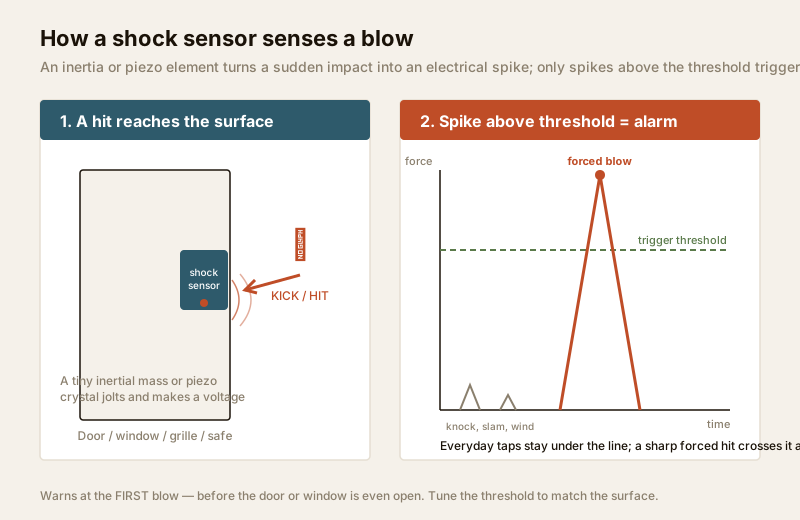
That is the whole principle: turn a physical impact into a voltage spike, and fire only when the spike clears the threshold. Because it senses the blow rather than the opening, a shock sensor warns you at the first hit — before the door contact ever registers the door as open. On a solid barrier it may sound the alarm several blows before the intruder gets through at all.
What the sensor actually reports
Be precise about this, because the limits follow from it. A shock sensor reports one thing: that a sharp impact just struck the surface it is mounted on. It does not know what caused the impact, whether the barrier has actually failed, or whether anyone got in. It is deliberately tuned to a single sudden event, not to gentle handling. That is its strength — a fast, early warning — and also why it pairs so well with a door contact that confirms whether the door then opened, and with a camera that lets you see what caused the alert.
Shock versus vibration: the distinction that matters
This is the one point people most often get muddled, so it is worth stating clearly. A shock sensor and a vibration sensor belong to the same family — both sense movement in a surface — but they are tuned to notice different things.
- A shock sensor reacts to a single sharp impact event: one kick, one hammer blow, one ram. It is looking for a sudden, high spike and it fires fast on that one event.
- A vibration sensor watches for a sustained pattern of smaller repeated movements — the steady buzz of someone drilling through a wall or a safe, or the rhythmic rasp of a saw. Rather than firing on any one pulse, it typically counts pulses over a short window and triggers only when a persistent pattern builds up.
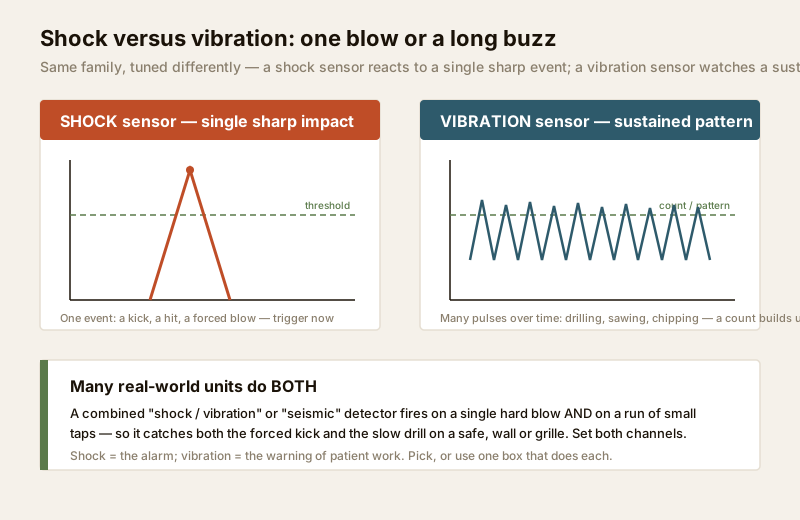
The practical upshot for a buyer is simple. If you want to catch someone forcing a door, grille or window — a kick, a pry, a ram — you want the shock behaviour. If you want to catch someone patiently working at a safe, a strong-room wall or a shutter with a drill or saw, you want the vibration behaviour. And here is the good news: many real-world units do both. A combined "shock / vibration" or "seismic" detector has separate channels — one for the single hard blow, one for the sustained pattern — and you set each. If you are protecting a safe or a masonry wall as well as a door, a dual-mode unit often makes the most sense; if you only want first-blow warning on a door or grille, a plain shock sensor is enough. The full drilling-and-sawing story is covered in the vibration sensors guide.
| Shock sensor | Vibration sensor | |
|---|---|---|
| Reacts to | A single sharp impact | A sustained pattern of pulses |
| Classic threat | Kick, pry, ram, hammer blow | Drilling, sawing, chipping |
| How it decides | One spike above the threshold | A count of pulses over a short window |
| Best on | Doors, grilles, window frames, shutters | Safes, strong-room walls, ATM-style enclosures |
| Combined units | Many "shock / vibration" boxes do both channels together |
Where a shock sensor adds value
The most valuable place for a shock sensor is built into, or fitted right beside, a door or window contact — so the two work as a pair. The door contact tells you the door has opened; the shock sensor warns you a beat earlier, at the first blow, before the door is open at all. Together they give you both the early warning and the confirmation. Many alarm-grade contacts sold in India are actually combined units with a shock element already inside; if yours is, you simply enable and tune the shock channel.
Beyond that pairing, a shock sensor earns its keep on the Indian openings that get attacked directly:
| Where | What it catches | Notes |
|---|---|---|
| Metal grille or safety door | Prying or hammering a bar | Fit to the frame; grilles ring loudly, so tune carefully |
| Wooden main / back door | A kick or shoulder-ram before the lock gives | Best mounted beside the door contact |
| Window frame | A forced or levered sash | On the frame, not the glass — glass is a glass-break sensor's job |
| Roller shutter | A blow to force the shutter | Robust unit; shops and garages |
| Safe or steel almirah | Hammering or a ram | Use a dual shock / vibration unit to also catch drilling |
| Boundary or strong-room wall | Breaching attempt | Usually the vibration channel of a combined unit |
One important boundary: a shock sensor senses an impact to a surface, so it is the wrong tool for detecting breaking glass, which is about the sound and shatter pattern of a pane rather than a blow to the frame. For a large window or glass facade, the right detector is a glass-break sensor; pair it with a shock sensor on the frame and a contact on the sash and the whole opening is covered. This layering — contact plus shock plus glass-break plus interior motion — is the essence of a good layered security design.
Tuning: ignoring the everyday, catching the attack
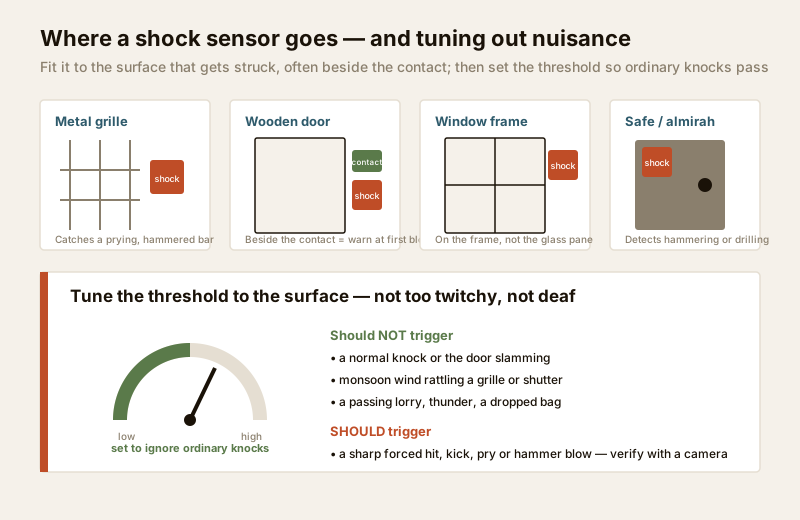
A shock sensor lives or dies by its sensitivity setting. Set it too high (too twitchy) and every slammed door, gust of monsoon wind on the grille, passing lorry or roll of thunder cries wolf until someone disables the whole zone in frustration. Set it too low (too deaf) and a real blow slips under the line. Good tuning is honest, patient work, and it is a placement-and-setting task, not a trick:
- Match the threshold to the surface. A light aluminium grille rings and rattles far more than a solid wooden door, so it needs a higher threshold to ignore its own noise. A heavy safe barely moves, so it can be set more sensitive. Start from the maker's suggested setting for that surface and adjust.
- Test with the real nuisances, then a real blow. Once fitted, deliberately slam the door, rattle the grille, and (in the monsoon) watch it through a windy, stormy evening. If it false-alarms, ease the sensitivity down a notch. Then give the frame a firm, deliberate knock to confirm it still triggers on a genuine impact. Repeat until it sleeps through the everyday and wakes to the real thing.
- Mount it solidly and squarely. A sensor stuck to a loose bead or a flimsy panel picks up rattles that a firm mounting on the main frame would ignore. Fit it to the most solid part of the barrier.
- Use pulse-count settings if the unit has them. Better units let you require, say, two or three impacts within a short window before firing — which sails past a single accidental bump while still catching a sustained attack. Combined shock / vibration units use exactly this idea on their vibration channel.
- Verify, do not just react. Because Indian alarms are overwhelmingly self-monitored — a siren plus a GSM or app alert to you or a guard, rather than a monitoring centre with police auto-response — the most powerful anti-nuisance tool is a camera on the same zone. When the shock sensor fires, you glance at the intrusion-zone camera and see instantly whether it is the wind or a real attempt. Camera verification is what turns a twitchy sensor into a trustworthy one.
None of this is about making the sensor easy to defeat — it is about making it trustworthy, so that when it does cry out, everyone believes it. A sensor that has been switched off after a hundred false alarms protects nothing.
Honest limits — and how to answer them
Stated plainly, so you buy with open eyes:
- It senses impact, not entry. A shock sensor knows something struck the surface; it does not confirm the barrier failed or that anyone got in. That is why it works best paired with a door or window contact that confirms the opening, and a camera that shows the cause.
- It is the wrong tool for breaking glass. Shattering a pane is a job for a glass-break sensor; use both on a large glazed opening.
- Nuisance is real and must be designed out. Grilles rattle, doors slam, monsoon wind and thunder shake things. Sensitivity tuning, solid mounting, pulse-count settings and camera verification are the honest answers — not switching the zone off.
- Self-monitored reality. The sensor will faithfully raise a siren and an app or GSM alert, but the response is yours to arrange — decide who acts on a first-blow alert, day or night.
- Power cuts. Through a mains outage the panel runs on its backup battery and the shock sensors keep working; keep that battery healthy so the line stays live.
To choose the right mix of contacts, shock, glass-break and motion for your home, the burglar-alarm system selector walks through it, and the perimeter vulnerability assessment helps you audit every opening first. Shock sensors also sit naturally within a perimeter alarm system on gates, grilles and shutters, and within the wider burglar-alarm sub-hub.
When to bring in a professional. Choosing where shock sensors go and setting their sensitivity are homeowner jobs, as is sticking a self-contained wireless unit onto a reachable door, grille or safe. Bring in a licensed installer for any wired run chased back to the panel, work at height, roller-shutter and gate mounting, mains-connected work, and a whole-home design across contacts, shock, glass-break and motion — see the electrical hub. For a full survey, use the villa or apartment security guide to frame the brief.
Key takeaways
- A shock sensor catches the first blow — an inertia mass or piezo crystal turns a sudden impact into a voltage spike, and the alarm fires when the spike clears the threshold, warning you before the door or window is even open.
- Shock versus vibration is the key distinction: a shock sensor reacts to a single sharp impact (kick, pry, ram), a vibration sensor watches for the sustained pattern of drilling or sawing — and many combined "shock / vibration" units do both.
- Its best home is beside a contact: fit a shock sensor into or next to a door or window contact so you get early warning and confirmation together; use a glass-break sensor for the pane itself.
- Tuning is everything: match the threshold to the surface, test against a slamming door and monsoon wind on the grille, mount solidly, use pulse-count settings, and verify with a camera — so ordinary knocks pass and a real attack triggers.
- It senses impact, not entry, and it is self-monitored in most Indian homes — pair it, verify it with an intrusion-zone camera, and decide in advance who responds to a first-blow alert.
References
- Manufacturer datasheets for shock, vibration and combined seismic detectors — verify the sensitivity range, pulse-count options, mounting surface guidance, wireless battery life and whether the unit combines shock and vibration channels on the maker's own specification before ordering.
- Digital Personal Data Protection Act, 2023 — any camera used to verify a sensor alert records personal data; keep app credentials private and set access and retention terms with any installer or monitoring provider in writing.
- National Building Code of India (SP 7), Bureau of Indian Standards, and local municipal bye-laws for any mains-connected or life-safety aspect of an install, and to ensure no sensor obstructs an escape route; verify the current edition via the BIS catalogue: https://www.services.bis.gov.in/
This is an educational overview, not legal advice. Wall-chased cabling, mains-connected work and any work at height are qualified professional tasks — engage licensed installers and verify any standard's current status via the BIS catalogue before relying on it.
Export this guide
Related Guides — Deep-dive reading
Glass-Break Sensors in India (2026): Catching a Smashed Pane Before Entry
How acoustic glass-break sensors listen for the twin sound of breaking glass, why they cover what door and window contacts miss, and how to place one sensor to protect a whole room of windows in an Indian home or shop.
SecurityVibration Sensors in India (2026): Catching an Attack Through the Wall, Safe or Shutter
How a vibration or seismic sensor feels the sustained tremor of a wall, safe or shutter being drilled, hammered or prised open, where they earn their place in Indian shops and homes, and how to tune out passing trucks and thunder.
SecurityHow to Choose a Burglar Alarm in India (2026): Sensors, Alerts and What Actually Matters
A homeowner's guide to selecting an intruder alarm that fits your flat, villa or shop and alerts you the way you want — matching the sensor mix, control panel and the big siren-versus-monitored decision to your real risk, and dodging the false-alarm traps that make people switch systems off.
SecurityRelated Tools — Try Free
CCTV System Type Selector
Answer five questions and get the right CCTV setup — analog / IP / hybrid, wired / wireless, local / cloud — with reasons.
CCTV SelectorAccess-Control Battery-Backup Calculator
Size the standby battery so an access system keeps running through a power cut, with an egress life-safety note.
Battery BackupSecurity Backup Power Calculator
Size a UPS/inverter and battery to keep CCTV, NVR, router and alarm running through a power cut — load, Ah, VA and cost.
Backup Power