
Solar & BIPV Facades in India: When the Building's Skin Makes Its Own Electricity
Building-Integrated Photovoltaics explained for India — how PV becomes the cladding, glazing and shading, why a vertical wall yields less than a roof, when a solar facade still makes sense, and the honest cost and payback versus ordinary rooftop solar.
Most solar panels in India sit on a roof, tilted to the sky, doing one job: making electricity. A solar facade asks a more interesting question. What if the wall of the building was the solar panel? What if the skin that keeps out rain and sun also generated the power that runs the lights and the air conditioning behind it?
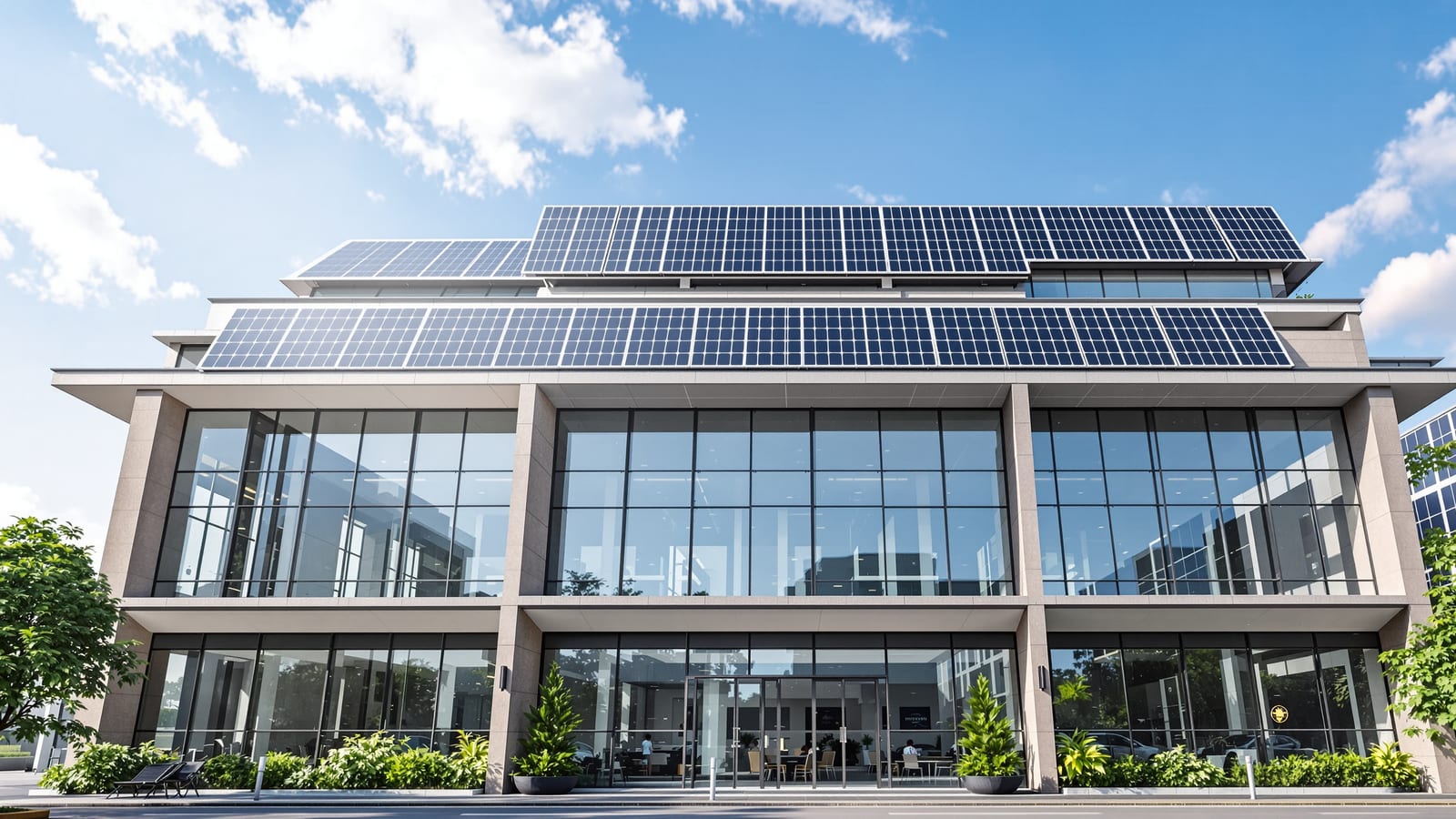
That is the idea behind a photovoltaic facade. The proper name for the serious version is BIPV, short for Building-Integrated Photovoltaics. The word that matters is integrated: the solar is not an add-on bolted to a finished wall, the solar IS the wall. The same panel does two jobs at once: it is the cladding (or window, or spandrel) and it is the power plant. For a country drenched in sunshine, with tall buildings running short of roof, that double duty is worth understanding honestly, because it is also expensive, niche, and easy to oversell.
This is part of our Building Facades series. If you are new to the topic, start with why building facades matter for the big picture. And because the question almost every Indian homeowner really wants answered is "should I just put panels on my roof instead," keep our companion guide on solar power for homes in India open alongside this one. The short version, which we will earn through the guide: for most homes, the roof wins. The facade earns its place in specific situations, and this guide is about knowing which.
1. BIPV versus BAPV: integrated skin or bolted-on panel
The single most important distinction in this whole subject is two acronyms that look almost identical.
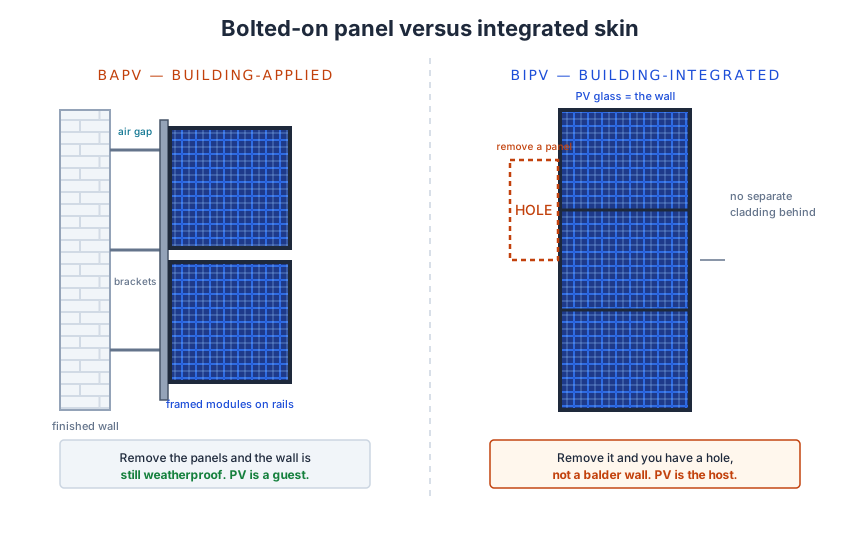
BAPV is Building-Applied Photovoltaics. This is the ordinary solar you already picture: finished, framed solar modules mounted on rails ABOVE an existing surface. The roof (or the wall) is built first, then panels are fixed on top of it. If you removed the panels, the building would still be weatherproof. The panels are a guest.
BIPV is Building-Integrated Photovoltaics. Here the photovoltaic material replaces a conventional building element. There is no separate cladding behind it. The PV module is the rainscreen, the spandrel, the window glass, the canopy. If you removed it, you would have a hole in the building, not just a balder roof. The PV is the host.
This is not pedantry; it changes the economics. With BAPV you pay for the wall AND the panels. With BIPV the panel money is partly offset because you were going to spend on cladding anyway, so the real question is the extra cost of solar glass over the granite, ACP or glazing it replaces. That "avoided cladding cost" is the entire financial argument for BIPV, and we will come back to it.
2. The forms a solar facade can take
"Solar facade" is not one product. The PV can be integrated in several quite different ways, and they look and cost very differently.
| BIPV facade form | What it is | Light through it | Typical use |
|---|---|---|---|
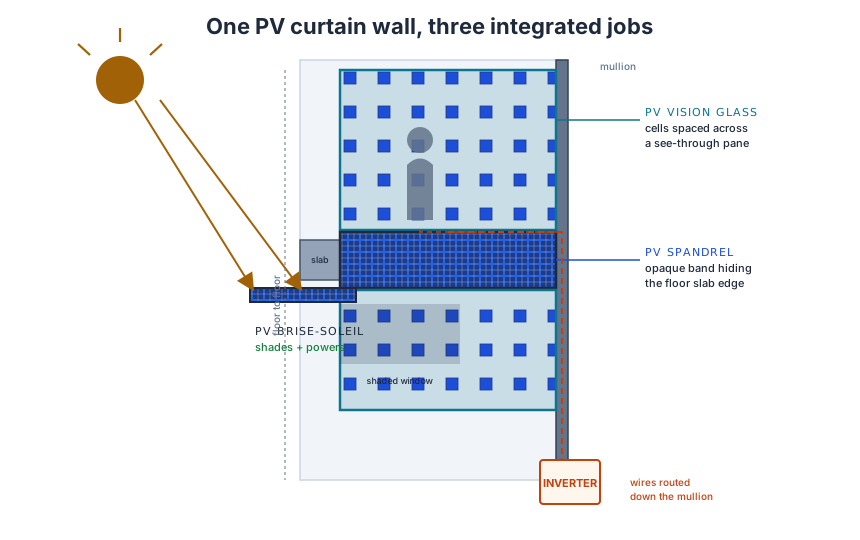
| PV spandrel panels | Opaque PV laminated into the solid (non-window) bands of a curtain wall, between floors | None (opaque) | Office towers; replaces the colored back-painted spandrel glass with a power-generating one |
| PV curtain-wall vision glass | PV cells spaced inside the see-through window units | Partial (you see between the cells) | Lobbies, atria, where some shading and view are both wanted |
| Semi-transparent PV windows | Thin-film or widely spaced cells on glass that you can genuinely see out of | High (tinted) | Skylights, conservatories, sun-facing windows that double as shade |
| PV rainscreen cladding | Opaque PV laminate used as ventilated cladding tiles over a structural wall | None (opaque) | Solid walls of tall buildings; the Copenhagen and Manchester approach |
| PV canopies, brise-soleil, balcony rails | PV fixed as horizontal shading fins, awnings or railings | Varies | Adds shade AND power on the same element; very practical retrofit |
The clever insight running through that table: the best BIPV often does THREE jobs, not two. A PV brise-soleil shades the window below it (cutting cooling load), keeps the rain off, AND generates power. That triple duty is where solar facades make the most honest sense in India, because the shading benefit is real money saved on air conditioning regardless of how much electricity the panel makes.
3. Why a vertical wall makes less power than a roof
Here is the inconvenient physics, and you should hear it plainly before anyone sells you a solar wall.
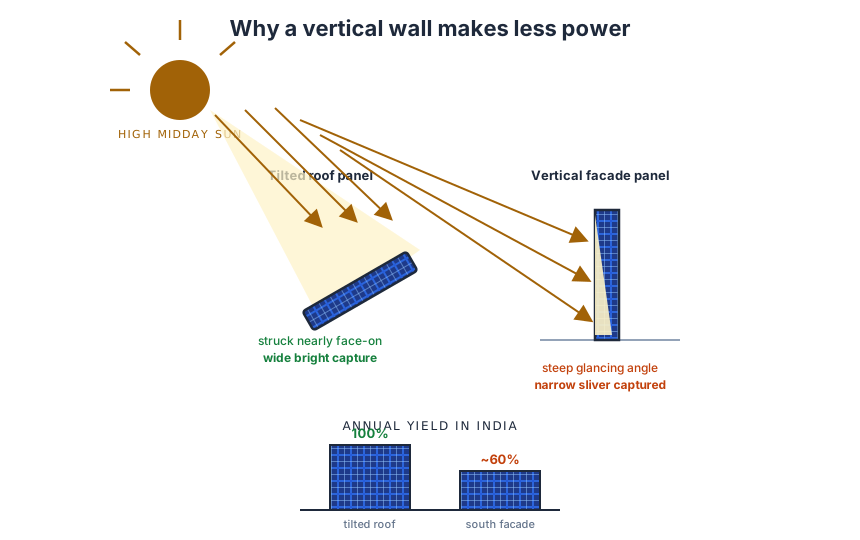
A solar panel makes the most electricity when sunlight hits it square-on, at ninety degrees to its face. In India, for most of the year, the sun is high in the sky. That means a panel lying flat-ish on a roof, tilted slightly toward the south, catches the sun nearly face-on for many hours. A panel standing bolt upright on a wall catches that same high sun at a steep, glancing angle, so it intercepts far less of it.
As a rough rule, a vertical facade in India generates somewhere around 50 to 70 percent of what the same panel would make on a well-tilted roof, depending on the wall's orientation and how much it is shaded by other buildings. A south-facing wall does best; east and west walls catch only morning or evening sun; a north-facing wall in most of India is close to pointless for generation.
So why would anyone accept that penalty? Because of WHAT a tall building has and has NOT got.
4. When a solar facade still makes sense
A vertical solar wall earns its keep in a handful of clear situations.
The big one is the tall building with a tiny roof. A forty-storey tower has a huge area of wall and a comparatively small roof. Once you fill that roof with conventional solar, you have barely dented the building's appetite for electricity, and the walls are the only large sunlit surface left. Here a facade that makes even 60 percent of roof yield beats a wall that makes nothing, because there is no roof left to use. This is exactly the logic behind the famous examples below.
The second case is the shading-plus-generation overlap. If a south or west wall needs shading devices anyway (and in Indian heat it usually does), making those fins, canopies and brise-soleil out of PV is close to free generation. You were going to build the shade; now it pays you back.
The third case is the statement project: a corporate headquarters, a green-rated campus or a government net-zero building, where the visible commitment to clean energy is part of the point and the facade is the most visible surface there is.
For an ordinary Indian home with a usable terrace, none of these usually apply. You have a roof, the sun is high, and rooftop solar is cheaper and makes more power. That is why we keep pointing you back to solar power for homes in India: for most homes, that is the correct answer, and a solar facade is a poor substitute.
5. The India context: huge sun, but BIPV is still a premium niche
India is one of the sunniest large countries on earth, receiving strong solar irradiance across most of the year, which is why rooftop solar has boomed. The government's flagship rooftop scheme, PM Surya Ghar: Muft Bijli Yojana, offers generous subsidies for residential ROOFTOP solar and aims to light up crores of homes. Read the word carefully: rooftop. The subsidy machinery, the standard products, the trained installers and the simple economics are all built around panels on roofs.
BIPV sits outside that mainstream. It is treated as a premium, architect-driven, mostly-commercial product. There is no large consumer subsidy aimed squarely at solar facades the way there is for rooftops. The panels are often custom (sized, colored and shaped to suit the building), which makes them dearer and slower to procure than off-the-shelf modules. So in India today, BIPV is genuinely niche: you find it on showcase corporate buildings, green-certified offices and government net-zero projects, not on streets of houses.
The one piece of policy that helps BIPV is net metering, the arrangement that lets a building export surplus solar electricity to the grid and get credited for it, spinning the meter backwards in effect. Net-metering rules in India are set state by state through the electricity regulators and DISCOMs, and the caps and tariffs vary and change, so any BIPV (or rooftop) business case must be checked against your own state's current rules, not a national average. Without favorable net metering, a facade that makes power at the wrong time of day (an east wall peaking at breakfast, say) is much harder to justify.
6. The honest cost and payback, versus rooftop
This is the section the brochures skip, so we will be blunt.
BIPV is more expensive per unit of electricity than rooftop solar, for stacked reasons. The modules are often bespoke. The mounting is bespoke facade engineering, not standard solar racking. A vertical wall makes less power per panel (Section 3), so you need more panels and more wall for the same kilowatt-hours. And facade work involves glazing trades and curtain-wall contractors, all dearer than a roofing crew.
Against all that sits one real credit: the avoided cladding cost. If the building was going to be clad in premium granite, fritted spandrel glass or high-end ACP anyway, then BIPV's "extra" cost is only the difference between solar glass and that expensive cladding, not the full price of the solar. This is why BIPV makes most financial sense on buildings that were always going to have an expensive skin. On a cheap painted-plaster wall, BIPV's whole cost lands on the solar, and the payback stretches out badly.
In plain terms for an Indian decision-maker: rooftop solar in India often pays back in roughly five to seven years and is a near-default sensible investment. A solar facade typically pays back much more slowly (frequently well into double-digit years, sometimes longer), unless the avoided-cladding credit and the cooling-load savings from shading are large. So the honest framing is: do the rooftop first, always. Consider the facade only when the roof is full, the cladding budget was premium anyway, or the architectural and net-zero statement is itself worth paying for.
7. Heat, efficiency and maintenance: the practical caveats
A few physical realities shape how a solar facade behaves day to day.
Solar cells lose efficiency as they get hot, and a dark facade in Indian sun gets very hot. A roof panel sits in moving air; a facade panel pressed against a wall can bake. This is why good BIPV uses a ventilated cavity behind the panels (the same breathing gap idea behind a ventilated rainscreen and double-skin facade), so air rises behind the modules and carries heat away. That cavity is not optional in our climate; without it you lose output to heat and risk cooking the lamination.
Cleaning matters too. A flat-ish roof panel gets rinsed by monsoon rain; a vertical wall sheds dust unevenly and lower panels collect grime, bird mess and pollution film, all of which cut output. Facade cleaning means access cradles, which cost money and must be planned into the building, not improvised later.
Lifespan and replacement need thought. PV modules degrade slowly over decades, but if one facade panel fails or shatters, you are not swapping a roof module on rails; you may be replacing a structural piece of the building skin, possibly a custom-sized one that is no longer made. Specify spares and demand a clear warranty on both the electrical output and the weatherproofing, because a BIPV panel is failing at two jobs if it leaks.
8. Real solar facades worth studying
These are built, documented projects, not renders, and each teaches something specific.
- Copenhagen International School, Copenhagen, Denmark. Its four towers are wrapped in around 12,000 custom photovoltaic cladding panels covering roughly 6,000 square metres of facade and rated about 720 kWp, supplying more than half the school's annual electricity. The sea-green panels are individually angled and use a color technique so the whole skin shimmers. At completion it was Europe's largest building-integrated PV facade. It is the textbook case of PV as the literal cladding of a building.
- CIS Tower, Manchester, United Kingdom. A 1962 office tower whose deteriorating mosaic-tile service tower was reclad in 2005 with about 7,244 solar cells (roughly 575 kWp), feeding power to the grid. Its lesson is the retrofit logic: the PV was justified partly because the old tiles needed replacing ANYWAY, so the solar offset a cladding cost the owner already faced. That is the avoided-cladding argument from Section 6, made real.
- Indira Paryavaran Bhawan, New Delhi, India. Often cited as India's first net-zero-energy office building, it balances its annual consumption with on-site solar, integrating PV across roof and facade elements. It shows BIPV used as part of a serious government net-zero statement rather than a gimmick.
- Chimes commercial complex, Gurugram, Haryana, India. A 2024 project that combined rooftop solar with BIPV mounted on a vertical, ninety-degree wall, adopted precisely because the roof ran short of space. It is a clean Indian illustration of Section 4's "the roof is full, use the wall" logic, and of facade PV as a genuine, if niche, working choice in India today.
Notice the pattern across all four: BIPV won where the roof was insufficient, the cladding spend was happening regardless, or the green statement was the point. None of them is an ordinary house.
What this means for you
If you are a homeowner with a terrace, the honest advice is simple: put solar on your roof first, the conventional way, and read solar power for homes in India to do it well. A vertical solar facade will cost more and make less power, and the PM Surya Ghar subsidies are aimed at your roof, not your walls. There is rarely a good reason to clad a normal house in solar glass.
A solar facade becomes a real, sensible option in a narrower set of cases: a tall building whose roof is too small for its energy appetite; a sun-facing elevation that needs shading devices anyway, where making those fins and canopies out of PV is nearly free generation; or a showcase, green-certified or net-zero building where the visible commitment is part of the brief and the cladding budget was always going to be premium. In those cases the avoided-cladding credit and the cooling savings from shading can turn a slow payback into a justified one. Insist on a ventilated cavity behind the panels, a realistic cleaning-access plan, spares for the custom modules, and a warranty that covers BOTH power output and weatherproofing.
Treat BIPV as what it honestly is in India today: a premium, architect-led skin for the right building, not a default. To see how a solar facade sits beside glass, stone, terracotta and metal, browse the full types of building facades overview, and revisit why facades matter for the fundamentals that decide whether any of this earns its keep.
Sources
- Eurac Research and SolarLab, Copenhagen International School case study (approximately 12,000 BIPV cladding panels, around 6,000 square metres, roughly 720 kWp, more than half of annual electricity; largest BIPV facade in Europe at completion).
- Institution of Mechanical Engineers and Solarcentury / Arup project records, CIS Tower Manchester (roughly 7,244 solar cells, about 575 kWp, approximately 180,000 kWh per year, grid-connected from November 2005; retrofit replacing failing mosaic tiles).
- Government of India, Indira Paryavaran Bhawan, New Delhi (cited as India's first net-zero-energy building balancing consumption with on-site solar across roof and facade).
- Mercom India, Chimes commercial complex Gurugram (185 kWp rooftop plus BIPV on a ninety-degree wall, commissioned 2024, adopted due to limited rooftop area).
- Ministry of New and Renewable Energy (MNRE), PM Surya Ghar: Muft Bijli Yojana (residential rooftop solar subsidy scheme; rooftop-focused).
- State electricity regulatory commissions and DISCOM net-metering regulations (vary by state; export-credit arrangements for solar).
- General photovoltaics literature on tilt and orientation effects on yield, temperature derating of solar cells, and ventilated-cavity cooling for facade-mounted modules.
Export this guide
Related Guides — Deep-dive reading
The Solar Roof Guide
Putting rooftop solar on an Indian home, made clear — the system types (grid-connected, off-grid and hybrid, plus BIPV and solar tiles), how to judge whether your roof is ready (area, orientation, tilt, shading, structure and age), how panels are mounted and waterproofed, the electrical and fire-safety essentials, cleaning and access, indicative cost and payback, and the permissions, net-metering and subsidy path. Plain language, India-grounded.
RoofingRooftop Solar Approvals & Net Metering in India: The Permissions You Actually Need
The approvals side of putting solar on an Indian roof — not how solar works, but the permissions: the DISCOM net-metering application and feasibility, an empanelled installer, the structural load check, the electrical safety inspection, the PM Surya Ghar subsidy, and metering and commissioning. These are DISCOM, state and MNRE rules — not one national IS code — so amounts and caps change; always confirm the current rule locally.
RoofingDouble-Skin & Ventilated Facades in India: The Layered Envelope That Buffers Heat, Noise & Glare
What a double-skin facade is, how the ventilated cavity cuts solar gain, noise and glare, the four cavity types, how it differs from a rainscreen, honest India cost and monsoon caveats, plus real examples.
Building FacadesRelated Tools — Try Free
Brise-Soleil Visualizer
Interactive horizontal-louvre cut-off angle calculator — sun altitude, louvre depth, and spacing inputs with a live shadow preview. Computes θ = arctan(spacing/depth) for façade shading, ECBC envelope compliance, hospital daylight design, and tropical sun-control detailing.
Sun Shading ToolCross-Ventilation Analyzer
Estimate airflow and air changes per hour (ACH) from room size, window areas, layout, and local wind — with NBC 2016 Part 8 compliance check.
Ventilation CalculatorWindow Orientation Planner
Pick the best window type, glass and shading by wall direction — north, east, south and west.
Window Tool