

Jaali & Traditional Indian Façades: India's Original Climate-Smart Screen
Guide to the jaali and traditional Indian façades: history from Mughal and Rajasthani stone screens to Hawa Mahal and Sidi Saiyyed, the building physics of daylight, heat, privacy and breeze, materials from sandstone to GRC and metal, the parametric revival at Pearl Academy Jaipur, and how a homeowner can use a jaali.
India's original climate-smart facade
Long before anyone in India had air-conditioning, double-glazing or a building-energy code, builders solved a hard problem with extraordinary elegance: how do you let light, air and a view into a room while keeping out the harsh sun, the dust, the prying eye and the worst of the heat? Their answer was the jaali — a perforated screen of stone, clay, plaster or, today, concrete and metal, pierced with a pattern of small openings.
Walk into the shade of an old jaali on a hot afternoon and you feel the answer immediately. The wall is solid enough to throw deep shadow, yet you can see daylight through it as a thousand bright points. The air moving through feels faster and cooler than the still air of the room. From outside, you cannot see in. One element, doing five jobs at once. That is the genius of the jaali, and it is why a device perfected by Mughal and Rajput craftsmen centuries ago is now being reinvented by some of India's most forward-looking architects.
This guide is part of our building facades series and builds on the larger case made in why building facades matter. Here we look closely at one family of facade that is unmistakably Indian — what a jaali is, where it came from, the building physics that make it work, the materials it is made from, how it is being revived with computers and concrete today, and how you, as a homeowner, might actually use one.
1. What a jaali actually is
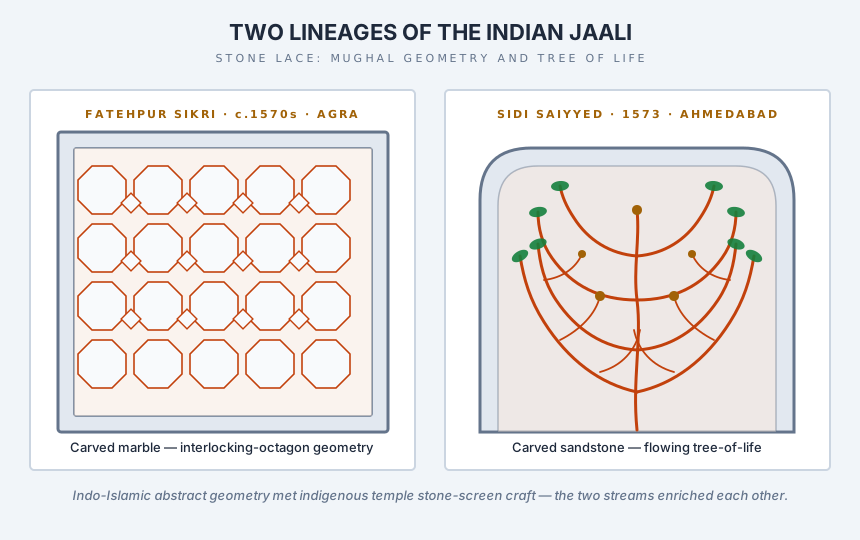
The word jaali (also spelt jali) comes from the Hindi and Urdu word for a net or mesh. In architecture it means a perforated screen: a panel or wall pierced with a repeating pattern of holes so that it reads as solid from a distance but is full of small openings up close. The pattern can be geometric — stars, hexagons, interlocking octagons, lattices of squares and diamonds — or floral and vegetal, with stylised flowers, vines and leaves. In Indo-Islamic work the patterns are usually abstract geometry, partly because of the tradition of avoiding figurative imagery; in Hindu and Jain temple work you also find figures, animals and deities woven into the screen.
A jaali is not a window with a grille bolted over it. In the great historic examples it is the wall itself — a load-sharing or non-structural screen carved from a single slab or assembled from interlocking pieces, doing the work of wall, window, shade and ornament all at once. That integration is the point. It is also what distinguishes the traditional Indian jaali from the more generic perforated screen facade you see worldwide: the jaali carries a specific cultural lineage of craft, geometry and climate wisdom.
2. A short history: stone lace from Mughal Agra to Gujarati mosques
The jaali has at least two great lineages in India, and they met and married over the centuries.
The first is the Indo-Islamic and Mughal tradition. Islamic rulers brought a love of geometric ornament and of the screen as a device for privacy — especially the screening of women's quarters, the zenana, and the separation of sacred and public space. Mughal craftsmen in Agra and Fatehpur Sikri raised the carved-marble and carved-sandstone jaali to one of the high arts of world architecture. The tomb screens at Akbar's capital of Fatehpur Sikri (1570s, near Agra) are astonishingly fine — thin sheets of stone cut into lattices so delicate they look woven. The most famous individual jaali in India is probably the Sidi Saiyyed jaali in Ahmedabad (1573), carved as a flowing tree-of-life with intertwining branches; it is so loved that it became the unofficial emblem of the city and of IIM Ahmedabad.
The second lineage is indigenous Hindu and Jain temple and palace stone-screen work — the pierced stone windows of Gujarati and Rajasthani havelis, the carved screens of Jain temples, the lattice openings of western and South Indian temple architecture. This tradition was already cutting stone into lace before the Mughals arrived, and the two streams enriched each other.
The most spectacular flowering of the jaali as an idea for an entire facade is the Hawa Mahal in Jaipur (1799, commissioned by Maharaja Sawai Pratap Singh, designed by Lal Chand Ustad). Its five-storey pink-sandstone street front is essentially one enormous jaali — 953 small windows, each with its own carved screen — built so the royal women could watch the city's processions unseen, and so that breeze would pour through and cool the building. Its name literally means "Palace of Winds" — the clearest possible statement that in India, the jaali was understood as a climate device, not only as ornament.
3. How a jaali works as building physics
This is the part most people miss. A jaali is not decoration that happens to have holes; it is a genuinely sophisticated piece of environmental engineering. It does several things at once.
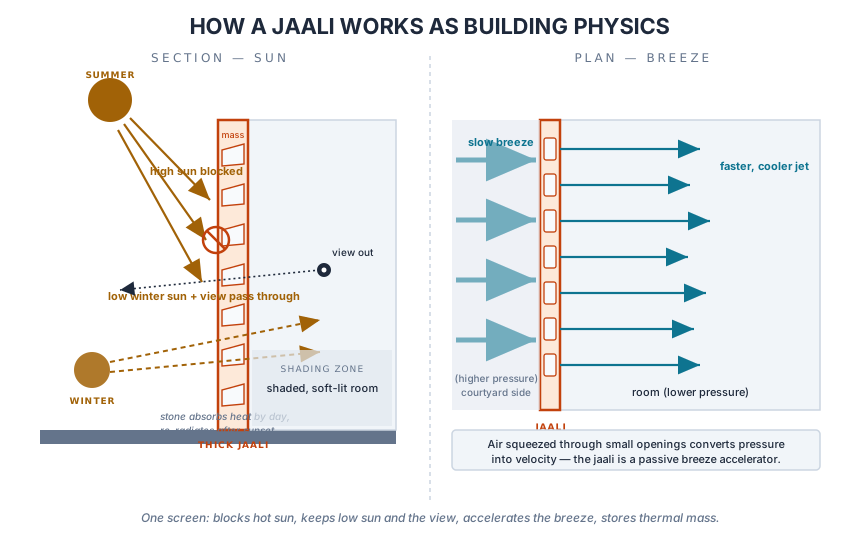
It filters daylight and kills glare. A plain window admits a small number of very bright openings — the sky, the sun — which the eye reads as glare against a dark room. A jaali breaks that same quantity of light into hundreds of small sources spread across the whole screen. The total light entering may be similar, but it arrives soft, diffuse and even, and the contrast between the bright opening and the dark wall around it drops sharply. The room feels gently lit rather than harshly punched through.
It cuts solar heat gain. Because the solid stone or concrete between the holes blocks a large fraction of the wall area, a jaali admits far less direct sun than an open window. The thicker the screen and the more the openings are angled or recessed, the more of the high, hot sun is blocked while the lower view is kept open. Stone and concrete jaalis also have thermal mass: they absorb heat slowly during the day and re-radiate it after sunset, smoothing the indoor temperature swing.
It gives privacy without darkness. The geometry that scatters light also defeats the eye. From the bright outside looking into the darker inside, a jaali reads as an opaque patterned wall; from inside looking out, you can see through it perfectly well. This asymmetry is why the screen could shield a courtyard or a zenana while still letting its occupants watch the world.
It accelerates the breeze — the part people forget. When moving air is forced through many small openings, it speeds up as it squeezes through: a pressure drop across the screen converts pressure into velocity. A gentle, barely felt outdoor breeze can become a noticeably faster, cooler jet on the inside face of a jaali. Combined with the courtyard-and-screen layout of traditional houses — cool shaded courtyard on one side, warm sunny side on the other — the pressure difference drives a steady cross-flow. The jaali is, in effect, a passive accelerator for natural ventilation.
It has evaporative potential. Traditionally, water channels, wet khus (vetiver) mats or fountains were placed near jaalis and courtyards so that the accelerated breeze passing over water picked up moisture and dropped in temperature — early evaporative cooling. The Hawa Mahal and many Rajasthani palaces used exactly this combination of screen, shade and water.
4. What jaalis are made of
A jaali can be made from almost any material that can be pierced or cast with a repeating pattern. Each has its own character, cost and performance.
| Material | How it is made | Look and feel | Cost (relative) | Best used for |
|---|---|---|---|---|
| Carved stone (sandstone) | Hand-carved or CNC-cut from soft sandstone (Dholpur, Jaisalmer, Agra red) | Warm, traditional, the classic "stone lace" | Medium to high (very high if hand-carved) | Heritage-style homes, temples, hotels, restoration |
| Carved marble (Makrana) | Hand-carved or machine-cut from white marble | Fine, luminous, palatial | High to very high | Premium residences, religious buildings, feature panels |
| Terracotta / fired clay | Pressed or extruded clay units, fired; stacked or framed | Earthy, warm, hand-made character | Low to medium | Homes, cultural buildings, eco projects, garden walls |
| Brick jaali | Standard or special bricks laid with gaps in a perforated bond | Honest, textured, low-cost | Low | Boundary walls, stair towers, low-cost and Laurie-Baker-style homes |
| Concrete blocks | Precast hollow decorative blocks (the old "ventilation block") | Mid-century, modernist, robust | Low | Compound walls, stairwells, car porches, retro homes |
| GRC / GFRC | Glass-fibre-reinforced concrete cast in moulds to any pattern | Crisp, slim, complex geometry, large panels | Medium to high | Contemporary facades, large screens, parametric patterns |
| Perforated metal | Steel or aluminium sheet laser-cut or punched, then coated | Sharp, precise, modern, lightweight | Medium | Modern facades, balconies, gates, screens over glazing |
The choice is rarely just aesthetic. Hand-carved sandstone says heritage and craft but is expensive and slow; GRC and laser-cut metal let an architect repeat a complex pattern hundreds of times at controlled cost and weight, which is exactly why the contemporary revival leans on them.
5. The contemporary revival: computers, GRC and parametric jaalis
The jaali never really disappeared — concrete ventilation blocks were everywhere in mid-century Indian homes — but it has had a striking high-design revival in the last fifteen years, and technology is the reason.
Two things changed. First, GRC (glass-fibre-reinforced concrete) and laser-cut metal made it cheap and fast to produce intricate perforated panels at building scale, without an army of stone carvers. Second, parametric and computational design let architects do something the old masters could only approximate: vary the porosity of the screen across a facade in response to where the sun actually falls. Software models the sun's path for the building's exact latitude and orientation, then opens the jaali wider where it faces away from the harsh sun and closes it tighter where the brutal west and south-west afternoon sun strikes. The pattern becomes a performance map.
The landmark Indian example is the Pearl Academy of Fashion in Jaipur, designed by Morphogenesis (Manit Rastogi and Sonali Rastogi) and completed around 2008. Its entire building is wrapped in a contemporary GRC jaali, set about a metre away from the glass behind it, in a double-skin arrangement. The screen shades the glass, the cavity between them buffers the heat, and below, a sunken stepped courtyard with a water body draws cool air up through the building — a deliberate, measured reinterpretation of exactly the Rajasthani jaali-courtyard-water tradition described above, using modern materials and computer-tuned geometry. It is studied worldwide as a model of climate-responsive design, and we cover it in detail in our case study on the Pearl Academy Jaipur.
Many other Indian practices have made the jaali central to their work — using brick jaalis, terracotta screens, perforated metal and GRC across homes, offices and institutions throughout Rajasthan, Gujarat, Delhi and the south. The common thread is the same idea: porosity tuned to orientation. The way an architect decides how open a jaali should be is summarised below.
| Orientation (Northern India) | Sun exposure | Suggested screen porosity | Why |
|---|---|---|---|
| South / South-west | Most intense, hot afternoon sun | Low (small, deep openings) | Block the worst heat and glare; protect glazing |
| West | Harsh low evening sun | Low to medium | Hard to shade with overhangs alone; the screen does it |
| East | Morning sun, gentler | Medium | Some control, but morning light is welcome |
| North | Little or no direct sun | High (open) | Maximise daylight and view; minimal heat penalty |
| Courtyard / shaded faces | Self-shaded | High (open) | Encourage airflow and connection |
This is the contemporary version of what the Hawa Mahal's builders knew by instinct, now made explicit and measurable — see our sibling guide on climate-responsive facades for the wider principle.
6. The jaali's family: chajja, jharokha and verandah
The jaali rarely worked alone. It belongs to a whole family of traditional Indian shading and screening devices that together made buildings comfortable before machines did.
- Chajja — the projecting sunshade or overhang, usually of stone or concrete, that runs above a window or along a parapet. It throws shade onto the wall and screen below, keeps monsoon rain off the openings, and is the direct ancestor of the modern concrete sunshade over every Indian window.
- Jharokha — the projecting, screened balcony window that leans out from the facade, often the most ornate element of a Rajasthani or Gujarati haveli. A jharokha is essentially a jaali that has stepped out into the street: it gives a wider view and catches more breeze while still screening its occupants. The Hawa Mahal is, in effect, a cliff of jharokhas.
- Verandah (and the deep courtyard) — the shaded transitional space, open on one side, that wraps the rooms of a traditional home. The verandah keeps the sun off the walls, and the central courtyard pulls air through the house. The jaali, the chajja, the jharokha and the verandah were designed as one system: shade the wall, screen the opening, move the air, cool the court.
Understanding this family matters because a jaali bolted onto an otherwise modern, sealed, west-facing glass box will disappoint. The traditional logic was holistic — and the best contemporary projects, like Pearl Academy, succeed precisely because they revive the whole system, not just the decorative screen.
7. Using a jaali in your own home
So how does this apply if you are building or renovating an Indian home today? A jaali is one of the most achievable pieces of climate-smart design a homeowner can use, but it pays to go in with open eyes.
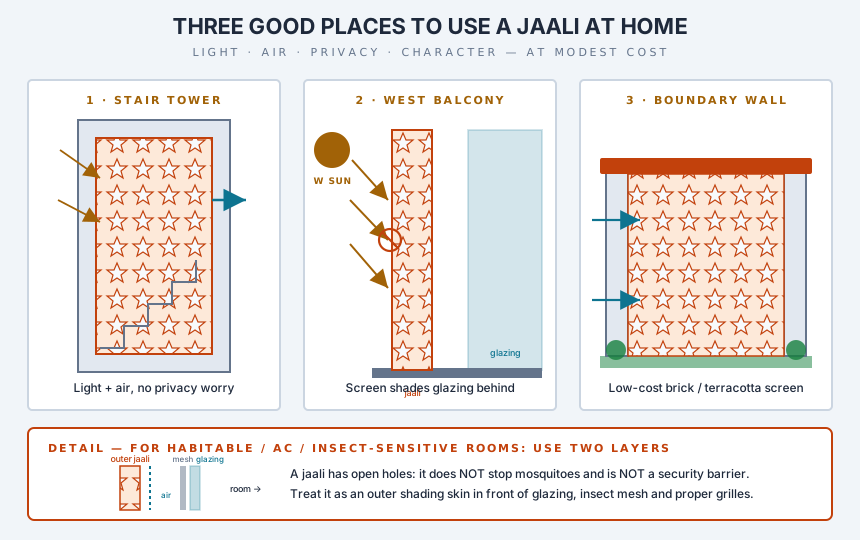
Where it works beautifully. Staircase walls and stair towers (light and ventilation, no privacy concern), compound and boundary walls, the wall of a pooja room or a double-height living space, a screen over a hot west-facing balcony, a parapet, a car porch, or a courtyard-facing wall. In all of these the jaali earns its keep: light without glare, breeze without a fully open hole, privacy, and a strong sense of Indian character.
Cost. A simple brick jaali or precast concrete ventilation-block screen is genuinely cheap — often comparable to a plain wall, because you use fewer units. Terracotta jaali units are inexpensive too. Costs climb steeply for GRC panels, laser-cut metal, and most of all for hand-carved sandstone or marble, which is a craft commission rather than a building product.
Cleaning and maintenance. Honesty matters here: jaalis collect dust, and the inside of the perforations is fiddly to clean — more so with intricate floral patterns and in dusty cities. Smooth materials (metal, glazed terracotta, polished stone) clean far more easily than rough carved sandstone. Plan for occasional washing-down, and avoid the most intricate patterns in very dusty or polluted locations unless you accept the upkeep.
The mosquito and security caveats — read this. A jaali is a screen with open holes. It does not keep out mosquitoes, and it is not a security barrier. If a jaali forms the actual opening to an inhabited, air-conditioned or insect-sensitive room, you will usually need a second layer behind it: glazing, an openable window, or a fine insect mesh, and proper grilles or shutters for security on ground floors. The cleanest approach — and the one Pearl Academy uses at large scale — is to treat the jaali as an outer shading skin set in front of a normal glazed, secure, mosquito-proofed wall, rather than as the only barrier between you and the outside.
What this means for you
The jaali is proof that India already solved much of the building-comfort problem centuries ago, and did it beautifully. It is not nostalgia to use one today; it is good engineering. A well-placed jaali gives you soft daylight without glare, real solar shading, accelerated breeze, privacy and unmistakable Indian character — often at modest cost.
The practical lessons are simple. Treat the jaali as part of a system, the way the old builders did — pair it with shade (chajja), with airflow (courtyard or cross-ventilation), and with the right orientation (tightest where the west and south-west sun is harshest, most open where it faces north or a shaded court). For habitable, air-conditioned or insect-sensitive rooms, set it in front of a proper glazed, secure, meshed wall rather than relying on it alone. Choose the material for the job: brick or concrete-block jaali for low-cost walls and screens, terracotta for warmth, GRC or laser-cut metal for crisp modern patterns at scale, carved stone where you want craft and heritage and can fund it.
Do that, and you are not copying the Hawa Mahal — you are doing what its builders did: using a perforated screen to make a building that is cooler, calmer, more private and more rooted in this place. For the bigger picture, read our pillar on why building facades matter, the overview of facade types, the Pearl Academy Jaipur case study, and the sibling guide on climate-responsive facades.
Sources
- Hawa Mahal, Jaipur (1799), Maharaja Sawai Pratap Singh, designed by Lal Chand Ustad — historical and architectural accounts of the "Palace of Winds" and its 953 jharokha windows.
- Fatehpur Sikri (1570s), Agra — UNESCO World Heritage Site documentation on Mughal carved-stone jaali screens.
- Sidi Saiyyed Mosque jaali, Ahmedabad (1573) — Archaeological Survey of India and city-heritage records on the tree-of-life stone screen.
- Pearl Academy of Fashion, Jaipur — Morphogenesis (Manit and Sonali Rastogi) project documentation and published case studies on the double-skin GRC jaali, thermal cavity and stepped water court.
- Chhatrapati Shivaji Maharaj Vastu Sangrahalaya (CSMVS), Mumbai — Indo-Saracenic museum building incorporating jaali and screen motifs.
- General building-physics references on perforated-screen daylighting, pressure-drop ventilation and thermal mass in hot-dry and warm-humid Indian climates.
- Studio Matrx building facades series — types of facades, why facades matter, and climate-responsive facades.
Export this guide
Related Guides — Deep-dive reading
The Hawa Mahal, Jaipur: A Palace That Is Almost Entirely a Window
How the rulers of Jaipur built a five-storey honeycomb of nine hundred latticed windows — a thin pink screen that let the royal women watch the city unseen and cooled itself on the desert breeze
Architectural WondersDouble-Skin & Ventilated Facades in India: The Layered Envelope That Buffers Heat, Noise & Glare
What a double-skin facade is, how the ventilated cavity cuts solar gain, noise and glare, the four cavity types, how it differs from a rainscreen, honest India cost and monsoon caveats, plus real examples.
Building FacadesEnergy-Efficient Facades in India: How the Building Skin Cuts Your Cooling, Heating & Lighting Bills
How a building facade drives cooling, heating and lighting energy in India, the three levers of solar-heat-gain control, insulation and daylighting, U-value, SHGC, VLT and WWR in plain terms, ECBC and Eco-Niwas expectations, and real Indian green buildings.
Building FacadesRelated Tools — Try Free
Brise-Soleil Visualizer
Interactive horizontal-louvre cut-off angle calculator — sun altitude, louvre depth, and spacing inputs with a live shadow preview. Computes θ = arctan(spacing/depth) for façade shading, ECBC envelope compliance, hospital daylight design, and tropical sun-control detailing.
Sun Shading ToolCross-Ventilation Analyzer
Estimate airflow and air changes per hour (ACH) from room size, window areas, layout, and local wind — with NBC 2016 Part 8 compliance check.
Ventilation CalculatorWindow Orientation Planner
Pick the best window type, glass and shading by wall direction — north, east, south and west.
Window Tool