
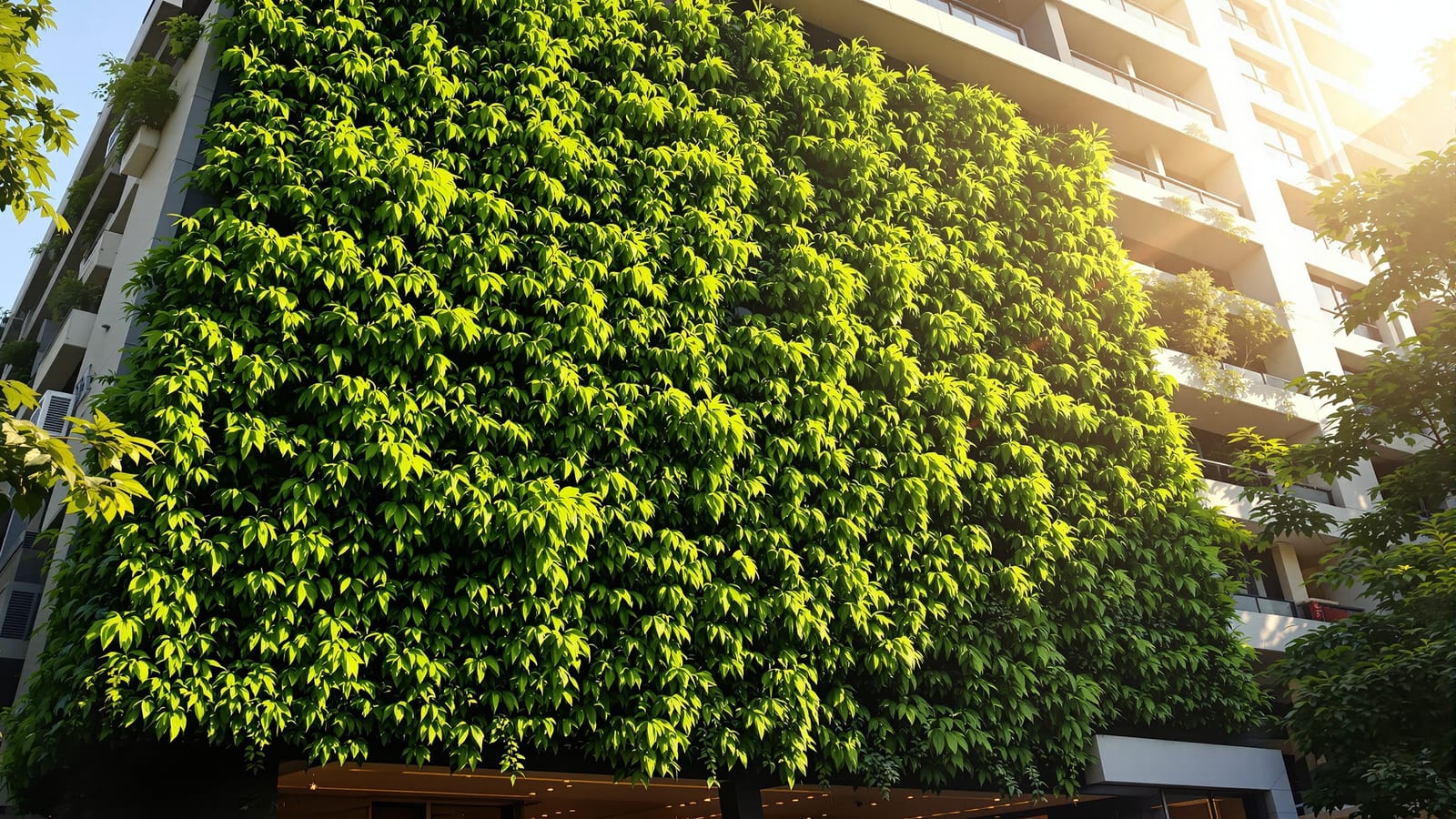
Green & Living Facades in India — Vertical Gardens and Living Walls as a Building Skin
The honest guide to planted facades: the crucial difference between a green facade (climbers on cables and trellis) and a living wall (plants growing in modular or hydroponic panels), how each is built and watered, the real benefits and the Indian caveats — water, maintenance, cost and what kills them.
A wall that is also a garden
For most of building history, a wall covered in plants meant one thing: neglect. A peepal seedling rooting in a crack, moss creeping up a damp north wall, a money-plant gone feral — these were signs that nobody was looking after the building. So it takes a small mental shift to accept the opposite idea: that a wall deliberately and engineered to be green can be one of the most sophisticated, best-performing skins a building can wear.
This is the world of green and living facades — buildings whose outer face is, quite literally, alive. You have almost certainly seen them: the dramatic planted towers in architecture magazines, the lobby wall of a five-star hotel breathing oxygen at you, the steel-mesh screen of climbers softening a glass office block. They look effortless in photographs. They are anything but. A living facade is a piece of horticulture bolted to a piece of engineering, and in India — where water is precious, summers are brutal and maintenance budgets evaporate — getting it right or wrong has very real consequences.
This guide separates the two quite different things people lump together under "green wall," explains how each is built and watered, and is honest about what it costs and what kills it. It is a companion in our building facades series, it builds on the case in why building facades matter, and it goes deeper on one specific skin than our broader piece on how buildings give back: biodiversity and environmental health.
1. Two different things wearing the same name
The single most important distinction in this whole subject — and the one most marketing brochures blur — is between a green facade and a living wall. They look related. They are built, watered, costed and maintained completely differently.
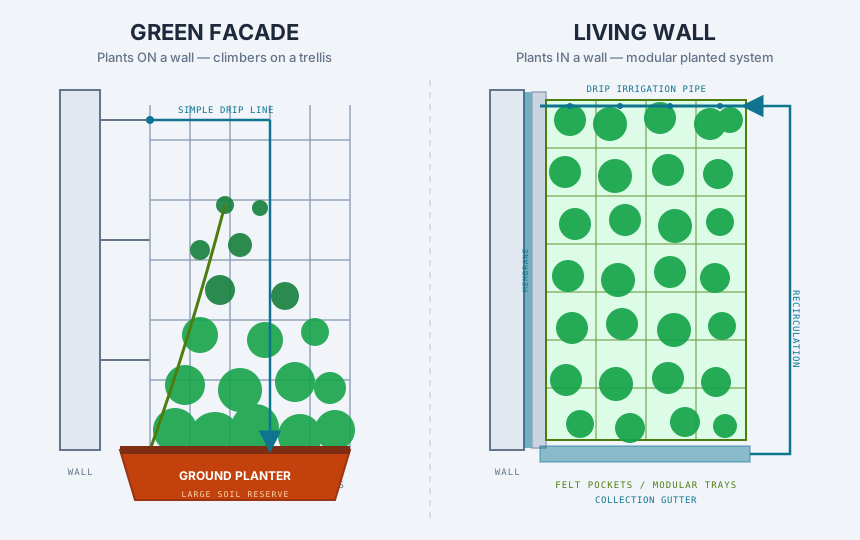
A green facade is climbers growing up the outside of a building. The plants are rooted in the ground, or in large planters at the base or on balconies, and they climb — up the wall directly, or, far better, up a support structure of stainless-steel cables, a steel mesh, or a timber or metal trellis held a little off the wall. The plant does the work; the building just gives it something to hold. This is the old idea — ivy on an English college, bougainvillea over a Goan gate — engineered into a clean, deliberate system.
A living wall, also called a vertical garden or vertical greenery system, is something more radical. Here the plants do not climb from the ground at all. They grow in the wall itself, out of a growing medium — felt pockets, modular plastic trays, mineral wool, or a soilless hydroponic substrate — that is fixed to the face of the building and fed by a built-in irrigation system. Every plant, from the bottom row to the top, is planted into the wall surface. This is what lets you cover a wall in dense foliage, ferns, flowering plants and varied textures from top to bottom in a way no climber can.
In one line: a green facade is plants on a wall; a living wall is plants in a wall. The first is cheap, slow and forgiving; the second is expensive, instant and demanding.
2. How a green facade is built and watered
A green facade is the simpler, sturdier and far more affordable of the two — and for most Indian buildings, it is the smarter starting point.
The structure is essentially a frame for the plant to climb. The best systems use a grid of tensioned stainless-steel cables or mesh, held 50 to 150 mm off the wall on stand-off brackets. That gap matters: it keeps the foliage and its moisture away from the wall surface (protecting plaster and paint), lets air circulate, and gives twining climbers something to wrap around. Timber or galvanised-steel trellis does the same job. The cardinal rule is to keep the plant on the frame and off the masonry — letting an aggressive climber attach its roots directly to the wall is what cracks plaster and traps damp.
The plants are rooted at the base, either directly in the ground or, more commonly on upper floors and podiums, in planters large enough to hold soil, water and root mass. Watering is correspondingly simple: a drip irrigation line to the planters or root zone, usually on a timer. Because there is a real volume of soil acting as a reservoir, a green facade is forgiving — miss a few days of watering and an established climber shrugs it off. There is no recirculation, no felt to keep wet, no pump that must run or the whole wall dies.
Coverage is the trade-off. A climber grows from the bottom, so it takes one to three seasons to clothe a wall, and it greens the lower and middle reaches far more readily than the very top. You get a softening green veil, not a wall-to-wall tapestry. For most homes, boundary walls, parking structures and mid-rise facades, that veil is exactly enough — and it is the version a homeowner can actually maintain.
3. How a living wall is built and watered
A living wall is a completely different animal — closer to a hydroponic farm turned vertical and stuck to a building. Working from the wall outwards, a typical system has:
1. A waterproof barrier and backing board. Because you are about to hold water and wet growing medium permanently against the building, the wall behind must be protected by a robust waterproof membrane, usually with an air gap or drainage layer. Skip this and you will rot the structure behind. This is non-negotiable in India.
2. A support frame — a metal or treated sub-frame fixed back to the structure, carrying the full saturated weight of the system.
3. The growing system — this is what varies between products. Common types are modular trays or pots (plants pre-grown in plastic modules that clip onto rails), felt or fabric pocket systems (plants rooted into pouches of geotextile felt), and structured-substrate or hydroponic panels (plants growing in mineral wool or an inert medium with nutrients delivered in the water).
4. A built-in irrigation system — drip lines or emitters at the top and at intervals down the wall, feeding water and dissolved nutrients to every plant.
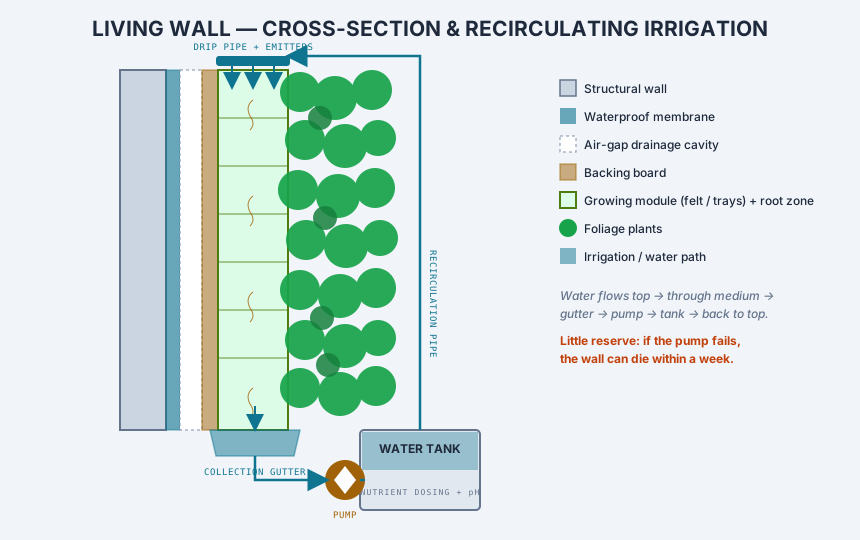
Irrigation is the heart of the system and its biggest liability. There are two approaches. A drip-to-waste system runs clean water (often with liquid nutrient dosed in) down through the wall and lets the excess drain away — simple, but wasteful of water, which is a serious mark against it in water-stressed Indian cities. A recirculating system collects the run-off in a gutter at the base, returns it to a tank, and pumps it back to the top, re-dosing nutrients and topping up — far more water-efficient, but more complex, with a pump that must run, water that must be tested for pH and salts, and filters that must be cleaned.
Either way, the defining fact of a living wall is this: it depends entirely on its irrigation. The growing medium holds very little reserve. If the pump fails, a timer glitches, a filter clogs or the power goes out for a few hot days, a living wall can brown and die in under a week — and a dead living wall is a far uglier, more expensive thing than the bare wall you started with. This single dependency is why living walls succeed on serviced commercial buildings with maintenance contracts and fail on neglected ones.
4. The real benefits — and the honest Indian caveats
Living and green facades genuinely deliver on several fronts. They are also routinely oversold. Here is the balanced picture for Indian conditions.
Heat-gain reduction and cooling. A layer of foliage shades the wall from direct sun, so the wall surface behind stays dramatically cooler — measured reductions of 10 to 20 degrees Celsius on the shaded surface are well documented. The plants also cool the surrounding air by evapotranspiration (releasing water vapour as they "breathe," which absorbs heat, the same way sweating cools you). In India's hot-dry and warm-humid cities this is real, useful cooling — it cuts the heat reaching the building and softens the urban heat island. The honest caveat: in humid coastal climates the evaporative-cooling benefit is smaller because the air is already moisture-laden, and the cooling effect of the air is local, not a substitute for insulation.
Air quality and dust. Foliage traps particulate dust and filters some pollutants — a tangible benefit on a dusty, traffic-choked Indian street. The caveat: the effect is real at the wall surface and modest at city scale; a green wall is not an air purifier for a whole neighbourhood.
Acoustics. The plants and growing medium absorb and scatter sound, cutting reflected traffic noise — genuinely useful for a building on a busy road.
Biodiversity. A planted facade gives insects, birds and pollinators habitat and forage in concrete-dominated cities. This is where this guide hands off to the bigger picture in how buildings give back: biodiversity and environmental health — a single facade is one tile in a much larger ecological mosaic.
Aesthetics and wellbeing. This is, honestly, often the real driver, and it is a legitimate one. A living wall is spectacular, signals environmental intent, and the documented psychological benefit of greenery on people is well established.
Now the caveats that decide whether you should build one at all:
- Water use. A living wall in a hot Indian summer is thirsty. In water-stressed cities, an open drip-to-waste system can be hard to justify ethically and financially; a recirculating system or, better, one fed by treated greywater or harvested rainwater is the responsible choice.
- Maintenance intensity. This is the deal-breaker for most failed installations. A living wall needs regular checking of the irrigation, pruning, replacing dead plants, managing pests, and dosing nutrients — effectively a part-time gardener and a service contract, forever. A green facade needs far less: occasional pruning to keep it off windows and gutters.
- System and lifecycle cost. Living walls are among the most expensive facade systems per square metre once you include the waterproofing, frame, plants, irrigation, pump, controls and the ongoing maintenance. A cable-trellis green facade is a fraction of that.
- Structural and waterproofing load. A saturated living wall is heavy and holds water permanently against the building. It must be engineered for the dead load and, above all, waterproofed properly — a leak behind a living wall is hidden and slow and can quietly damage structure.
- Plant selection. Many show-garden species cannot survive an Indian summer on a south or west wall. Get the planting palette wrong and the wall is patchy within a season.
5. Green facade vs living wall — side by side
| Factor | Green facade (climbers on trellis/cable) | Living wall (modular / felt / hydroponic) |
|---|---|---|
| Where plants root | In ground or planters at the base | In the wall itself, every level |
| Coverage | Bottom-up; veil, takes 1–3 seasons | Full, top-to-bottom, instant on install |
| Irrigation | Simple drip to root zone; large soil reserve | Built-in drip; little reserve; pump-dependent |
| If irrigation fails | Forgiving — established plants survive days | Can brown and die in under a week |
| Water use | Low | High (lower if recirculating + greywater) |
| Maintenance | Light — periodic pruning | Intensive — gardener + service contract |
| Waterproofing risk | Low (plants kept off wall) | High — water held against structure |
| Structural load | Low | High (saturated medium is heavy) |
| Upfront cost | Low to moderate | High to very high |
| Best for | Homes, boundary/parking walls, mid-rise | Serviced commercial, hotels, signature lobbies |
The pattern is clear: a green facade is the robust, affordable, low-risk option that suits almost any building including homes; a living wall is a high-performance, high-maintenance showpiece that only makes sense where someone is paid to keep it alive.
6. Plants that actually survive in India
The right species depends on your city's climate, the wall's orientation (a west wall in Nagpur is a furnace; a shaded north wall in Shillong is gentle) and which system you are building.
For green facades (climbers), hardy, India-tested choices include:
- Bougainvillea — the workhorse: drought-tolerant, sun-loving, spectacular flowering, ideal for hot-dry cities, though it needs a strong trellis and pruning.
- Madhumalti / Rangoon creeper (Combretum indicum) — fast, fragrant, flowering, very tough.
- Money plant (Pothos / Epipremnum) — excellent for shaded and semi-shaded walls, near-indestructible.
- Passion flower, jasmine (Jasminum), and morning glory — flowering climbers for varied conditions.
- Coral creeper (Antigonon) and curtain creeper (Vernonia) — fast green cover, the latter giving a dense hanging veil.
For living walls, where plants must thrive in shallow medium on a vertical face, dependable Indian-climate performers include Pothos and Philodendron (shade-tolerant, vigorous), Spider plant (Chlorophytum), ferns (Boston, bird's-nest — for humid, shaded walls), Syngonium, Dracaena and Aglaonema, Peace lily (Spathiphyllum) for indoor walls, and hardy Portulaca and succulents for hot, bright outdoor exposures. The principle is to match the plant to the light and to favour tough, fast-recovering species over delicate showpieces. A good vertical-garden contractor will plant in zones — sun-tolerant species on the hot upper/edge bands, shade-lovers in the protected lower middle.
7. Where it makes sense — versus just planting a climber
Be ruthless here, because this is where money is wasted. Ask what you are actually trying to achieve.
If the goal is to soften and cool a wall, cut dust and noise, and add green to a home, boundary wall, parking structure or mid-rise facade on a normal budget with normal maintenance — a green facade on a cable or trellis is almost always the right answer. It is cheap, it is robust, it survives a missed watering, and a gardener or even an attentive owner can keep it going.
A full living wall is justified only when several of these are true: the building has a professional maintenance contract and budget, you need dense, instant, full-height coverage for a flagship or branding reason (a hotel lobby, a corporate frontage, an experience centre), there is reliable power and a water source (ideally recirculated or greywater-fed), and the waterproofing and structure have been properly engineered. Outside those conditions, a living wall is a beautiful liability waiting to brown out.
A useful middle path many Indian projects choose: a green facade for the bulk of the wall, with a small, well-serviced living wall as a feature at the entrance where it is seen, watered and maintained. You get the drama where it counts and the robustness everywhere else.
8. Real buildings worth knowing
A few real, verifiable examples — green and living facades, Indian and global — to ground the idea. We never invent buildings; where a specific named project is uncertain, the description stays general.
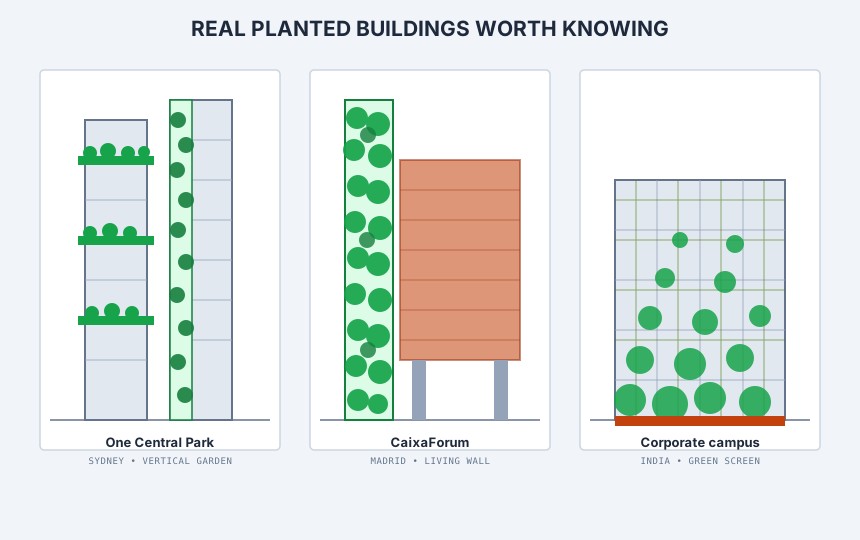
- One Central Park, Sydney, Australia (Ateliers Jean Nouvel with botanist Patrick Blanc, 2014) — the global icon of the vertical garden. Patrick Blanc, the inventor of the modern felt-based "mur végétal" (living wall), clad the residential towers in vast hydroponic living walls running up the building, combined with planted balconies — the reference point for the whole field.
- CaixaForum Madrid, Spain (Herzog and de Meuron, with Patrick Blanc, 2007) — a four-storey living wall of around 15,000 plants on the side of the museum's plaza; one of the most photographed and longest-running living walls in the world, and a real-world test of how such a wall ages.
- Bosco Verticale, Milan, Italy (Stefano Boeri Architetti, 2014) — the "Vertical Forest": two residential towers whose balconies hold hundreds of mature trees and thousands of plants. Strictly this is balcony planting rather than a wall-mounted living wall, but it is the most influential demonstration of buildings as habitat.
- Indian corporate campuses and hotels — green-screened facades and interior living walls now appear across Indian commercial and hospitality projects, including IT and corporate campuses in Bengaluru, Hyderabad and Pune and hotel and airport interiors, where dense planted walls are used as a sustainability and wellbeing statement. When evaluating any specific building, ask the operator who designed and who maintains the wall — a living wall's reputation lives or dies on the maintenance contract, not the install.
If a salesperson cannot tell you the irrigation type, the plant palette and who services it, treat the proposal with suspicion.
What this means for you
If you are a homeowner, the honest advice is to fall in love with the green facade, not the living wall. A bougainvillea or madhumalti on a tensioned steel cable, or a curtain of money plant on a shaded wall, will give you most of the cooling, dust-trapping, noise-softening and beauty of a planted facade for a tiny fraction of the cost and effort — and it will forgive you a holiday and a missed watering. Keep the plant on a frame held off the wall, never directly on the plaster, and you protect the building while greening it. If you want the living-wall look indoors, a small, well-watered interior vertical garden in a lobby or stairwell is far more manageable than an exposed outdoor one.
If you are a developer, architect or facilities manager, a living wall can be a genuinely brilliant move — but only with eyes open. Budget for the lifetime, not the install: the waterproofing, the recirculating irrigation, a reliable water source (greywater or harvested rain, not mains in a water-stressed city), and above all a maintenance contract with a named gardener. Engineer the waterproofing and structure as if a leak behind the wall is invisible — because it is. And right-size the ambition: a focused, serviced feature wall at the entrance, with a robust green facade across the rest, almost always outperforms a heroic full-building living wall that nobody has budgeted to keep alive.
The deepest lesson is the same one Indian gardeners have always known: a green wall is not a finish you install and forget. It is a living thing you commit to keep alive. Match that commitment to your real budget and water, and a planted facade is one of the most rewarding skins a building can wear. Mismatch it, and you get the saddest facade of all — a dead garden.
Continue with the types of building facades overview, the pillar on why building facades matter, and the broader environmental picture in how buildings give back: biodiversity and environmental health.
Sources
- Patrick Blanc, "The Vertical Garden: From Nature to the City" — the botanist who developed the modern felt-based living-wall (mur végétal) system; project documentation for One Central Park, Sydney and CaixaForum Madrid.
- Ateliers Jean Nouvel and PTW Architects project records for One Central Park, Sydney (2014), on the building's hydroponic vertical gardens.
- Herzog and de Meuron / Fundación "la Caixa" documentation for CaixaForum Madrid (2007), on the four-storey living wall.
- Stefano Boeri Architetti project records for Bosco Verticale, Milan (2014), on building-integrated tree and plant planting.
- Reviews of vertical greenery systems and building science literature on green facades versus living-wall systems, thermal performance, evapotranspirative cooling and surface-temperature reduction.
- Horticultural references on climber and indoor/vertical-garden species suited to Indian climatic zones (bougainvillea, Combretum indicum, Pothos, ferns, succulents and others).
- National Building Code of India (NBC 2016) and general guidance on waterproofing, structural loading and irrigation for building-mounted greenery.
Export this guide
Related Guides — Deep-dive reading
Bosco Verticale: How Stefano Boeri Turned a Milan Tower into a Forest
Boeri Studio's twin residential towers in Milan hang roughly 800 trees and tens of thousands of shrubs off cantilevered concrete balconies, treating façade as habitat. A deep case study of the vertical forest idea — its structure, its irrigation and maintenance machine, its awards, and the embodied-carbon and elitism critiques it cannot outgrow.
The Future of ArchitectureHow Buildings Can Give Back: Biodiversity and Environmental Health
How an Indian home and its plot can actively improve the ecology and environment around it, not just reduce harm
SustainabilityWhy Landscape Architecture Matters More Than the Building
How the green around, above and beyond your home out-cools, out-drains and out-appreciates the structure itself — at every scale from balcony to city.
LandscapeRelated Tools — Try Free
Acoustic Privacy (STC) Visualizer
Indian healthcare acoustic visualizer — compare wall assemblies and noise sources, see received SPL after STC attenuation, and check FGI 2018 / IS 1950 / NABH speech-privacy compliance with live dual-canvas waveform.
Acoustic ToolCross-Ventilation Analyzer
Estimate airflow and air changes per hour (ACH) from room size, window areas, layout, and local wind — with NBC 2016 Part 8 compliance check.
Ventilation CalculatorRainwater Tank Sizer
How big should your rainwater tank be? Computes annual harvest, recommended tank capacity in litres, water-bill savings, and payback — for 10 Indian cities.
RWH Calculator