
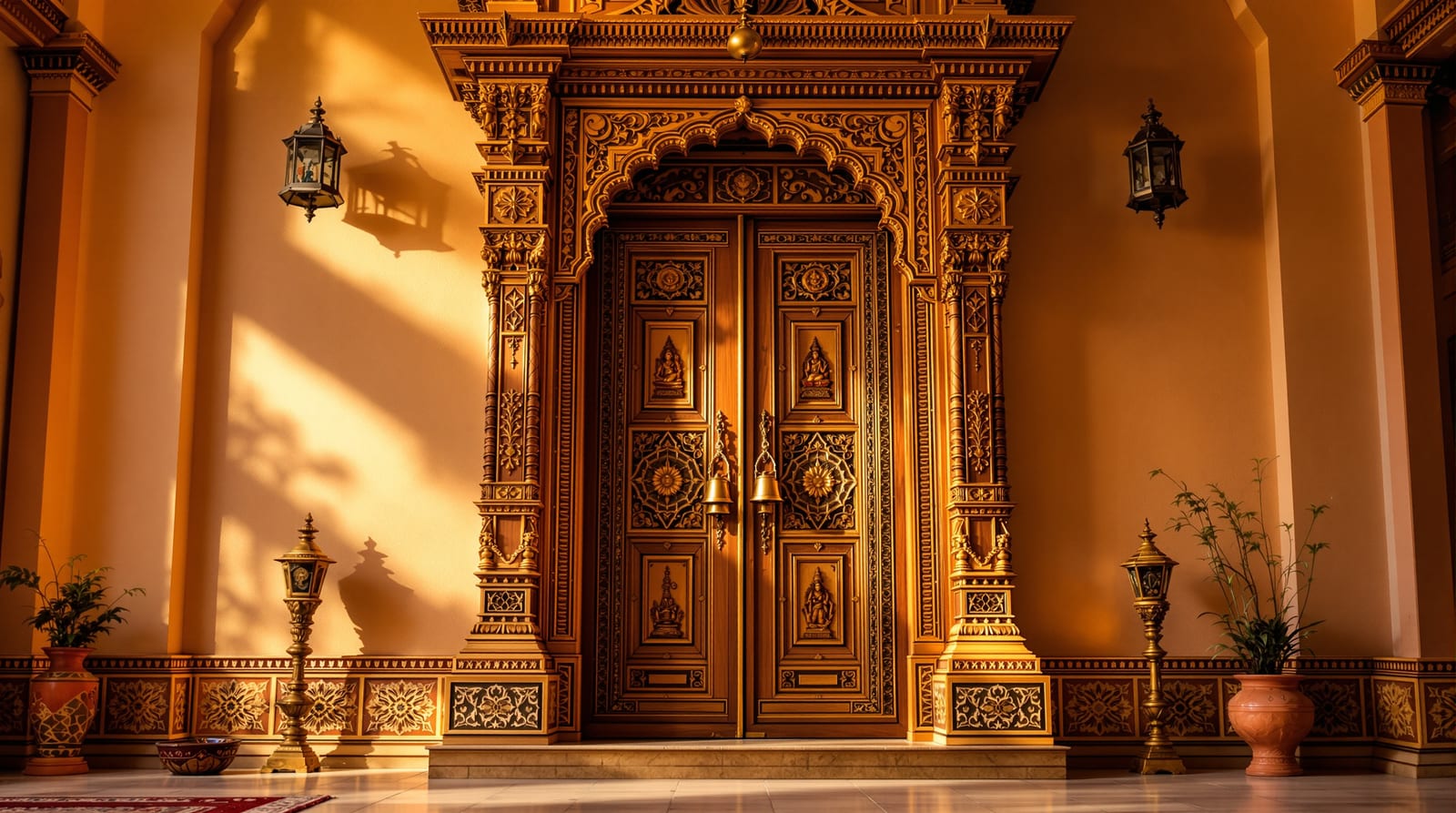
Temple Doors in India: Carved Devotional Doors for Pooja Rooms, Mandirs and Main Entrances
Temple-style carved teak and rosewood doors with deities, bells, kalash and lotus motifs — meanings, regional styles, brass cladding, sizes for a home mandir, costs and care.
A temple door is a door designed to be worshipped at, not merely opened. Where an ordinary door divides two rooms, a temple-style door marks the threshold between the everyday house and the sacred — a home mandir, a pooja room, or, for many Indian families, the main entrance itself. Carved teak or rosewood, crowned with a Ganesha or Lakshmi panel, hung with brass bells and topped by a kalash and lotus, it is a door whose every motif means something. This guide explains those motifs, the South- and North-Indian idioms they belong to, the brass cladding and bell-fronts, the right sizes for a home mandir, and the practical reality of buying and caring for one in India today.
This is the devotional door type. For where a pooja door sits and how to design the room around it, see our pooja room door guide; for orientation and ritual rules, the pooja room door Vastu piece. This guide goes deep on the temple door itself — its carving, its hardware and its meaning.
What makes a door a temple door
A temple door is defined less by its size than by its iconography and the way it is built to be the focal point of devotion. It draws directly on the koyil (temple) tradition — the carved gopuram doorways of South Indian temples and the ornately panelled dwar of North Indian shrines — and miniaturises that grammar for the home. Several features recur:
- A deity or auspicious crown — a carved Ganesha (the remover of obstacles, traditionally placed at thresholds), Lakshmi or Gajalakshmi (prosperity), or a kalash-and-lotus panel above the leaves.
- A two-shutter (double-leaf) construction wherever space allows — opening a temple is a symmetrical act, and a pair of leaves that part to reveal the deity is the classic devotional gesture. Small mandirs use a single leaf or even a half-door.
- Brass elements — hanging bells (ghanti), cladding sheets, repoussé panels, studs, and a central pull or kada-style ring.
- Carved relief, not flat printing — lotus, kalash, conch (shankh), bells, elephants, peacocks, the Om and swastik, and floral vines.
- A respected threshold (dehleez / vasal padi), often kept slightly raised and marked with kumkum, a toran of mango leaves and a daily rangoli.
It is the combination — devotional crown, symmetry, brass, relief carving and an honoured threshold — that turns a well-made wooden door into a temple door.
Motifs and what they mean
Almost nothing on a temple door is decorative for its own sake. The table below maps the common motifs to their meaning and the materials they are usually rendered in.
| Motif | Meaning / significance | Usual material & placement |
|---|---|---|
| Ganesha | Remover of obstacles; auspicious threshold guardian, invoked before any beginning | Carved teak/rosewood relief, or brass repoussé, on the lintel or top panel |
| Lakshmi / Gajalakshmi | Wealth and prosperity entering the home; elephants pour abundance | Carved or brass crown panel above the leaves |
| Kalash (pot) | Auspicious vessel of plenty; a full kalash signals a complete, blessed home | Carved finial or brass kalash atop the frame, or mirrored on each leaf |
| Lotus (kamal) | Purity, spiritual unfolding, the seat of the divine | Carved rosettes on panels and corners; brass inlay |
| Bells (ghanti) | Sound that wards off negativity and announces presence before the deity | Hanging brass bells on a top rail or beside the frame; carved bell relief |
| Nettipattam / elephant caparison | The ornamental gold forehead-plate of the Kerala temple elephant; festival grandeur | Brass repoussé panel or carved crest, common in Kerala-idiom doors |
| Om / Swastik | Primordial sound and auspiciousness/well-being | Carved or brass-inlaid central panels |
| Conch (shankh) & Chakra | Vishnu's emblems; the call to prayer and cosmic order | Paired carved or brass medallions |
| Peacock / parrot / vines | Beauty, fertility, the living garden of the divine | Carved borders and spandrels |
| Dwarapalaka (door guardians) | Sentinels who guard the sanctum, one each side | Carved jamb figures on grander South-Indian doors |
A small home mandir typically picks two or three of these — most often a Ganesha or kalash crown, bells, and a lotus border — rather than crowding every motif onto one door.
A carved temple double door, drawn
The diagram below shows the classic elements of a temple-style double door in portrait proportion — these doors are deliberately tall so the eye travels up to the deity.
South Indian versus North Indian temple doors
The two great idioms differ in carving language, hardware and crown motif, even when both are made in teak or rosewood.
| South Indian temple door | North Indian temple door | |
|---|---|---|
| Carving language | Deep, figural relief — dwarapalakas, deities, the gopuram-style tiered crown; dense, sculptural | Floral and geometric jali-influenced panels, vine borders, lighter relief; Rajasthani/Mughal arch motifs |
| Crown motif | Gajalakshmi, gopuram tier, Nettipattam (Kerala) | Kalash, lotus medallion, mehrab (pointed-arch) panel |
| Timber | Teak, rosewood, Burma teak; Kerala uses aanjili and rosewood | Sheesham (Indian rosewood), teak, mango wood |
| Brass | Heavy bells, repoussé Nettipattam plates, studs (Kerala/Tamil Nadu) | Brass cladding sheets, ring pulls, engraved patti borders (Rajasthan/UP) |
| Hardware | Hand-forged iron/brass hinges, sliding thaazh bar | Brass hinges, sankal (chain) latch, ring knockers |
| Typical home use | Pooja room, mandir, traditional Kerala/Tamil entrance | Mandir, haveli-style main door, pooja niche |
The Nettipattam door front deserves a special note. The nettipattam is the gold-coloured ornamental forehead caparison worn by the temple elephant in Kerala festivals — a cascade of embossed brass bosses. As a door motif it is rendered as a brass repoussé crest or full-leaf cladding, instantly evoking Kerala temple grandeur. It is one of the most striking devotional door fronts and pairs naturally with hanging bells. For the broader Kerala idiom, see our Kerala traditional doors guide; for the deep South-Indian merchant-mansion tradition, Chettinad doors.
Brass cladding and bell fronts
Brass does three jobs on a temple door: it shines (auspicious in itself), it sounds (the bell), and it tells stories (repoussé panels). You will encounter:
- Full or partial brass cladding — sheets of embossed brass over a wooden core, common on mandir doors and Nettipattam-style fronts. Visually spectacular; needs regular polishing or a lacquer coat to slow tarnish.
- Brass repoussé panels — Ganesha, Lakshmi, kalash or Nettipattam motifs hammered into relief and fixed to the leaves.
- Hanging bells (ghanti) — a row on the top rail or a pair beside the frame, rung in passing or at aarti. Solid brass bells have a longer, warmer tone than thin pressed ones.
- Ring pulls, kada handles and studs — the working hardware, also in brass.
A practical caution for India's climate: in coastal and humid regions, brass tarnishes and can pit. Either commit to regular Brasso/tamarind-and-salt polishing as a ritual in itself, or specify a clear lacquer (then re-lacquer every few years). Lacquered brass keeps its shine but mutes the lived-in patina some families prefer. For finishes across all door hardware, see our door hardware guide, and for the brass-on-teak tradition more broadly, brass-fitted traditional doors.
Sizes for a home mandir
A temple door is sized to its setting, not to a single standard. Three common settings:
| Setting | Typical leaf / opening size | Notes |
|---|---|---|
| Small pooja niche / wall mandir | 450-600 mm wide x 750-1050 mm high (single or half-door) | Often a single carved leaf or a pair of small half-doors; sits on a platform, not floor-to-ceiling |
| Walk-in pooja room | 750-900 mm wide x 1950-2100 mm high | A proper room door; double leaves (2 x ~375-450 mm) are traditional and let both leaves open at aarti |
| Temple-style main entrance | 1000-1200 mm wide x 2100 mm high (NBC 2016 main-door range) | A full main door carrying temple motifs; double-leaf where the wall allows |
Tradition favours an even number of panels and a double leaf for a pooja room — a symmetry that mirrors the temple sanctum. Keep the threshold (dehleez) present but, for a main door or an accessible home, limit its upstand to about 12 mm so it does not become a trip hazard (the accessibility benchmark in the [RPwD Harmonised Guidelines 2021]); see our broader pooja room door and pooja room door Vastu guides, and check any opening before you commit with the door size calculator.
A Vastu note, offered as living tradition and prudent practice rather than rigid rule: the pooja room and its door are usually placed in the north-east (Ishanya), the door made to open inward and the deity faced so the worshipper looks east or north. These customs sit alongside the broader main-door Vastu and entrance Vastu ideas — read them as belief plus the practical logic of light, air and a calm, honoured threshold.
Materials, carving and what drives the price
Genuine temple doors are carved, not pressed or printed. The carving — and the timber — dominate the cost.
| Item | Indicative cost (₹) | Notes |
|---|---|---|
| Carved teak pooja-room double door (lightly carved) | 18,000 - 60,000 | Tracks teak-door pricing; carving hours add sharply |
| Heavily carved teak/rosewood temple double door | 60,000 - 2,50,000+ | Deity panels, dwarapalakas and dense relief drive it |
| Small carved mandir door / half-door (single leaf) | 6,000 - 25,000 | For a niche or wall mandir |
| Brass-clad / Nettipattam-style door front | 30,000 - 2,00,000+ | Sheet brass + repoussé work; weight and craft heavy |
| Set of hanging brass bells (ghanti) | 400 - 4,000 | Per piece/set; solid brass costs more and sounds better |
| Brass repoussé deity panel (add-on) | 1,500 - 15,000 | Fitted to plain leaves |
| Carving / hardware fitting labour | 1,500 - 8,000+ | Local carpenter; varies by city |
All figures are indicative for 2026, vary by city, vendor, timber and carving, and typically attract +18% GST. A new "temple-style" reproduction in teak is honest value; a reclaimed antique temple door (from a demolished home or shrine) commands a premium and the same termite/borer cautions as any salvaged timber — see antique doors and termite proofing doors. For carving idioms across all door types, the carved door designs guide goes deeper, and traditional Indian doors maps the full regional spectrum. Sanity-check your budget with the door cost calculator.
Where to buy
Temple doors come from several channels in India:
- Local temple-door carpenters and carving workshops — Kerala (Ernakulam, Thrissur), Tamil Nadu (Karaikudi, Kumbakonam), Karnataka (Channapatna, Mysuru), Rajasthan (Jodhpur, Jaipur) and Saharanpur (UP) are carving hubs. Best for made-to-order and authentic relief.
- Architectural-salvage and antique dealers — for reclaimed temple and mandir doors with genuine patina; verify timber and treat for borer.
- Branded / online furniture and mandir specialists — convenient, consistent quality, but inspect whether carving is genuine relief or applied/pressed.
- Brass artisans (thathaar) — for bells, cladding and repoussé panels to add to a plain leaf.
Insist on a clear GST invoice, confirm the timber species (teak and rosewood are routinely over-claimed), and ask whether the carving is hand-relief or machine-routed — both are legitimate, but the price should reflect which.
Caring for a temple door
A temple door earns daily touch — oil lamps, kumkum, incense, hands at the threshold — so its care is part of the household rhythm.
- Feed the wood, do not drown it. Teak oil or a traditional wax/oil finish keeps carved relief alive; avoid thick glossy polyurethane that fills the carving. Re-oil annually, more often in coastal or high-rainfall regions.
- Polish the brass, or lacquer it. Choose your path early: ritual polishing (Brasso, or tamarind-salt-flour) preserves a living shine; clear lacquer slows tarnish but must be renewed every few years. Soot from oil lamps and incense settles on brass and carving — wipe gently and regularly.
- Protect against monsoon and termite. A pooja room is usually interior and sheltered, but a temple-style main door needs an overhang or porch, a good threshold seal, and termite vigilance — watch for fine bore-dust and treat early. See termite proofing doors and our door maintenance and door polishing and refinishing guides.
- Mind the bells and hardware. Check bell fixings and clappers periodically; tighten ring pulls and hinges, which loosen with daily use.
Cleaned, oiled and rung daily, a good temple door deepens with age — the patina, the worn threshold and the soft-toned bells become part of the family's devotional memory.
Frequently asked questions
What is the difference between a temple door and an ordinary carved door?
Any carved door can be beautiful; a temple door is specifically devotional. It carries sacred iconography — a deity crown (Ganesha, Lakshmi), kalash, lotus, bells, Om/swastik — built to mark the threshold of a pooja room, mandir or sacred entrance. It usually favours a symmetrical double leaf, an honoured raised threshold and brass bells. For where such a door sits in the home, see our pooja room door guide.
Which wood is best for a temple door in India?
Teak is the classic choice — stable against monsoon swelling, naturally termite-resistant and it holds fine relief carving well. Rosewood (sheesham in the North, Indian rosewood in the South) is prized for its dark, dense grain and is common in heritage and Kerala doors. Both are durable indoors; for an exposed main door, teak with an overhang and annual oiling is the safest bet.
What size should a home mandir temple door be?
It depends on the setting. A small wall-niche mandir uses a single or half-door roughly 450-600 mm wide; a walk-in pooja room takes a 750-900 mm opening, ideally a double leaf; and a temple-style main entrance follows the NBC 2016 main-door range of 1000-1200 x 2100 mm. Even panel counts and double leaves are traditional. Check your opening with the door size calculator.
Why do temple doors have bells, and where should they go?
Bells (ghanti) are rung to announce one's presence before the deity and, by tradition, to clear negativity with their sound. On a home temple door they hang from the top rail or beside the frame, rung in passing or at aarti. Solid-brass bells have a warmer, longer tone than thin pressed ones, so they are worth the small premium.
How much does a temple-style door cost in India?
A lightly carved teak pooja-room double door starts around ₹18,000; heavily carved teak or rosewood temple doors with deity panels run ₹60,000 to several lakh, and brass-clad or Nettipattam-style fronts more again. A small niche mandir door can be ₹6,000-25,000. All figures are indicative for 2026 and vary by timber, carving, city and vendor, usually plus 18% GST. Use the door cost calculator to budget.
Export this guide
Related Guides — Deep-dive reading
Carved Door Designs in India (2026): Motifs, Regional Styles, Hand vs CNC & Costs
A design-led guide to ornamental carved wooden doors for Indian homes — regional traditions, motifs, hand-carving vs machine carving, wood choice, where they belong and what they cost.
Home Doors & EntrancesKerala Traditional Doors: The Nalukettu Padippura & Carved Main Door Explained (2026)
The heritage door style of the Kerala tharavadu, from the padippura gateway to the carved teak and aanjili main door, its motifs, brass studs and panel proportions, and how it is revived in modern Kerala homes.
Home Doors & EntrancesTraditional Indian Door Designs: Kerala, Chettinad, Rajasthani & Temple-Style Heritage Doors
A heritage tour of India's great door traditions - Kerala nalukettu teak, Chettinad mansions, Rajasthani haveli carving, South-Indian temple doors, brass cladding and nakshi work, thresholds and toranas - and how to bring reclaimed and revival traditional doors into a modern home.
Home Doors & EntrancesRelated Tools — Try Free
Door Cost Calculator
Estimate the all-in cost of a door — leaf, frame, hardware, fitting and GST — by type, material and size.
Door CalculatorCross-Ventilation Analyzer
Estimate airflow and air changes per hour (ACH) from room size, window areas, layout, and local wind — with NBC 2016 Part 8 compliance check.
Ventilation CalculatorDouble Door Planner
Decide single vs double from your opening width and get leaf sizes, hardware and a Vastu even-leaf note.
Door Planner