
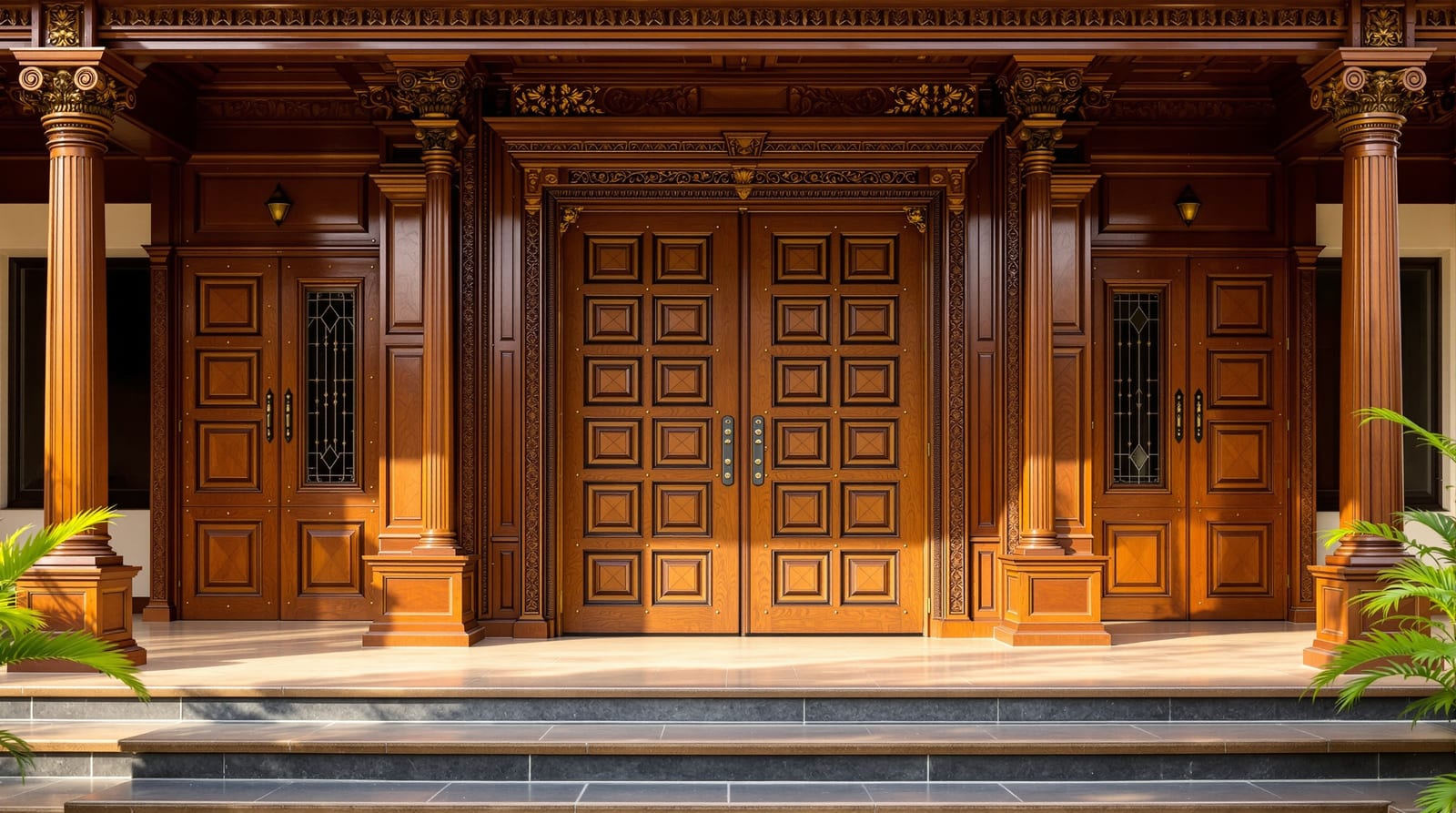
Chettinad Doors in India: The Grand Teak Doors of Chettinad Mansions
Massive Burma-teak entrance doors, brass studs, ornate locks and the thinnai context — and how to source, restore and reuse a reclaimed Chettinad door today.
Few doors in India carry the gravity of a Chettinad door. Hewn from old-growth Burma teak, studded with hand-beaten brass, and framed by carved jambs deep enough to seat a lintel of mythical figures, these were the entrances to the palatial homes of the Nattukottai Chettiars — a merchant-banking community whose 19th and early-20th-century mansions still stand across the Chettinad region of Tamil Nadu. Today the same doors are prized as statement entrances and collectible antiques. This guide covers what makes a genuine Chettinad door, the thinnai and Athangudi-tile context it belongs to, and the practical reality of sourcing, restoring and reusing a reclaimed one.
This is a regional, heritage-specific companion to our broader traditional Indian doors overview. Where that guide maps the whole spectrum, this one goes deep on a single, unmistakable tradition.
Where Chettinad doors come from
The Chettinad region — roughly the area around Karaikudi in Sivaganga and Pudukkottai districts — was home to the Chettiar trading community that prospered through commerce across Burma (Myanmar), Ceylon (Sri Lanka), Malaya and Vietnam from the mid-1800s. Wealth flowed home as building material: Burma teak and satinwood for structure and joinery, Italian marble and Belgian glass for finish, and locally fired Athangudi tiles for floors. The mansions, called veedu, were built around a sequence of open courtyards (muttram), and the most lavish craftsmanship was concentrated at the threshold — the front door.
A Chettinad entrance is never just a leaf in a wall. It sits at the back of a raised, columned porch called the thinnai — a semi-public verandah with built-in masonry seating where the family received guests, traders and the community. You climb a few steps, cross the thinnai, and only then reach the great door. That sequence — street, steps, thinnai, threshold, courtyard — is the architectural logic the door was designed to crown.
What makes a door unmistakably Chettinad
Several features recur across genuine examples. No single one defines the type; it is the combination — and the sheer scale — that does.
| Chettinad door feature | The detail to look for |
|---|---|
| Burma teak (or Pyinkado / satinwood) leaves | Dense, close-grained, dark-honey to deep brown old-growth timber; very heavy single-plank or wide-plank construction |
| Massive double leaves | Tall entrance doors, often 2.4 m+ high; main doors of grander homes can approach 3 m, hung in two leaves |
| Deep carved frame and lintel | Thick teak jambs with carved figures of Lakshmi, Gajalakshmi, peacocks, lotus, vines; a carved kalasam or deity panel above |
| Brass / iron studs (alankaram) | Rows of domed brass or wrought-iron studs across the leaves — part decorative, part to clinch the planks |
| Hand-forged fittings | Large iron or brass hinges (strap or pin), pull rings, knockers, and corner brackets, often blacksmith-made |
| Ornate locks and bolts | Heavy mortise or rim-style iron locks, sliding teak/iron thaazh (latch) bars, and traditional lever locks |
| Carved or panelled leaves | Raised teak panels, sometimes with applied turned spindles or pierced fretwork in the transom |
| Threshold and step | A raised teak or stone vasal padi (threshold), often with a kolam-decorated step and turmeric/kumkum markings |
| Athangudi tile surround | Handmade cement-oxide Athangudi tiles framing the thinnai floor and door approach in geometric colour |
| Toran / auspicious marks | Mango-leaf toran, brass bells or a small Pillaiyar (Ganesha) niche near the entrance |
The carved upper panel deserves a note: Gajalakshmi — Lakshmi flanked by elephants — is the most common entrance motif, invoking prosperity at the point a trading family's fortunes literally entered the house.
A diagram of the classic double leaf
The drawing below shows the typical proportions and elements of a Chettinad carved double door. Note the portrait proportion — these doors are tall.
The fittings: brass studs, locks and the thaazh
The hardware is half the story. On a genuine old Chettinad door, almost everything was hand-made. Domed brass studs (and on humbler doors, iron studs) run in bands across the leaves — they clinch the wide planks together and catch the light. Pull rings, lion-faced knockers and corner brackets were forged by local kollan (blacksmiths). The locking was typically a heavy sliding thaazh — a teak or iron bar that drops or slides into the frame from inside — backed up by lever locks or, in later homes, imported brass mortise locks.
If you are restoring a reclaimed door for a modern home, this is where the most thought is needed. The original thaazh is charming but offers little security against contemporary threats. The usual compromise is to keep the original studs, rings and visible brasswork, retain the thaazh as a decorative interior bolt, and discreetly add a modern multi-point or mortise lock — see our door hardware guide and the deeper carved door designs piece for how carved leaves and modern locks coexist. Brass and iron studs should be cleaned, not stripped — patina is part of the value.
The revival: statement doors and antiques today
From the 1990s onward, as many Chettinad mansions fell into disrepair or were demolished, their teak doors, columns, windows and Athangudi tiles entered the architectural-salvage market. Today you will find Chettinad doors in three forms:
- Genuine reclaimed antiques — original leaves and frames lifted from a demolished or renovated veedu. The most authentic and the most expensive; condition and provenance vary enormously.
- Restored / re-hung antiques — original leaves cleaned, repaired and fitted to a new frame, sometimes resized. The practical middle path for most homeowners.
- New "Chettinad-style" reproductions — freshly carved teak (or reclaimed-timber) doors made to the same idiom by carpenters in Karaikudi, Channapatna, Jaipur and elsewhere. Honest reproductions are excellent value; they are not antiques, and a reputable dealer will say so.
Designers love them as the single dramatic gesture in an otherwise restrained home — a great Burma-teak door at the entrance of a contemporary house, or as a feature interior partition. They pair naturally with teak wood doors elsewhere in the home for material continuity, and with other antique doors if you are building a collected, heritage look.
Sourcing a reclaimed Chettinad door
Reclaimed doors come from architectural-salvage yards (Karaikudi, Madurai, Pondicherry, Cochin, Jaipur, Bengaluru and Delhi all have dealers), heritage-demolition lots, auctions and a growing number of online antique platforms. A few cautions:
- Verify the timber. "Burma teak" is claimed far more often than it is true. Genuine old Burma teak is dense, oily and close-grained. Ask, and where the price is high, ask for the dealer's provenance.
- Check for termite and borer. Even teak frames (the softer meranti or country-wood components especially) can be infested. Look for fine bore-dust, soft patches and tunnels. Budget for fumigation and termite proofing.
- Measure realistically. Antique doors are tall and rarely match a modern NBC opening (main door ~1000-1200 x 2100 mm per NBC 2016). You will usually either build the opening to the door, or have the door trimmed and re-hung — see how to measure a door.
- Account for weight. A solid teak double leaf can weigh a great deal; the frame, hinges and wall must carry it. Plan hinges and fixings accordingly.
- Insist on a clear bill with GST. Reputable dealers issue proper invoices; antiques and salvaged timber may attract GST, and clear paperwork protects you.
Indicative costs in India
Prices vary widely with provenance, size, carving and condition. Treat the table below as indicative and confirm with the vendor.
| Item | Indicative cost (₹) | Notes |
|---|---|---|
| New Burma-teak door (per door, plain to lightly carved) | 25,000 - 1,50,000+ | Tracks general teak-door pricing; heavy carving adds sharply |
| New "Chettinad-style" carved teak double door | 60,000 - 3,00,000+ | Made-to-order; carving hours dominate the price |
| Reclaimed Chettinad antique door (leaves only) | 30,000 - 2,50,000+ | Provenance, size and carving drive it; exceptional pieces far higher |
| Reclaimed antique with original frame + carved lintel | 80,000 - 5,00,000+ | A complete vasal set commands a premium |
| Restoration / re-hanging of a reclaimed door | 8,000 - 40,000+ | Carpentry, new frame, fumigation, hardware |
| Fumigation / borer treatment | 2,000 - 8,000 | Essential for any salvaged timber |
| Athangudi tile surround (handmade) | 80 - 250 / sq ft | To recreate the thinnai-style approach |
Figures are indicative for 2026 and vary by city, vendor, size and condition; +18% GST may apply. Plan a contingency — antiques rarely fit on the first attempt. Our door cost calculator and door size calculator help you sanity-check the opening and budget before you commit.
Restoring and living with a Chettinad door
A salvaged door usually arrives grey, dry and stiff. Sympathetic restoration means: dry-clean and gently sand the teak (never aggressively — you can carve away patina and detail), treat for borer, feed the timber with teak oil or a traditional wax/oil finish rather than a thick glossy polyurethane, and clean the brass studs and fittings without over-polishing. Re-hang on robust new hinges sized for the weight, and add a discreet modern lock behind the original ironwork.
In India's climate the teak is your friend — old Burma teak is famously stable against monsoon swelling and termite — but an exposed entrance still needs a small overhang or the protection of a thinnai-style porch, plus annual oiling, especially in coastal or high-rainfall regions. For full method, see our door polishing and refinishing and door maintenance guides.
A note on tradition: the Chettinad threshold carried meaning. The vasal padi was kept auspicious — a daily kolam, a toran of mango leaves at festivals, kumkum at the jambs. Many homeowners reviving these doors also honour the older orientation customs (the main door as the largest, the threshold respected), which overlap with broader main-door Vastu ideas — best read as living tradition and prudent practice rather than rigid rule.
Frequently asked questions
Are Chettinad doors always made of Burma teak?
The grand entrance doors of the major mansions usually were — Burma teak and satinwood were imported as part of the Chettiars' trade. Humbler doors and back/interior doors used country woods and were less elaborately fitted. Today many "Chettinad-style" doors are new teak or reclaimed-timber reproductions, so always verify the species and whether a piece is antique or new.
How do I tell a genuine antique from a reproduction?
Look at wear: genuine antiques show consistent ageing — worn thresholds, patinated brass, old hand-forged (not machine-uniform) studs and fittings, irregular hand-tool carving, and timber that is uniformly aged front and back. Reproductions are crisper, with machine-even hardware and fresh end-grain. A reputable dealer will state plainly which one you are buying and offer provenance for true antiques.
Will an old Chettinad door fit a modern doorway?
Rarely without work. These doors are tall and were built to non-standard openings, while a modern main door is around 1000-1200 x 2100 mm (NBC 2016). You will usually build the opening to suit the door, or have a carpenter trim and re-hang it on a new frame. Measure carefully first with how to measure a door.
Can I make a reclaimed door secure?
Yes. The original thaazh latch is best kept as a decorative interior bolt; behind the visible heritage ironwork you can fit a modern mortise or multi-point lock, and reinforce the new frame and hinges for the door's weight. See the door hardware guide for compatible modern fittings.
What do Chettinad doors cost?
Anywhere from around ₹30,000 for a modest reclaimed leaf to several lakh for a complete antique set with carved lintel, plus restoration, hardware and fitting. New Chettinad-style carved teak doors typically run ₹60,000 upward depending on carving. All figures are indicative for 2026 and vary by provenance, size and city.
Export this guide
Related Guides — Deep-dive reading
Kerala Traditional Doors: The Nalukettu Padippura & Carved Main Door Explained (2026)
The heritage door style of the Kerala tharavadu, from the padippura gateway to the carved teak and aanjili main door, its motifs, brass studs and panel proportions, and how it is revived in modern Kerala homes.
Home Doors & EntrancesDouble Doors in India (2026): Two-Leaf Entrances, Proportions, Hardware & Cost
When a double-leaf door makes sense for Indian main entrances, pooja rooms and master suites, plus active/inactive leaf hardware, the Vastu note on even panels, security at the meeting stile and the rupee premium over a single door.
Home Doors & EntrancesThe Complete Home Door Guide for Indian Homes (2026): Types, Materials, Cost, Security & Vastu
Everything an Indian homeowner needs to specify the right door for every opening — from main entrance to bathroom — with real 2026 prices, IS/NBC standards and Vastu sense.
Home Doors & EntrancesRelated Tools — Try Free
Cross-Ventilation Analyzer
Estimate airflow and air changes per hour (ACH) from room size, window areas, layout, and local wind — with NBC 2016 Part 8 compliance check.
Ventilation CalculatorDoor Cost Calculator
Estimate the all-in cost of a door — leaf, frame, hardware, fitting and GST — by type, material and size.
Door CalculatorWindow Hardware Cost Calculator
Estimate window hardware cost — hinges, handles, locks, rollers and multipoint gears.
Window Calculator