
Brass Door Fittings for Traditional Indian Doors: Studs, Knockers, Latches & Care (India 2026)
The full vocabulary of brass ornamentation on traditional Indian doors — studs, knockers, kadi latches, nameplates and cladding — plus solid vs plated, finishes, and how to stop tarnish in humid, coastal India.
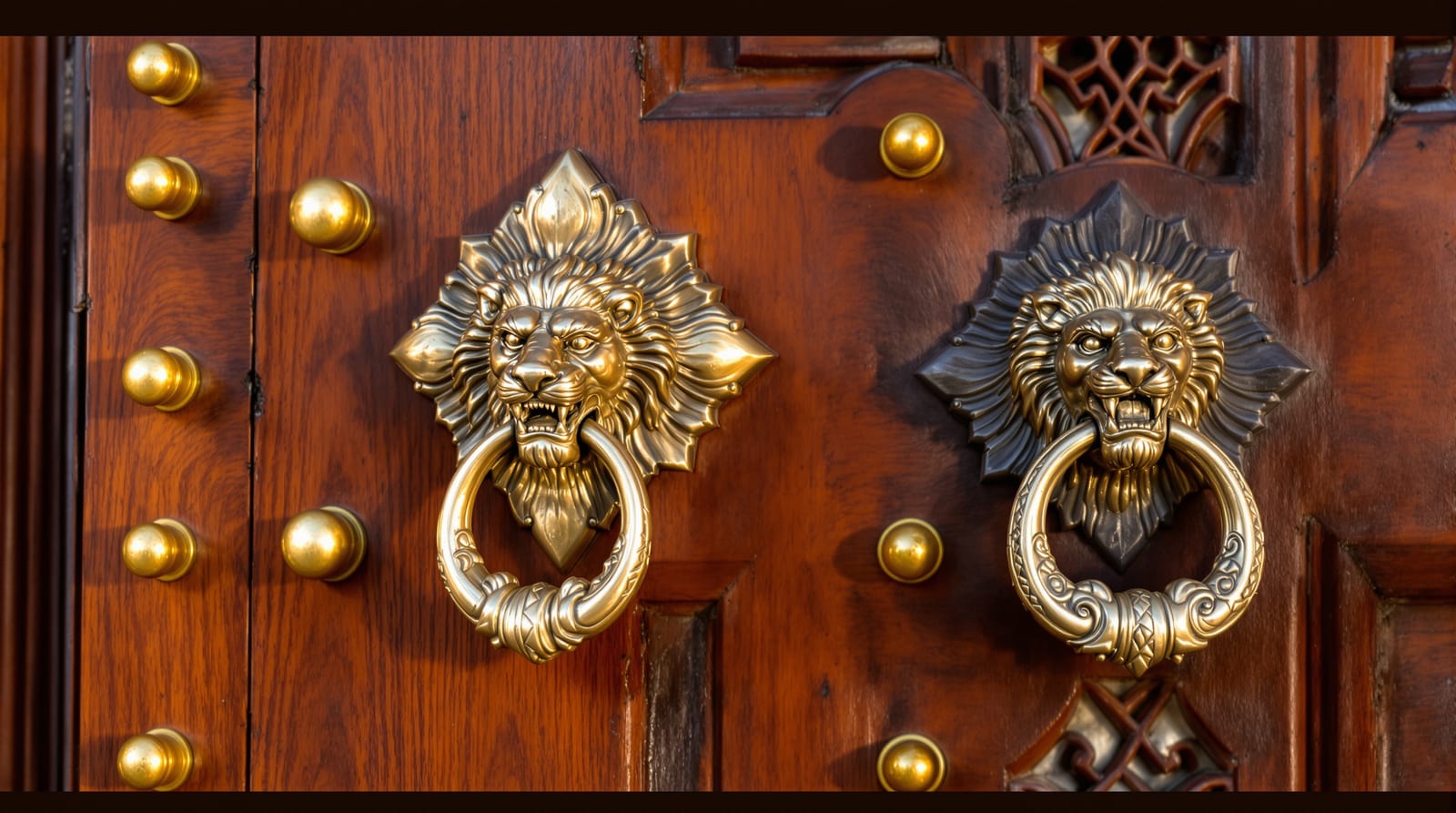
Walk up to any old haveli, Chettinad mansion or Kerala tharavadu and the first thing your hand meets is brass — a grid of dome-headed studs, a heavy lion-faced knocker, a curved kadi you lift to swing the leaf open. On a traditional Indian door the timber is the body, but the brass is the jewellery: it announces the household, protects high-wear edges, and turns a plain plank into a heirloom. This guide is the working vocabulary of that ornamentation — every fitting by name and role, how to tell solid brass from a thin plated shell, which finish to ask for, and the unglamorous part nobody mentions at the showroom: how to keep brass from going dull-green in a Mumbai monsoon or a Kochi sea breeze.
For the door leaf itself — the carving, the wood, the panels — pair this with carved door designs in India and traditional Indian doors. Here we stay on the metal.
Why brass, and why it still rules the traditional Indian door
Brass is an alloy of copper and zinc, and that recipe is exactly why it has dressed Indian doors for centuries. It is warm and golden rather than cold like steel, it is soft enough for craftsmen to cast, beat and engrave by hand, and it is naturally bacteriostatic — copper-rich surfaces are unkind to germs, which is partly why brass became the metal of thresholds and temple doors people touch daily. It is also forgiving: a brass fitting that has gone dark with decades of use can be brought back to a mirror with nothing more than tamarind, lemon or a tube of metal polish.
In the traditional grammar, brass also carries meaning. A large, well-fitted main door with generous brass is read as auspicious and prosperous — which dovetails with Vastu thinking that the main door should be the grandest in the house and should welcome wealth inward. We treat that as living tradition plus sensible practice (a heavy, well-armoured leaf genuinely is more secure and durable); for the directional and ritual side, see Vastu for the main door and entrance Vastu.
The vocabulary of brass: every fitting and what it does
A fully dressed traditional door is a small catalogue of named parts. Knowing the names gets you a far better conversation with a carpenter or a fittings dealer in Sivakasi, Moradabad (India's brass city) or your local hardware bazaar.
- Studs / knobs (kil): the dome-headed nails or bolts hammered in rows or grids across the leaf and panels. Originally structural — they clenched the plank-and-batten construction together and reinforced it against axes and battering — now mostly decorative armour. Sizes run from small 12-15 mm caps to fist-sized bosses on fortress-style doors.
- Handles and pull bars: vertical pulls, ring pulls, and long bar handles for heavy double doors. On grand entrances these are substantial cast pieces; IS 208 covers brass/aluminium handle standards if you want a benchmark.
- Door knockers: the showpiece. Cast as a lion's face (the classic "singha mukh"), an elephant, a hand-of-Fatima, a peacock or a simple ring. You lift and drop the ring against a brass strike plate. Even where a bell now does the work, the knocker stays as ornament and identity.
- Nameplates: engraved or embossed brass plates carrying the family name or house name — often the single most personal fitting on the door.
- Kadi / aldrop / sliding-bolt latches: the kadi is the curved hasp-and-staple latch you padlock; the aldrop is the heavier sliding-bar bolt for double doors. These are the everyday working hardware of a traditional leaf.
- Tower bolts and locking bolts: vertical sliding bolts top and bottom that pin a leaf to the frame and floor (IS 7196 covers tower bolts).
- Corner brackets and L-plates: angle pieces at the leaf corners — part decoration, part anti-sag and anti-splitting protection at the joints.
- Cladding sheets: thin embossed brass sheet wrapped over part or all of the leaf — common on temple doors and showpiece entrances, giving a fully golden face.
- Bell strings / chain pulls: a brass chain or pull rod connected to a bell, the older sibling of the modern video door phone.
- Threshold strips and dehleez accents: brass inlay or a strip on the sill, echoing the auspicious dehleez where toran and rangoli sit.
Brass fitting × role × care — at a glance
| Brass fitting | Indian name | Primary role | Care priority |
|---|---|---|---|
| Studs / bosses | Kil | Decorative armour, joint clenching | Wipe domes dry; polish recesses with a brush |
| Pull / bar handle | Handle / mooth | Daily grip, opening | High-touch — re-lacquer or wax often |
| Door knocker | Singha mukh / kadiya | Announce visitor, ornament & identity | Detail cleaning around the face casting |
| Nameplate | Naam patti | House identity | Avoid abrasive polish on engraving |
| Kadi / aldrop | Kadi / aldrop | Latching & padlocking | Oil pivot; polish moving bar |
| Tower bolt | Sitkini | Pinning leaf to frame/floor | Lubricate barrel; keep slide clean |
| Corner bracket | Kona patti | Anti-sag, anti-split, ornament | Check fixing screws yearly |
| Cladding sheet | Pital chadar | Full golden face, protection | Lacquer essential; never abrasive |
| Threshold strip | Dehleez patti | Sill protection, auspicious accent | Foot traffic wears finish — wax |
Indicative; names vary by region and trade.
Solid brass vs brass-plated: how to not get cheated
This is the single most important thing to get right, because the price gap is large and the difference is invisible at first glance.
- Solid (cast or extruded) brass is brass all the way through. It is heavy, it ages gracefully (it goes darker, never rusts orange), and a scratch just reveals more brass. It is what heritage doors used and what survives a century.
- Brass-plated is a thin brass coating — typically over zinc alloy (zamak), mild steel or aluminium. It looks identical when new but is far lighter, and once the micron-thin plating wears or chips at the high-touch handle, the base metal shows and can rust or pit. In coastal salt air, plating fails fast.
Quick field tests at the shop:
1. Heft it. Solid brass is noticeably dense for its size. If a "brass" knocker feels suspiciously light, it is plated.
2. Magnet test. A magnet will NOT stick to solid brass (or to brass over zinc), but it WILL grab brass-plated steel. A magnet sticking is a red flag.
3. Scratch a hidden spot. Solid brass is the same colour underneath; plating shows a silvery or grey base.
4. Ask the weight and price. Solid brass is sold by the kilo logic; an unrealistically cheap "brass" set is plated.
For a main door and knocker, pay for solid brass. For low-stakes interior studs you can accept good plated. The wider material trade-offs across all door hardware sit in the door hardware guide for India, and finish choices specifically in door hardware finishes in India.
Finishes: antique, polished, satin and lacquered
Same metal, very different look — and the finish decides how much you will be polishing.
- Polished (mirror) brass: bright gold, formal, glamorous. It also shows fingerprints and starts to dull/tarnish first, so it needs the most upkeep — or a good lacquer.
- Antique / aged brass: deliberately darkened with a chemical patina (often almost brown-black in the recesses, gold on the highlights). It hides fingerprints and uneven tarnish, and suits carved teak, Chettinad and rustic doors beautifully. Lowest maintenance look.
- Satin / matte brass: a soft, brushed sheen — contemporary, between the two.
- Antique copper / oil-rubbed tones: warmer, redder cousins, popular on heritage restorations.
Crucially, finish and protection are two different decisions. Any of the above can be supplied raw (unlacquered) — which will keep changing colour and "live" with the house, the way old haveli brass does — or lacquered, with a clear coat that locks the look and stops tarnish. For an inline diagram of where each fitting sits on the leaf, see below.
The tarnish problem: lacquering, cleaning and coastal India
Bare brass tarnishes. Oxygen, moisture, sulphur in the air and the salt and oils from hands react with the copper to form a dull brown-to-green film (and, over years, a green verdigris in crevices). In India this is hugely climate-dependent: dry inland air is gentle, but monsoon humidity and coastal salt accelerate it dramatically — brass in Mumbai, Goa, Chennai, Kochi or any seafront flat will dull far faster than the same fitting in Delhi or Bengaluru.
You have two strategies, and you can mix them by fitting.
1. Lacquer it (lowest effort). A clear lacquer or modern PVD/clear coat seals the brass so air and hands never touch the metal. Factory-lacquered fittings stay bright for years with just a wipe. The catch: lacquer can chip or wear at high-touch points (handles, knocker rings), and where it breaks, that spot tarnishes while the rest stays bright — so the fix is to strip and re-lacquer, not spot-polish. Best for polished-brass looks you want to stay bright and for coastal homes.
2. Leave it raw and polish it (the heritage way). Unlacquered brass "lives" — it darkens, you polish it back, and over decades it develops the deep glow of old haveli hardware. This is the authentic choice for antique and restored doors but it is a maintenance commitment.
Cleaning and polishing brass at home
- Confirm it is bare, not lacquered, before polishing — abrasive polish on lacquer leaves a cloudy mess. Lacquered brass only needs a damp microfibre wipe and a dry buff.
- Gentle first: warm water with a drop of mild dish soap on a soft cloth removes grime and light dullness.
- Indian kitchen classics for bare brass: a paste of lemon (or tamarind/imli) with a pinch of salt, or lemon with baking soda; rub on, leave a couple of minutes, rinse, dry thoroughly. Pitambari and Brasso are the popular ready polishes. Toothpaste works in a pinch.
- Use a soft toothbrush to lift tarnish out of stud recesses, engraving and the knocker's casting detail.
- Dry completely — trapped moisture is what starts the next round of tarnish. This step matters most in coastal and monsoon conditions.
- Protect after polishing: a thin coat of microcrystalline wax (or even a light food-grade mineral oil on handles) slows re-tarnishing for months. Re-wax high-touch pieces every few months on the coast.
- Avoid: steel wool, harsh scouring pads and over-frequent abrasive polishing — each pass removes a little metal and, on plated fittings, will eventually rub through to the base.
The same wood-on-the-leaf needs its own routine — oiling teak, watching for monsoon swelling and termites — covered in the door maintenance guide for India if you want the full picture for the whole door.
Where to source, and what it costs
Brass door fittings come from three broad channels in India:
- Heritage clusters and craft towns — Moradabad (UP), Sivakasi/Nachiarkoil and Kumbakonam (Tamil Nadu), and Jaipur/Jodhpur in Rajasthan — for hand-cast, custom and antique-reproduction pieces. Best for knockers, cladding and custom nameplates. See Rajasthani carved doors and Kerala traditional doors for the regional door styles these fittings dress.
- Branded hardware — Dorset, Europa, Ozone and similar offer solid-brass handle and lock sets with reliable finishes and lacquering, sold through architectural-hardware dealers.
- Local hardware bazaars and salvage/antique dealers for everyday kadi, aldrop, bolts and reclaimed heritage pieces (great for antique doors and heritage door restoration).
Indicative pricing (solid brass, before fitting labour; add 18% GST; varies by city, weight and craftsmanship):
| Item | Indicative price (solid brass) |
|---|---|
| Decorative studs (kil), per piece | ₹15-150 |
| Brass tower bolt | ₹150-700 |
| Kadi / aldrop latch set | ₹200-1,200 |
| Brass pull / bar handle (pair, grand) | ₹1,200-8,000+ |
| Cast brass knocker (lion/elephant) | ₹800-6,000+ |
| Engraved brass nameplate | ₹600-4,000+ |
| Brass-clad door sheet work | ₹ project-priced by weight & area |
| Branded solid-brass handle + mortise set | ₹2,000-12,000 |
Indicative, varies by city and vendor; hand-cast and antique pieces can run far higher. For budgeting the whole door, the door cost calculator and the broader door hardware brands in India guide help you compare. To plan leaf sizes that suit grand brass-dressed double doors, the door size calculator is useful.
Specifying a brass-fitted door well
A few decisions made up front save years of regret: choose solid brass for the main door and all high-touch pieces; pick antique finish if you hate polishing, lacquered polished if you want bright-and-low-care, raw if you want it to age like a heirloom; keep all fittings on the door the same finish family so they read as a set; and on the coast, lacquer everything and budget for re-waxing. Match the brass weight to the leaf — delicate fittings on a massive teak door look mean, and heavy bosses on a thin flush door look comic. For the carving and proportions that the brass should complement, return to carved door designs and traditional Indian doors.
Frequently asked questions
How do I tell solid brass from brass-plated before buying?
Three quick checks: heft it (solid brass is heavy for its size), try a magnet (it must NOT stick — if it grabs, it is plated steel), and scratch a hidden spot (solid brass is gold underneath; plating shows a grey base). For a main door knocker and handles, insist on solid brass.
Should I lacquer my brass door fittings or leave them raw?
Lacquer if you want them to stay bright with almost no effort, and especially in coastal or high-humidity homes — but expect to re-lacquer high-touch pieces when the coating wears. Leave them raw (and polish periodically) if you want authentic, ever-darkening heritage brass.
How do I clean tarnished brass on an old door?
First confirm it is unlacquered. Then use a paste of lemon or tamarind with a little salt or baking soda, rub gently, work recesses with a soft toothbrush, rinse, and dry completely. Ready polishes like Pitambari or Brasso also work. Finish with a thin wax coat to slow re-tarnishing.
Why does brass on my coastal home go dull so quickly?
Salt-laden, humid sea air reacts with the copper in brass much faster than dry inland air, so tarnish and verdigris appear within weeks. The fix is lacquered (or PVD-coated) solid brass, drying fittings after rain, and re-waxing high-touch pieces every few months.
Does brass on the main door have Vastu significance?
Tradition favours a large, well-appointed main door — generous brass included — as auspicious and prosperous, which also happens to make for a stronger, more durable leaf. Treat it as living tradition plus good practice, and see Vastu for the main door and entrance Vastu for direction and ritual.
Export this guide
Related Guides — Deep-dive reading
Door Maintenance Guide India: A Seasonal Care Routine to Keep Doors Smooth for Decades
Oil the hinges, tighten the screws, lube the lock, check the seals and re-coat the finish — a simple seasonal calendar that stops Indian doors from binding in the monsoon, sagging, tarnishing on the coast or falling to termites.
Home Doors & EntrancesDoor Hardware Finishes in India: Satin SS, Brass, Matte Black, PVD & Coastal Picks
How to choose handle, lock and hinge finishes that look right, age well and survive Indian humidity and coastal salt air.
Home Doors & EntrancesModern Door Design for Indian Homes: 9 Contemporary Looks That Still Work in the Monsoon
Minimalist flush-and-groove leaves, vertical and horizontal slats, flush-with-frame reveals, handle-less pulls, glass accents and statement pivots - the contemporary door styles that look right in a 2026 Indian home, and what each one costs and demands.
Home Doors & EntrancesRelated Tools — Try Free
Door Cost Calculator
Estimate the all-in cost of a door — leaf, frame, hardware, fitting and GST — by type, material and size.
Door CalculatorWindow Maintenance Cost Calculator
Estimate annual window upkeep by frame material — yearly, per-window and 5-year cost.
Window CalculatorDouble Door Planner
Decide single vs double from your opening width and get leaf sizes, hardware and a Vastu even-leaf note.
Door Planner