
Pooja Room Door Vastu for Indian Homes: Direction, Threshold & Materials
Where to place the pooja room door, which way it should face, the two-shutter wooden tradition, and grounded remedies when the layout cannot be ideal.
In most Indian homes the pooja room is the one space where belief, daily ritual and design meet at a single threshold. Vastu Shastra treats that threshold and its door as more than carpentry: the door decides which way you face the deity, what crosses into the sacred space, and how the room sits within the home's energy map. This guide stays practical. It explains what tradition asks of a pooja room door, why those rules exist, and what to do honestly when your floor plan cannot deliver the textbook ideal.
This is the Vastu companion to our design-led pooja room door guide, which covers carving, finishes and dimensions. Here we focus only on direction, placement and the rituals around the doorway.
Where the pooja room should sit before you fix the door
Vastu places the pooja room in the north-east (Ishanya) corner of the home, with north and east as the next-best zones. The reasoning blends belief and building sense: the north-east receives the soft early-morning sun, which is ideal for a dawn aarti, and the corner is kept light, clean and undisturbed. The deity is meant to be installed so that the worshipper faces east or north while praying.
The door follows from that placement. Once the room is in the NE and the idols sit against the western or southern wall of that room (so the worshipper faces east/north), the doorway should open from the side that lets you walk in and face the deity correctly. In practice this means the door is usually on the east or north wall of the pooja room.
A few placements Vastu treats as inauspicious, with grounded remedies discussed later in this guide:
- Pooja room (and its door) under a staircase.
- Pooja door sharing a wall with, or directly facing, a toilet.
- Pooja room in the south-west (the heaviest zone, reserved for the master bedroom or storage) or in a basement.
- The door opening into a bedroom or directly toward the main entrance.
Pooja room door direction and deity facing
The single rule people get wrong is conflating the door's facing with the deity's facing. They are linked but distinct. The deity should face the worshipper as east or north; the door is positioned so that you enter and naturally face that way without turning your back on the idols.
| Pooja door aspect | Vastu guidance | The practical reason |
|---|---|---|
| Best room zone | North-east, then north or east | Morning light, calm corner kept clean |
| Door on which wall | East or north wall of the pooja room | Lets the worshipper enter and face east/north |
| Deity facing | Deity faces west or south so YOU face east/north | East/north are auspicious prayer directions; you never turn your back to the idol |
| Door swing | Opens inward, ideally clockwise | Energy drawn in; clockwise mirrors the parikrama (circumambulation) |
| Number of shutters | Two (double-shutter) preferred | Symmetry, balance, sense of a "gateway" |
| Number of panels | Even number per shutter | Even numbers read as complete and balanced |
| Threshold (dehleez) | A raised sill, even a low one | Marks the boundary of the sacred space |
| Top of the door | Lintel/frame with a small arch or pediment is favoured | Echoes a temple gopuram silhouette |
| Avoid | Door under stairs, facing/abutting a toilet, opening into a bedroom | Belief + hygiene + acoustic/visual respect |
A quick test on site: stand where you would sit to pray. If you are facing east or north and the idols are in front of you against the opposite wall, the orientation is right, and the door simply needs to be on the wall behind or to the side of you so it never sits directly behind the deity.
Why a two-shutter wooden door is the tradition
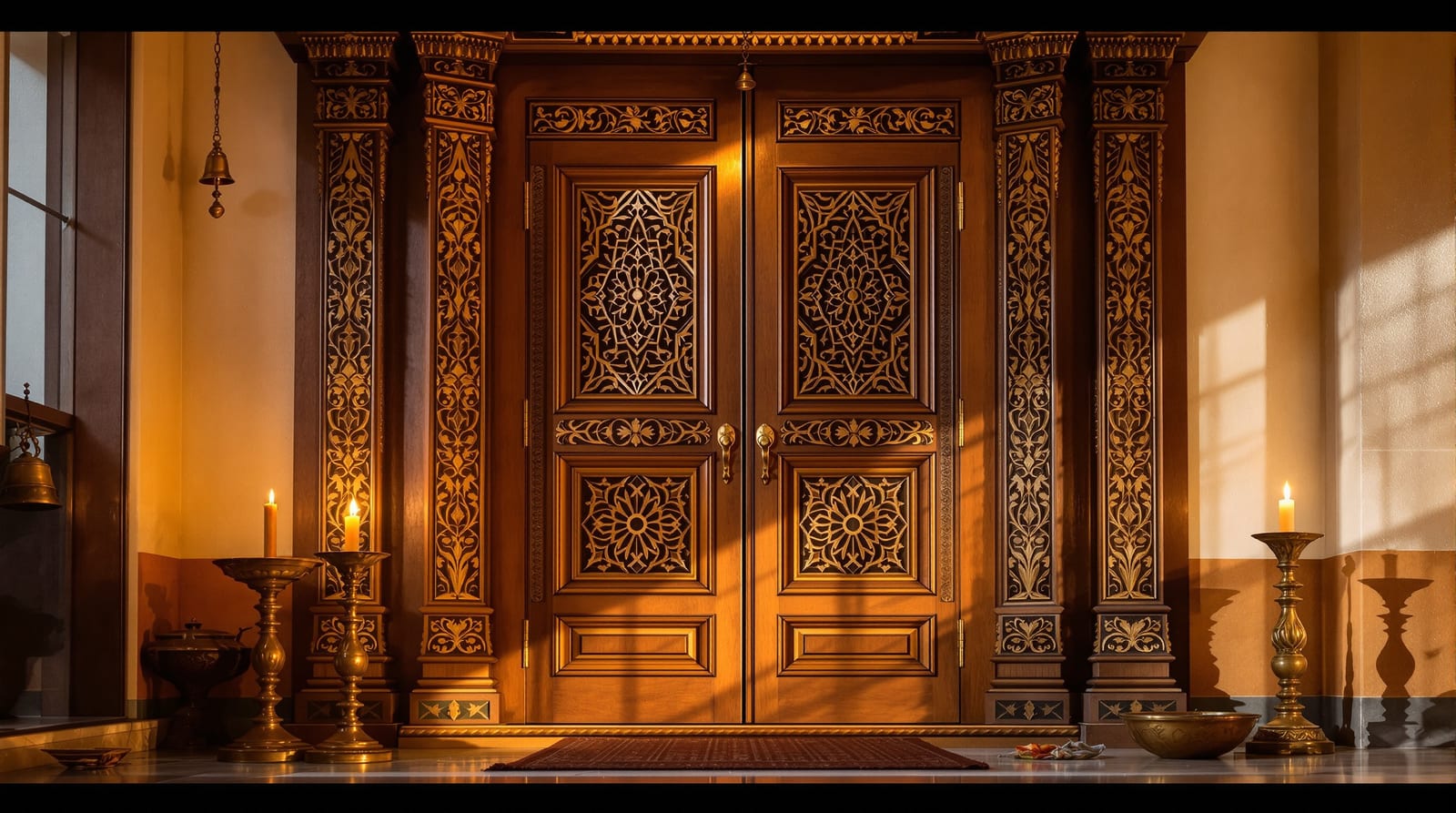
Walk through old homes in Tamil Nadu, Karnataka or Maharashtra and the pooja niche almost always has a small double-shutter (two-leaf) door, usually in wood, often with brass bells, a kalash motif or a carved Ganesha on the lintel. There are three reasons this persists.
Symmetry and the gateway feeling. A two-shutter door reads as a dwar, a gateway, the way a temple's sanctum is approached. A single flush shutter looks like a cupboard; two leaves opening outward to reveal the deity create a small moment of darshan each morning.
Material belief. Tradition strongly favours solid wood for a pooja door, and treats metal-faced or all-glass doors as less suitable. The reasoning given is that wood is a "warm", natural, living material aligned with sacred use, while metal and large glass are seen as cold or exposing. There is a practical layer too: a wooden door with a louvre or jali panel lets a little air and the scent of incense move while still feeling enclosed. If you do want visibility, a small jali or carved openwork in the wood is the traditional compromise rather than a full glass leaf.
Even panels and proportion. Each shutter ideally carries an even number of panels, and the door is often the more ornate element in the room, echoing how the main door is meant to be the largest and grandest in the home (see Vastu for the main door).
For materials and joinery in the Indian climate, wood choice matters: seasoned teak resists monsoon swelling and termites far better than cheaper options. Our pooja room door design guide and the teak wood doors guide cover species, cost (a carved teak pooja door can run anywhere from ₹10,000 to well over ₹1,50,000 depending on size and carving; indicative, varies by city and vendor) and finish in detail.
The threshold (dehleez) and what crosses it
The dehleez or threshold is central to pooja room Vastu. Traditionally a raised sill, even just 25-50 mm, marks the line between everyday space and sacred space. People pause at it, sometimes touch it, and remove footwear before crossing. The belief is that the threshold holds positive energy in and keeps the casual outside world out; the practice is that it physically signals "you are entering the mandir now".
A simple inline diagram of the orientation:
Above the door, a toran (the marigold-and-mango-leaf string, or a brass/beaded one) is hung to welcome auspicious energy and, by belief, to keep negativity out. Small bells on or beside the door are rung on entry to signal the start of worship and, practically, to focus attention. We cover the threshold-and-toran customs in more depth in the toran and threshold Vastu guide.
When the layout cannot be ideal: honest remedies
Most Indian flats and many independent homes simply cannot put the pooja room in the north-east with an east-facing door. Vastu tradition allows remedies, and a grounded reading of them is: do what you can, keep the space clean and intentional, and don't let anxiety about a rule undo the calm the room is meant to create.
| Problem placement | Common remedy (belief) | Practical, honest note |
|---|---|---|
| Pooja door under a staircase | Avoid if possible; if unavoidable, keep the under-stair area only for storing pooja items, not as the main shrine | Tradition discourages anyone or anything being "above" the deity; a low under-stair niche feels cramped anyway |
| Pooja door near or facing a toilet | Keep the toilet door always shut; add a partition, curtain or full-height shutter; ideally relocate the shrine | The real issue is hygiene, smell and noise next to a contemplative space; a solid closing door solves most of it |
| Cannot place door on east/north wall | Position the deity so the worshipper still faces east or north, even if the door is elsewhere | Deity facing matters more than door wall; orient idols first, then place the door where the wall allows |
| Pooja room in a bedroom (flats) | Use a closed cabinet-style mandir with shutters that close fully at night | Closing shutters give privacy and respect; treat it as a temporary daily shrine, not a permanent room |
| No room for a raised threshold | Use a slim symbolic sill, a rangoli line, or a brass strip on the floor | A 12 mm strip keeps it accessible while still marking the boundary |
For a fuller toolkit of corrective measures, see our dedicated Vastu door remedies guide. And because the same principles of facing, threshold and door grandeur apply to the home's entrance, the main door direction Vastu guide and the carving traditions in temple doors of India are useful companions.
You can also sketch a quick orientation with the door Vastu planner tool, and check sizes and frame costs with the door cost calculator before commissioning a carpenter.
A short checklist before you commission the door
- Confirm the pooja room sits in the NE, N or E zone of the home where possible.
- Place the deity so the worshipper faces east or north; let that decide the door wall.
- Choose a solid wooden two-shutter door with even panels; reserve full glass and metal-faced doors for elsewhere.
- Add a raised dehleez, even a slim one, and plan for a toran and bells above it.
- Keep the door clear of staircases and toilets; if not possible, apply the remedies above and keep the space scrupulously clean.
- Hinge it to open inward; check the swing with the door swing planner.
Frequently asked questions
Which direction should the pooja room door face as per Vastu?
The pooja room is best placed in the north-east, and the door usually sits on the east or north wall of that room. What matters most is that you can enter and face east or north while praying, with the deity in front of you, not behind.
Should the pooja room door be one shutter or two?
Tradition strongly favours a two-shutter (double-leaf) door. It reads as a gateway to the sacred space, gives symmetry, and lets both leaves open to reveal the deity for darshan. A single flush shutter works but feels more like a cupboard than a mandir.
Can the pooja room door be glass or metal?
Vastu tradition prefers solid wood and treats all-glass or metal-faced pooja doors as less suitable, seeing wood as the warm, natural, sacred material. If you want a little visibility or airflow, use a carved jali or louvre panel within a wooden door rather than a full glass leaf.
What is the remedy if the pooja door faces a toilet?
Keep the toilet door permanently closed, add a partition or full-height shutter between them, and ideally relocate the shrine. The genuine concern is hygiene, odour and noise beside a contemplative space, so a solid, well-sealed closing door resolves most of the issue.
Why is there a raised threshold (dehleez) at the pooja room door?
The dehleez marks the boundary between everyday and sacred space. By belief it holds positive energy within and keeps negativity out; in practice it signals to everyone to pause, remove footwear and enter mindfully. Keep it low (around 12-50 mm) so it stays easy to step over.
Export this guide
Related Guides — Deep-dive reading
Vastu for Main Door in India: Direction, Size, Panels, Threshold & Colour
A door-specific Vastu reference for the Indian home - best direction quick-table, the right size and proportion, why an even number of panels, the dehleez/threshold, auspicious colours and materials by direction, what to avoid, and remedies when an apartment door is builder-fixed.
Home Doors & EntrancesKitchen Door Vastu for Indian Homes: Direction, Placement & Remedies
Where to place the kitchen door, which way it should open, and how to fix the alignments Vastu warns against — explained as tradition plus practical kitchen sense.
Home Doors & EntrancesToran and Threshold (Dehleez) Vastu for Indian Homes: Tradition Meets Practical Sense
Why the toran over the door and the dehleez underfoot endure: their auspicious meaning and their genuine job as a barrier, level marker and welcome signal.
Home Doors & EntrancesRelated Tools — Try Free
Cross-Ventilation Analyzer
Estimate airflow and air changes per hour (ACH) from room size, window areas, layout, and local wind — with NBC 2016 Part 8 compliance check.
Ventilation CalculatorAcoustic Privacy (STC) Visualizer
Indian healthcare acoustic visualizer — compare wall assemblies and noise sources, see received SPL after STC attenuation, and check FGI 2018 / IS 1950 / NABH speech-privacy compliance with live dual-canvas waveform.
Acoustic ToolMain Door Vastu Planner
Check your main door direction against Vastu, with remedies and colour and material suggestions.
Vastu Planner