
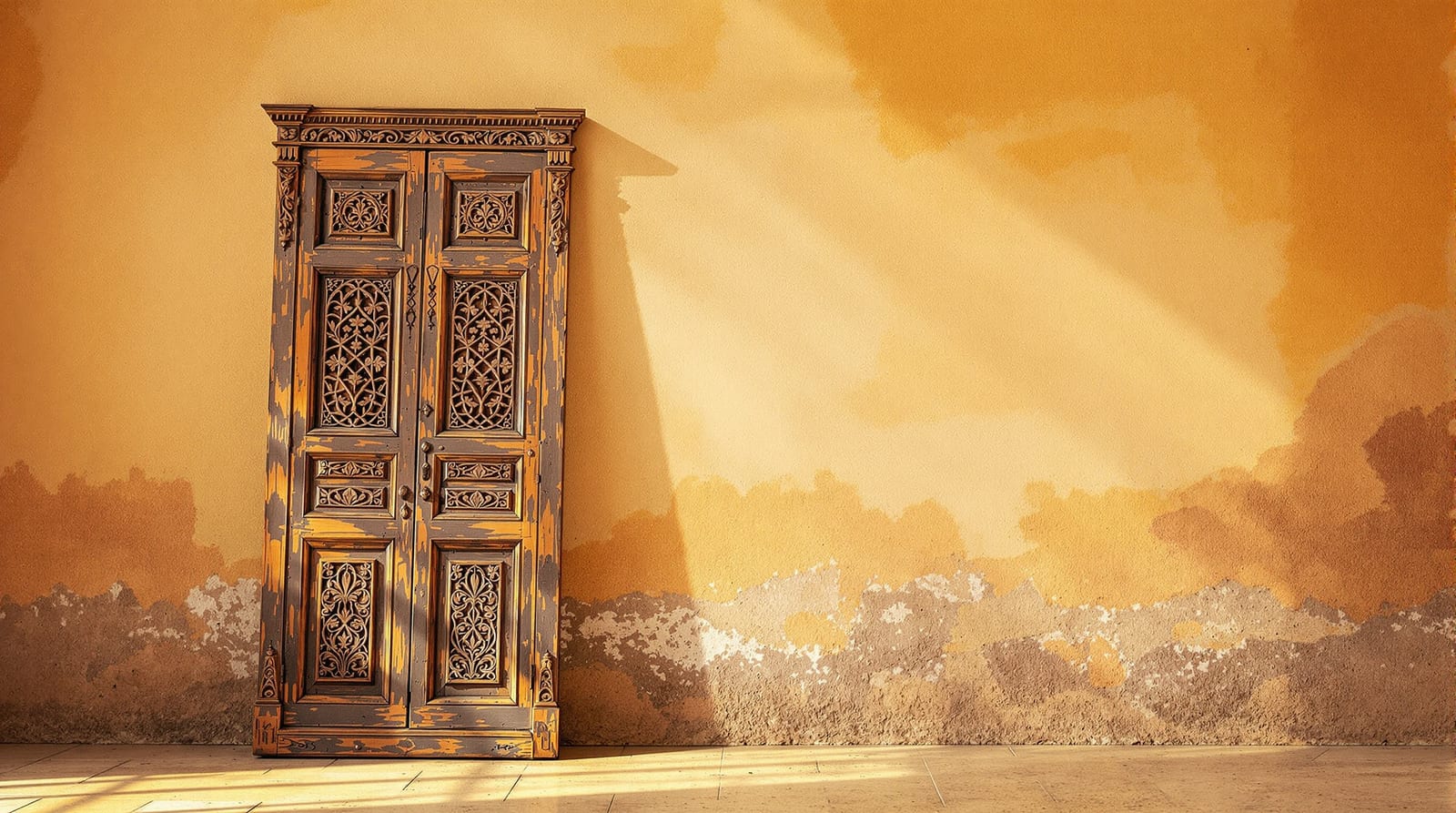
Antique Doors in India: Buying, Repurposing & Fitting Reclaimed Old Doors
How to source, inspect and reuse reclaimed haveli, Chettinad and colonial doors in a modern Indian home.
An antique door carries something a new door never can: a century of hands on the same brass ring, the swell-and-shrink memory of a hundred monsoons, the chisel marks of a carpenter whose name is long forgotten. Across India, doors salvaged from crumbling havelis, Chettinad mansions and colonial bungalows are finding second lives as dramatic main doors, headboards, dining tables and wall art. But a reclaimed door is also a gamble — old wood hides borer, rot and warps that a polished surface won't show. This guide is the homeowner's field manual: where to find genuine old doors, exactly what to check before paying, how to reuse them, and how to fit a 110-year-old leaf into a modern concrete opening.
Why antique doors, and where they come from
Most antique doors on the Indian market trace to three broad sources, each with a distinct look:
- Haveli doors (Rajasthan, Gujarat, North India) — heavy, often double-leaf, deeply carved in deodar, sheesham or teak, frequently with brass studs (the original anti-elephant hardware) and a smaller wicket door set within the main leaf.
- Chettinad doors (Tamil Nadu) — tall, slim-panelled teak and Burma-teak doors from the merchant mansions of the Chettiar community, prized for joinery and restrained carving. See our deep-dive on Chettinad doors.
- Colonial / Indo-European doors (Goa, Kerala, hill stations, port cities) — panelled, sometimes glazed or louvered, in teak or rosewood, with European proportions and Indian wood.
Kerala adds its own tradition of solid jackwood and rosewood doors with temple-style detailing — covered in our guide to Kerala traditional doors. For the broader vocabulary of styles and motifs, start with traditional Indian doors and Rajasthani carved doors.
Sourcing happens through a few channels: dedicated architectural-salvage yards (Jodhpur, Jaipur, Karaikudi, Cochin, and dealers in most metros), antique furniture exporters who sell domestically, estate clearances when old homes are demolished, and online marketplaces and Instagram dealers. Prices swing wildly — a plain reclaimed teak leaf might be ₹8,000-25,000, while a museum-grade carved double haveli door with original brass can run ₹60,000 to several lakhs. Treat every figure here as indicative; condition, wood, carving and provenance matter more than any list price.
The antique-door buying checklist
Never buy on photos alone, and never buy in dim light. Carry a torch, a magnet, a thin awl or screwdriver, and a measuring tape. Work through the table below before you negotiate.
| What to check | What to look for | Red flag |
|---|---|---|
| Wood species & weight | Dense, heavy teak/sheesham/rosewood; cool to touch; tight grain | Suspiciously light leaf (rot or soft wood inside) |
| Borer (powder-post beetle) | Surface only, few exit holes | Many pinholes + fresh fine powder ("frass") = active borer |
| Termite damage | Solid sound when tapped | Hollow tap, mud tubes, crumbling edges, blistered surface |
| Rot / water damage | Firm wood at bottom rail & base | Awl sinks into spongy wood at the base or hinge edge |
| Warping & twist | Sight along the leaf edge; lay flat | Cup, bow or twist over ~6-10 mm — won't seal in a frame |
| Splits & joinery | Tight mortise-and-tenon joints; minor age cracks ok | Open joints, loose panels, split rails through the thickness |
| Thickness & squareness | Consistent thickness; corners near 90 degrees | Badly out-of-square (hard to re-hang) |
| Original hardware | Period brass/iron hinges, latch, ring, studs | Modern screws/parts passed off as original |
| Carving integrity | Crisp, hand-cut depth; consistent wear | Machine-router uniformity (often a reproduction) |
| Old finish / paint | Removable lime wash, shellac, oil | Thick over-paint hiding splits and putty repairs |
| Size vs your opening | Measure leaf AND record frame if included | Far oversized = costly cutting; undersized = visible gaps |
| Provenance & price | Coherent story, fair price for condition | Vague origin + "antique" premium on an obvious copy |
Two checks deserve extra attention. Active borer/termite is the single biggest risk — bringing infested wood home can spread it to your furniture and structure; demand fumigation or boron treatment before delivery, or budget for it (see restoration below). Warp is the silent deal-breaker — a beautifully carved leaf that has twisted will never seal cleanly in a frame; it can still work superbly as a non-functional piece (headboard, wall art) but not as a working door.
Authenticity vs reproduction
The market is full of convincing reproductions and "antiqued" new doors — and that is not automatically bad, only something you should pay for knowingly. Genuine antiques show irregular, hand-cut carving, uneven patina, hand-forged or cast hardware with real wear, old joinery (pegged mortise-and-tenon, not modern dowels or screws), and species consistent with the claimed origin. Reproductions show machine-router uniformity, even "distressing", Phillips-head screws, and plywood or MDF cores under a veneer. Ask the dealer directly whether a piece is original, restored-original, or a reproduction, and let the answer set the price you'll pay.
Inline diagram: a reclaimed door and its second lives
Repurposing ideas: when not every old door should be a door
The most romantic use is also the hardest — and not every salvaged leaf earns it. Match the door's condition to the job:
- Main door — for a structurally sound, near-square leaf with manageable warp. The showpiece use; see fitting notes below. Pairs beautifully with a Vastu-aware entrance (cross-link vastu-main-door-india) and a main-door security checklist, since old leaves often lack modern locking.
- Headboard — lay a wide double-leaf or single carved leaf horizontally behind the bed, wall-mounted on a cleat. Forgiving of warp because it never has to seal. The most popular reuse in Indian homes.
- Coffee / dining table — a thick door becomes a table top over a metal or reclaimed-wood base; add a toughened-glass top to level the carving and protect it.
- Sliding partition or barn door — hang a single leaf on a top track to divide a living-dining or puja zone. See partition doors and sliding doors for hardware.
- Wall art / statement panel — a carved section, a wicket door, or a pair of shutters mounted as relief sculpture. Best home for a beautiful but unusable (rotted/warped) leaf.
- Bar unit, mirror frame, console — smaller offcuts and panels for furniture detail.
A practical filter: if a leaf is sound and seals, keep your options open including a working door; if it is gorgeous but warped, infested or rotted, steer it toward a non-functional life rather than fighting physics at the threshold.
Fitting an old door into a modern opening
This is where antique-door dreams meet site reality. Old doors were sized to old frames — typically NON-standard, often shorter or wider than today's. Modern Indian openings follow NBC 2016 guidance: a main door around 1000-1200 mm wide and ~2100 mm high, bedrooms ~900 x 2100 mm. An antique leaf rarely matches. Your carpenter has three moves:
1. Resize the leaf — trimming a stile or rail is possible on a solid timber door, but limited: you cannot cut away carved panels or weaken mortise-and-tenon joints. Plan the door around the door, not the other way round — ideally choose the opening size before the masonry is finished.
2. Build a new frame to suit the leaf — usually the better route. A new seasoned-teak or hardwood frame (IS 4021 for timber frames) is made to the leaf's actual size and the masonry opening is adjusted with the frame. This keeps the antique intact.
3. Fill the gap architecturally — if the leaf is smaller than the opening, frame the difference with a fixed top transom and side panels (glass, jali, or matching timber) so the door reads as intentional, not patched.
Other fitting realities: an old leaf is HEAVY, so use three or four robust hinges (or even original-style strap hinges) rated for the weight; expect to add a modern mortise lock and night latch discreetly, because period latches rarely meet today's security (see door hardware guide); and account for monsoon swell — leave a slightly larger reveal gap and finish all six faces (including top and bottom edges) to control moisture movement. For sizing your opening and budgeting the conversion, our door size calculator and door cost calculator are useful starting points.
Restoration overview and cost factors
Most antiques need work between yard and home. A typical restoration sequence:
1. Inspection and pest treatment — fumigation or boron/borer treatment for any sign of borer or termite, BEFORE the door enters your house. This is non-negotiable. Many salvage yards offer it; budget roughly ₹1,500-6,000 per door depending on size and method (indicative, varies by city/vendor).
2. Cleaning and stripping — gentle removal of old lime wash, over-paint or failed polish, preserving patina where you can.
3. Structural repair — re-gluing loose joints, splicing in matching old wood for rot, filling borer galleries, flattening minor warp with battens where feasible.
4. Hardware — cleaning and re-lacquering original brass, or sympathetically sourcing period-style replacements; adding discreet modern security.
5. Finishing — traditional shellac/French polish, natural oils (linseed, tung), or a clear matte PU; a wax or oil finish keeps the antique character better than a high-gloss film.
| Cost factor | Why it moves the price |
|---|---|
| Wood species & size | Solid teak/rosewood and large double leaves cost far more |
| Carving & provenance | Hand-carved, documented haveli/Chettinad pieces carry a premium |
| Condition | Heavy rot/borer = more repair labour; sometimes more than the door |
| Original hardware | Intact period brass adds value; missing parts add sourcing cost |
| Restoration scope | Strip-repair-finish labour, often ₹3,000-20,000+ per door |
| Conversion work | New frame, resizing, transom/side panels, fitting labour |
| Transport | Heavy leaves; inter-city freight and handling |
| GST | Add 18% GST on restoration/fitting services and most purchases |
A realistic all-in for a restored, fitted antique main door — leaf + treatment + restoration + new frame + hardware + fitting — commonly lands anywhere from ₹25,000 to well over ₹1,00,000. For deeper restoration technique, see our companion guide on heritage door restoration, and for keeping it healthy afterwards, termite-proofing doors and the general door maintenance guide.
Frequently asked questions
Are antique doors a good idea for the Indian climate?
Yes, with care. Old teak, sheesham and rosewood are dense, well-seasoned woods that have already survived decades of monsoon and heat — often more stable than new green timber. The risks are borer/termite and existing rot, not the climate itself. Treat the door, finish all six faces, and maintain it, and it will outlast most new doors.
How do I know if an antique door is real or a reproduction?
Look for irregular hand-cut carving, uneven patina, hand-forged or cast hardware with genuine wear, and pegged mortise-and-tenon joinery rather than dowels or screws. Machine-uniform carving, even "distressing", Phillips screws and a plywood/MDF core point to a reproduction. Ask the dealer to state plainly whether it is original, restored, or a copy.
Can any old door be used as a working main door?
No. It must be structurally sound, close to square, with manageable warp, and treatable for pests. Warped, rotted or badly infested leaves are better repurposed as headboards, tables, partitions or wall art, where they never have to seal. A near-square sound leaf, fitted to a new frame with proper hinges and a modern lock, makes a superb main door.
Does an antique main door follow Vastu rules?
It can. Vastu traditionally favours a large main door in the north, east or north-east, opening inward and clockwise, ideally with an even number of panels and a defined threshold (dehleez). Many haveli and Chettinad doors already fit this beautifully. Frame it as tradition plus the practical sense of a generous, welcoming entrance, and see vastu-main-door-india and entrance-vastu.
What is the most reliable repurpose if I'm unsure about the door's condition?
A wall-mounted headboard or a statement wall panel. Neither has to seal, swing or lock, so warp and minor damage stop mattering — you keep the carving and patina on full display while sidestepping the hardest engineering. Still treat for borer/termite first, since you don't want infested wood indoors.
Export this guide
Related Guides — Deep-dive reading
Double Doors in India (2026): Two-Leaf Entrances, Proportions, Hardware & Cost
When a double-leaf door makes sense for Indian main entrances, pooja rooms and master suites, plus active/inactive leaf hardware, the Vastu note on even panels, security at the meeting stile and the rupee premium over a single door.
Home Doors & EntrancesKerala Traditional Doors: The Nalukettu Padippura & Carved Main Door Explained (2026)
The heritage door style of the Kerala tharavadu, from the padippura gateway to the carved teak and aanjili main door, its motifs, brass studs and panel proportions, and how it is revived in modern Kerala homes.
Home Doors & EntrancesHow to Measure a Door India: Opening, Leaf, Frame and Hand the Right Way
A homeowner's measuring guide for India — measure the structural opening, work out leaf versus frame size, find the door hand and swing, allow for floor finish, and order without the classic too-tight or wrong-hand mistakes.
Home Doors & EntrancesRelated Tools — Try Free
Door Cost Calculator
Estimate the all-in cost of a door — leaf, frame, hardware, fitting and GST — by type, material and size.
Door CalculatorDoor Security Rating Calculator
Score your main door out of 100 across leaf, frame, lock and hardware — and see the top upgrades.
Security ToolCross-Ventilation Analyzer
Estimate airflow and air changes per hour (ACH) from room size, window areas, layout, and local wind — with NBC 2016 Part 8 compliance check.
Ventilation Calculator