
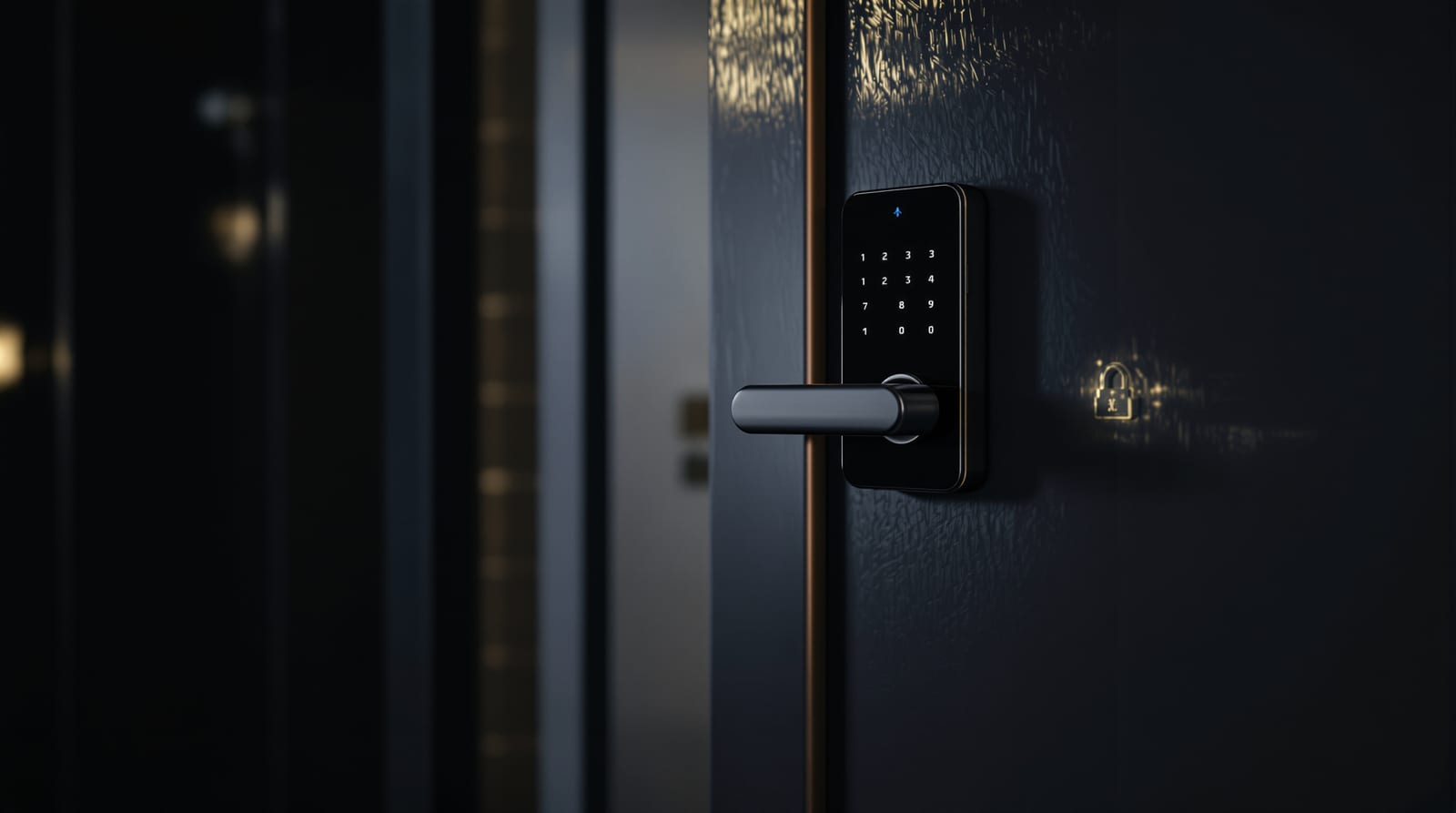
Smart Lock Security Risks and Hardening Guide India 2026
The honest list of digital, physical and reliability threats to smart locks in Indian homes, plus a practical hardening checklist.
A smart lock is a small computer bolted to your front door, and that is exactly why smart lock security risks deserve a clear-eyed look rather than marketing gloss. The good news first: a well-chosen, well-configured smart lock from a reputable brand is, for most Indian homes, at least as safe as a decent mortise lock and a lot more convenient. The honest caveat: it adds new failure modes a brass key never had. Threats fall into three buckets — digital (your PIN, the app, the cloud, the radio, the firmware), physical (the lock body and its mechanical override still have to resist a determined attacker), and reliability (a dead battery, dropped internet or a vendor walking away can lock you out as effectively as any burglar). This guide walks through each, names the real-world brands you will see — Godrej, Yale, Qubo, Ozone, Philips, Atomberg, Hikvision, Dorset — generically, and ends with a hardening checklist you can act on today. For the wider picture, start with our complete door guide and the smart door locks overview.
Smart lock security risks at a glance
Think of risk as the chance an attacker (or bad luck) defeats the lock, times the effort required. A smart lock has more attack surface than a key cylinder, but most real break-ins in India are still opportunistic — a prised frame, a forced window, an unlocked back door — not cryptographic wizardry. Keep that proportion in mind as you read.
| Risk category | Example threat | Likelihood (Indian home) | Mitigation difficulty |
|---|---|---|---|
| Digital — credential | Weak/default PIN, shoulder-surfing | High | Easy |
| Digital — app/cloud | App account breach, cloud data leak | Medium | Easy-medium |
| Digital — radio | BLE relay/replay, Wi-Fi sniffing | Low-medium | Medium |
| Digital — firmware | Unpatched vulnerability | Low-medium | Easy (update) |
| Physical — mechanical | Bumping/picking the key override | Medium | Medium |
| Physical — force | Prying, drilling, magnet/strong-arm | Medium | Medium-hard |
| Reliability | Dead battery, internet down, vendor shutdown | High | Easy-medium |
Digital risks, explained honestly
Weak PINs and credential habits
The single most common weakness is human: '1234', '0000', a birth year, or the same code shared with the maid, the cook, the plumber and three relatives. Many locks ship with a default installer PIN that owners never change. Shoulder-surfing at the keypad and tell-tale wear marks on four buttons also leak codes. None of this needs hacking. Use a 6-digit PIN, change the default, give time-bound or one-time PINs (OTP) to visitors, and review the door access audit logs to see who entered when.
App and cloud breaches
Wi-Fi locks talk to a vendor cloud and a phone app. A reused, weak app-account password — or a phishing link — can hand an attacker remote unlock. Cloud breaches at the vendor end can expose user data or, rarely, control. Mitigate by enabling two-factor authentication on the app, using a unique password, and revoking access for old phones and ex-residents. Understand what data leaves your home before you buy; see smart lock Wi-Fi connectivity.
Radio attacks — BLE relay, replay, Wi-Fi sniffing
Bluetooth (BLE) auto-unlock is convenient but, on weaker implementations, vulnerable to a relay attack: two attackers with cheap radios extend the signal between your phone (inside) and the lock (at the door) to trick it into unlocking. Replay attacks capture and re-send an unlock command. Open or WEP/poorly-secured home Wi-Fi can be sniffed. These attacks are real but uncommon against ordinary homes — they need proximity, equipment and intent. Choosing locks with encrypted, rolling-code BLE and WPA2/WPA3 Wi-Fi closes most of the gap.
Firmware
Like any computer, a lock can ship with bugs. Reputable brands push firmware updates that patch them; budget no-name imports often never do. Treat "receives regular firmware updates" as a buying criterion — it is covered in choosing a smart lock.
Physical risks are still real
A fingerprint reader does not make the door body stronger. Most smart locks keep a mechanical key override so you are not stranded if electronics die — and that cylinder is an attack point. Cheap pin-tumbler cylinders can be bumped or picked; insist on an anti-bump, anti-drill cylinder. The lock body and strike can be prised if the frame is weak; pair the lock with multipoint locking and a steel-reinforced frame. A specific concern with electromagnetic locks (maglocks) used in access-controlled doors is the magnet attack and, more importantly, simple loss of holding force — always specify adequate kilogram rating and tamper-proof mounting (see magnetic door locks). Some keypads can be fooled by detecting button wear or, on poor designs, by sensing residual heat; varied PINs and an occasional full-keypad wipe defeat this.
Reliability risks — the Indian reality
In India, power-cuts and patchy internet are not edge cases; they are Tuesday. Plan for them.
Dead-battery lockout
Most smart locks run on AA batteries lasting 6-12 months and chirp low-battery warnings — which people ignore. A flat battery can lock you out. Good locks offer an emergency 9V-battery or USB-C jump terminal at the base; all keep a mechanical key. Keep that physical key off-site with someone trusted, and read our smart lock battery guide.
Internet and vendor risk
If a feature only works "through the cloud", an internet outage or a vendor shutting the service down can disable remote access — or, in the worst cases, brick the lock. Prefer locks that function fully offline (PIN, fingerprint, key) with cloud as a bonus, not a dependency. For mains-powered access control, plan battery/UPS backup as in door access power backup.
Free egress and life-safety
If your smart lock or maglock sits on an escape route, NBC 2016 fire and life-safety provisions require free egress — people must always be able to get out without a key, code or power, and maglocks must release on a fire-alarm signal. This is non-negotiable; choose fail-safe hardware on escape doors and understand the trade-off in fail-safe vs fail-secure locks.
How the layers fit together
The hardening checklist
Work through this when you install, and revisit it twice a year.
| Step | Action | Why it matters |
|---|---|---|
| 1 | Change the default/installer PIN immediately | Closes the most exploited gap |
| 2 | Use a 6-digit PIN; give visitors time-bound or OTP codes | Limits exposure and shoulder-surfing |
| 3 | Set unique app password + enable 2FA | Stops remote account takeover |
| 4 | Keep firmware up to date | Patches known flaws |
| 5 | Use WPA2/WPA3 Wi-Fi; separate IoT network if possible | Blocks sniffing and lateral movement |
| 6 | Disable BLE auto-unlock if you do not need it | Removes relay-attack surface |
| 7 | Fit an anti-bump, anti-drill override cylinder | Protects the mechanical fallback |
| 8 | Pair with multipoint locking + reinforced frame | Resists prying and force |
| 9 | Keep a charged spare phone/key + know the jump-power method | Avoids dead-battery lockout |
| 10 | Confirm free egress + fire-release on escape doors | Legal and life-safety compliance |
| 11 | Review audit logs and revoke stale access monthly | Catches misuse early |
| 12 | Check what data the vendor stores (DPDP Act) | Protects biometrics and footage |
For biometrics and footage specifically, the DPDP Act 2023 treats them as sensitive personal data — prefer locks that store fingerprint templates on-device rather than in the cloud. To size and compare options, try the smart lock selector and the door security rating tool, and read smart lock vs traditional lock and the broader door security checklist. Where a lock sits inside a larger access system, the same principles scale up — see access control systems and door automation.
Frequently asked questions
Can a smart lock be hacked from across the street?
For most quality consumer locks, no — remote radio attacks like BLE relay need an accomplice physically near you and the lock, plus equipment. Cloud-account hacking is the more realistic remote path, which is why a unique app password and 2FA matter far more than worrying about over-the-air wizardry.
Is a fingerprint safer than a PIN?
Fingerprints cannot be shoulder-surfed or shared casually, which is a real advantage, but no sensor is perfect and you should never rely on one method alone. Use fingerprint plus a strong PIN, and ensure the template is stored on the device, not uploaded to a server — important under the DPDP Act 2023.
What happens if the battery dies or the power goes out?
A good smart lock warns you for weeks first, keeps a mechanical key override, and offers emergency jump power (9V or USB-C) at the base. Battery locks are unaffected by mains cuts. For mains-powered maglocks and access control, plan UPS or battery backup, and keep a physical key off-site as a backstop.
Are cheap, unbranded smart locks risky?
Often, yes. The biggest issues are no firmware updates, weak or absent encryption, flimsy lock bodies and no real support if the vendor disappears. Buy from established brands that publish update and warranty policies; the savings on a no-name import rarely justify the exposure.
Is my front door legally allowed to lock people in?
No. Under NBC 2016, any lock on an escape route must allow free egress — people must get out without a key, code or power — and electromagnetic locks must release on a fire alarm. Specify fail-safe hardware on escape doors and have an integrator confirm compliance.
Export this guide
Related Guides — Deep-dive reading
Access Control Maintenance in India (2026): Readers, Locks and Fail-Safe Egress
How to keep a card, keypad, fingerprint or face access-control system reading reliably and locking securely — and, above everything, how to test that its doors still release on a fire alarm and on power loss, so an access-controlled door never becomes a life-safety trap.
SecurityComplete Guide to Security System Cybersecurity in India (2026): Protecting the Systems That Protect You
The cameras, locks, alarms and door phones you install to feel safer are internet-connected computers that can themselves be attacked, and an insecure one is worse than none. This pillar maps the whole attack surface — devices, network, accounts and data, operations — and points to every guide that hardens it.
SecurityMechanical Key Override on Smart Locks (India, 2026): Your Get-In-Anyway Backup
The physical key or backup that opens your smart lock when the electronics fail, why a home main door must never be keyless-only, and how to manage the override key so it protects you without becoming a weak point.
SecurityRelated Tools — Try Free
Door Lock Selector
Answer a few questions and get the right lock type — mortise, multipoint, deadbolt, privacy or smart — for any door.
Door ToolAccess-Control Battery-Backup Calculator
Size the standby battery so an access system keeps running through a power cut, with an egress life-safety note.
Battery BackupEmergency-Egress Checker
A life-safety self-check that access-controlled doors on escape routes still let people out in an emergency.
Egress Check