
Contingency, Provisional Sums & Risk Allocation in Indian Construction Contracts
CPWD GCC, FIDIC, NITI Aayog Model EPC, and the Working Contract Architecture for Indian Residential Practice
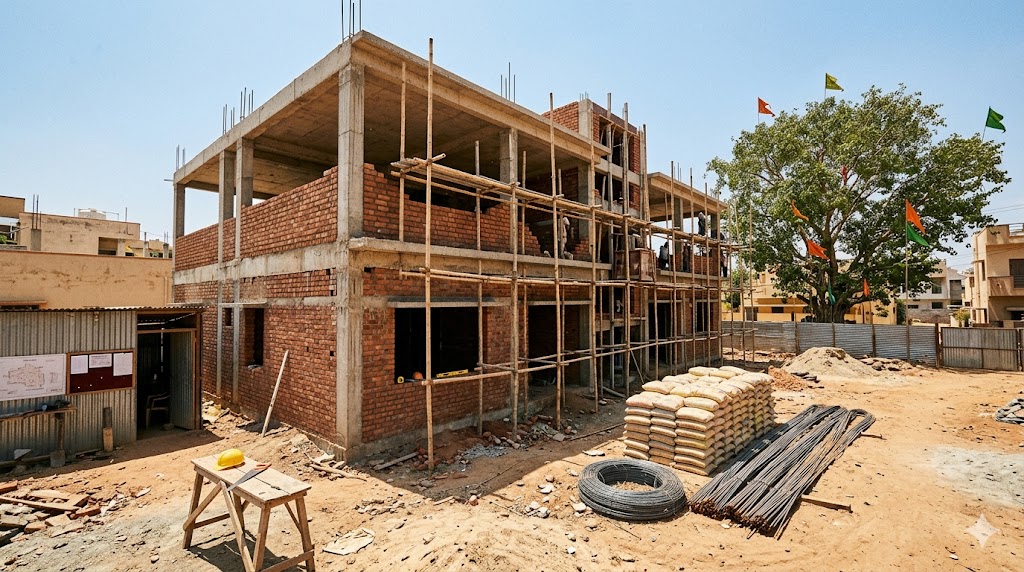
Every Indian residential construction contract is a document that pretends to know things that cannot be known when it is signed. The marble vein has not been quarried yet. The soil under the third column footing has not been seen yet. The price of cement has not been printed yet. The labour migration patterns of the next monsoon have not been observed yet. The contract is signed in March; the unknowns become known progressively across the next eighteen months, each one demanding a financial answer that the contract must produce without re-opening the negotiation.
The architectural-financial machinery that supplies those answers — contingency, provisional sums, prime-cost items, dayworks, the change-order mechanism, and the underlying risk-allocation matrix — is the most under-taught component of architectural education and the most consequential operational lever in residential project management. A project executed on a contract with the right contingencies and the right provisional-sum framework is a project that closes within ±5% of the contract value. A project executed on a lump-sum contract without these mechanisms is a project that closes 25–60% over budget, with disputes, with relationship damage, and frequently with litigation.
This guide is the working reference for that machinery. It is intended for the practising Indian architect or project manager who has to draft, review, or operate residential construction contracts in 2026 — whether under CPWD General Conditions of Contract, FIDIC, NITI Aayog Model EPC, or the bespoke item-rate contracts that dominate the Indian residential private market. The treatment is contractual and operational; it is not legal advice, and the §15 disclaimer remains in force. Architects must engage qualified construction-law counsel for project-specific drafting.
The companion Project Failure Causal Map guide treats the failure modes that the mechanisms described here are designed to prevent. The Architect's Scope of Services guide locates the contract-administration function within the COA seven-stage framework. This guide takes the contract as the primary instrument of risk transfer and walks through how it works.
"The function of a contract is not to define the relationship between the parties; it is to define what they will do when the relationship breaks down." — Lord Denning (1899–1999), Master of the Rolls, in dictum frequently cited in English construction-law jurisprudence
1. The Foundational Distinction — Contingency versus Provisional Sum
The two terms are routinely conflated in Indian residential practice, and the confusion is responsible for a large fraction of contract disputes. The distinction is fundamental and operational.
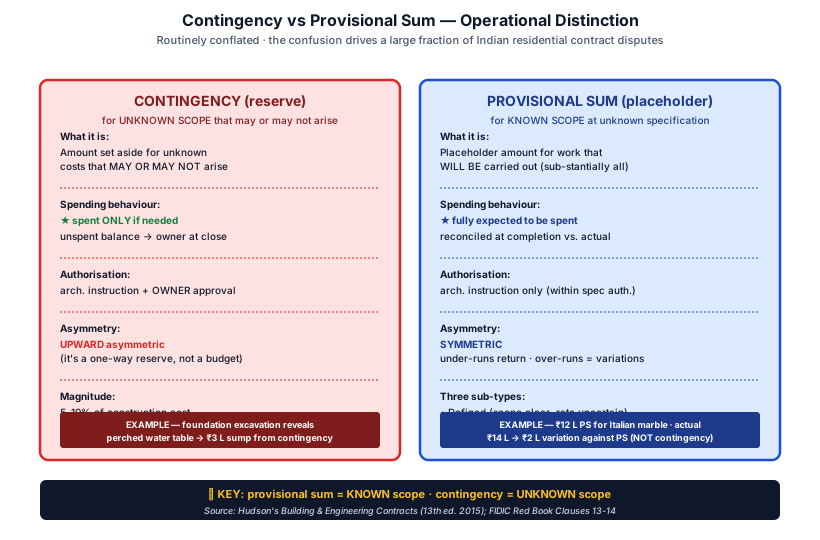
A contingency is a reserve sum — an amount of money set aside to cover unknown costs that may or may not arise. The contingency is spent only if needed; if no triggering event occurs, the contingency is returned to the owner at project close. Contingencies are not a budget for the contractor or designer; they are a reserve held by the owner (or the agreed agent of the owner) and released only against documented justification.
A provisional sum is a placeholder amount — an amount of money included in the contract for an item of work that will be carried out but that cannot be priced precisely at tender stage. The provisional sum is fully expected to be spent (or substantially all of it); the actual spend is reconciled at completion through measurement, market rates, and the contract's variation mechanism. Provisional sums are not reserves — they are substitute pricing for known scope at unknown specification.
The distinction is operational because the two have different contractual handling. A contingency requires the architect's instruction and the owner's approval to be drawn on. A provisional sum requires only the architect's instruction (in line with the contract's specification authority) to be consumed against actual delivered scope. The contingency is upward asymmetric; the provisional sum is symmetric (under-runs return to the owner; over-runs trigger variations).
A practical illustration. Suppose the contract has a ₹12 lakh provisional sum for "imported Italian marble — Statuario, 18 mm, polished, butt-jointed, including all sub-trades" and a ₹15 lakh owner's contingency. At slab selection, the actual marble cost comes to ₹14 lakh. The variation between ₹12 lakh and ₹14 lakh is paid as a variation against the provisional sum — the contingency is not touched. Two months later, the foundation excavation reveals a perched water table requiring a sump and dewatering not anticipated in the original soil report. The ₹3 lakh sump-and-dewatering cost is paid from the contingency, against the architect's instruction and the owner's approval. The provisional sum was for known scope at unknown specification; the contingency was for unknown scope.
"A provisional sum which is not a reserve is a contradiction in terms; a reserve which is not a provisional sum is a misunderstanding." — Construction-law commentary, Hudson's Building and Engineering Contracts (13th ed., 2015)
2. The Four Contingency Types
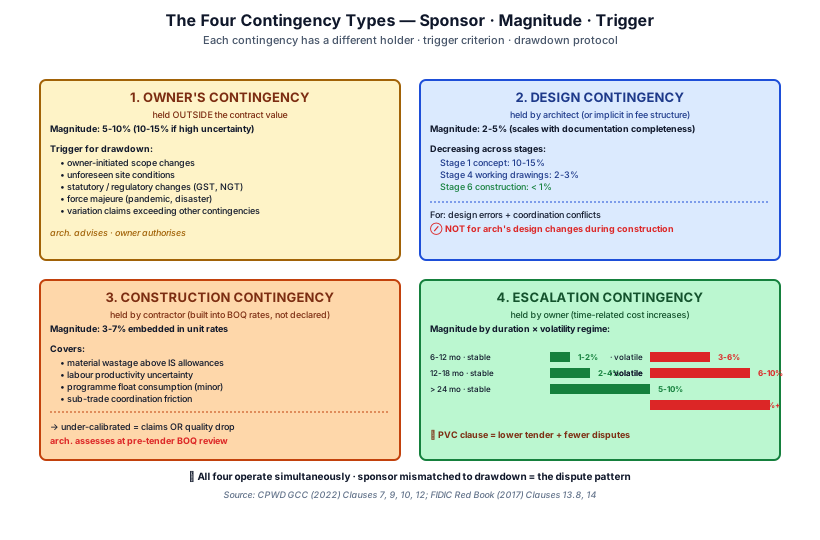
Indian residential contracts that operate the contingency mechanism well distinguish four contingency types, each with a different sponsor, magnitude band, and trigger criterion.
Owner's Contingency
The owner's contingency is a reserve held outside the contract value — that is, it is in the owner's project budget but is not part of the contractor's tender or the architect's fee. Magnitude is typically 5–10% of construction cost for a well-prepared residential project, scaling up to 10–15% for projects with significant design or site uncertainty.
The owner's contingency is drawn on for:
- Scope changes initiated by the owner — programme additions, finish upgrades, layout changes
- Unforeseen site conditions — soil, water table, structural surprises in alterations
- Statutory or regulatory changes — GST adjustments, NGT orders, BBMP-level zoning amendments
- Force majeure — pandemic disruption, natural disasters
- Settlement of legitimate variation claims that exceed any contractor or design contingency
The owner's contingency is the owner's discretionary reserve; the architect advises but does not authorise without owner consent.
Design Contingency
The design contingency is held by the architect (or implicit in the architect's fee structure) and is drawn on for design-side errors and omissions that produce cost or schedule consequences during construction. Magnitude is typically 2–5% of construction cost for a well-developed working drawing set; the magnitude scales inversely with documentation completeness.
A common pattern in Indian residential practice: at concept stage (Stage 1 of the COA Scope of Services framework) the design contingency may notionally sit at 10–15% (because so much is yet to be designed); by working drawings (Stage 4) the design contingency should be down to 2–3%; at construction stage (Stage 6) any remaining design contingency relates to detail decisions and minor coordination errors, typically under 1%. The design contingency should not be a reserve for the architect to make changes during construction — it is for errors and the resolution of unanticipated coordination conflicts.
Construction Contingency
The construction contingency is held by the contractor and is built into the priced rates of the BOQ. Magnitude is typically 3–7% of contractor-controlled costs, embedded as a wastage-and-uncertainty margin in unit rates rather than declared as a separate line item.
The construction contingency covers:
- Wastage — material wastage above the IS-code-specified allowances
- Productivity uncertainty — labour productivity below the contractor's planning assumptions
- Programme float consumption — minor delays absorbed without claim
- Sub-trade coordination friction — minor coordination losses
When the contractor's construction contingency is well-calibrated, the contractor delivers within tender; when it is under-calibrated, the contractor either underperforms on quality or makes claims against the owner. The architect's pre-tender review of the BOQ rates is the principal opportunity to assess whether the contractor has adequately self-priced the construction contingency.
Escalation Contingency
The escalation contingency is held by the owner — sometimes embedded in the owner's contingency, sometimes broken out separately — and is drawn on for time-related cost increases during the construction period.
Magnitude depends on contract duration and the price-volatility regime:
| Contract Duration | Stable Price Regime | High-Volatility Regime |
|---|---|---|
| < 6 months | 0–1% | 1–3% |
| 6–12 months | 1–2% | 3–6% |
| 12–18 months | 2–4% | 6–10% |
| 18–24 months | 3–6% | 8–14% |
| > 24 months | 5–10% | 12–20%+ |
For 2025–2026 residential projects, the price-volatility regime is moderate for most material categories (cement, steel, RMC) but high for select categories (river sand, certain timber species, imported finishes). Escalation contingencies should be tier-by-tier rather than blanket.
The escalation clause in the contract — formally called a price-variation clause or PVC — is the mechanism that operationalises the escalation contingency. CPWD GCC includes a standard escalation formula tied to wholesale price indices for cement, steel, and labour; FIDIC Sub-Clause 13.8 provides a similar mechanism with adjustment formulae. Indian residential lump-sum contracts often omit the escalation clause, transferring escalation risk entirely to the contractor — which the contractor either prices into elevated rates or, more commonly, becomes a friction point during construction. Including a documented escalation mechanism produces lower tender prices and fewer disputes.
3. The Provisional Sum Family
Provisional sums are the substitute-pricing instrument for scope that is known to be required but cannot be priced precisely at tender. Three sub-types are distinguished in mature contract drafting.
Defined Provisional Sums
A defined provisional sum has full specification clarity and is priced provisionally because the market rate or quantity is uncertain. Example: "Provisional sum of ₹8 lakh for vitrified flooring tiles, 800 × 800 mm, polished, with rectified edges, including grouting and skirting; final selection from approved sample list at the architect's instruction." The contractor knows what is required; only the brand selection and final delivered rate are awaiting confirmation.
Defined provisional sums are reconciled at completion by open-book invoicing — the contractor produces the supplier's invoices, applies the agreed mark-up (often 8–15% for material PCs in residential work), and the difference between the provisional sum and the actual cost flows as a variation. Disputes are minimal because the scope is fixed at tender.
Undefined Provisional Sums
An undefined provisional sum has partial specification clarity and is priced provisionally because the scope itself is partially unknown. Example: "Provisional sum of ₹4 lakh for landscape works including planting, paving, and irrigation, scope to be developed by the landscape consultant during construction." The contractor knows roughly the value at risk, but the actual deliverables will be defined later.
Undefined provisional sums require more careful contractual handling — the contract must specify how the scope will be developed, who has the authority to develop it, what the contractor's cost reimbursement basis is (cost-plus, schedule of rates, separate tender), and how the contractor's profit and overhead apply. In practice, undefined provisional sums are best converted to separate tender packages once the scope is defined, rather than absorbed into the main contract.
Prime Cost (PC) Sums
Prime cost sums are a sub-category of defined provisional sums used specifically for materials supplied by nominated suppliers — typically high-value finish items where the owner has selection authority. The PC sum is the cost of supply only; the contractor adds a percentage for fixing, handling, and overhead. Example: "Prime cost sum of ₹15 lakh for sanitaryware, supply only, from nominated supplier; contractor to add 12% for fixing, plumbing connection, and overhead."
The PC sum mechanism is widely used in Indian residential practice for marble, sanitaryware, kitchen modular, electrical fittings, light fixtures, and specialist hardware. Its advantage is that it allows the owner to retain selection authority over high-value items without delegating procurement to the contractor.
Daywork Allowances
Dayworks are time-and-material billing for incidental works that cannot be priced in advance. The contract specifies daywork rates per hour for skilled and unskilled labour, plus material at cost-plus, plus equipment hire at scheduled rates. Dayworks are typically used for minor variations, opening-up work (investigative excavation, demolition probes), and items that arise during construction without a clear unit-rate fit.
Daywork allowances should be capped in the contract — typically at 1–2% of contract value — and require the architect's pre-authorisation per instance. Uncapped daywork allowances are an open invitation to contract erosion.
4. The Indian Contract Framework Landscape
Indian residential construction contracts in 2026 operate in five distinct contractual frameworks. The architect must know which framework the project sits in and adapt the contingency-and-provisional-sum architecture accordingly.
CPWD General Conditions of Contract (GCC)
The Central Public Works Department GCC is the de-facto Indian construction-contract reference for public-sector and many private-sector projects. The current edition (2022, with amendments) is the most-used Indian GCC for residential and commercial work above ~₹2 crore.
Key clauses for the contingency-and-provisional-sum architecture:
- Clause 7 — Variations. Defines the architect's authority to instruct variations; specifies cost-rate methodologies for varied work
- Clause 9 — Provisional Sums. Distinguishes prime cost from provisional sums; specifies reconciliation at completion
- Clause 10 — Dayworks. Specifies daywork rates and authorisation procedure
- Clause 12 — Price Adjustment. The escalation formula based on wholesale price indices
- Clause 14 — Risk Allocation. Lists the residual risks, force majeure, and the owner-versus-contractor risk split
- Clause 17 — Insurance. Mandates CAR (Contractor's All Risks) and Workmen's Compensation insurance
CPWD GCC is well-developed for the contingency-and-provisional-sum architecture; its use in residential contracts is generally the high-end alternative to the bespoke item-rate contracts that dominate the smaller-residential market.
FIDIC Red Book (Construction Contracts)
The International Federation of Consulting Engineers (FIDIC) Red Book — Conditions of Contract for Construction — is the global reference for construction contracts where the employer provides the design (i.e. the architect's design role is upstream of the contractor). The 1999 edition is widely used in India; the 2017 second edition is the current FIDIC standard, with India-specific local-law adaptations frequently required.
FIDIC Red Book is the rigorous framework for high-value or international-financed Indian residential projects. Its provisional-sum and variation clauses (Clauses 13, 14) are widely cited as the gold standard. For residential projects under ~₹10 crore, FIDIC is typically over-engineered; for higher-value or institutional-client projects (luxury custom homes, family-trust projects, builder villa projects), FIDIC adoption is appropriate.
NITI Aayog Model EPC Contract
NITI Aayog's Model EPC (Engineering, Procurement, and Construction) Contract is the Indian-specific model for design-build and EPC residential and commercial projects. It is structured for single-point accountability — the contractor is responsible for both design and construction — and the contingency architecture differs from a traditional design-bid-build:
- Design contingency is held entirely by the contractor (no architect's contingency)
- Construction contingency is built into the contractor's lump-sum price
- Owner's contingency covers scope additions and unforeseen site conditions only
- Provisional sums are typically minimised — the EPC model prefers fully-specified deliverables
EPC is increasingly used in Indian residential developer projects (group housing, integrated townships) but remains uncommon in single-residence custom work.
Karnataka PWD / State PWD Schedule of Rates
State Public Works Department contracts (Karnataka, Tamil Nadu, Maharashtra, etc.) operate on schedule-of-rates pricing, where the contractor's rates are fixed in advance against a published rate schedule and only quantities vary. The contingency-and-provisional-sum architecture is largely absent from SoR contracts; risk is allocated by the rate-schedule structure itself, with quantity variations handled by re-measurement.
SoR contracts are not appropriate for high-finish residential work because the fixed rates do not reflect the bespoke specification. They remain common for civil-works packages within larger residential projects (basement, structural shell).
Bespoke Item-Rate Contracts
The most common Indian residential contract — used by 80%+ of projects under ~₹3 crore — is a bespoke item-rate contract drafted by the architect or the contractor's commercial team. These contracts vary widely in quality. The well-drafted ones include the contingency-and-provisional-sum architecture; the poorly-drafted ones do not, and produce most of the disputes that fill the residential construction-law caseload.
The Studio Matrx Contract Template and Contract Clause Checklist utilities provide templated language and a 16-section, 98-clause review framework for bespoke residential item-rate contracts.
5. The Risk-Allocation Matrix
Risk allocation is the underlying logic of all contingency-and-provisional-sum decisions. The fundamental principle, articulated in the Abrahamson Principles (Max Abrahamson, English construction-law authority, 1973) and codified in modern construction-contract drafting, is:
Each risk should be allocated to the party best positioned to manage it.
The party best positioned is typically the party with the information, the control, and the capacity to mitigate the risk. Allocating risk to a party that cannot manage it produces either (a) a high contingency price, transferred to the owner anyway, or (b) a dispute when the risk eventuates.
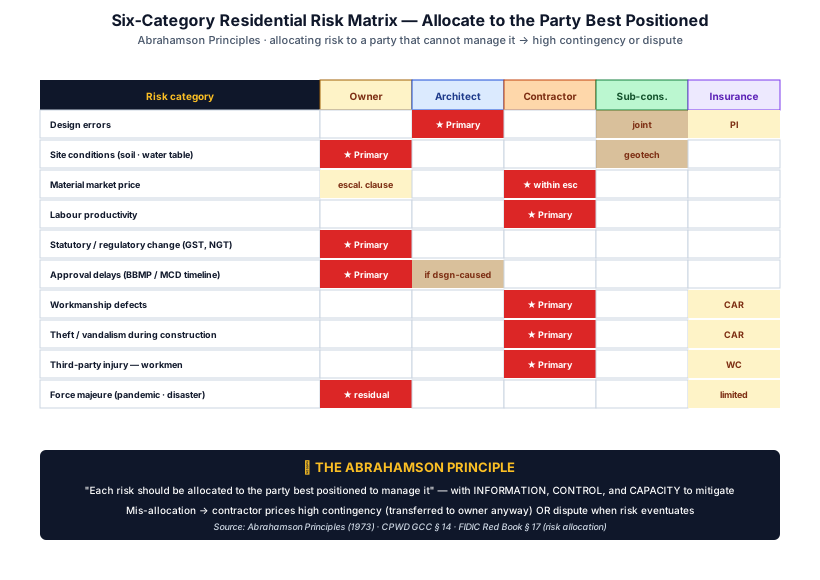
The Six-Category Residential Risk Matrix
| Risk Category | Owner | Architect | Contractor | Sub-Consultants | Insurance |
|---|---|---|---|---|---|
| Design errors | — | Primary | — | Joint (structural, MEP) | PI |
| Site conditions (soil, water table) | Primary (with soil report) | — | — | Geotechnical | — |
| Material market price | Escalation clause | — | Primary (within escalation) | — | — |
| Material availability | — | — | Primary | — | — |
| Labour productivity | — | — | Primary | — | — |
| Labour market disruption | Joint | — | Joint | — | — |
| Statutory / regulatory change | Primary | — | — | — | — |
| GST changes | Primary | — | — | — | — |
| Approval delays | Primary | Joint (when caused by design) | — | — | — |
| Court orders (NGT, BBMP) | Primary | — | — | — | — |
| Workmanship defects | — | — | Primary | — | CAR (during construction); contractor's defects-liability post-construction |
| Force majeure | Primary (residual) | — | — | — | Limited |
| Theft, vandalism (during construction) | — | — | Primary | — | CAR |
| Third-party injury (workmen) | — | — | Primary | — | Workmen's Compensation |
| Third-party injury (public) | Joint | — | Joint | — | Public Liability |
| Architect's professional negligence | — | Primary | — | — | PI |
This matrix is the structural backbone of any well-drafted Indian residential contract. The contractor's tender includes the construction contingency calibrated against the risks allocated to the contractor; the owner's contingency is calibrated against the risks remaining with the owner. Disputes typically arise when the contract is silent on a risk category and both parties believed the other had it.
The detailed treatment of the insurance interface — CAR (Contractor's All Risks), EAR (Erection All Risks), PI (Professional Indemnity), Workmen's Compensation — is in §10 of the Project Failure Causal Map guide. This guide treats insurance as the transfer mechanism for residual quantifiable risks not allocated to a party with capacity to bear them.
6. Eight Indian-Specific Risk Categories
The general risk categories above are common to construction worldwide. Eight categories are unusually significant in the Indian residential context and warrant specific contractual treatment.
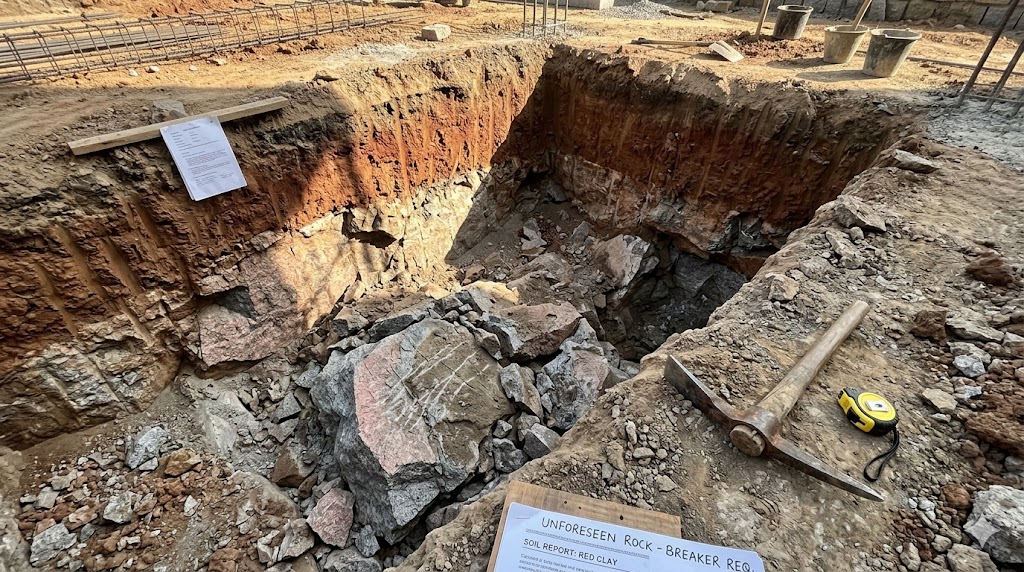
Risk 1 — GST Rate Changes
GST rates on construction materials and services have changed multiple times since the regime was introduced in 2017. A long-duration project (12+ months) is at material risk of a GST adjustment during the contract period. The contractual response is a GST change clause — typically: "Any change in the rate of Goods and Services Tax during the contract period shall be paid or credited by the Owner; the Contractor shall not absorb GST changes in its rates." This is owner-allocated risk because the owner cannot transfer it to anyone.
Risk 2 — River Sand Availability
River sand availability has been disrupted by NGT and state-level mining bans for over a decade. Manufactured sand (M-sand) is the substitute, but specifications, prices, and acceptance vary by state. The contractual response is a sand specification clause that explicitly permits substitution between river sand and M-sand at the architect's instruction with rate-adjustment per the SoR.
Risk 3 — Skilled-Labour Migration
Indian skilled labour (carpenters, electricians, tile-layers, marble-fitters) is highly mobile across states. A project signed in March may have its skilled-labour pool absent in November because of festivals, monsoon return migration, or competing project recruitment. The contractual response is no special clause — labour productivity risk is contractor-allocated under standard contracts — but the architect's programme buffer must anticipate the seasonal cycle and the contractor's tender rate must include a defensible labour-availability margin.
Risk 4 — Monsoon Programme Disruption
The monsoon shuts down most external work and significantly affects internal work (humidity, drying, RH-sensitive applications) for two to four months across most of India. The contractual response is a programme adjustment clause that recognises monsoon as an excusable delay (no liquidated damages) but does not entitle the contractor to additional payment. Time-related cost (preliminaries, plant on-site) is typically owner-borne for additional monsoon delay beyond the programme allowance, and contractor-borne for the programmed monsoon period itself.
Risk 5 — RERA Compliance and Statutory Change
The Real Estate (Regulation and Development) Act, 2016 (RERA) imposes timelines and compliance obligations on projects within its scope (typically 500+ sqm or 8+ units). Owner-developer contracts in residential development projects must include RERA compliance allocation — which party bears the cost of compliance, registration, and disclosure. For single-residence custom homes, RERA does not apply, but architects working on multi-unit projects must reflect RERA risk in the contract.
Risk 6 — Approval Timeline Risk
Building plan approval, environmental clearance, and OC issuance are subject to statutory and administrative timelines that frequently slip. The contractual response is a statutory delay clause that excuses delays attributable to the relevant authority but allocates the time-related cost to the owner (preliminaries, plant on-site, escalation) — provided the architect has filed completely and on time. The detailed treatment of the OC/CC/plinth verification process is in the OC/CC/Plinth Verification guide.
Risk 7 — Court Orders
NGT orders (sand mining, construction during pollution-elevated days), BBMP / municipal orders (zoning, FAR), and state High Court interventions can pause projects with little notice. The contractual response is a force majeure clause expanded to cover regulatory and judicial interventions. The 2017 Supreme Court order pausing construction in Delhi-NCR during severe-pollution episodes is the canonical example of court-ordered construction halt.
Risk 8 — Third-Party Property Damage
Indian residential construction frequently involves party walls, adjacent buildings, and common compound walls. Damage to these during excavation, scaffolding, or piling is a recurring risk. The contractual response is a site-care clause that allocates damage to neighbours' property to the contractor (with CAR insurance backing) and a pre-construction condition survey (joint inspection of adjacent property) that establishes the baseline.
The Studio Matrx Risk Index utility produces a project-specific risk register against these eight Indian-specific categories plus the general matrix.
7. The Change Order (Variation) Discipline
The change order is the contractual mechanism by which all contingency-and-provisional-sum decisions are operationalised during construction. A discipline-of-execution at the change-order level distinguishes well-managed projects from dispute-prone ones.
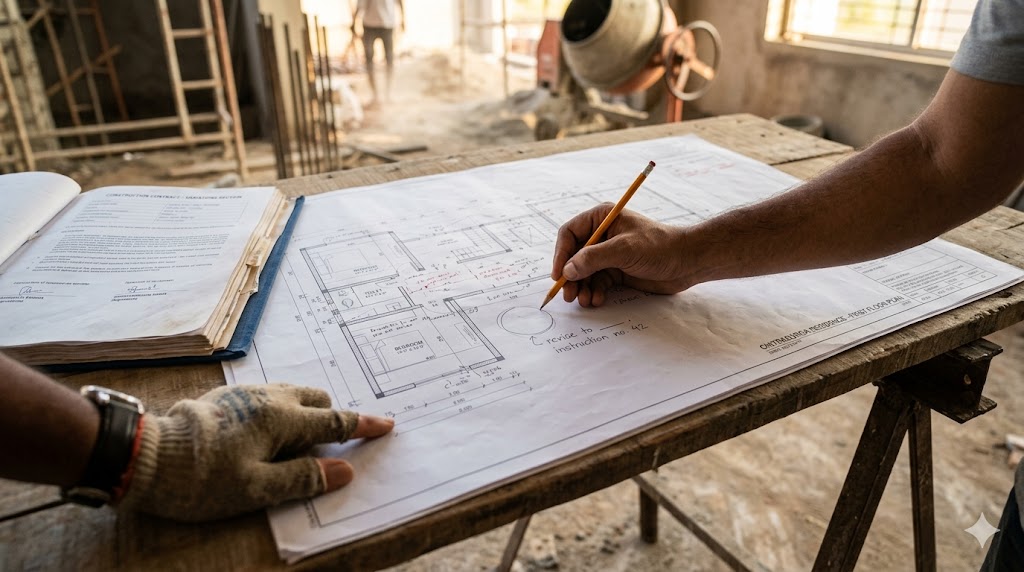
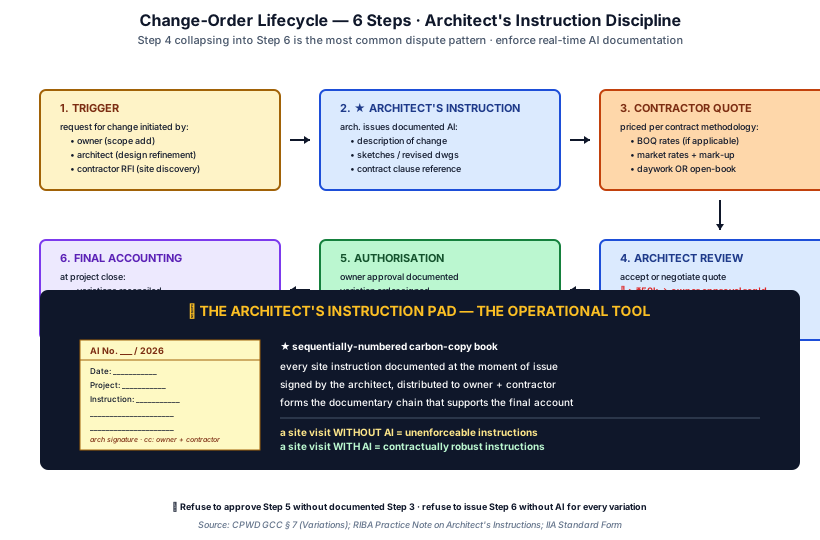
The Change Order Lifecycle
A complete change order proceeds through six steps:
1. Trigger — a request for change is initiated by the owner, identified by the architect, or surfaced by the contractor (RFI — Request for Information)
2. Architect's instruction (AI) — the architect issues a documented instruction describing the change, with sketches or revised drawings as required, and references the contract clause under which the variation operates
3. Contractor's quotation — the contractor prices the variation per the contract's variation methodology (BOQ rates if available, market rates with mark-up, daywork rates, or open-book costing)
4. Architect's review — the architect reviews the quotation against the contract's variation methodology and either accepts or negotiates; for variations above a threshold (typically ₹50,000 in residential work) the owner's approval is also required
5. Authorisation — the owner's approval is documented (variation order, signed by owner); contractor proceeds with the work
6. Final accounting — at project close, all variations are reconciled in the final account; provisional sums are matched to actual cost; contingency draws are listed; the final certificate is issued
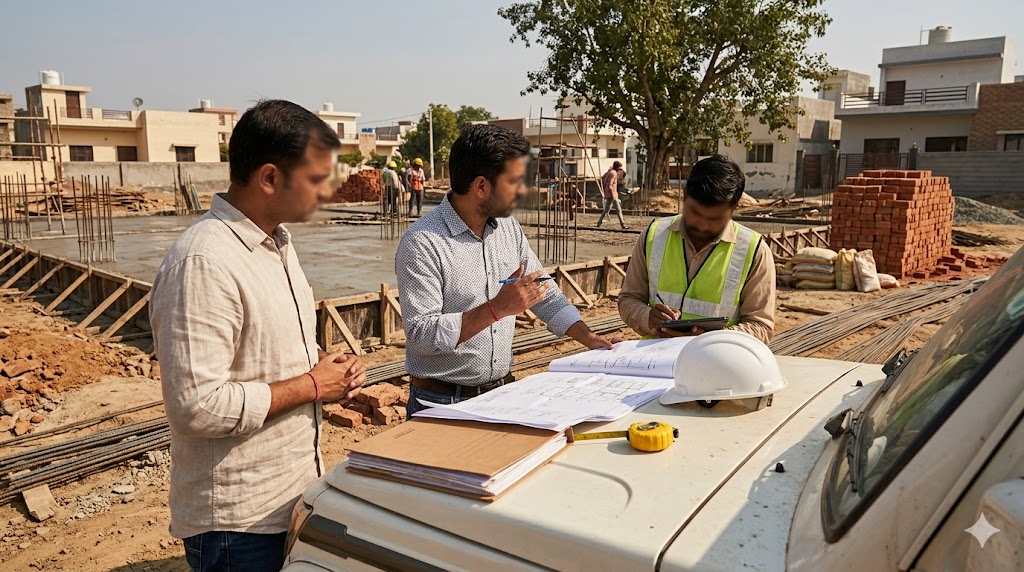
The discipline failure most common in Indian residential practice is step 4 collapsing into step 6 — the contractor proceeds with verbal or informal instruction, costs accumulate, and at project close the owner is presented with a six-figure variation total without prior approval. The architect's role is to enforce step 2 and step 3 in real-time and to refuse to approve step 5 without documented step 3.
The Architect's Instruction Pad
The single most useful operational tool in Indian residential contract administration is the architect's instruction (AI) pad — a sequentially-numbered carbon-copy book in which every site instruction is documented at the moment of issue. AIs are signed by the architect, distributed to owner and contractor, and form the documentary chain that supports the final account. A site visit without AI documentation is a site visit that has produced unenforceable instructions; a site visit with AI documentation is a site visit that has produced contractually robust instructions.
The Studio Matrx Site Inspection utility includes an AI-generation template integrated with the inspection log.
8. The Working Contract Architecture for Indian Residential Practice
The discussion so far has been at the level of principle. The operational synthesis — the working contract architecture an architect should aim to deploy on a typical Indian residential project — has six elements.

Element 1 — The Contract Type
Default to lump-sum item-rate for residential projects under ~₹5 crore. Lump-sum item-rate combines the cost certainty of lump-sum (the contractor commits to a total) with the variation flexibility of item-rate (priced per BOQ item, allowing precise variation pricing). Schedule-of-rates is appropriate for civil shell only; cost-plus is appropriate only when the design is genuinely incomplete at contract award; EPC is appropriate for design-build with single-point accountability.
Element 2 — The BOQ Discipline
The BOQ should be complete to the working drawing level at contract award — every architectural, structural, MEP, and finishes item priced against measurable quantity. The BOQ rates should be the basis for variation pricing throughout the project. A BOQ that is thin at tender produces an item-rate contract that operates in practice as a cost-plus-with-disputes contract.
Element 3 — The Provisional Sum Allocation
A typical Indian residential project's provisional sums and PC sums account for 15–30% of contract value — covering finishes, sanitaryware, kitchen, electrical fittings, lighting, modular furniture, and specialist work. The architect's discipline is to:
- Specify each provisional sum tightly (defined PS preferred over undefined)
- Capped the contractor's mark-up (typically 8–15% for material PCs)
- Schedule the PS-resolution timeline (selection deadlines so the contractor's programme is not held up)
- Reconcile at completion against documented invoices
Element 4 — The Contingency Architecture
Recommended residential contingency stack:
| Contingency Type | Magnitude | Holder | Drawn against |
|---|---|---|---|
| Owner's contingency | 8% of contract value | Owner | Owner-instructed scope, unforeseen site, statutory change |
| Design contingency | 2% of contract value | Owner (sometimes architect) | Design errors, working drawing omissions |
| Construction contingency | (built into contractor rates) | Contractor | Wastage, productivity, minor coordination |
| Escalation contingency | 0–3% (12-month project) or escalation clause | Owner | Material price changes |
Element 5 — The Insurance Stack
Residential contracts must mandate, at contract signing:
- CAR (Contractor's All Risks) insurance — covering material and works damage, theft, fire, and accidental damage during the contract period; sum insured at contract value plus 10% for site materials
- Workmen's Compensation insurance — mandatory under the Workmen's Compensation Act, 1923 (now Employees' Compensation Act); covers labour injuries on site
- Public Liability insurance — third-party injury and property damage; sum insured ₹10–25 lakh for residential
- Architect's Professional Indemnity (PI) insurance — held by the architect; minimum ₹50 lakh sum insured for projects under ₹5 crore, scaling up
The detailed insurance treatment is in §10 of the Project Failure Causal Map guide.
Element 6 — The Dispute Resolution Pathway
The contract should specify a staged dispute-resolution mechanism: (a) negotiated settlement within 30 days; (b) mediation by a neutral expert within 60 days; (c) arbitration under the Arbitration and Conciliation Act, 1996 (as amended) within 180 days; (d) court action only as final escalation. A staged mechanism converts most disputes to negotiation; an unstaged mechanism converts most disputes to litigation.
9. Model Clause Language for Residential Contracts
The following model clauses are templated language the architect can adapt for Indian residential lump-sum item-rate contracts. They are not legal advice; project-specific clauses must be reviewed by qualified counsel.
Model Clause — Provisional Sums
"Provisional sums included in the Bill of Quantities represent allowances for items of work that will be executed under the Contract but for which the precise specification, quantity, or supplier has not been fixed at the time of tender. Each provisional sum shall be reconciled at the time of execution by the Architect's Instruction, supported by the Contractor's quotation in line with Clause [X] (Variations). The Contractor's mark-up on Prime Cost provisional sums for materials shall not exceed [12%] for handling, fixing, and overhead. At completion, the difference between the provisional sum and the actual cost incurred (or, in the case of PC sums, the supply cost plus the agreed mark-up) shall be added to or deducted from the Contract Value as a Variation."
Model Clause — Owner's Contingency
"The Owner shall maintain a Contingency Reserve of [eight percent (8%)] of the Contract Value, held outside the Contract Value, drawable only against documented Architect's Instructions for: (a) Owner-initiated scope changes; (b) unforeseen site conditions not reasonably ascertainable from the soil report and pre-construction surveys; (c) statutory or regulatory changes during the contract period; (d) force majeure events; (e) settlement of legitimate variation claims that exceed any other contingency. The Owner's prior written approval shall be required for each draw on the Contingency Reserve. Unspent Contingency Reserve at project close shall be retained by the Owner."
Model Clause — Price Adjustment (Escalation)
"For the period of the Contract exceeding twelve (12) months from the date of contract award, the Contract Value shall be adjusted for changes in the wholesale price index of cement, steel, and labour as published by the Office of the Economic Adviser, Department for Promotion of Industry and Internal Trade, Government of India. The adjustment shall be calculated quarterly per the formula in Schedule [X], with the base index taken at the date of contract award. The Owner shall maintain an Escalation Reserve of [three percent (3%)] of the Contract Value to absorb the adjustments."
Model Clause — Statutory Change
"Any change in the rate of Goods and Services Tax, cess, or any other statutory levy applicable to the goods, services, or works of the Contract during the contract period shall be paid or credited by the Owner. The Contractor shall not be required to absorb such changes in the agreed rates. The Architect shall certify the adjustment based on the change-effective date and the residual contract scope."
Model Clause — Variations
"The Architect may, at any time during the contract period, instruct Variations in the Works. Each Variation shall be priced as follows, in descending order of preference: (a) at the rates and prices in the Bill of Quantities, where the varied Work is of a like character and conditions to that priced; (b) at rates derived from the Bill of Quantities by adjustment for differing character or conditions; (c) at fair market rates supported by quotations and documented by the Contractor; (d) at Daywork rates as set out in the Daywork Schedule. No Variation exceeding [INR fifty thousand (₹50,000)] shall be valued for payment without the Owner's prior written approval. Variations exceeding ten percent (10%) of the original Contract Value shall trigger a review of the Contract programme."
Model Clause — Force Majeure
"Neither the Contractor nor the Owner shall be liable for any default or delay in performance of the Contract caused by an event of Force Majeure, defined as any event beyond the reasonable control of the affected party, including but not limited to: (a) acts of God, natural disasters, severe weather; (b) war, civil disturbance, terrorism; (c) epidemic or pandemic; (d) governmental or judicial orders directly preventing the Works (including but not limited to NGT orders, court-ordered construction halts, and state-level construction restrictions); (e) failure or unavailability of public utilities. The affected party shall give written notice within seven (7) days of the event. The Contract programme shall be extended by the duration of the Force Majeure event; time-related costs during the extension shall be allocated per Clause [X] (Risk Allocation)."
These model clauses are starting points only. The Studio Matrx Contract Template utility generates a complete contract draft incorporating the above clauses, project-specific parameters, and the Contract Clause Checklist review framework. The Quote Comparison and Cost Calculator utilities support pre-tender pricing analysis.
10. Common Failure Modes and Recoveries
Even well-drafted contracts fail in execution. Six recurring failure modes and their recoveries:
Failure Mode 1 — The Verbal Variation
The contractor executes work on the architect's verbal instruction, without an AI; at the next bill, the work is priced as a variation. Recovery: institute the AI pad discipline (§7); treat verbal instructions as advisory only; ensure every site visit produces documented instructions or no instructions.
Failure Mode 2 — The PC Sum Run-Up
The contractor selects a high-end supplier for a PC item without owner consent, presents the higher invoice, and claims the variation. Recovery: contract clause requiring owner approval of the supplier shortlist before quotation; architect's specification of acceptable suppliers in the BOQ.
Failure Mode 3 — The Programme Slip Cascade
A delay in one trade cascades through the programme; the contractor claims time-related costs (preliminaries, escalation) for the extended period. Recovery: concurrent delay analysis — the architect must establish whether the delay was contractor-caused (no recovery), owner-caused (full recovery), or concurrent (typically pro-rata recovery).
Failure Mode 4 — The Spec-Drift Variation
The architect issues design refinements during construction that the contractor prices as variations; the cumulative spec-drift exceeds the design contingency. Recovery: lock the working-drawing scope at Stage 4 sign-off; treat post-Stage-4 design refinements as owner-initiated changes only, with explicit owner approval.
Failure Mode 5 — The Provisional Sum Black Hole
An undefined provisional sum (e.g. landscape, art lighting, smart-home wiring) expands during construction without scope discipline; final cost is double the provisional sum. Recovery: convert undefined PS to separate tender packages once scope is defined, rather than absorbed into the main contract; cap undefined PS contributions at 110% of the original sum without renewed owner approval.
Failure Mode 6 — The Dispute-at-Final-Account
The owner, contractor, and architect arrive at project close with substantially different views of the final account. Recovery: maintain a running final account — updated monthly — that all three parties endorse; resolve disputes at the monthly checkpoint, not at completion.
The detailed pattern analysis is in §6 of the Project Failure Causal Map guide.
11. References and Further Reading
Indian Statutory and Regulatory
- The Indian Contract Act, 1872. Government of India.
- The Specific Relief Act, 1963 (as amended 2018). Government of India.
- The Sale of Goods Act, 1930. Government of India.
- The Limitation Act, 1963. Government of India.
- The Arbitration and Conciliation Act, 1996 (as amended 2015, 2019, 2021). Government of India.
- The Real Estate (Regulation and Development) Act, 2016 (RERA). Government of India.
- The Building and Other Construction Workers (Regulation of Employment and Conditions of Service) Act, 1996. Government of India.
- The Employees' Compensation Act, 1923 (formerly Workmen's Compensation Act). Government of India.
- The Goods and Services Tax (Compensation to States) Act, 2017 and CGST/SGST Acts. Government of India.
Indian Contract Frameworks
- CPWD General Conditions of Contract for Central Public Works Department Works (2022 edition, with amendments). Central Public Works Department, Government of India.
- CPWD Manual on Procurement. Central Public Works Department, Government of India.
- NITI Aayog Model EPC Contract for Civil Works. NITI Aayog, Government of India, 2014 (with revisions).
- State Public Works Department Schedule of Rates — Karnataka PWD SoR; Tamil Nadu PWD SoR; Maharashtra PWD SoR; etc.
- Indian Roads Congress (IRC) — Standard Specifications and Codes of Practice. For civil-works packages.
International Contract Frameworks
- FIDIC (1999, 2nd ed. 2017). Conditions of Contract for Construction (Red Book). International Federation of Consulting Engineers.
- FIDIC (2017). Conditions of Contract for Plant and Design-Build (Yellow Book).
- JCT (Joint Contracts Tribunal) Standard Building Contract (UK).
- AIA (American Institute of Architects) A201–2017 General Conditions of the Contract for Construction.
- NEC4 — Engineering and Construction Contract. Institution of Civil Engineers (UK).
- ISO 21500:2012 — Guidance on project management.
Construction Law and Commentary
- Atkin Chambers (2015, 13th ed.). Hudson's Building and Engineering Contracts. Sweet & Maxwell. Canonical English construction-law treatise.
- Furst, S., & Ramsey, V. (2020, 14th ed.). Keating on Construction Contracts. Sweet & Maxwell.
- Jenkins, J. (2018). International Construction Arbitration Law (3rd ed.). Wolters Kluwer.
- Bunni, N. G. (2008). The FIDIC Forms of Contract (3rd ed.). Wiley-Blackwell.
- Iyer, K. C. (2015). Construction Contracts and Disputes: A Practitioner's Guide. Lexis Nexis. Indian-context commentary.
- Singh, A. (2020). Law and Practice of Arbitration in India. Universal Law Publishing.
Construction Risk and Project Management
- Abrahamson, M. W. (1973). "Risk management." International Construction Law Review, 1(3). The "Abrahamson Principles" of risk allocation.
- Smith, N. J., Merna, T., & Jobling, P. (2014, 3rd ed.). Managing Risk in Construction Projects. Wiley-Blackwell.
- Project Management Institute (2017, 6th ed.). A Guide to the Project Management Body of Knowledge (PMBOK Guide). PMI.
- Construction Industry Council (CIDC) — India. Various publications on Indian-context construction risk and contract management.
- Indian Institute of Architects (IIA), various practice notes on contract administration.
Insurance Reference
- Insurance Regulatory and Development Authority of India (IRDAI) — Construction All Risks (CAR) policy guidelines.
- Indian Insurance Institute (III) — Construction Insurance Practice Manual.
Companion Studio Matrx Guides
- The Architect's Scope of Services in India
- Architect Fee Structures in India
- Project Failure Causal Map
- Site Supervision Checklist for Indian Architects
- OC/CC and Plinth Verification
- Working Drawings Documentation in India
Companion Studio Matrx Tools
- Contract Template — generates lump-sum item-rate residential contract drafts
- Contract Clause Checklist — 16-section, 98-clause review framework
- Risk Index — project-specific risk register against the Indian risk matrix
- Cost Calculator — pre-tender cost estimation
- Quote Comparison — multi-bid evaluation with rate-anomaly detection
- Site Inspection — site-visit log with AI-generation template
- Contractor Checklist — pre-engagement contractor evaluation
- Red Flag Checklist — pre-signature contract red-flag review
Author's Note: The contract is the architectural-financial machinery of the residential project — the instrument that converts the eighteen months of unknowns ahead into a series of priced, instructed, and reconciled answers. The architect who masters the contingency-and-provisional-sum architecture is the architect who delivers projects within ±5% of contract value rather than 25–60% over. The CPWD, FIDIC, and NITI Aayog frameworks have been refined across decades of Indian and international practice; the model clauses in §9 distill that refinement into language that can be deployed on the next residential project. The discipline is not in the drafting but in the operational use — the AI pad, the running final account, the staged dispute resolution, the documented variation chain. The architect who runs the contract this way is an architect whose projects close cleanly.
Disclaimer: This article is for informational and educational purposes only. It does not constitute legal advice. Contract drafting must be reviewed by qualified construction-law counsel. Statutory citations, contract framework references, and risk-allocation conventions reflect 2026 Indian practice but may shift with regulatory amendment, judicial interpretation, and contract-form revision. Architects must verify against current legal authority and applicable state-level rules. Studio Matrx, its authors, and contributors accept no liability for decisions based on this guide.
Export this guide
Related Guides — Deep-dive reading
Scope Boundaries — Architect, Interior Designer & Contractor
The Architects Act 1972, the IIID Code, BOCW 1996 & RERA 2016 — Stage-by-Stage Role Map, Hot Boundary Zones, Liability Matrix, and the Tri-Party Contracting Discipline for Indian Residential Practice
ConstructionUnderstanding Construction Contracts & Retainage in India
A homeowner-protective guide to the contract and payment structure behind every interiors or build project — the contract types and when each fits, how to stage payments so your money trails the work, and the retention clause that quietly protects you more than any other.
Cost & MoneyDesigning Adaptable & Universal-Design Homes
Accessibility, Aging-in-Place, and the Multi-Stage Family — Code, Anthropometrics, and Plan-Stage Discipline for Indian Residential Architects
Room PlanningRelated Tools — Try Free
Interior Contract Clause Checklist
16 sections and 98 checkboxes covering scope, BOQ, milestones, penalties, warranty, and disputes.
Contract ChecklistCircadian Light Meter
Patient-centric circadian lighting visualizer for Indian healthcare design — time-of-day × intensity → CCT, melanopic lux (EML / mEDI), melatonin suppression, and an alertness curve. Calibrated against WELL v2 L03 Circadian Lighting Design, CIE S 026:2018, Brainard 2001, and Lucas et al. 2014.
Circadian ToolModular Kitchen Budget Calculator
Live breakdown by running feet, countertop area, material tier and city — with wastage, design fee, GST.
Kitchen Calculator