
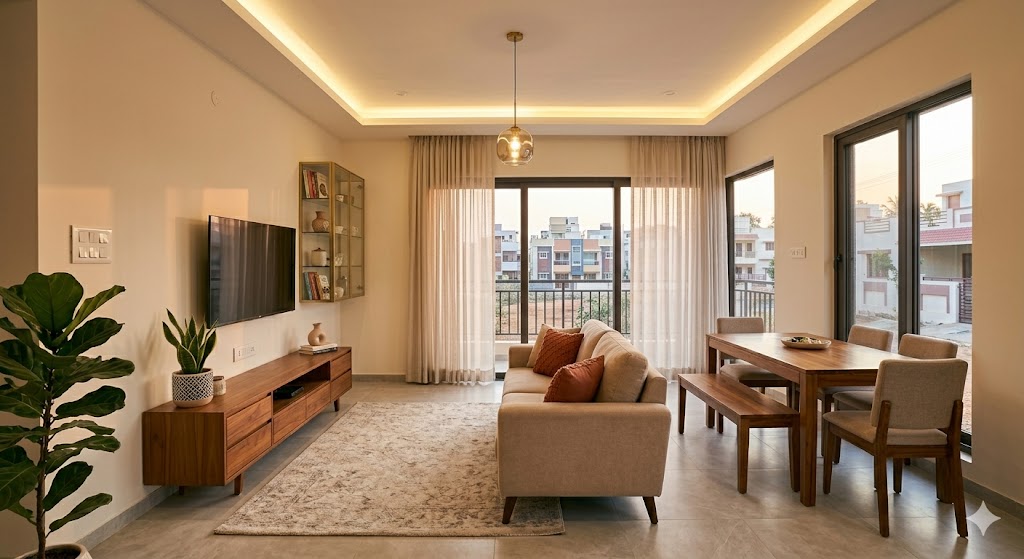
Interior Cost per Sft in India — The Homeowner's Working Reference
Spec Bands from Basic to Luxury, Room-by-Room Breakdown, Eight Cost Drivers, Renovation Premium & Eight Savings Strategies
The second most common question I receive — right after "what's construction cost per sft" — is "what's interior cost per sft?" The answer is a different framework entirely, because interior cost has a different composition (joinery + finishes + appliances), a different timeline (often re-done every 7-12 years vs construction's 30-50 year lifecycle), and a different cost driver set than construction.
This guide is the homeowner's working reference for interior fit-out cost in India 2025-26 — for new-construction interiors layered onto a fresh build, for renovating an existing house or apartment, for apartments handed over in shell-and-core or bare-shell condition, and for full interior re-dos of an occupied home.
It covers the four spec bands (basic, mid, premium, luxury), what each band actually buys across nine fit-out categories, a worked room-by-room budget for a 1,500 sft 3 BHK at mid-spec, the eight independent cost drivers, the renovation premium over new-build fit-out, eight cost optimisation strategies that don't sacrifice quality, six common interior cost mistakes, and a pre-fit-out budgeting checklist.
Interior cost is fundamentally different from construction cost. Construction is mostly labour + commodity materials (cement, steel, brick), with ±15% variation across builders. Interior is mostly joinery + finishes + appliances + decor, with ±70% variation across designers and material choices. The discipline shifts from "control structure cost" to "control finish choices" — and the eight drivers in this guide are how you do it.
For the complementary cost-cluster guides see Construction Cost in India, Hidden Costs in Interiors, Home Renovation Cost in India, Turnkey Interiors in India, and BOQ Explained for Indian Homeowners. For the broader build-and-design framework see Building a House in India and Modular Kitchen Design Guide.
The Spec Band Matrix — What Each Band Actually Buys
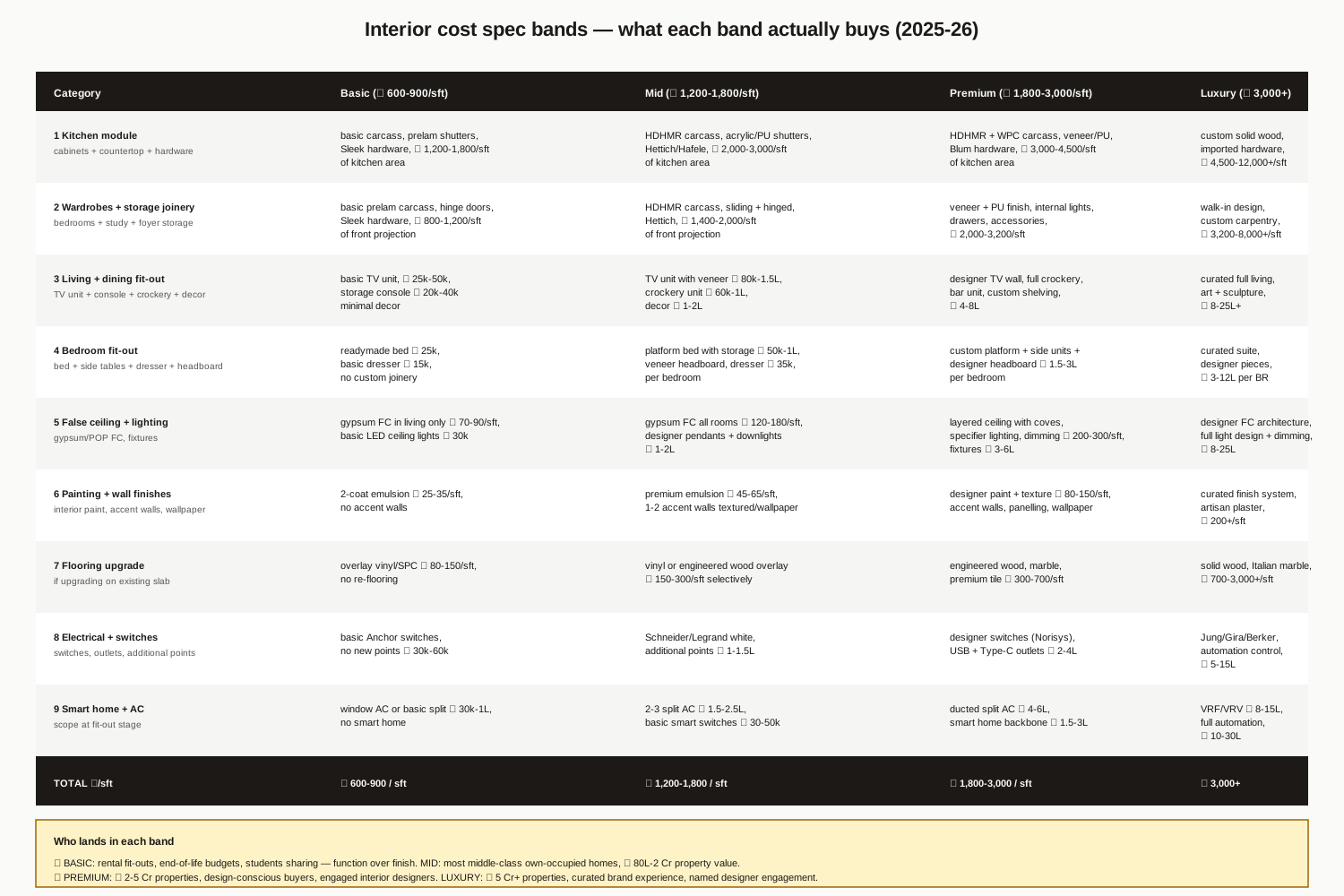
The figure above is the working interior spec-band matrix. Read it as four distinct "what you get" packages.
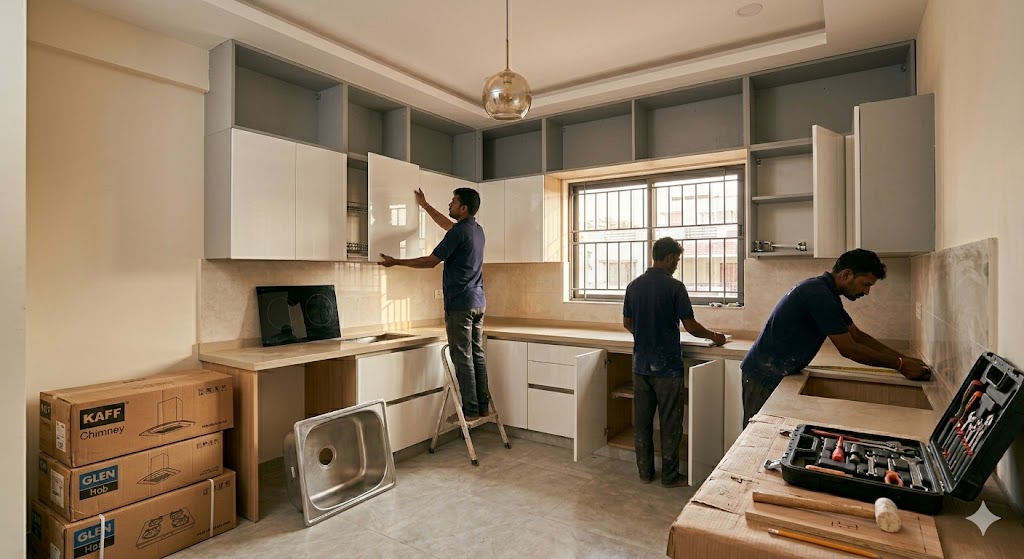
Basic — ₹ 600-900/sft
The functional-essentials build. Suitable for rentals, transitional homes, end-of-life budgets, or students sharing.
Kitchen: basic carcass, prelam shutters, Sleek hardware, ₹ 1,200-1,800/sft of kitchen area. Wardrobes: basic prelam, hinge doors, ₹ 800-1,200/sft of front projection. Living fit-out: basic TV unit ₹ 25-50k, minimal decor. False ceiling: gypsum FC in living only. Painting: 2-coat emulsion, no accents. No re-flooring. Basic Anchor switches. Window AC or basic split.
This band has its place — but most homeowners in India who land here are accepting compromise, not choosing it. If you have a 5-year+ horizon, mid-spec is almost always better total economics.
Mid — ₹ 1,200-1,800/sft
The middle-class own-occupied home — most ₹ 80 L - ₹ 2 Cr property-value homes in India.
Kitchen: HDHMR carcass, acrylic or PU shutters, Hettich/Hafele hardware, ₹ 2,000-3,000/sft of kitchen area. Wardrobes: HDHMR carcass, mixed sliding + hinged, Hettich hardware, ₹ 1,400-2,000/sft. Living: TV unit with veneer ₹ 80k-1.5L, crockery unit ₹ 60k-1L, decor ₹ 1-2L. Bedroom: platform bed with storage ₹ 50k-1L, veneer headboard, dresser ₹ 35k. False ceiling: complete gypsum FC ₹ 120-180/sft. Painting: premium emulsion ₹ 45-65/sft, 1-2 accent walls. Vinyl or engineered wood overlay flooring selectively. Schneider/Legrand switches. 2-3 split AC, basic smart switches.
For a 1,500 sft 3 BHK, this lands at ₹ 18-28 L total fit-out.
Premium — ₹ 1,800-3,000/sft
The design-conscious build — ₹ 2-5 Cr property-value homes, engaged interior designer.
Kitchen: HDHMR + WPC carcass, veneer or full PU shutters, Blum hardware, ₹ 3,000-4,500/sft. Wardrobes: veneer + PU finish, internal lights, accessory drawers, ₹ 2,000-3,200/sft. Living: designer TV wall, full crockery unit, bar shelf, custom shelving, ₹ 4-8L. Bedroom: custom platform + side units + designer headboard ₹ 1.5-3L per bedroom. Layered ceiling with coves, designer lighting + dimming ₹ 200-300/sft. Designer paint + texture ₹ 80-150/sft, accent walls + panelling. Engineered wood, marble, premium tile ₹ 300-700/sft. Designer switches (Norisys), USB + Type-C outlets ₹ 2-4L. Ducted split AC ₹ 4-6L, smart home backbone ₹ 1.5-3L.
For a 1,500 sft 3 BHK, this lands at ₹ 28-45 L total fit-out.
Luxury — ₹ 3,000-7,000+/sft
The curated-brand build — ₹ 5 Cr+ property-value homes, named designer engagement.
Kitchen: custom solid wood, imported hardware, ₹ 4,500-12,000+/sft. Wardrobes: walk-in design, custom carpentry, ₹ 3,200-8,000+/sft. Curated full living with art + sculpture ₹ 8-25L+. Bedroom suites with designer pieces ₹ 3-12L per BR. Designer FC architecture, full light design + scene control ₹ 8-25L. Curated finish system, artisan plaster ₹ 200+/sft. Solid wood or Italian marble flooring ₹ 700-3,000+/sft. Jung/Gira/Berker switches, full automation control ₹ 5-15L. VRF/VRV AC ₹ 8-15L, full automation ₹ 10-30L.
For a luxury villa at 2,500-3,500 sft, this lands at ₹ 75 L - 2 Cr+ total fit-out.
Room-by-Room — A 1,500 sft 3 BHK Mid-Spec Walk-through
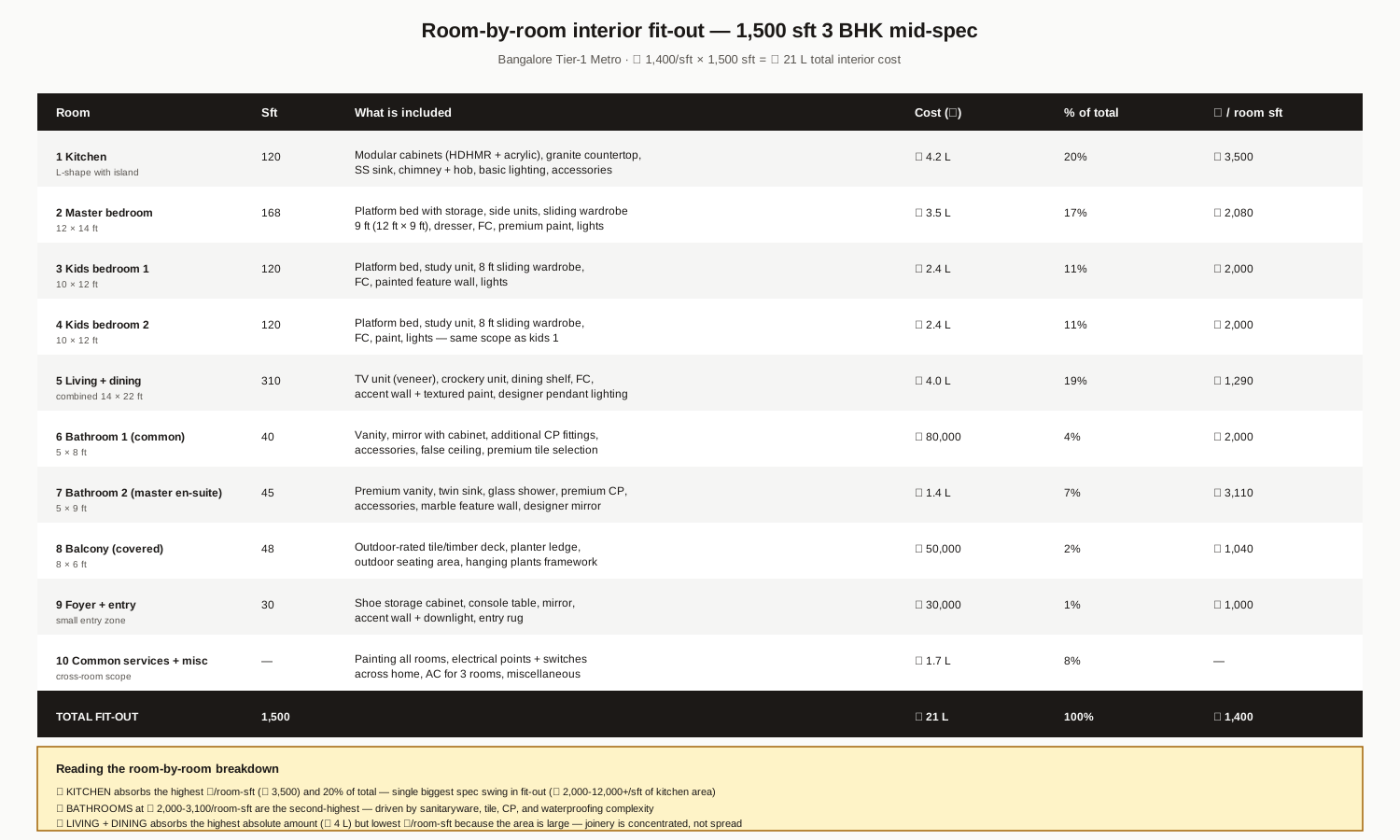
The figure above decomposes a representative ₹ 21 L Bangalore mid-spec interior into its room-by-room components. The pattern repeats predictably across most 3 BHK fit-outs.
What absorbs the budget
Kitchen at 20% — single biggest room cost. The kitchen carries the highest ₹/room-sft (₹ 3,500) because it combines: cabinets (₹ 1.8-2.5 L), countertop granite or quartz (₹ 50k-1L), chimney + hob + sink (₹ 70k-1.5L), accessories (₹ 30-50k). Kitchen is also where the spec band swings hardest — basic ₹ 1,200/sft of kitchen area vs luxury ₹ 12,000+/sft.
Living + dining at 19% — second biggest in absolute terms because the area is large (310 sft of the 1,500). But ₹/room-sft is the lowest (₹ 1,290) because joinery is concentrated (TV wall, crockery unit) rather than wall-to-wall.
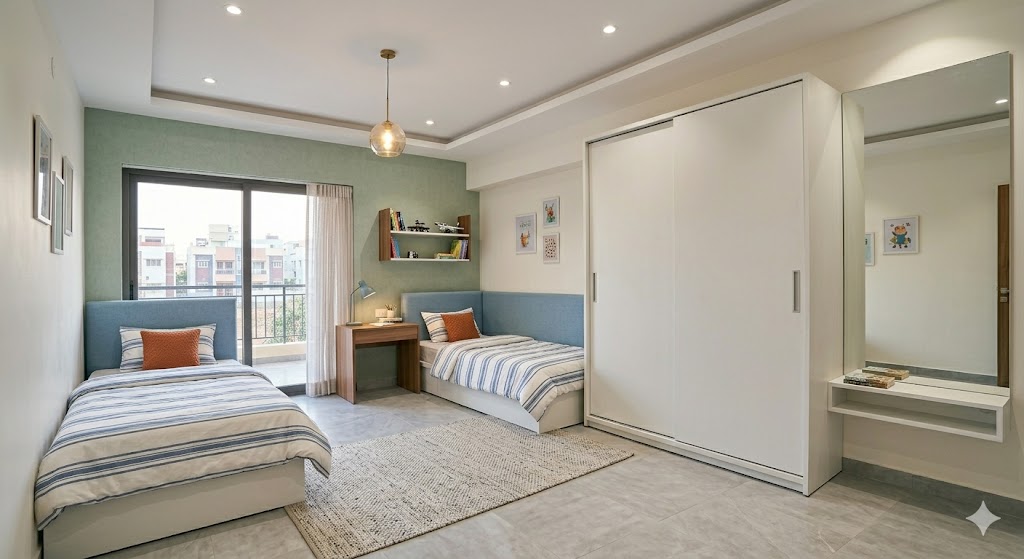
Bedrooms combined at 39% (17% master + 22% two kids) — high cumulative cost because of wardrobe surface area. The master bedroom carries ₹ 3.5 L; each kids' bedroom ₹ 2.4 L. Wardrobes are the biggest joinery line in any bedroom — typically 30-40% of the room's total fit-out cost.
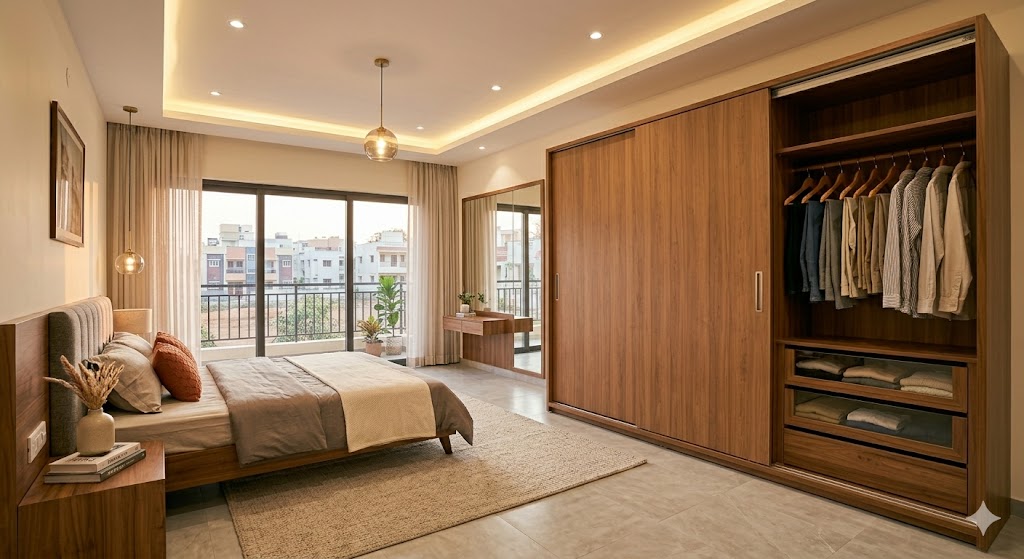
Bathrooms at 11% combined (4% common + 7% master) — second-highest ₹/room-sft (₹ 2,000-3,110) because of fixtures, sanitaryware, vanity, mirror, accessories, and the high tile + waterproofing intensity per sft.
Common services + misc at 8% — painting all rooms, electrical points + switches across home, AC for 3 rooms. Often forgotten when budgeting room-by-room — make sure it's a separate line item.
Interior Cost vs Construction Cost — They Are Different Things
A clarification that resolves most homeowner confusion:
- Construction cost = building the structure to handover-shell condition. ~₹ 1,400-7,500/sft (city × spec). Once in 30-50 years. See Construction Cost in India.
- Interior fit-out cost = fitting out the shell with joinery, finishes, lighting, AC, decor. ~₹ 600-7,000+/sft. Often refreshed every 7-12 years.
- Furniture cost = movable furniture (sofa, dining set, beds, etc.). ~₹ 200-1,000+/sft. Refreshed often, with taste.
For a new-build independent house, your all-in cost is the sum of all three:
| Spec band | Construction (₹/sft) | Interior (₹/sft) | Furniture (₹/sft) | All-in (₹/sft) |
|---|---|---|---|---|
| Economy | ₹ 2,400 | ₹ 700 | ₹ 250 | ₹ 3,350 |
| Mid | ₹ 3,500 | ₹ 1,400 | ₹ 500 | ₹ 5,400 |
| Premium | ₹ 5,800 | ₹ 2,200 | ₹ 800 | ₹ 8,800 |
| Luxury | ₹ 10,000+ | ₹ 4,500+ | ₹ 1,500+ | ₹ 16,000+ |
For a 2,400 sft mid-spec G+1 build, the all-in is ₹ 5,400 × 2,400 = ₹ 1.3 Cr. Of which construction is ₹ 84 L, interior is ₹ 33 L, and furniture is ₹ 12 L.
Treat these as three separate budgets. The single most common mistake is treating "construction cost" as the total — and then running out of money 80% of the way through, leaving the interior half-finished and the home occupied with only the kitchen and one bedroom done.
New Build vs Renovation — The Renovation Premium
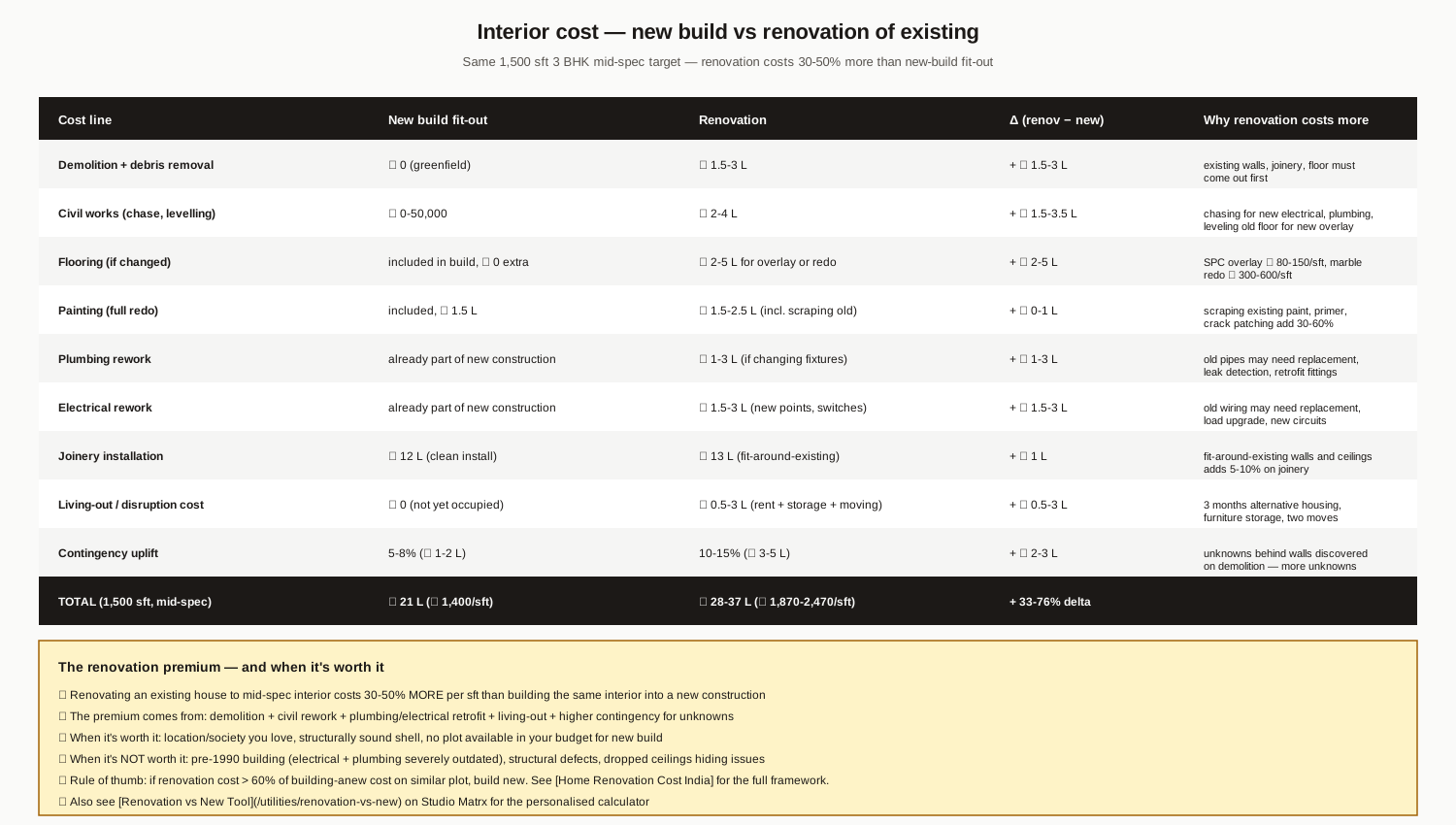
A common homeowner question: "I have a house I bought 8 years ago; what does it cost to renovate the interior?"
The answer: 30-50% more per sft than building the same interior into new construction. The reasons:
What the renovation premium pays for
1. Demolition + debris removal (₹ 1.5-3 L): existing walls, joinery, floor must come out before new can go in. Greenfield builds have no demolition.
2. Civil rework (₹ 2-4 L): chasing walls for new electrical and plumbing routes, leveling old floor for new overlay, patching walls where old joinery anchors were.
3. Plumbing rework (₹ 1-3 L): old pipes may need replacement (PVC degradation, scale build-up, leak history). Bathroom redos almost always need full plumbing redo.
4. Electrical rework (₹ 1.5-3 L): old wiring may need replacement (capacity, safety standards have evolved since 1990), load upgrade for AC + appliances + smart home, new circuits for any new appliances.
5. Living-out / disruption cost (₹ 0.5-3 L): 2-4 months alternative housing rent, furniture storage, two moves. Direct cost AND opportunity cost.
6. Higher contingency (10-15% vs 5-8% for new build): unknowns get discovered when walls open — water damage, hidden pipes, structural cracks. Allow more.
The decision framework
- If renovation cost > 60% of new-build cost on a similar plot in your locality → build new
- If you love your location and society and a similar plot in the same locality is unaffordable → renovate
- If the building is pre-1990 with significant electrical/plumbing risk → consider very carefully; sometimes a deep gut-renovation is cheaper than dealing with hidden surprises year after year
- For an apartment in a working society, renovation is usually the only option (you can't tear down and rebuild a flat) — focus on optimising the renovation budget instead
See Home Renovation Cost in India for the full renovation cost framework, and Pre-Renovation Checklist for the scoping discipline before you start.
The Eight Cost Drivers — What Moves Interior ₹/sft
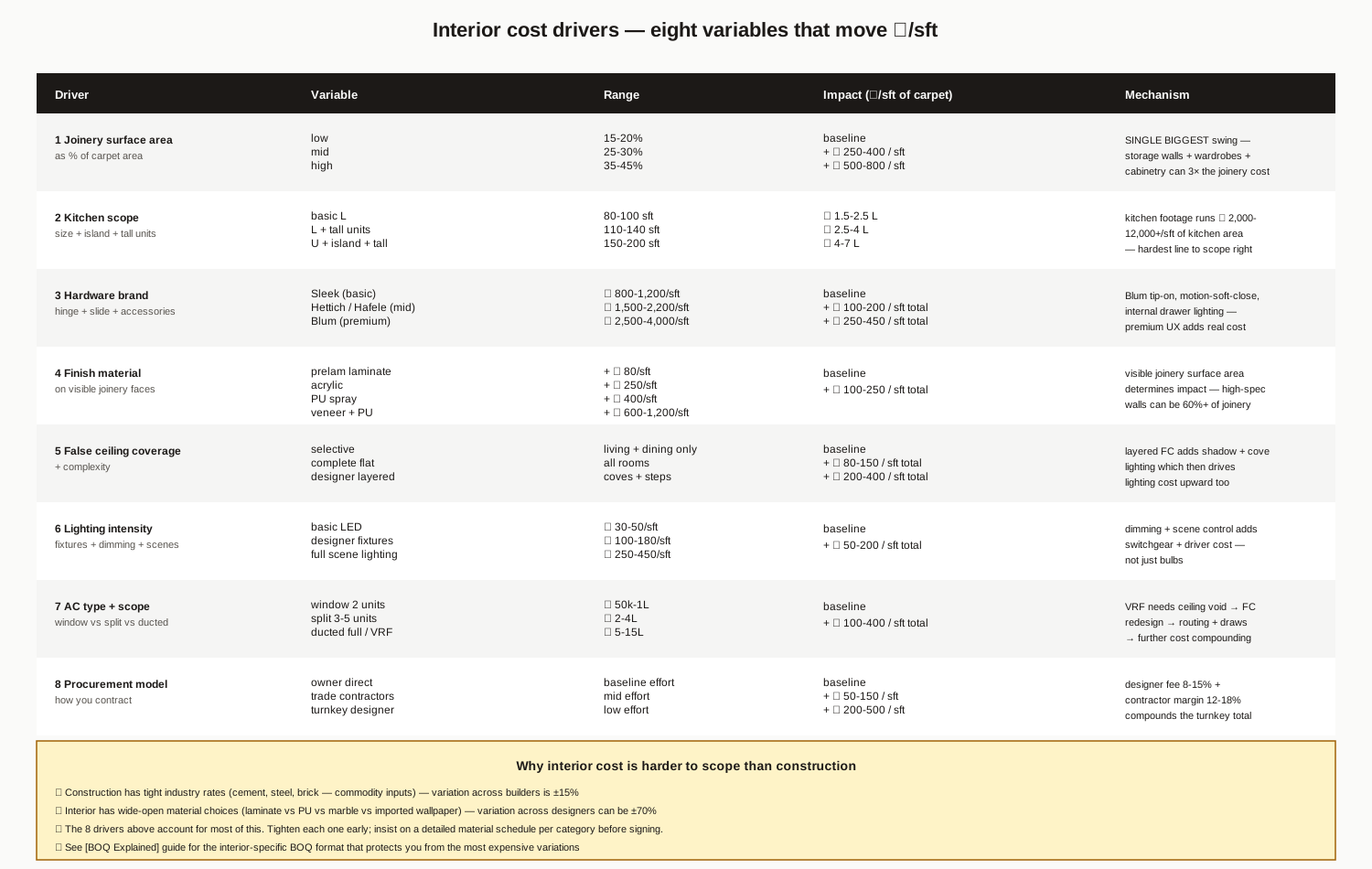
The eight drivers above account for nearly all of the variation in interior ₹/sft within the same spec band. Tighten each one before signing.
1. Joinery surface area (the single biggest swing)
The joinery footprint of a home — measured as projected joinery surface area as a percentage of carpet area — varies from 15% (minimal storage, exposed walls) to 45% (storage walls + full-height wardrobes + custom cabinetry everywhere). The same spec band can deliver radically different ₹/sft depending on how much wall is covered in joinery.
- Low joinery (15-20% of carpet): baseline
- Mid joinery (25-30%): + ₹ 250-400/sft
- High joinery (35-45%): + ₹ 500-800/sft
If you have a small carpet area (1,000 sft 2 BHK), going high-joinery to maximise storage is often the right call — net effect is a more usable home. If you have a large carpet area (3,500 sft villa), high-joinery can become visually heavy AND expensive — be selective.
2. Kitchen scope (basic L vs U + island + tall units)
The kitchen is the highest-cost-per-sft room in any interior fit-out. Scope drives total cost:
- Basic L-shape, 80-100 sft: ₹ 1.5-2.5 L
- L + tall units, 110-140 sft: ₹ 2.5-4 L
- U + island + tall units, 150-200 sft: ₹ 4-7 L
Layout decisions made at design stage are very expensive to undo later. See Modular Kitchen Design Guide for the layout-and-storage discipline.
3. Hardware brand (Sleek vs Hettich/Hafele vs Blum)
Hardware quality is invisible to a casual visitor but a daily UX driver for the occupant. The progression:
- Sleek economy: ₹ 800-1,200/sft of kitchen area
- Hettich/Hafele mid: ₹ 1,500-2,200/sft (the standard for mid-spec)
- Blum premium: ₹ 2,500-4,000/sft (motion soft-close, internal lighting)
- Imported (Häfele Germany, Salice, Grass): ₹ 3,500-6,000/sft
Hettich/Hafele is the sweet spot for most mid-spec homes — durable, well-supported in India, soft-close hinges and tandem drawers as standard.
4. Finish material on visible faces
Same carcass, vastly different visible finishes:
- Prelam laminate: + ₹ 80/sft
- Acrylic: + ₹ 250/sft
- PU spray: + ₹ 400/sft
- Veneer + PU: + ₹ 600-1,200/sft
On a kitchen with 40 sft of door faces, PU vs prelam is ₹ 13k extra. On a home with 400 sft of total visible joinery face, PU vs prelam is ₹ 1.3 L extra. The choice matters.
5. False ceiling coverage + complexity
- Selective FC (living + dining only): baseline
- Complete flat FC (all rooms): + ₹ 80-150/sft total
- Designer layered FC with coves and steps: + ₹ 200-400/sft total
The FC choice also drives lighting cost — layered FC enables cove lighting which adds ₹ 80-200/sft of further fixture cost.
6. Lighting intensity
Basic LED throughout (₹ 30-50/sft) vs designer fixtures (₹ 100-180/sft) vs full scene lighting with dimming and zones (₹ 250-450/sft). Scene lighting adds driver, switchgear, and control cost on top of fixture cost — not just bulbs.
7. AC type and scope
- Window AC, 2 units, no smart: ₹ 50k-1L
- Split AC, 3-5 units, basic smart: ₹ 2-4L
- Ducted split AC: ₹ 5-15L
- VRF/VRV: ₹ 8-25L
VRF/VRV needs ceiling void → FC redesign → routing → draws — the cost compounds. See Architectural Lighting Design for Indian Homes and Residential MEP Coordination for the design-side reference.
8. Procurement model
- Owner-direct, trade contractors: baseline
- Single interior contractor: + ₹ 50-150/sft
- Turnkey designer with full project ownership: + ₹ 200-500/sft
Designer fee 8-15% + contractor margin 12-18% compounds. The turnkey premium pays for project management, accountability, and zero-effort delivery — and for some homeowners that's exactly worth it. For others with time, owner-managed delivers 15-25% savings on the same outcome. See Turnkey Interiors in India for the full decision framework.
Eight Cost Optimisation Strategies — Without Sacrificing Quality
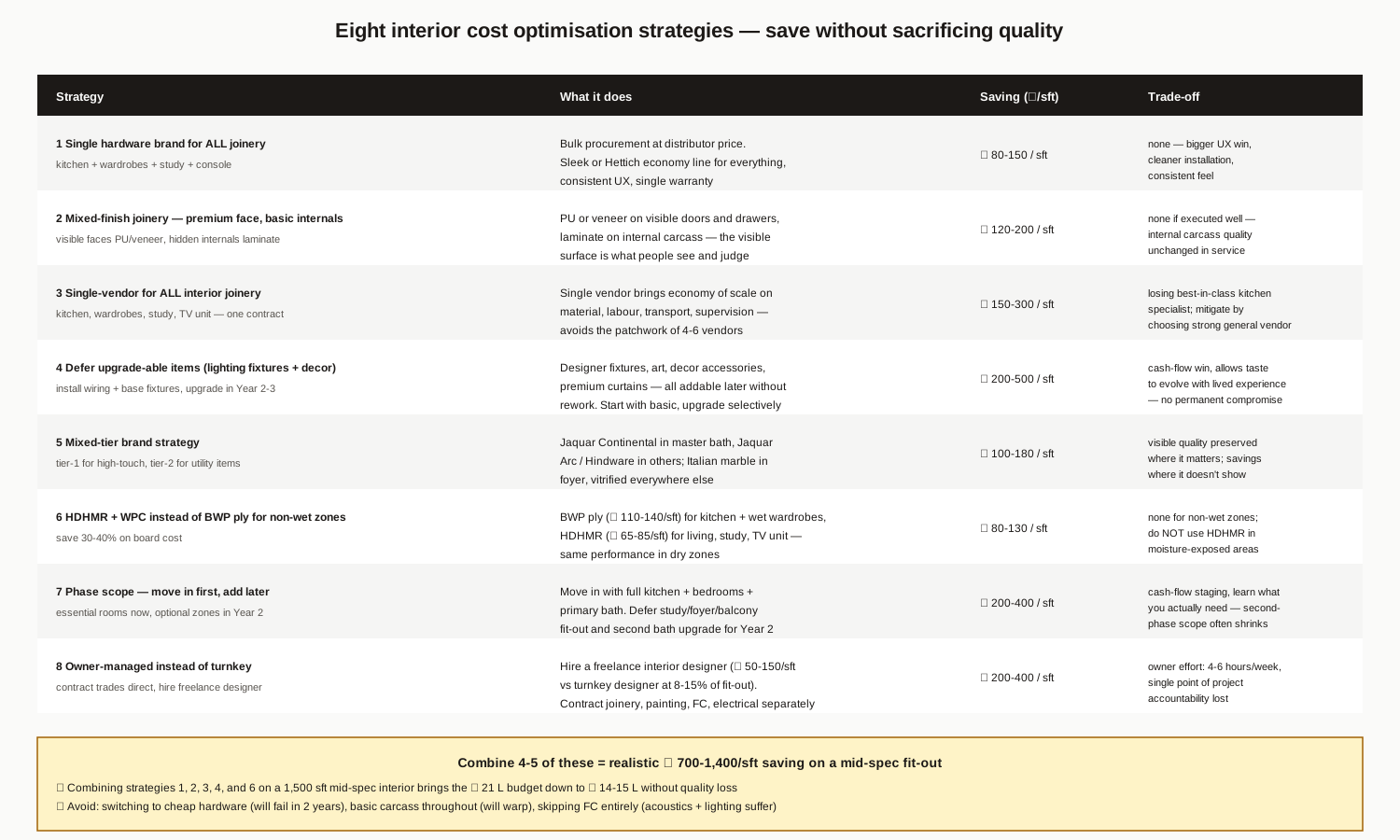
Eight strategies that move ₹/sft down without making the home feel cheaper. Combine 4-5 of these and a typical ₹ 21 L mid-spec interior comes down to ₹ 14-15 L.
1. Single hardware brand across all joinery (₹ 80-150/sft saving)
Bulk procurement at distributor price. Sleek or Hettich economy line for everything. Consistent UX, single warranty, cleaner installation. Trade-off: none — bigger UX win, not less.
2. Mixed-finish joinery — premium face, basic internals (₹ 120-200/sft)
PU or veneer on visible doors and drawers, laminate on internal carcass. The visible surface is what people see and judge. Internal carcass quality is unchanged in service. Trade-off: none if executed well.
3. Single vendor for ALL interior joinery (₹ 150-300/sft)
Kitchen + wardrobes + study + TV unit — one vendor, one contract. Bulk material, labour, transport, supervision. Avoids the patchwork of 4-6 vendors. Trade-off: losing best-in-class kitchen specialist — mitigate by choosing a strong general vendor with kitchen specialisation.
4. Defer upgrade-able items (₹ 200-500/sft)
Designer fixtures, art, decor accessories, premium curtains — all addable later without rework. Install the wiring and base now. Start with basic, upgrade selectively in Year 2-3. Cash-flow win, allows taste to evolve with lived experience.
5. Mixed-tier brand strategy (₹ 100-180/sft)
Jaquar Continental in master bath, Jaquar Arc or Hindware Premium in others. Italian marble in foyer, vitrified everywhere else. Quality where people see + touch; savings where it doesn't show.
6. HDHMR for non-wet zones instead of BWP plywood (₹ 80-130/sft)
BWP ply (₹ 110-140/sft of board) for kitchen + wet wardrobes. HDHMR (₹ 65-85/sft) for living, study, TV unit. Same performance in dry zones. Critical: do NOT use HDHMR in moisture-exposed areas (kitchen, bathroom, balcony storage).
7. Phase scope — move in first, add later (₹ 200-400/sft)
Move in with full kitchen + bedrooms + primary bath. Defer study, foyer, balcony fit-out, and second bath upgrade for Year 2. Cash-flow staging, learn what you actually need — second-phase scope often shrinks.
8. Owner-managed instead of turnkey designer (₹ 200-400/sft)
Hire a freelance interior designer at ₹ 50-150/sft for design + supervision (vs turnkey designer at 8-15% of fit-out). Contract joinery, painting, FC, electrical separately. Owner effort: 4-6 hours per week over 4-5 months. Net savings: ₹ 200-400/sft.
Six Common Interior Cost Mistakes
1. Treating interior as construction's afterthought. Construction budget locked at ₹ 84 L, interior assumed at "₹ 5-10 L." Reality: 1,500 sft mid-spec interior is ₹ 18-28 L. Budget interior at 25-35% of construction.
2. No spec band declared upfront. "Modular kitchen" can mean ₹ 1.5 L or ₹ 12 L. "Wardrobes" can mean ₹ 50k each or ₹ 4 L each. Declare your spec band per category before quotes.
3. Hardware as an afterthought. Hinges and slides are the single most-touched component of any home — and the most common source of "this kitchen feels cheap" complaints two years in. Spend on Hettich/Hafele at minimum.
4. Forgetting AC, electrical extras, and smart-home in interior budget. These get assumed under "construction" but happen at fit-out stage. Budget AC at ₹ 2-15 L, electrical extras at ₹ 1-4 L, smart home (if you want it) at ₹ 30k-15 L explicitly.
5. Doing the kitchen "for now" with a plan to upgrade. Kitchen redos are 2-3× more painful than first-build kitchens because of dependencies (electrical, plumbing, chimney, exhaust). Do it right the first time, or wait until you can.
6. Trusting "₹/sft all-in" quotes. Same as construction — demand a line-item BOQ for interior, with material brand, model, and unit price for every line. See BOQ Explained for Indian Homeowners for the format.
Pre-Fit-out Budgeting Checklist
1. Spec band declared per category (kitchen, wardrobes, FC, lighting, painting, AC, electrical, smart-home) — basic, mid, premium, luxury
2. Joinery surface area calculated — measure the projected joinery surface as % of carpet area. 25-30% is mid-spec norm.
3. Kitchen scope locked — layout, size, tall units yes/no, island yes/no. See Modular Kitchen Design Guide.
4. Hardware brand chosen — Sleek / Hettich-Hafele / Blum / imported
5. Finish material chosen — laminate / acrylic / PU / veneer for visible faces. Internal carcass laminate is fine.
6. FC coverage plan — selective / complete / designer layered. Drives lighting cost.
7. Lighting intensity plan — basic LED / designer fixtures / scene control. Drives switchgear cost.
8. AC scope — window / split / ducted / VRF. Drives FC redesign.
9. Smart home backbone — none / basic switches / full automation. Decide BEFORE first electrical drawing.
10. Procurement model — owner-direct / single contractor / turnkey designer. Drives final ₹/sft.
11. Detailed BOQ in hand — line-item with brand, model, unit price, quantity for every category
12. Contingency at 10% — interior surprises are common (material out of stock, dimension corrections, mid-build upgrades)
Where to Go Next
- For construction cost specifically: Construction Cost in India
- For BOQ format and what to demand: BOQ Explained for Indian Homeowners
- For what hidden costs to expect: Hidden Costs in Interiors
- For the turnkey vs direct decision: Turnkey Interiors in India
- For renovating an existing house: Home Renovation Cost in India
- For kitchen design depth: Modular Kitchen Design Guide
- For false ceiling depth: False Ceiling Design Guide
- For wardrobe finish material depth: Top Wardrobe Finish Ideas
- For the personalised renovation-vs-new calculator: Renovation vs New Tool
References
1. BIS IS 303. Plywood for General Purposes — Specification. Plywood grade reference.
2. BIS IS 710. Marine Plywood (BWP) — Specification. Moisture-resistance grade.
3. BIS IS 12823. Pre-laminated Particle Board. Particle board reference.
4. BIS IS 14276. Medium Density Fibre Board (MDF) — Specification.
5. Council of Architecture (2020). Interior Designer Practice Bylaws. Designer fee reference.
6. CPWD Schedule of Rates, Interior Fit-out Section, latest revision. Interior item rates.
7. Hettich India, Hafele India, Blum India product catalogues (2024-25). Hardware pricing reference.
8. Sleek Kitchens, Stanley Lifestyles, Wood Stock, Sleek Kitchens, IKEA India market data (2024-25). Modular kitchen pricing benchmarks.
9. JLL India / Knight Frank quarterly interior fit-out cost reports (2024-25). Tier-1 benchmarks.
10. Mehta Plywood, Greenply, Century Plywood pricing schedules. Board material pricing.
Author's note: Interior cost in India is the single biggest "surprise" line in most homeowner budgets — not because the numbers are unknowable, but because most homeowners (and most contractors) treat it as a small after-the-fact appendix to construction, when it should be sized at 25-35% of construction from day one. Treat interior as a serious budget with its own discipline: declare your spec band per category before quotes, lock joinery surface area as a percentage of carpet area, choose hardware brand explicitly, pick finish materials face-by-face, and demand a line-item BOQ. The eight drivers above are how you keep ₹/sft honest. The eight savings strategies are how you bring ₹/sft down without making the home feel cheaper. Combine 4-5 strategies and a ₹ 21 L mid-spec fit-out becomes a ₹ 14-15 L mid-spec fit-out — same outcome, ₹ 7 L back in pocket for furniture or for the kids' education fund.
Disclaimer: Cost ranges are 2025-26 indicative for Indian metro and Tier-1 cities and vary by micro-market, vendor, material grade, brand, design complexity, and procurement model. The reference room-by-room walk-through is illustrative for a representative 1,500 sft 3 BHK Bangalore mid-spec project; specific projects vary materially. Hardware, finish, and appliance brand pricing changes with market conditions and currency movement (for imported items). Sanitaryware, switches, lighting, and AC pricing changes with brand cycles and dealer margins. Designer fees vary by practice, scope, and project complexity. Studio Matrx, its authors and contributors accept no liability for budget decisions made on the basis of this guide; engage a licensed interior designer and quantity surveyor for project-specific budget development. The BIS material standards cited are authoritative for material quality validation in disputed material engagements; the Council of Architecture Interior Designer Practice Bylaws are the fee reference.
Interactive · Interior cost by room and tier
1,200 sq.ft · Standard → ₹16.8 L
Estimated
₹16.8 L
@ ₹1,400 / sq.ft
For standard interiors at 1200 sq.ft. Typical 12-16 week timeline once BOQ is approved.
Indicative metro ₹/sq.ft for interior fit-out only (excludes civil construction, taxes).
Export this guide
Related Guides — Deep-dive reading
The Design Decisions With the Biggest Cost Consequences
A cost-leverage map of Indian home interiors — the handful of decisions that swing your total budget the most, so you spend your attention where a single choice has an outsized rupee impact.
Cost & MoneyThe Truth About Cost Per Square Foot
Why a ₹/sqft interior quote is the most misleading number in Indian home costing — and how to convert it into a real BOQ
Cost & MoneyThe Homeowner's Guide to Interior Design Budgets in India
Where the money really goes in an Indian fit-out — realistic 2026 ranges, cost-per-sqft truths, bang-for-buck upgrades, life-cycle costing and contracts
Home PlanningRelated Tools — Try Free
False Ceiling Cost Estimator
Live ₹/sqft across 8 ceiling types — POP, gypsum, designer, metal, PVC, wooden — with cove and spot lighting for 20 Indian cities.
Cost CalculatorHome Building & Interior Cost Calculator — 20 Cities
Construction + interior costs for 20 Indian cities across kitchen, wardrobes, flooring, painting, ceiling.
Cost CalculatorCross-Ventilation Analyzer
Estimate airflow and air changes per hour (ACH) from room size, window areas, layout, and local wind — with NBC 2016 Part 8 compliance check.
Ventilation Calculator