
What ₹10 Lakhs Can Actually Build in Interiors
A realistic, itemised look at what a ₹10 lakh interior budget gets you in an Indian home (2026)
You have ₹10 lakh set aside for interiors. The flat is a freshly handed-over 2BHK in Whitefield or Wakad or Wagholi, the keys are in your hand, and three designers have just quoted you anywhere from ₹8 lakh to ₹19 lakh for what sounds like exactly the same scope. One says ₹10 lakh "won't even finish the kitchen properly." Another says ₹10 lakh is "more than enough." You genuinely cannot tell who is lying. That uncertainty is the most expensive thing in the whole project, because it is the thing that makes you overspend out of fear.
This guide fixes that. It takes a single, very common number — ₹10,00,000 — and shows you, line by line, in real 2026 rupees, exactly what it builds in an Indian home. A fully itemised allocation for a 2BHK. What that budget can confidently include and what it must honestly skip. How the same ₹10 lakh stretches across a 3BHK or concentrates into a near-premium 1BHK. And a clear ladder showing what ₹7 lakh, ₹10 lakh and ₹15 lakh each actually deliver.
₹10 lakh is not a "small" interior budget and it is not a luxury one — it is the precise amount that finishes a 2BHK completely and beautifully in laminate-grade materials, with nothing premium and nothing missing. Hit that mental model and every quote you receive suddenly becomes readable.
Who ₹10 lakh actually suits
The first honest answer is that ₹10 lakh means very different things depending on the home it is poured into. The same budget is "tight," "perfect" or "generous" purely as a function of carpet area and how much carpentry the home demands.
| Home type | Carpet area | What ₹10L delivers | Verdict |
|---|---|---|---|
| 1BHK | 450–600 sqft | Near-premium finishes, some PU, designer touches | Generous |
| 2BHK | 850–1,000 sqft | Complete, photogenic, all-laminate fit-out | The sweet spot |
| 3BHK | 1,150–1,400 sqft | Functional and finished, but spread thin | Tight, needs priorities |
| 4BHK / villa | 1,800 sqft+ | Partial — kitchen + a couple of rooms only | Not enough |
For a typical Indian 2BHK of around 850 to 1,000 sqft carpet, ₹10 lakh is the number where the project stops feeling like a compromise. You are spending roughly ₹1,000 to ₹1,200 per square foot of carpet area on interior fit-out — squarely in the mid-spec band that our interior cost per sqft guide maps in detail. Below this, you start cutting things people notice; above it, you start buying things only you will notice.
₹10 lakh is the line where a 2BHK stops being "done on a budget" and simply becomes "done." Every rupee below it is a visible compromise; every rupee above it is an upgrade nobody asked for.
The fully itemised ₹10 lakh: a 2BHK, line by line
Here is the allocation in full. This is a real, build-able BOQ for an owned 2BHK around 900 sqft carpet, mid-spec, in a metro or large Tier-1 city in 2026. Figures are bands; the right-hand column is the number you should actually plan around.
| Line item | What it covers | Realistic band | Plan for |
|---|---|---|---|
| Modular kitchen | 9–11 ft L or U layout, laminate shutters, quartz counter, soft-close, chimney cut-out | ₹2,10,000–2,90,000 | ₹2,50,000 |
| Wardrobes × 2 | Two 6–7 ft floor-to-ceiling laminate wardrobes, sliding or hinged | ₹1,70,000–2,30,000 | ₹2,00,000 |
| Contingency | 10% reserve for surprises, rate revisions, scope creep | — | ₹1,00,000 |
| Electrical + lighting | New points, modular switches, profile + cove LED, fixtures | ₹75,000–1,10,000 | ₹90,000 |
| False ceiling | Gypsum, living + dining only, with cove detail | ₹70,000–1,00,000 | ₹85,000 |
| Soft furnishings | Curtains, blinds, rugs, basic cushions | ₹55,000–90,000 | ₹70,000 |
| Painting | Full-flat repaint, premium emulsion, one accent wall | ₹55,000–85,000 | ₹70,000 |
| TV / feature wall | One laminate or louvered panel wall with niche | ₹55,000–90,000 | ₹70,000 |
| Foyer + extra units | Foyer shoe unit, crockery or study niche | ₹50,000–80,000 | ₹65,000 |
| Total | ₹10,00,000 |
Three things in this table do most of the work and deserve a comment.
Carpentry dominates. The modular kitchen and two wardrobes alone consume ₹4.5 lakh — forty-five percent of the entire budget. This is not a quirk of this plan; it is true of almost every Indian interior project. If a designer's quote spends materially less than this on kitchen plus wardrobes, they are either using thinner board, fewer accessories, or skimping on hardware — and our guide on why cheap hardware destroys expensive interiors explains why that is the worst place to save.
The contingency is real money, not a rounding line. A full ₹1 lakh — a tenth of the budget — sits untouched as a reserve. Pull it out to "afford" one more thing and the first genuine surprise (a wall that is not plumb, a slab that needs an extra electrical chase, a steel-price revision) blows the project. The brutal arithmetic of skipped contingencies is laid out in contingency, provisional sums and risk allocation.
The "invisible" lines are not optional. Electrical and lighting at ₹90,000 buys nothing you can photograph, yet it is the difference between a flat that feels finished and one that feels like a builder handover. Starving these to fund visible glamour is the single most common ₹10 lakh mistake.
What ₹10 lakh CAN have — and what it must SKIP
A budget is defined as much by its skip list as its buy list. At ₹10 lakh for a 2BHK you can have a genuinely complete, move-in-ready, photogenic home — provided you accept that "complete" is built in laminate, not in PU, veneer and stone.

You CAN have
- A full modular kitchen with quartz counter, soft-close hinges and a tall unit
- Two floor-to-ceiling wardrobes with internal organisation
- A gypsum false ceiling in the living and dining areas with cove lighting
- One designed feature wall behind the TV
- Layered lighting — ceiling, cove, task and a few accent fixtures
- A fresh full repaint in premium emulsion with an accent wall
- A foyer unit and a crockery or study niche
- Curtains, blinds and basic soft furnishings
- A real 10% contingency
You must SKIP
- PU, acrylic or veneer finishes across the home (laminate is your palette)
- False ceiling in every room, especially bedrooms
- Imported marble, large-format stone or engineered-wood flooring
- Smart-home automation and motorised blinds
- A walk-in wardrobe or dresser room
- High-end designer sofas, beds and dining sets
- Backlit onyx, fluted or 3D feature walls
- Civil rework — knocking down walls, relocating toilets, new plumbing lines
The trade-off is strict and worth internalising: at this budget, pushing any one skip-list item back in means cutting two buy-list items out. Want PU shutters on the kitchen? That is roughly ₹1.2 to ₹1.5 lakh extra on the kitchen alone — which means losing the false ceiling and the feature wall entirely. The fuller picture of where the laminate-versus-premium line falls sits in our budget vs premium interiors guide.
The same ₹10 lakh, stretched across a 3BHK
Move the identical ₹10 lakh into a 1,200 sqft 3BHK and the per-sqft spend drops to about ₹830 — and something has to give. You now have a third bedroom, often a third toilet, and frequently a longer kitchen run, all competing for the same pot. ₹10 lakh in a 3BHK is not a "complete" interior; it is a "prioritised" one.
| Line item | 2BHK plan | 3BHK reality | What changed |
|---|---|---|---|
| Modular kitchen | ₹2,50,000 | ₹2,60,000 | Slightly longer run |
| Wardrobes | ₹2,00,000 (×2) | ₹2,70,000 (×3) | Third bedroom added |
| False ceiling | ₹85,000 | ₹60,000 | Living only, simpler |
| TV / feature wall | ₹70,000 | ₹45,000 | Plainer panel |
| Electrical + lighting | ₹90,000 | ₹1,00,000 | More area to wire |
| Painting | ₹70,000 | ₹85,000 | More wall area |
| Soft furnishings | ₹70,000 | ₹45,000 | Cut back |
| Foyer + extra units | ₹65,000 | ₹40,000 | Trimmed |
| Contingency | ₹1,00,000 | ₹95,000 | Held near 10% |
| Total | ₹10,00,000 | ₹10,00,000 |
What gives, in plain terms: the third bedroom forces an extra ₹70,000 of wardrobe, and that money is pulled almost entirely from the "finishing and feel" lines — soft furnishings, feature walls and decorative ceiling. The third bedroom typically ends up plain: a wardrobe, paint and a light. That is the correct call. A 3BHK done well to ₹10 lakh feels like a well-organised home; done badly, it tries to make every room a showpiece and ends up with three half-finished ones. For a fuller 3BHK-scale plan you would want closer to ₹13–15 lakh — the logic of that step-up sits in our room-by-room cost breakdown.
₹10 lakh on a 1BHK: near-premium territory
Now run the opposite experiment. Pour ₹10 lakh into a 500–600 sqft 1BHK and you are spending ₹1,700 to ₹2,000 per square foot — comfortably into the premium band. Here, for once, you do not have to skip the glamour list. You can afford the things a 2BHK at this budget cannot.
| Line item | 1BHK at ₹10L | Upgrade vs 2BHK |
|---|---|---|
| Modular kitchen | ₹2,80,000 | PU or acrylic shutters, tall units, premium hardware |
| Wardrobe (×1) | ₹1,60,000 | Veneer or lacquered-glass shutters |
| False ceiling | ₹1,10,000 | Full home, including bedroom, with detailing |
| Feature + TV wall | ₹1,20,000 | Fluted panels, veneer, integrated lighting |
| Flooring upgrade | ₹70,000 | Large-format tile or vinyl plank in living |
| Electrical + lighting | ₹1,00,000 | Designer fixtures, some automation |
| Painting + texture | ₹80,000 | Texture / wallpaper accent walls |
| Soft furnishings + decor | ₹90,000 | Better curtains, rug, art, decor |
| Contingency | ₹90,000 | Held near 10% |
| Total | ₹10,00,000 |
A 1BHK at ₹10 lakh is the budget's happiest expression. Because the carpentry footprint is small, the surplus flows straight into finish quality. This is the one configuration where ₹10 lakh genuinely buys a "premium-feeling" home — which is exactly why young couples and investors fitting out a compact flat often get a result that punches well above the headline number.
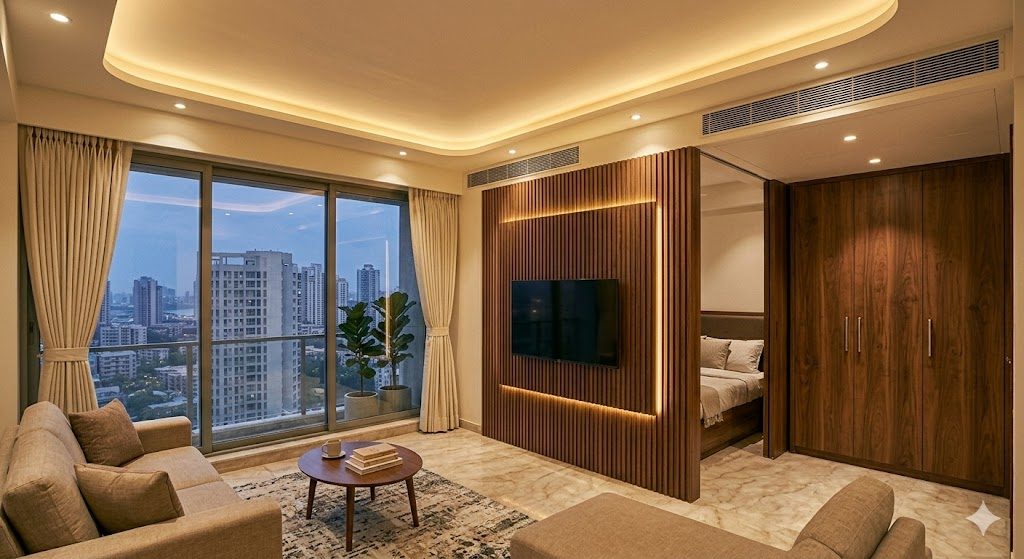
Smart moves to make ₹10 lakh feel like ₹15 lakh
The gap between a ₹10 lakh home that looks like ₹10 lakh and one that looks like ₹15 lakh is almost never about spending more. It is about putting the money where the eye lands and starving the places it never does. This is the highest-leverage skill in the whole exercise, and our smart budget allocation guide is built entirely around it.
| Where to SPLURGE | Why it reads as premium | Where to SAVE | Why nobody notices |
|---|---|---|---|
| Kitchen hardware (hinges, channels) | Felt every single day; failure is visible and loud | Inside-cabinet finishes | Behind closed shutters |
| Lighting layers + warm temperature | Single biggest "luxury" cue in any room | Bedroom false ceiling | Skip it entirely — eyes are closed |
| One feature wall (living) | Concentrates the "wow" in the most-seen wall | Other walls | Plain premium paint reads clean |
| Curtains (floor-to-ceiling, full width) | Make ceilings look taller, rooms richer | Loose furniture (buy later) | Spread the cost over months |
| Handle-less / clean shutter lines | The biggest tell of "designer" vs "carpenter" | Veneer everywhere | Laminate at eye level is invisible |
Three moves do most of the lifting. First, light warm and light in layers — a ₹90,000 lighting plan with cove, profile and a few pendants out-luxuries a ₹3 lakh PU kitchen lit by a single tube. Second, hang curtains to the ceiling and wall-to-wall, not to the window frame; it is the cheapest trick that fakes height and money. Third, concentrate, do not spread — one fully resolved feature wall beats four half-decorated ones. The inverse failure — spreading thin and ageing badly — is exactly what expensive interior choices that age poorly warns against.
What ₹10 lakh does NOT cover
This is where most budgets quietly explode, because homeowners assume "interiors" means "everything." It does not. The figures above are an interior fit-out number, and the following sit entirely outside it. Budget for them separately or you will be ₹2–4 lakh short on move-in day.
| Excluded item | Typical extra cost | Notes |
|---|---|---|
| Kitchen appliances | ₹80,000–2,00,000 | Chimney, hob, oven, fridge, washer, RO |
| Loose furniture | ₹1,00,000–3,00,000 | Sofa, beds, mattresses, dining set |
| Civil / structural work | ₹50,000–2,00,000 | Wall demolition, new toilets, plumbing |
| Electronics | ₹60,000–1,50,000 | TV, AC units, geysers |
| GST + design fee | 0–18% on applicable items | Confirm inclusive vs exclusive in the quote |
| Society / move-in charges | ₹10,000–50,000 | Deposits, debris removal, lift charges |
The single most common shock is GST. A "₹10 lakh" turnkey quote and a "₹10 lakh plus GST" quote are nearly ₹1.4 lakh apart on the modular and furniture components. Always confirm whether the headline number is inclusive. The other silent drains — debris removal, society deposits, the chimney that "wasn't in the kitchen quote" — are catalogued in hidden costs of home renovation, and they are exactly why the 10% contingency exists.
How the ₹10 lakh splits by tier of finish
It is worth seeing the same ₹10 lakh expressed not by room but by the quality tier of materials it buys, because this is the lever you will actually pull in negotiation.
| Spend tier | Share of ₹10L | Material reality |
|---|---|---|
| Core structure (board, ply, frames) | ~35% (₹3,50,000) | BWP / BWR ply and MDF carcass — never compromise here |
| Surface finish (laminate, paint, edge) | ~22% (₹2,20,000) | All-laminate; this is the tier that defines "₹10L" |
| Hardware + accessories | ~13% (₹1,30,000) | Mid-premium hinges, channels, baskets |
| Lighting + electrical | ~9% (₹90,000) | Layered LED, modular switches |
| Soft + decor | ~11% (₹1,10,000) | Curtains, blinds, basic furnishings |
| Contingency | ~10% (₹1,00,000) | Untouched reserve |
The headline insight: at ₹10 lakh the carcass and hardware tiers should be uncompromised — they are what keep the home standing and functioning for fifteen years — while the surface tier is held firmly at laminate. Spend premium on what fails, save on what merely shows. Reversing that order — beautiful veneer on a cheap carcass with rattling hinges — is precisely why cheap interiors get expensive later.
The ladder: ₹7L vs ₹10L vs ₹15L
To place ₹10 lakh in context, here is the full ladder for the same 2BHK. Each rung is a coherent, complete-in-itself level — not a half-version of the next.
| Level | ₹7L — Basic | ₹10L — Complete | ₹15L — Premium |
|---|---|---|---|
| Per sqft (900 sqft) | ~₹780 | ~₹1,110 | ~₹1,670 |
| Kitchen | Laminate, basic accessories | Laminate, quartz, soft-close | PU / acrylic, tall units |
| Wardrobes | 1–2, basic internals | 2, full internals | 2–3, veneer, organisers |
| False ceiling | None or living only | Living + dining | Full home, detailed |
| Feature walls | None | One (TV) | Two to three, premium |
| Lighting | Basic + a few points | Layered LED | Designer + automation |
| Flooring | As handed over | As handed over | Upgraded in living |
| Furniture | Reuse existing | Buy separately | Some designer included |
| Contingency | Thin (5%) | Real (10%) | Comfortable (10%+) |
The jump from ₹7L to ₹10L is the most valuable ₹3 lakh you will ever spend on a home: it converts a functional flat into a finished one by adding the false ceiling, the feature wall, layered lighting and a real contingency. The jump from ₹10L to ₹15L is pure refinement — it swaps laminate for PU and veneer and adds automation, but it does not make the home more livable, only more luxurious. If money is finite, get to ₹10 lakh and stop; the marginal rupee after that buys diminishing visible return. The full premium-tier logic lives in our cost of luxury interiors in metro cities.
How to budget ₹10 lakh, in order
1. Lock the carcass and hardware first. Decide your ply grade (BWP for wet zones, BWR elsewhere) and your hinge/channel brand before anything else. This is roughly ₹4.8 lakh and it is non-negotiable.
2. Fund the kitchen fully. It is the hardest-working, most-photographed and most-failure-prone room. Give it its ₹2.5 lakh before you decorate anything.
3. Set aside the ₹1 lakh contingency immediately. Move it to a mental "do not touch" line on day one, before temptation arrives.
4. Buy the invisible essentials. Electrical, plumbing points and waterproofing — ₹90,000 — come before any feature wall.
5. Add one ceiling and one feature wall. Living and dining only. Resist the urge to ceiling every room.
6. Light it in layers, warm. The single highest-leverage ₹90,000 in the project.
7. Finish soft. Floor-to-ceiling curtains and blinds last — they tie the whole home together.
8. Defer loose furniture. Sofa, beds and dining can be bought over the following months from a separate pot.
DesignAI turns this exact logic into a working document for your specific flat: feed it your floor plan and your ₹10 lakh ceiling, and it drafts an itemised BOQ and room-by-room allocation in minutes — the same line items you see above, tuned to your carpet area and city. Pair it with our budget allocation tool to test scenarios and the cost calculator to sanity-check any vendor quote against real 2026 bands before you sign.
References
1. CPWD, Delhi Schedule of Rates (DSR) 2023 with 2025–26 cost indices — baseline civil, carpentry and finishing labour rates.
2. CIDC (Construction Industry Development Council) — published material and labour cost indices for India.
3. National Building Code of India (NBC) 2016, Bureau of Indian Standards — space, electrical and safety norms underpinning fit-out scope.
4. BIS / IS 303 and IS 710 — specifications for plywood (MR, BWR, BWP grades) referenced in carcass costing.
5. BMTPC (Building Materials and Technology Promotion Council) — cost data on materials and alternative finishes.
6. RERA (Real Estate Regulation Act) carpet-area definitions — basis for the per-sqft framing used throughout.
7. Industry modular-interior price bands (CY 2026), cross-checked across major Indian turnkey vendors for laminate-grade fit-outs.
Read next: smart budget allocation for Indian homes, the realistic 2BHK interior budget for Bengaluru 2026, the room-by-room interior cost breakdown and budget vs premium interiors in India.
Export this guide
Related Guides — Deep-dive reading
The Design Decisions With the Biggest Cost Consequences
A cost-leverage map of Indian home interiors — the handful of decisions that swing your total budget the most, so you spend your attention where a single choice has an outsized rupee impact.
Cost & MoneyThe Truth About Cost Per Square Foot
Why a ₹/sqft interior quote is the most misleading number in Indian home costing — and how to convert it into a real BOQ
Cost & MoneyThe Homeowner's Guide to Interior Design Budgets in India
Where the money really goes in an Indian fit-out — realistic 2026 ranges, cost-per-sqft truths, bang-for-buck upgrades, life-cycle costing and contracts
Home PlanningRelated Tools — Try Free
False Ceiling Cost Estimator
Live ₹/sqft across 8 ceiling types — POP, gypsum, designer, metal, PVC, wooden — with cove and spot lighting for 20 Indian cities.
Cost CalculatorHome Building & Interior Cost Calculator — 20 Cities
Construction + interior costs for 20 Indian cities across kitchen, wardrobes, flooring, painting, ceiling.
Cost CalculatorCross-Ventilation Analyzer
Estimate airflow and air changes per hour (ACH) from room size, window areas, layout, and local wind — with NBC 2016 Part 8 compliance check.
Ventilation Calculator