
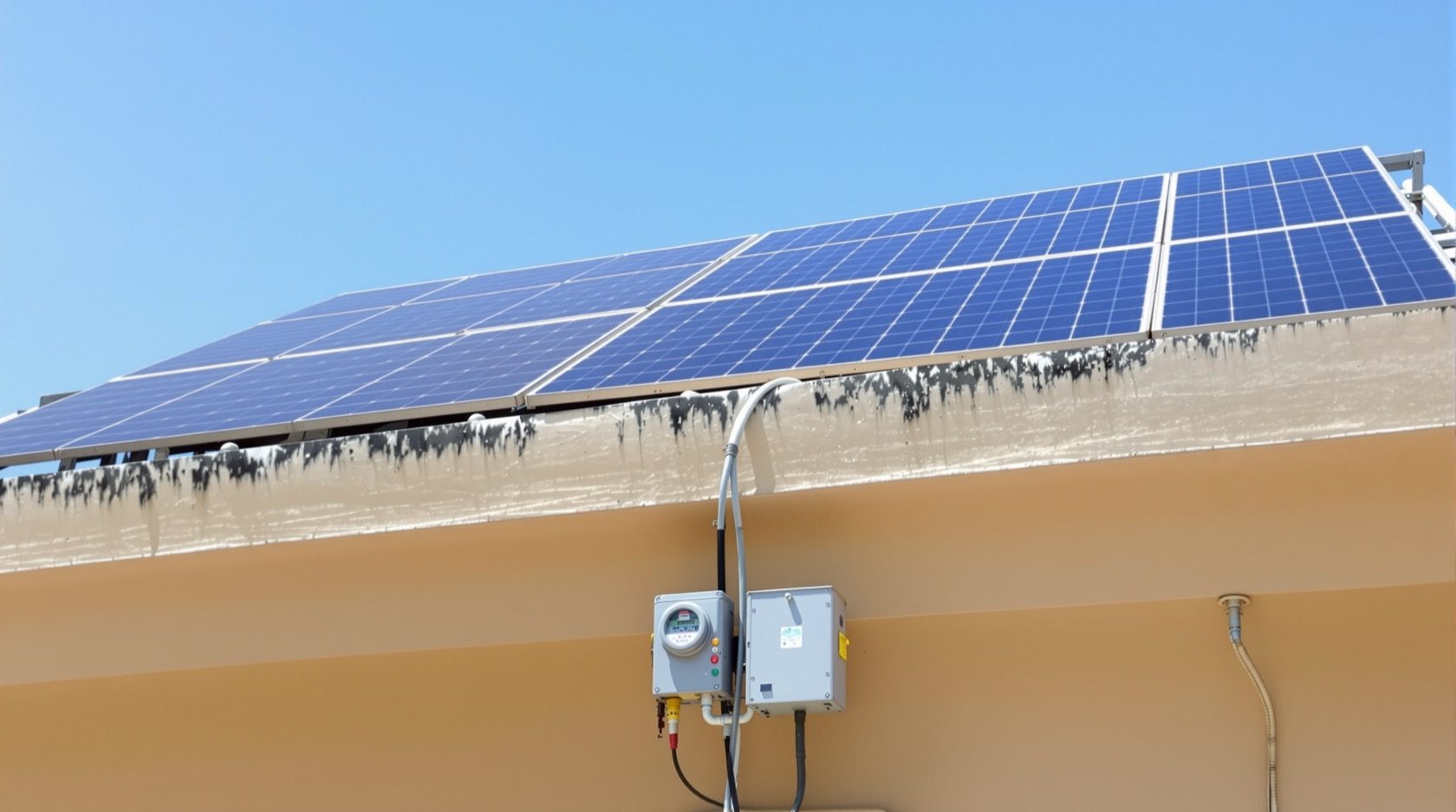
Rooftop Solar Approvals & Net Metering in India: The Permissions You Actually Need
The approvals side of putting solar on an Indian roof — not how solar works, but the permissions: the DISCOM net-metering application and feasibility, an empanelled installer, the structural load check, the electrical safety inspection, the PM Surya Ghar subsidy, and metering and commissioning. These are DISCOM, state and MNRE rules — not one national IS code — so amounts and caps change; always confirm the current rule locally.
Choosing panels is the easy part. What surprises most Indian homeowners is that a grid-connected rooftop system is not something you simply buy and switch on — it is a small power plant you are wiring into the public grid, and that means permissions. You need your electricity distribution company to agree to connect you, someone qualified to confirm the roof can safely carry the array, the state's electrical safety machinery to sign off, and — if you want the money back — the national subsidy portal. None of this is hard once you know the sequence; the trouble is that no single office runs it and no single rulebook covers it.
This is the approvals and net-metering companion to The Solar Roof Guide, which covers how rooftop solar actually works — system types, sizing, mounting and payback. Here we stay strictly on the paperwork: what a rooftop solar approval actually consists of, who does each step, what document you walk away with at each stage, and how to keep it all updateable as the rules change. It sits inside the Roofing Knowledge Hub and its regulatory chapter alongside Roofing Building Codes & Standards.
The single most important thing to understand up front: these are DISCOM, state electrical-inspectorate, MNRE and municipal rules — not one national Indian Standard (IS) code. There is no "IS code for solar approvals." The net-metering cap, the subsidy amount, the banking terms and even whether an electrical-inspector sign-off is needed all vary by state and are revised often. So treat every number below as typical, not fixed, and confirm the current rule with your DISCOM and the national portal before you plan around it.
Scope & safety. This guide helps you understand and navigate the approvals. Sizing and wiring the array, all DC and AC electrical work, earthing and surge protection, the mounting design and its structural load, and waterproofing every roof penetration are qualified work for a licensed solar installer / electrical contractor, a structural engineer and a roofing/waterproofing contractor; the DISCOM, the state electrical inspectorate and the local authority grant the approvals. Your job as the owner is to engage the right people, ensure they do it properly, and keep every certificate and approval. Never self-certify a structure or self-connect to the grid — DC solar voltages are lethal and persist in daylight even when the grid is off.
The approval journey at a glance
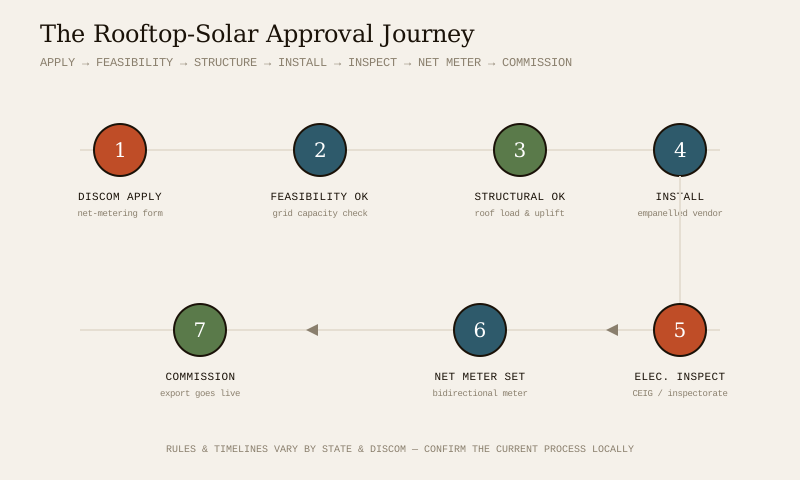
A grid-connected residential rooftop system typically moves through seven stages. In practice a good empanelled installer drives most of them on your behalf, but the responsibility and the paperwork are yours, so you should know what each stage is and what it produces.
| # | Stage | Who does it | What you get |
|---|---|---|---|
| 1 | Net-metering / net-billing application | You or the installer, to the DISCOM (usually via the national portal) | A registered application & reference number |
| 2 | Feasibility / technical approval | DISCOM engineer reviews grid & transformer capacity | Feasibility approval (sanction to proceed) |
| 3 | Structural load check | Structural engineer you engage | A structural stability / load certificate for the array |
| 4 | Installation | Empanelled / registered vendor using approved equipment | Installed system, test reports, equipment datasheets |
| 5 | Electrical safety inspection | State electrical inspectorate / CEIG (where the state requires it) | Safety approval / no-objection to energise |
| 6 | Net-meter installation | DISCOM installs/replaces with a bidirectional meter | A bidirectional (net) meter fitted & sealed |
| 7 | Commissioning & subsidy release | DISCOM energises; MNRE portal releases subsidy | Commissioning certificate; subsidy credited |
The order is broadly fixed — you cannot get a net meter before feasibility, and export does not count before commissioning — but the exact steps, forms, fees and timelines are DISCOM-specific, and some states fold two stages into one. Confirm the current sequence for your utility.
Step 1 & 2 — the DISCOM: net-metering application and feasibility
Everything starts with your electricity distribution company (DISCOM), because a grid-connected system feeds power into their network and they must agree to it. The application is now usually made through the national rooftop-solar portal, which routes it to your DISCOM, though some states still use their own portal.
Two things get decided here:
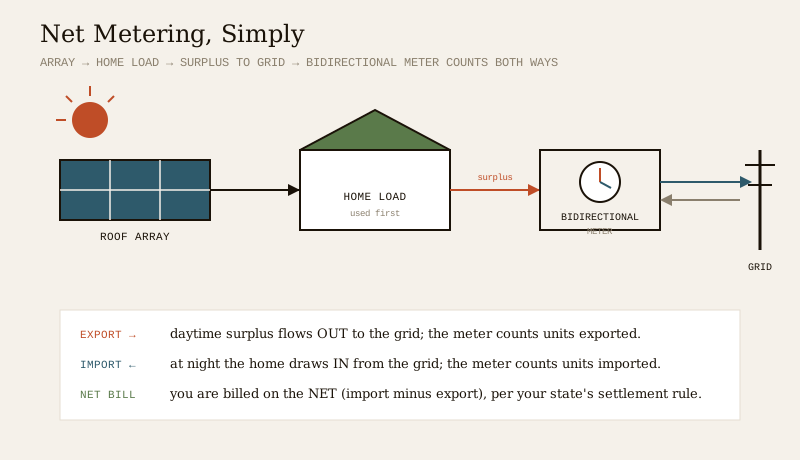
- The connection type — net metering vs net billing (or gross metering). Under net metering, your meter runs both ways and you are billed on the net (units imported minus units exported). Under net billing / gross metering, import and export are priced separately, often with export paid at a lower feed-in tariff. Which one you get is set by your State Electricity Regulatory Commission (SERC), not by you, and it has moved around a lot — several states have shifted larger systems from net metering to net billing. Ask your DISCOM which applies to your sanctioned load and system size.
- Feasibility. A DISCOM engineer checks whether the local transformer and network can absorb your export, and whether your proposed system size sits within the sanctioned-load and capacity caps for a domestic connection. If the local transformer is already loaded, they may cap your size or ask for network work. The output is a feasibility approval — your green light to install.
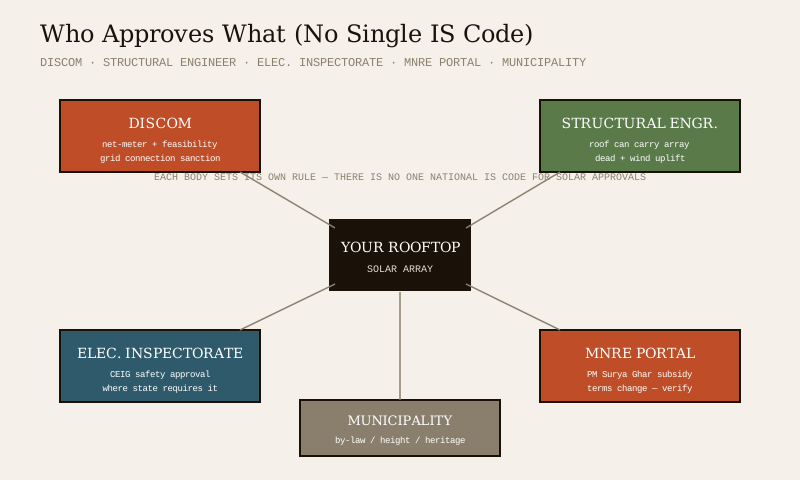
Keep in mind (rule of the road): the net-metering cap — the maximum kW you can install and still net-meter — is a state/SERC rule, commonly expressed as a percentage of your sanctioned load or transformer capacity. It is not a national IS number and it changes. Do not lift a cap figure from an old article; read your DISCOM's current net-metering regulation or ask their solar cell.
Step 3 — the structural check: can the roof carry the array?
Panels are light, but a mounted array is not just panels. On a flat RCC roof the mounting frames, ballast blocks and walkways add dead load; tilted panels catch the wind and generate uplift and overturning forces; and an older slab may already be near its limits. So a competent project has a structural engineer confirm the roof can safely carry the array's combined dead load and wind loads before anything is bolted or ballasted down.
This ties to India's structural design codes — principally IS 875 (Part 3) for wind loads (which governs the uplift on a tilted array) and IS 456 (Plain and Reinforced Concrete) for assessing an RCC slab — verify the current edition of each via the BIS catalogue, as editions are revised. These are design codes the engineer works to, not a "solar approval" you file; the deliverable you should ask for is a structural stability / load certificate stating the roof can take the array. To reason about the wind side before you engage the engineer, the roof wind-load calculator gives a feel for the uplift a tilted array attracts in your wind zone; for the fuller picture see Roof Structural Safety & Compliance and The RCC Roof Guide.
Two homeowner-safe principles fall out of this:
- Prefer ballasted mounts that hold the frame down with weight rather than piercing a sound flat roof — fewer penetrations means fewer leaks — but ballast is itself dead load, so it must be in the structural engineer's sums.
- Fix a tired roof first. If the slab is old, cracked or leaking, re-roof or re-waterproof before mounting solar; retrofitting waterproofing under a live array is miserable. See Roof Renovation & Replacement.
Step 4 — the installer: use an empanelled / registered vendor
For a subsidised residential system, the work almost always has to be done by a DISCOM-empanelled or scheme-registered vendor using approved (listed) equipment — this is a condition of both the net-metering approval and the subsidy, not an optional preference. Using a non-empanelled installer can void your subsidy and complicate the connection.
The empanelled-vendor list and the approved-equipment (module/inverter) list are published by the programme and the DISCOM and updated regularly, so check the current list rather than relying on a name someone gave you last year. A good empanelled installer will also run most of the portal paperwork for you — but confirm they are on the live panel first. For how to vet and contract a roofing/solar trade, see The Roofing Contractor Guide.
Step 5 — electrical safety inspection (CEIG / state inspectorate)
Because you are wiring generation into the grid, many states require an electrical safety inspection and approval before the system is energised, carried out by the Chief Electrical Inspector to Government (CEIG) or the state electrical inspectorate. They check earthing, isolation, protection and that the installation is safe to connect. Whether this step applies, and at what system size it kicks in, is a state rule — some states inspect all grid-tied systems, others only above a threshold, and some fold it into the DISCOM process. The deliverable is a safety approval / no-objection to energise. Your installer should know your state's requirement; confirm it, because energising without a required inspection is both unsafe and a compliance breach.
Step 6 & 7 — metering, commissioning and the subsidy
Once feasibility, structure and (where needed) the safety inspection are cleared, the DISCOM installs a bidirectional net meter — a meter that records both the units you import and the units you export — and then commissions the system. Only from commissioning does your export officially count on the bill. Commissioning also usually triggers the subsidy release.
The MNRE subsidy: PM Surya Ghar: Muft Bijli Yojana
The current national residential rooftop-solar subsidy runs under PM Surya Ghar: Muft Bijli Yojana, administered by the Ministry of New and Renewable Energy (MNRE) through a national portal and delivered via your DISCOM. In broad terms it offers a Central Financial Assistance (a capital subsidy) for residential grid-connected rooftop solar, released to eligible homeowners who install through an empanelled vendor and complete commissioning. Some states add their own top-up incentive on top of the central subsidy.
Crucially: the subsidy amount, the per-kW slabs, the maximum eligible size, the eligibility conditions and the portal itself all change. Government schemes are revised, renamed and re-funded. So this guide deliberately quotes no fixed rupee figure or percentage — instead:
Check the current subsidy, the caps, the eligible system sizes and the application portal at the time you apply. Confirm it at the source: the MNRE / PM Surya Ghar national portal and your DISCOM. Treat any subsidy number you read anywhere — including here — as possibly out of date.
A well-run process here looks like: register on the portal → pick an empanelled vendor → get DISCOM feasibility → install → get the net meter and commissioning → upload documents → subsidy is credited (commonly to your bank account) after verification.
What varies by state (frame everything as typical)
This is where homeowners get burned by old information. The table below lists the moving parts and who sets them — every one is a state / DISCOM / SERC / MNRE decision, not a national IS standard, and every one changes.
| What varies | Set by | Typical shape (confirm current) |
|---|---|---|
| Net-metering cap (max size to net-meter) | SERC / DISCOM | Often a % of sanctioned load or transformer capacity |
| Net metering vs net billing / gross metering | SERC | Larger systems increasingly moved to net billing |
| Banking / settlement of surplus | SERC / DISCOM | Monthly or annual settlement; surplus paid or lapsed per rule |
| Feed-in / export tariff (under net billing) | SERC | State-notified rate, revised periodically |
| Electrical inspection (CEIG) threshold | State inspectorate | May apply to all systems or above a size threshold |
| Central subsidy amount & slabs | MNRE (PM Surya Ghar) | Capital subsidy in per-kW slabs; changes — verify |
| State top-up incentive | State government | Some states add extra; many do not |
| Municipal / by-law conditions | Local body | Height, heritage-zone or structural conditions may apply |
Because all of this moves, the honest advice is the same throughout: give ranges, not certainties, and verify at the source. For the municipal angle — height, heritage and by-law conditions that can affect a rooftop array — see Roof Building By-laws. If your plan combines solar with a green roof or rainwater harvesting, coordinate the loads and layouts early: Green Roof Guide.
Who is responsible — and what stays with you
Rooftop-solar approvals sit across several parties. Knowing who owns each piece stops the "I thought the installer handled it" gap.
| Party | Responsible for |
|---|---|
| You (owner) | Engaging the right people, choosing net-meter vs net-bill implications, confirming current subsidy/caps, and keeping every certificate |
| Empanelled installer / electrical contractor | System design & sizing, all DC/AC wiring, earthing, portal paperwork, test reports |
| Structural engineer | Confirming the roof carries the dead + wind-uplift load; the structural stability certificate |
| DISCOM | Net-metering application, feasibility, the net meter, grid sanction and commissioning |
| State electrical inspectorate / CEIG | Electrical safety inspection and approval to energise (where required) |
| MNRE / PM Surya Ghar portal | The national subsidy: eligibility, amount and release |
| Local body / municipality | By-law, height and heritage-zone conditions on the installation |
Notice there is no single authority and no single code — which is exactly why the paperwork matters. Your role is coordination and record-keeping, not doing the licensed work.
What to ask for and keep
Keep a single folder (paper and digital) with all of this. It is your proof of a compliant, safe, subsidy-eligible installation — and you will need it if you sell the home, make an insurance claim, or the meter is ever questioned.
- The DISCOM net-metering / net-billing application and its reference number.
- The feasibility / technical approval from the DISCOM.
- The structural stability / load certificate from the structural engineer (confirming dead + wind loads).
- Proof the installer is empanelled and the approved-equipment datasheets (module and inverter models, serial numbers).
- The electrical safety inspection approval / no-objection (where your state requires it).
- The bidirectional net-meter installation record and the commissioning certificate.
- Subsidy sanction and credit proof from the PM Surya Ghar / MNRE portal.
- All warranties — module (performance), inverter, mounting/waterproofing workmanship — and the installer's contact for service.
- As-installed drawings and the earthing/protection test reports.
Before you sign off, you can walk the whole compliance picture with the roofing compliance checklist, and keep the broader paperwork trail with the roofing homeowner toolkit.
The one-line answer
A rooftop solar approval in India is not one permit and not an IS code — it is a sequence of separate sign-offs: apply to your DISCOM for net metering and get feasibility approval; have a structural engineer confirm the roof carries the array's dead and wind-uplift loads (worked to IS 875 and IS 456 — verify current editions); install through an empanelled vendor with approved equipment; pass the state electrical inspection (CEIG) where required; get the bidirectional net meter fitted; and commission, which also releases the PM Surya Ghar (MNRE) subsidy. Because the caps, the subsidy and the metering rules are state, DISCOM and MNRE decisions that change often, treat every figure as typical and confirm the current rule with your DISCOM and the national portal before you plan around it — then keep every certificate.
Where to go next
- How solar actually works on a roof: The Solar Roof Guide.
- The regulatory chapter it belongs to: Roofing Building Codes & Standards · Roof Structural Safety & Compliance · Roof Building By-laws.
- The slab most arrays sit on: The RCC Roof Guide.
- Fix a tired roof first: Roof Renovation & Replacement.
- Hiring the trade: The Roofing Contractor Guide.
- Combining with other rooftop uses: Green Roof Guide.
- Tools: roofing compliance checklist · roof wind-load calculator · roofing homeowner toolkit.
- The whole library: Roofing Knowledge Hub · The Ultimate Guide to Roofing Systems.
References
- Ministry of New and Renewable Energy (MNRE) — PM Surya Ghar: Muft Bijli Yojana (national residential rooftop-solar programme): current policy, subsidy structure, eligibility and the official application portal. Subsidy amounts, caps and portal change — verify the current scheme at the source before relying on any figure.
- Your State Electricity Distribution Company (DISCOM) — net-metering / net-billing application procedure, feasibility, the bidirectional meter and commissioning; DISCOM-specific and revised periodically — confirm the current process for your utility.
- Your State Electricity Regulatory Commission (SERC) — the net-metering vs net-billing rule, the size caps and the banking/settlement terms; state-specific and revised — read the current regulation.
- State Electrical Inspectorate / Chief Electrical Inspector to Government (CEIG) — electrical safety inspection and approval to energise, where the state requires it. These are statutory electrical-safety functions, not a single national IS code.
- IS 875 (Part 3) — Design Loads (Wind) for Buildings and Structures; used to assess array uplift — verify the current edition via the BIS catalogue: https://www.services.bis.gov.in/
- IS 456 — Plain and Reinforced Concrete, Code of Practice; used to assess an RCC slab carrying the array — verify the current edition via the BIS catalogue.
- National Building Code of India (SP 7), Bureau of Indian Standards — general provisions relevant to roof loads and building services; the widely-used 2016 edition (SP 7:2016) is now withdrawn and superseded by SP 7:2026 — verify the current edition and its part structure via the BIS catalogue.
This is an educational overview of the approvals path, not legal or engineering advice. All electrical and DC work, earthing and protection, mounting design and structural load assessment, and waterproofing of every roof penetration are qualified professional work — engage a licensed solar installer / electrical contractor, a structural engineer and a roofing/waterproofing contractor. Rooftop-solar subsidies (PM Surya Ghar), net-metering caps, banking terms and DISCOM/CEIG procedures vary by state and change over time, and are DISCOM / SERC / state-inspectorate / MNRE / municipal rules rather than a single national IS code — verify the current position with your DISCOM and the national portal, and any standard's current status via the BIS catalogue, before relying on it.
Export this guide
Related Guides — Deep-dive reading
PM Surya Ghar Subsidy: The Rooftop Solar Scheme Explained (2026)
What the PM Surya Ghar Muft Bijli Yojana pays for home rooftop solar, the slab-based subsidy by system size, who is eligible, and the step-by-step portal-to-bank application -- with every rate flagged as indicative and to be verified officially.
Solar & EnergySecurity and Fire Regulations Guide for India (2026): Know the Rules and How to Navigate Them
There is no single national rulebook you can read off. This is the map of the whole regulatory landscape for home, housing-society and commercial security and fire systems in India, and a calm way to navigate it: who sets the rules, who approves what, and how to stay on the right side of them.
SecurityRooftop Rainwater Harvesting Rules in India: Where It's the Law
In much of India, a rooftop rainwater harvesting system is not a green extra — it is a condition of your building sanction, completion and occupancy certificate. What the rule typically requires, the standard it points to (IS 15797), who designs and certifies it, and why the exact threshold, rebate and penalty are set by your city, not the country.
RoofingRelated Tools — Try Free
Electrical Safety & Load Audit
Home electrical audit — 10 categories, 65+ checkpoints across earthing, RCCB, MCB, wiring, switchboards, appliance circuits, DG/inverter backup.
Safety AuditRainwater Tank Sizer
How big should your rainwater tank be? Computes annual harvest, recommended tank capacity in litres, water-bill savings, and payback — for 10 Indian cities.
RWH CalculatorRoofing Compliance Checklist
A tailored checklist of the approvals, certificates and standards that typically apply to a roof or terrace in India — by building type and work (sanction, structural stability certificate, fire, RWH, rooftop solar, occupancy). Print or save.
Printable