

PM Surya Ghar Subsidy: The Rooftop Solar Scheme Explained (2026)
What the PM Surya Ghar Muft Bijli Yojana pays for home rooftop solar, the slab-based subsidy by system size, who is eligible, and the step-by-step portal-to-bank application -- with every rate flagged as indicative and to be verified officially.
The PM Surya Ghar Muft Bijli Yojana is the central government scheme that put a real cash subsidy behind residential rooftop solar. The pitch is simple: put panels on your roof, get a chunk of the cost back from the government, and let net metering turn your daytime surplus into bill credit so your power becomes free or close to it. The details, though, are where homeowners get stuck: how much the subsidy actually is for your system size, whether you qualify, and the portal-to-bank sequence you have to follow to get the money. This guide walks through all three, and flags clearly what changes over time.
This is the subsidy explainer for the Solar and Energy hub. If you are still deciding whether solar makes sense at all, start with the rooftop solar guide and the solar power for homes guide; for how export credit works, read the net metering explainer.
Scope and safety. This guide helps you understand the scheme, estimate the subsidy and prepare your application. The rooftop wiring, panel mounting, grid interconnection and the net-metering application itself are done by a licensed, empanelled solar installer and your DISCOM — rooftop electrical work at height is a fall, shock and fire hazard and is never a DIY job. Crucially, every subsidy amount, slab and eligibility rule here is INDICATIVE and CHANGES; scheme rules and rates vary and are revised. Treat the numbers below as "as of now" and verify the current figures on the official national rooftop portal and with your DISCOM before you commit.
What the scheme is
PM Surya Ghar Muft Bijli Yojana is a capital-subsidy scheme run for residential rooftop solar. Instead of discounting your monthly bill, it pays a one-time subsidy on the cost of installing a grid-connected rooftop solar system on your home. The subsidy lands in your bank account by direct benefit transfer (DBT) after the system is installed, inspected and net-metered.
Two things make the scheme worth understanding properly:
- It is slab-based, not a flat percentage. The per-kW subsidy is higher for the first couple of kilowatts and then tapers, with an overall cap. So the marginal benefit of going bigger falls off — sizing matters.
- It is gated on process. The subsidy is released only when you go through an empanelled vendor and have net metering in place. Buy panels off-market or skip the portal and you forfeit the subsidy, however good the hardware.
The scheme runs alongside your state's own incentives and your DISCOM's net-metering policy. The aim, in the scheme's own framing, is to make home power free or much cheaper by combining the subsidy with self-generation.
The subsidy structure by system size
The subsidy is built in slabs tied to system capacity in kW. The current indicative structure gives a higher amount per kW for the first 2 kW, a lower amount for the third kW, and an overall cap once you reach 3 kW — so systems of 3 kW and larger all draw the same maximum subsidy.
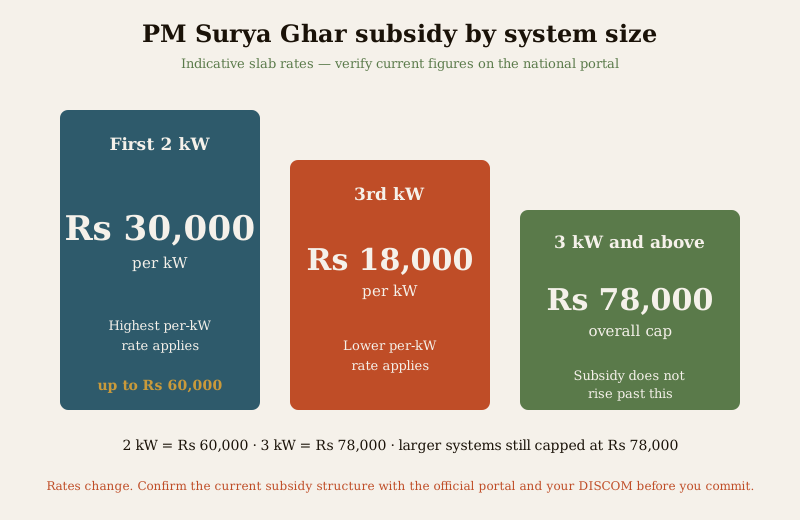
| System size | How the subsidy builds (indicative) | Indicative total subsidy |
|---|---|---|
| 1 kW | About Rs 30,000 per kW for the first 2 kW | About Rs 30,000 |
| 2 kW | 2 kW at about Rs 30,000 per kW | About Rs 60,000 |
| 3 kW | First 2 kW at about Rs 30,000 + 3rd kW at about Rs 18,000 | About Rs 78,000 |
| 4 kW and above | Capped — subsidy does not rise past the 3 kW level | About Rs 78,000 (cap) |
These are indicative amounts as of now, shown to explain the shape of the scheme. Rates, slab boundaries and the cap are revised over time. Confirm the current subsidy figures on the official national rooftop portal and with your DISCOM before sizing your system around them.
The practical takeaway is that the subsidy rewards you most up to about 3 kW and gives you nothing extra for capacity beyond it. If your consumption justifies a larger system, that is fine — but you fund the part above 3 kW yourself, so weigh it against your actual usage and roof rather than chasing the subsidy. To match capacity to your bill, use the solar sizing calculator, and check the numbers for your own case with the PM Surya Ghar subsidy calculator and the solar payback and ROI calculator.
Who is eligible
The scheme is aimed squarely at homeowners with their own roof. The common eligibility conditions are straightforward, but all of them normally need to hold together.
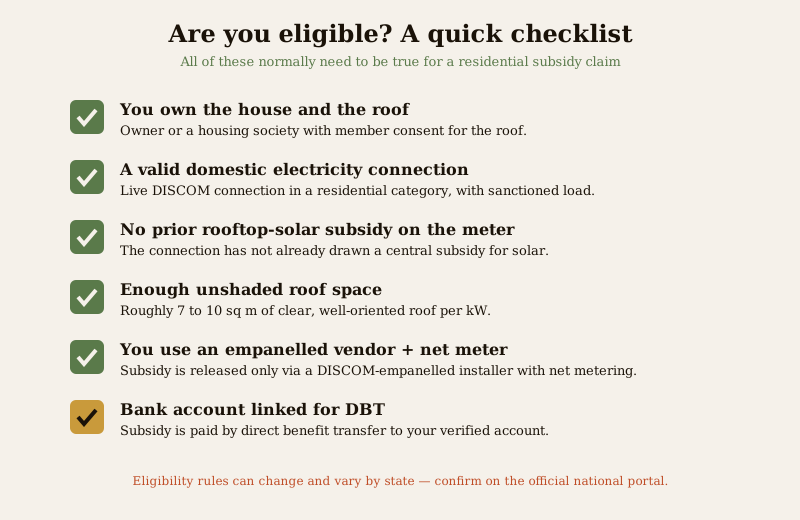
- You own the house and the roof. You should be the owner, or a housing society acting with member consent for a shared roof.
- You have a valid domestic electricity connection. A live DISCOM connection in a residential category, with a sanctioned load that covers the system.
- No prior rooftop-solar subsidy on that connection. The meter must not already have drawn a central subsidy for solar.
- You have enough unshaded roof space. Roughly 7 to 10 sq m of clear, well-oriented roof per kW — often the real limit, not the money.
- You use an empanelled vendor and net metering. The subsidy is released only through a DISCOM-empanelled installer with a net meter in place.
- You have a bank account for DBT. The subsidy is paid by direct benefit transfer, so a verified account linked in the application is essential.
If your sanctioned load is too low for the system you want, the DISCOM may ask you to enhance it before approving feasibility — plan for that step. For how the export side works and why net metering is non-negotiable for the subsidy, see the net metering explainer.
How to apply, step by step
The application runs on the national rooftop portal and threads through your DISCOM and an empanelled vendor. You drive the paperwork; the installer and DISCOM do the physical and grid work.
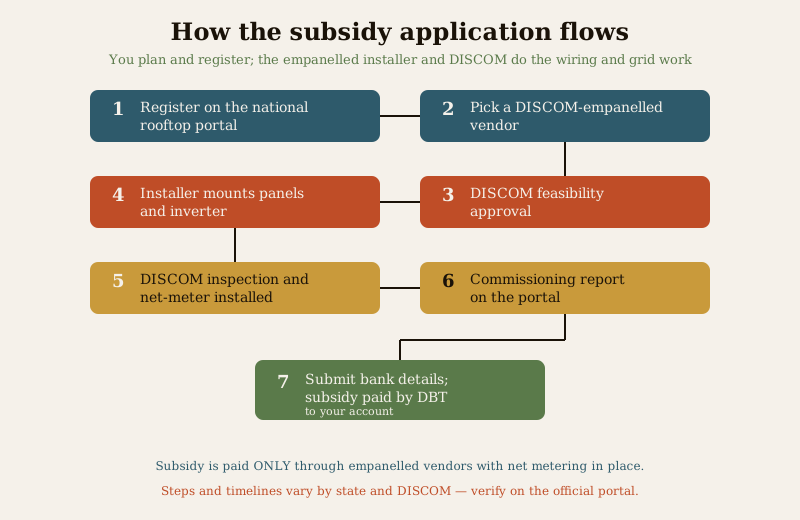
1. Register on the national rooftop portal. Create your account with your state, DISCOM and consumer number, and file the rooftop-solar application.
2. Pick a DISCOM-empanelled vendor. Choose an installer from the empanelled list for your DISCOM — using an empanelled vendor is what keeps the subsidy claim valid. Compare quotes and warranties; do not pick on price alone.
3. Get DISCOM feasibility approval. The DISCOM checks that your connection and the local grid can take the proposed system and clears it (this is where a load enhancement may be flagged).
4. Installer mounts the panels and inverter. The empanelled installer does the mounting and wiring to the module and inverter safety standards.
5. DISCOM inspection and net meter. The DISCOM inspects the installation and fits the bidirectional net meter that measures import and export.
6. Commissioning report on the portal. The commissioning details are uploaded so the system is on record as installed and net-metered.
7. Submit bank details; subsidy paid by DBT. You provide bank details on the portal and the subsidy is transferred to your account by DBT.
For the hardware side of these decisions — what inverter to specify and how it ties into the system — see the solar inverter buying guide.
Typical timelines and common issues
The whole process, from registration to subsidy in the bank, commonly runs across a few weeks to a few months depending on your DISCOM's workload and how quickly each approval clears. The table below shows an indicative shape; your DISCOM's actual timelines will differ.
| Stage | What happens | Indicative time |
|---|---|---|
| Registration and application | Account, consumer details, application filed | 1 to 3 days |
| Vendor selection | Compare and appoint an empanelled installer | A few days to a week |
| DISCOM feasibility approval | Grid and load check, approval | 1 to 3 weeks |
| Installation | Mounting, inverter, wiring by the installer | A few days |
| Inspection and net meter | DISCOM inspection, net meter fitted | 1 to 3 weeks |
| Commissioning and DBT | Report uploaded, bank details, subsidy transfer | 2 to 6 weeks |
Timelines are indicative and vary widely by state and DISCOM. Verify current turnaround and any documentation your DISCOM needs on the official portal.
The friction usually shows up in a few predictable places:
- Vendor empanelment. A vendor you like may not be empanelled for your DISCOM, or drops off the list. Confirm current empanelment before you sign — only an empanelled vendor keeps the subsidy valid.
- Load sanction. If your sanctioned load is lower than the system needs, feasibility can stall until you apply for a load enhancement. Check this early.
- DBT delays. The subsidy pays only after inspection, net meter and commissioning are all recorded, and the bank details are verified. Mismatched or unverified bank details are a common cause of held-up transfers — get them right on the portal.
None of these are reasons not to apply; they are reasons to work with a competent empanelled installer who has run the process before and to keep your own paperwork clean.
Key takeaways
- PM Surya Ghar Muft Bijli Yojana pays a one-time capital subsidy on residential rooftop solar, released by DBT after installation and net metering.
- The subsidy is slab-based: a higher per-kW amount for the first 2 kW, a lower amount for the 3rd kW, and an overall cap at 3 kW and above — indicatively about Rs 30,000, Rs 60,000 and Rs 78,000 for 1, 2 and 3 kW.
- Eligibility centres on owning the roof, a valid domestic connection, no prior subsidy, enough unshaded roof, an empanelled vendor with net metering, and a bank account for DBT.
- The subsidy is released only through a DISCOM-empanelled vendor with net metering — skip either and you forfeit it.
- Common snags are vendor empanelment, load sanction and DBT delays; a competent empanelled installer and clean paperwork prevent most of them.
- Every rate, slab and rule here is indicative and changes — verify the current figures on the official national rooftop portal and with your DISCOM.
References
- Ministry of New and Renewable Energy (MNRE) — PM Surya Ghar Muft Bijli Yojana scheme documents and the national rooftop solar portal (for current subsidy slabs, eligibility and application steps).
- Your state DISCOM — net-metering policy, empanelled-vendor list, feasibility and inspection procedures.
- Studio Matrx — rooftop solar guide, net metering explainer, solar power for homes, solar inverter buying guide, and the PM Surya Ghar subsidy calculator, solar payback and ROI calculator and solar sizing calculator.
Export this guide
Related Guides — Deep-dive reading
Rooftop Solar Approvals & Net Metering in India: The Permissions You Actually Need
The approvals side of putting solar on an Indian roof — not how solar works, but the permissions: the DISCOM net-metering application and feasibility, an empanelled installer, the structural load check, the electrical safety inspection, the PM Surya Ghar subsidy, and metering and commissioning. These are DISCOM, state and MNRE rules — not one national IS code — so amounts and caps change; always confirm the current rule locally.
RoofingRooftop Solar for Indian Homes: The Complete Guide
How rooftop solar actually works and pays back — the panels, inverter and net meter, the on-grid, off-grid and hybrid choice, how much roof and money a system needs, the PM Surya Ghar subsidy and net metering, and how to judge a good installation.
Electrical & WiringResidential Electrical Systems: The Complete Guide for Indian Homes
How the electricity in an Indian home actually works — from the utility supply and meter through the distribution board, circuits, wiring, earthing and protection, to lighting, safety, energy efficiency, smart controls, solar and backup — written so a homeowner can understand, plan and judge it, and know exactly where a licensed electrician must take over.
Electrical & WiringRelated Tools — Try Free
Solar Sizing Calculator
Size a rooftop solar system from your monthly electricity use — the kW system, number of panels, roof area and yearly generation.
SolarElectrical Safety & Load Audit
Home electrical audit — 10 categories, 65+ checkpoints across earthing, RCCB, MCB, wiring, switchboards, appliance circuits, DG/inverter backup.
Safety AuditPM Surya Ghar Subsidy Calculator
The indicative PM Surya Ghar rooftop-solar subsidy for your system size, on the current slab structure. Verify officially.
Solar Calculator