
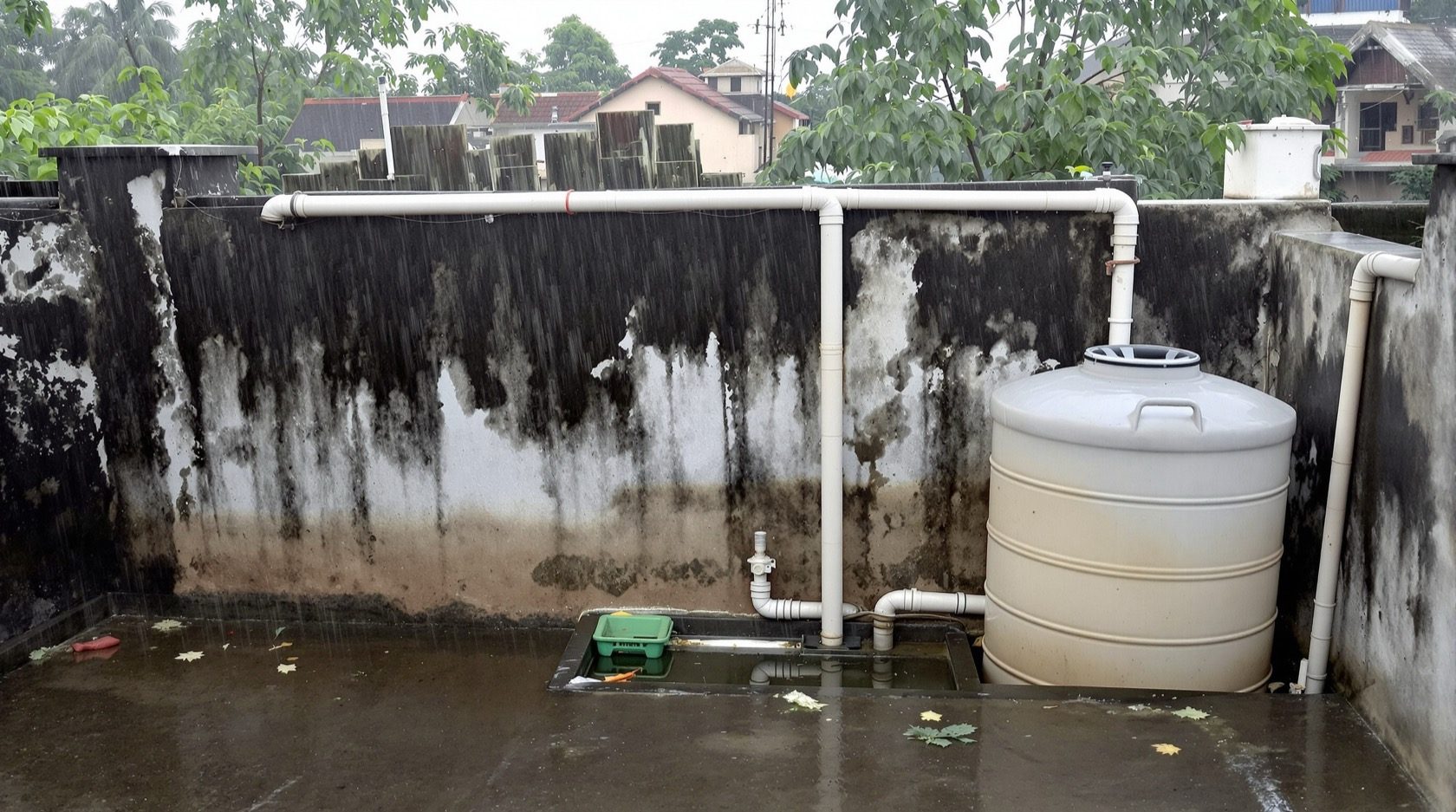
Rooftop Rainwater Harvesting Rules in India: Where It's the Law
In much of India, a rooftop rainwater harvesting system is not a green extra — it is a condition of your building sanction, completion and occupancy certificate. What the rule typically requires, the standard it points to (IS 15797), who designs and certifies it, and why the exact threshold, rebate and penalty are set by your city, not the country.
Somewhere in the pile of drawings that wins a building sanction in most Indian cities, there is a small detail you may never have noticed: a rooftop rainwater harvesting (RWH) provision, drawn on the plan, that the authority expects to see built before it will hand over an occupancy certificate. For a growing majority of urban homes, harvesting the rain is no longer a voluntary good deed. It is a rule — a condition attached to the sanction, checked at completion, and in many places tied to either a property-tax rebate for doing it or a withheld certificate for not.
This is the regulatory companion to our rooftop rainwater harvesting guide, which covers the technical side — the parts, the two paths (store or recharge), sizing and upkeep. Here we answer a narrower, more anxious question: where is rooftop RWH actually the law, how does that rule work, and what does it mean for your approval and your paperwork? It sits inside the Roofing Knowledge Hub and the wider Ultimate Guide to Roofing Systems, where the roof is treated not just as shelter but as a regulated water catchment.
One caution before anything else, and it governs this whole guide: rainwater harvesting rules in India are set locally. There is a national reference standard and a national building code that describe how to harvest, but the mandate itself — whether it applies to your plot, above what size, with what rebate or penalty — comes from your municipal corporation, your development authority or your state government. Everything below is written as typical practice. Treat it as a map of what to expect, then confirm the exact numbers with your own city.
Scope & safety. This guide helps you understand what the rainwater harvesting rules typically require, who certifies compliance, and what paperwork to keep. It does not design a system, size a recharge structure, or tell you your city's exact threshold. The RWH provision on your plan is designed and certified by a licensed architect or engineer, built by a plumber or RWH contractor, and approved by the local authority — the owner's job is to ensure it is done and to keep the records. Rules, thresholds, rebates and penalties vary by city and state and change often; every figure here is illustrative. Confirm your city's current rule with your municipal corporation or development authority before you rely on it.
The short version: in most Indian cities, it is mandatory
Across the last two decades, water-stressed states and cities — Tamil Nadu, Karnataka, Delhi, Rajasthan, Maharashtra, Telangana, Haryana and many more — have written rooftop rainwater harvesting into their building bye-laws and development-control rules. The pattern is remarkably consistent even though the numbers are not:
- It is a condition of building permission. The RWH provision has to appear on the sanctioned plan before construction is approved.
- It is inspected before occupancy. The authority looks for the built system at the completion / occupancy-certificate (OC) stage; no system, no clean OC in many cities.
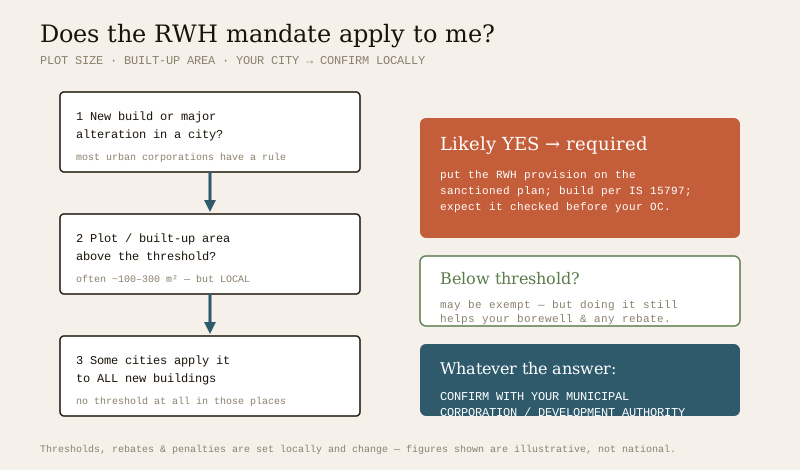
- It is usually threshold-based. The mandate commonly kicks in above a plot area or built-up area limit — many cities require it for plots above roughly 100 to 300 square metres, but the exact figure is local and some cities apply it to all new buildings.
- Carrot and stick both appear. Some corporations offer a property-tax rebate for a working system; many attach a penalty, a higher water tariff, or a withheld certificate for non-compliance.
The honest summary: if you are building or substantially renovating in urban India, assume RWH is required until your architect confirms otherwise, not the other way around. For how this interlocks with the rest of your approvals, see our guides to roof building bye-laws and roofing building codes and standards.
The standard behind the rule: IS 15797
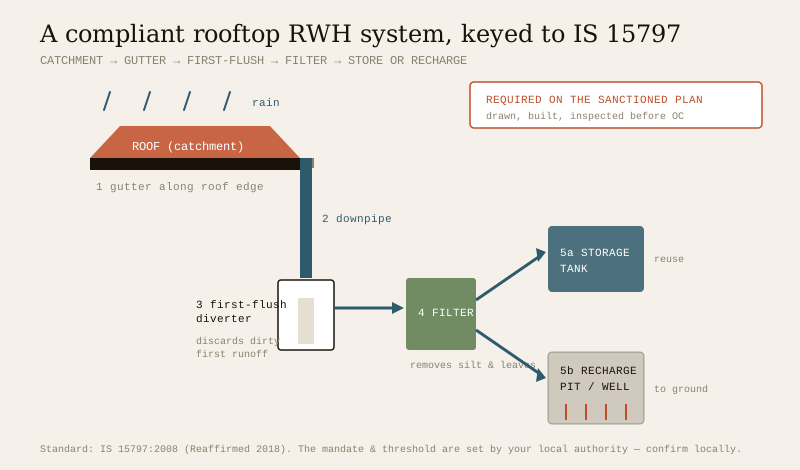
When a bye-law says a building must have rainwater harvesting, it rarely spells out the engineering in detail. It leans on a standard. The reference most Indian rules point to is IS 15797:2008 (Reaffirmed 2018) — Roof Top Rainwater Harvesting — Guidelines (Bureau of Indian Standards, Water Resources Division). It is an active, current standard, and it lays out the sensible chain every good system follows: a clean roof catchment, gutters and downpipes to collect the runoff, a first-flush arrangement to discard the dirty initial wash, a filter, and then either storage for reuse or a recharge structure (pit, trench, shaft or well) to return water to the ground. That is the same chain drawn in Figure 1 above and detailed technically in the rooftop rainwater harvesting guide.
The National Building Code of India — published by BIS as SP 7, the widely-used 2016 edition (SP 7:2016) now withdrawn and superseded by SP 7:2026 — also carries rainwater-management and sustainability provisions by topic, treating on-site rainwater retention and recharge as part of good building-services and water-conservation practice. Because the 2026 edition's part structure has not been independently confirmed here, refer to these as the National Building Code's rainwater-management and sustainability provisions rather than by a fixed part number, and verify the current edition and its structure via the BIS catalogue. Some states also draw on Central Ground Water Authority / Central Ground Water Board (CGWA / CGWB) guidance for recharge in notified areas, and on their own state water-policy notifications.
| What it is | Who publishes it | What it governs | How to cite it |
|---|---|---|---|
| IS 15797:2008 (Reaffirmed 2018) | Bureau of Indian Standards | Roof-top rainwater harvesting guidelines — catchment, first-flush, filter, storage, recharge | Verified active; you may state this edition |
| National Building Code (SP 7) | Bureau of Indian Standards | Rainwater-management & sustainability provisions, by topic | 2016 edition withdrawn → SP 7:2026; verify current structure via the BIS catalogue |
| CGWA / CGWB guidance | Central Ground Water Authority / Board | Recharge in notified / over-exploited groundwater areas | Central guidance, not a single IS code; confirm applicability locally |
| Municipal / DCR bye-law | Your municipal corporation / development authority / state | The actual mandate: threshold, rebate, penalty | Local — confirm the current text with your authority |
The takeaway: the IS standard and the code tell you and your engineer how to build a good system; the local bye-law tells you whether you must, above what size, and what happens if you do or do not. Never mistake the standard for the mandate.
How the mandate typically works, stage by stage
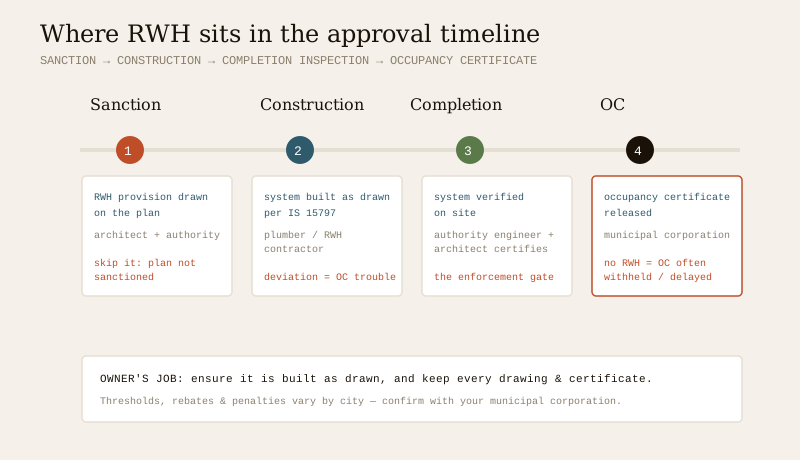
The rule almost always rides along your normal building-approval journey rather than being a separate application. It shows up at four moments.
| Stage | What is typically required | Typical consequence of skipping it |
|---|---|---|
| Sanction / building permit | RWH provision drawn and marked on the sanctioned plan by your architect; sometimes a rainwater-harvesting undertaking or affidavit | Plan not sanctioned / returned for correction |
| Construction | System built as drawn — catchment, first-flush, filter, recharge pit or storage per the approved detail | Deviation from the sanctioned plan; problems at completion |
| Completion / occupancy inspection | Physical system verified on site; completion drawings and, in some cities, a certificate from the architect / engineer that RWH is provided | Occupancy certificate (OC) withheld or delayed in many cities |
| Occupation & upkeep | System kept functional; some cities re-check for a continuing tax rebate or renewal | Rebate lost; penalty or higher water tariff in some corporations |
Notice where the pressure sits: the mandate is enforced hardest at the completion / OC gate, because that is the last point of leverage the authority has. This is exactly why the RWH provision has to be on the sanctioned plan from the start — retrofitting one after the fact, when the OC is stuck, is far costlier and slower than building it in. It is the same logic as the rest of your roof planning for a new home: decisions that touch approval belong in the drawings, not the snag list.
What varies by city and state, and what to confirm
This is the part that trips people up. Because the mandate is local, the three numbers that matter most — the size threshold, the rebate and the penalty — are exactly the three that differ from city to city. The table below shows the shape of what you will find, framed as typical; the specific figures are illustrative and must be confirmed with your municipal corporation or development authority.
| What varies | Typical pattern (illustrative — confirm locally) | What to ask your authority |
|---|---|---|
| Applicability threshold | Often plots above roughly 100–300 m², or above a stated built-up area; some cities apply it to all new buildings and to major alterations | What plot / built-up-area size triggers the rule here, and does it apply to renovations? |
| What counts as compliant | A working recharge structure and/or storage sized to the roof area, per IS 15797; sometimes a minimum recharge-pit volume per unit of roof | Is there a minimum pit / storage size, and does storage-only satisfy it or must I recharge? |
| Property-tax rebate | Some corporations give a modest rebate (often a small percentage of property tax) for a verified working system | Is there a rebate, how much, and what proof / inspection does it need? |
| Penalty for non-compliance | Withheld or delayed OC; a penalty charge; or a higher water / sewerage tariff until fixed | What is the penalty here, and is my OC or water connection affected? |
| Who inspects & certifies | Municipal / authority engineer verifies; architect or licensed engineer certifies on the completion drawings | Who signs off, and what document do I get as proof? |
The single most important line in that table is the last cell of the first row: does it apply to me at all? A small plot in one city may be exempt; the same plot in a water-stressed neighbouring city may not. Do not assume a figure you read for another city — or in this guide — is your figure.
Who designs it, who builds it, who certifies it
Because RWH is tied to your building approval, it is professional work with named responsibilities — not a homeowner DIY job. Knowing who owns each piece lets you ask the right person for the right document.
- Your architect places the RWH provision on the sanctioned plan, coordinates it with the roof, drainage and site levels, and in many cities signs the completion certification that the system is provided. This is where the mandate is actually satisfied on paper.
- A structural / civil or plumbing engineer (or an RWH specialist / hydrogeologist for recharge) sizes the storage or recharge structure to your roof area, rainfall and soil, and details the pit, trench or well. Recharge into the ground is a real engineering decision, not a template.
- The plumber or RWH contractor builds it — gutters, downpipes, first-flush, filter and the recharge or storage structure — including any work at height, which is their trade to do safely.
- The municipal corporation or development authority approves the sanctioned plan and inspects at completion. Its engineer is the one who ultimately decides your OC.
- You, the owner, make sure it actually gets built as drawn, keep every drawing and certificate, and maintain the system so any continuing rebate stays valid. You do not self-design it, self-certify it, or bypass the approval.
This division mirrors the one in our roofing contractor guide and the broader compliance picture in roofing building codes and standards: specify and decide, then let the licensed professionals design-to-code, certify and get the sign-offs.
What to ask for and keep
Compliance is proven with paper. The system on the roof is only half of it; the other half is the folder that shows the authority — and any future buyer — that it was sanctioned, built and certified. Ask for and keep the following.
| Document | Who provides it | Why you keep it |
|---|---|---|
| Sanctioned plan showing the RWH provision | Architect / authority | Proves the system was part of the approval, not an afterthought |
| RWH design detail / calculation | Engineer / RWH designer | Shows the recharge or storage was sized to your roof and rainfall (per IS 15797) |
| Completion drawings ("as-built") | Architect / contractor | Records what was actually installed for inspection and future service |
| Completion / architect's certification of RWH | Architect / licensed engineer | Often needed to release the occupancy certificate |
| Occupancy certificate (OC) | Municipal corporation / authority | The legal proof the building — RWH included — was approved for use |
| Property-tax rebate proof (if claimed) | Municipal corporation | Keeps the rebate valid and re-claimable |
| Filter / pump warranties & maintenance record | Contractor / you | Keeps the system working, which some cities re-inspect for the rebate |
Two homeowner-safe habits make the difference. First, get the RWH provision confirmed on the plan before you sanction, not discovered at the OC stage. Second, keep the completion certification with your other roof paperwork — alongside your waterproofing warranty and any structural-stability certificate — because the day you sell, a buyer's lawyer will ask for the OC, and a missing RWH sign-off is a common reason an OC gets stuck.
Rebates, penalties and the "why bother" answer
It is tempting to see the mandate as a box-ticking cost. Two things argue otherwise. The regulatory reason is simple: in many cities a clean occupancy certificate genuinely depends on it, and an OC is not optional — it affects your ability to get a completion sign-off, sometimes a water or power connection, and certainly a resale. The practical reason is that the system pays you back: a recharge structure props up the borewell you and your neighbours rely on, and a storage system gives you water you own when the tanker does not come. The rebate, where it exists, is a bonus on top of water you would want anyway.
For how a harvested system connects to the rest of the roof — getting the water off the roof cleanly, and keeping the terrace watertight while it sits under standing structures — see roof drainage, roof waterproofing and, if you are combining it with planting, green roofs.
Do the sums before you build
Two tools make the planning concrete. Use the rainwater harvesting calculator to estimate how much water your roof can actually collect — useful for sizing storage or a recharge pit and for the design detail your engineer will submit. And run the roofing compliance checklist so the RWH provision is captured alongside your other approval items rather than remembered late.
Where to go next
- Rooftop rainwater harvesting guide — the technical how-to: parts, sizing, storage vs recharge, upkeep.
- Roofing building codes and standards — the full map of codes and standards that govern a roof.
- Roof building bye-laws — how local bye-laws shape what you can build and how it is approved.
- Roof drainage guide — getting rainwater off the roof cleanly, the step before you harvest it.
- Roof planning for new homes — folding approval decisions into the drawings from the start.
- Green roof guide — when harvesting meets planted terraces.
- Roofing Knowledge Hub and the Ultimate Guide to Roofing Systems.
References
- IS 15797:2008 (Reaffirmed 2018) — Roof Top Rainwater Harvesting — Guidelines, Bureau of Indian Standards. Verify the current status via the BIS catalogue: https://www.services.bis.gov.in/
- National Building Code of India (SP 7) — rainwater-management and sustainability provisions, by topic. The 2016 edition (SP 7:2016) has been withdrawn and superseded by SP 7:2026; verify the current edition and its part structure via the BIS catalogue: https://www.services.bis.gov.in/
- Central Ground Water Authority / Central Ground Water Board — guidance on artificial recharge and rainwater harvesting in notified areas: http://cgwb.gov.in/
- Your municipal corporation / development authority building bye-laws or development-control rules — the source of the actual mandate, threshold, rebate and penalty. Confirm the current text with your local authority; figures in this guide are illustrative and vary by city and state.
- Related BIS references such as IS 456 (Plain and Reinforced Concrete) and IS 3067 (design and construction of waterproofing) for the structures that hold or carry the water — verify the current editions via the BIS catalogue: https://www.services.bis.gov.in/
Export this guide
Related Guides — Deep-dive reading
Rainwater Harvesting Rules in India: When RWH Is Mandatory & How to Comply
A plain-English guide to India's mandatory rainwater-harvesting rules for homeowners — why so many states and cities require RWH for buildings above a certain size, how it becomes a condition for plan sanction and completion certificate, and why the exact trigger, structure and rebate always come from your own local bye-laws.
PlumbingRooftop Rainwater Harvesting
The rain that lands on your roof is a free water supply and, in most Indian cities, a legal duty. What a rooftop rainwater harvesting system is, the two paths (store it for reuse or recharge the groundwater), the parts that make it work, how much a roof can actually collect, and the maintenance that keeps it honest. Plain language, India-grounded.
RoofingRainwater Harvesting Regulations Across India
Where harvesting rain is the law, not just a good idea: city-by-city rules, thresholds, penalties and how to get signed off
Building Regulations & ComplianceRelated Tools — Try Free
Rainwater Tank Sizer
How big should your rainwater tank be? Computes annual harvest, recommended tank capacity in litres, water-bill savings, and payback — for 10 Indian cities.
RWH CalculatorRainwater Harvesting Calculator
Estimate how much rainwater a roof can harvest in a year from its area, your annual rainfall and a collection coefficient.
Plumbing CalculatorRoofing Compliance Checklist
A tailored checklist of the approvals, certificates and standards that typically apply to a roof or terrace in India — by building type and work (sanction, structural stability certificate, fire, RWH, rooftop solar, occupancy). Print or save.
Printable