
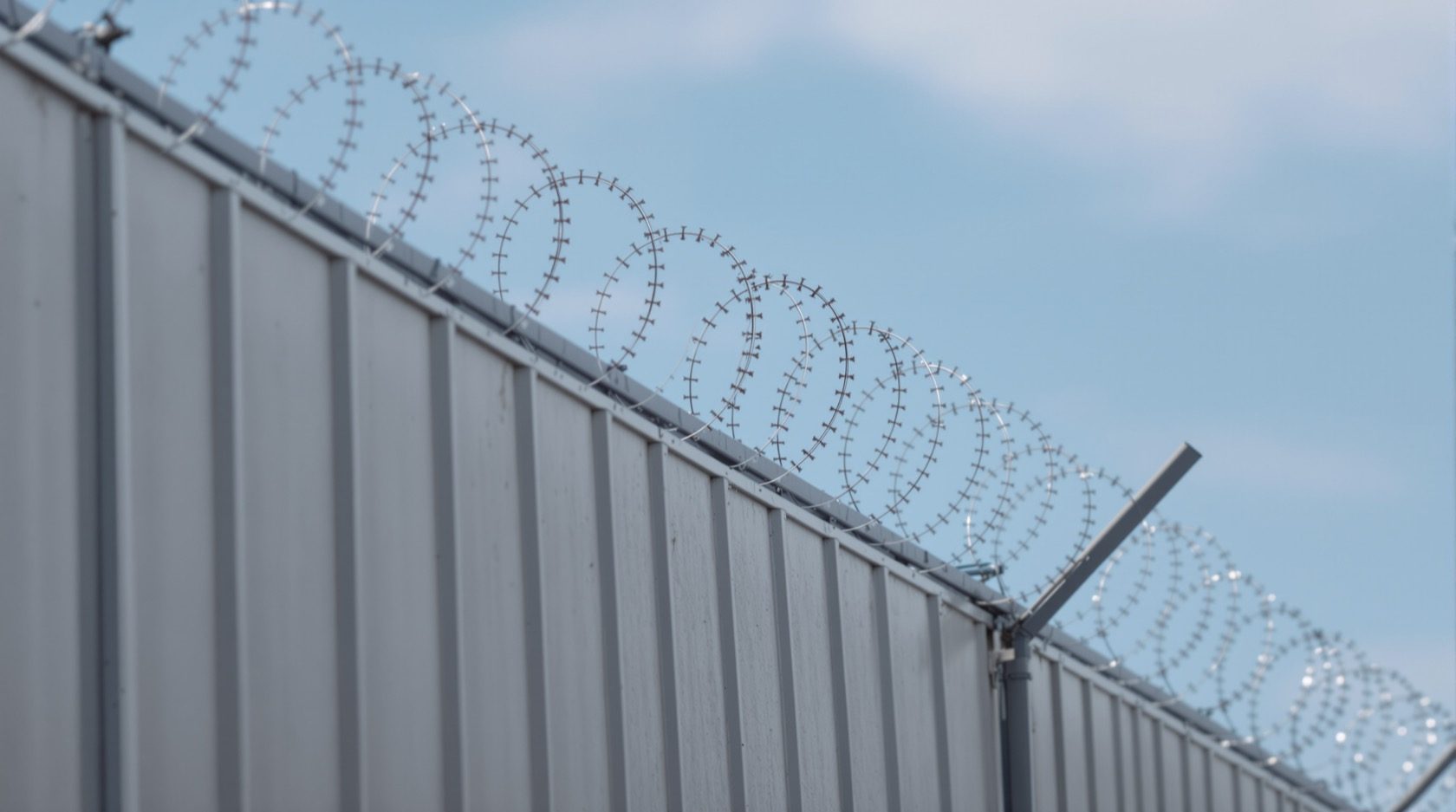
Razor Wire in India (2026): Security Use, Placement and the Legal & Liability Considerations
What razor wire and concertina coil really do as a perimeter topping, where it fits and where it does not, and the honest legal, injury-liability and humane trade-offs every Indian owner must weigh before stringing it up.
Few security products look as final as razor wire. A glinting coil of concertina along a wall-top says, plainly, "stop here." It is cheap, it delays a determined climber, and on a factory, warehouse, substation or farm boundary it can be exactly the right tool. But it is also the perimeter topping most likely to hurt someone who was never trying to break in — a child, a passer-by on a narrow lane, a stray animal — and to land the owner in a dispute or a liability claim. This guide, part of Studio Matrx's perimeter security library, treats razor wire honestly: what it is, where it genuinely fits, and the legal, injury-liability and humane considerations that come attached to every coil. It is strictly a planning-and-placement guide, never a how-to for defeating a barrier.
Scope, honesty & the law. Razor wire is a delay and deterrence topping — it buys time and warns intruders off; it does not detect anyone and it does not stop a truly determined person. That is why it belongs on top of a proper compound wall as one layer of a layered perimeter, paired with lighting, cameras and detection, never as a standalone answer. The serious part: razor wire can injure people who are not intruders, and an owner who mounts it carelessly — low, overhanging a public path, or where the public can touch it — can face injury-liability claims and may be breaking local municipal, RWA or development-authority rules. Installation is sharp, skilled, gloved work for a contractor. This is educational guidance, not legal advice — confirm your local rules before you buy.
What razor wire actually is
Razor wire is a steel strip or wire fitted with sharp, stamped barbs or blades at close intervals, designed so that anything pressing against it is gripped and cut rather than merely scratched. It is a cousin of ordinary barbed wire — the twisted double-strand wire with occasional barbs used for farm and boundary fencing, made to the Indian specification IS 278 : 2009 for galvanized steel barbed wire — but razor wire is a sharper, more aggressive generation of the same idea. Where barbed wire discourages, razor wire actively resists.
The security value is simple and worth stating plainly: it makes the top of a wall or fence hard and slow to cross. A climber who reaches the coil cannot vault it, cannot easily push it aside, and risks injury and torn clothing trying — so most opportunists do not try. That delay, and the visible threat of it, is the entire benefit. It is a delay-and-deter device, not a detector and not a trap.
- It is a topping, not a barrier on its own. Razor wire crowns a wall or fence; it assumes there is already a solid compound wall or security fence beneath it to climb. Strung between flimsy posts alone, it is weak and easy to distort.
- It delays; it does not detect. It will slow a climber, but nobody is told they are there unless you add perimeter detection — sensors, cameras or a taut-wire alarm — and lighting. Delay without detection just means a slower, unseen entry.
- It suits high-value, low-footfall sites. Its natural home is a factory, warehouse, godown, yard, substation, telecom site, farm or gated industrial estate — places with real assets, a genuine intrusion risk, and boundaries away from crowds. It is usually overkill, unwelcoming and legally risky on an ordinary home, where softer toppings do the job with far less liability.
The types, and how they differ
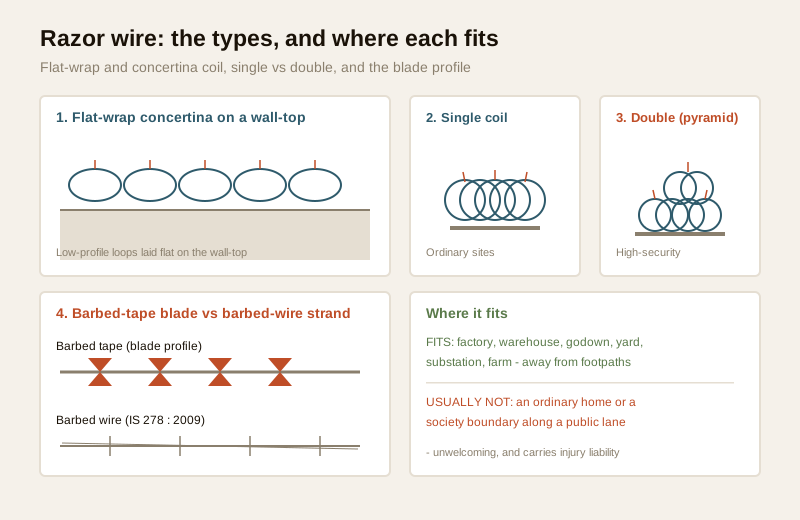
"Razor wire" covers a family of products. Choosing the right one is mostly about how much of a barrier you need and how it is mounted.
| Type | What it is | Typical use | Notes |
|---|---|---|---|
| Barbed wire (IS 278 : 2009) | Twisted galvanized strands with periodic barbs | Farm and boundary fencing, low-risk lines | The mildest; a deterrent line, easily overcome; the Indian-standard product |
| Barbed tape | A single steel strip stamped with sharp barbs | Straight wall-top runs, budget toppings | Sharper than barbed wire; laid flat or in short loops |
| Concertina / spiral coil | A helical coil of razor tape or wire, clipped so it springs open | The classic wall-top and fence topping | Expands into a coil; hard to compress or push aside; the common choice |
| Flat-wrap concertina | A flat, elongated loop version laid along a wall-top | Neat wall-tops where a fat coil looks bulky | Lower profile than a full round coil; still aggressive |
| Single vs double coil | One coil, or two coils with a third on top (pyramid) | Single for ordinary sites; double for high-security | Double/pyramid is a serious industrial barrier, wider and taller |
Two more distinctions matter when you buy:
- Blade (tape) profile vs wire core. A blade or "barbed-tape" profile has broad, sharp stamped blades on a steel-strip core — the aggressive, cutting kind. A lighter razor-wire profile has smaller barbs on a round wire. The bigger the blade and the tighter the barb spacing, the more injurious and the more "serious site" it reads as — and the more liability it carries near people.
- Corrosion protection. In Indian monsoon and coastal air, cheap razor wire rusts fast, going brittle and ugly within a couple of seasons and staining the wall below. Specify a properly galvanized (hot-dip) or stainless product, and expect to inspect and replace it periodically. Rust does not make it safer — a corroded coil is still perfectly capable of cutting a child, just uglier and weaker.
Where it fits — and where it really does not
The single most important decision is not which coil, but whether razor wire is the right topping at all. Run the site through an honest filter — the perimeter vulnerability assessment and the site perimeter assessment tool help structure this.
It genuinely fits a factory, warehouse, godown, industrial yard, cold store, substation, telecom or utility site, a farm or plot boundary far from footpaths, or the outer wall of a gated industrial estate — high-value assets, real intrusion risk, boundaries set back from the public, and a wall or fence solid enough to carry it. Even there it is one layer: pair it with lighting, cameras and perimeter detection, and keep the main gate — the real weak point — properly secured.
It usually does not fit an ordinary home. On a villa, an independent house or a housing-society boundary, razor wire is typically the wrong call for three honest reasons:
- Aesthetics and welcome. A coil of razor wire turns a home into something that looks like a jail or a compound under siege. For most families the message — to guests, neighbours and the street — is worse than the marginal security it adds. The guides on boundary-wall design and green boundary planting show far more liveable ways to make a wall harder to climb.
- Liability near people. A home boundary usually runs along a footpath or a shared lane where children, elderly neighbours, delivery riders and animals pass close. That is precisely the situation in which razor wire is most likely to injure the wrong person — and most likely to breach local rules (see below).
- Overkill for the risk. A typical residential risk is far better answered by anti-climb fencing, wall spikes, a taller smooth wall, or a certified non-lethal electric fence with signage, all of which deter without the cutting hazard. Match the barrier to the assessed threat, not to a wish to look impregnable.
The legal & liability core — read this before you buy
This is the part that gets owners into trouble, and it is why the user brief for this library flags razor wire and electric fencing as the two legally sensitive perimeter toppings. Razor wire is legal to own and install in most Indian contexts, but how and where you mount it decides whether it is a lawful security measure or a liability waiting to happen.
1. Injury liability to non-intruders. If your razor wire injures a passer-by, a child reaching through a gap, a delivery worker, or an animal, you — the occupier — can face a claim. Indian law recognises a broad duty on an occupier to take reasonable care that their premises, including the boundary, do not cause foreseeable harm to people lawfully nearby, and even to trespassers a purely reckless, unmarked hazard can attract liability. The defence "they should not have been near my wall" is weak when the wire was mounted where people obviously pass. The practical rules that follow all flow from this one principle.
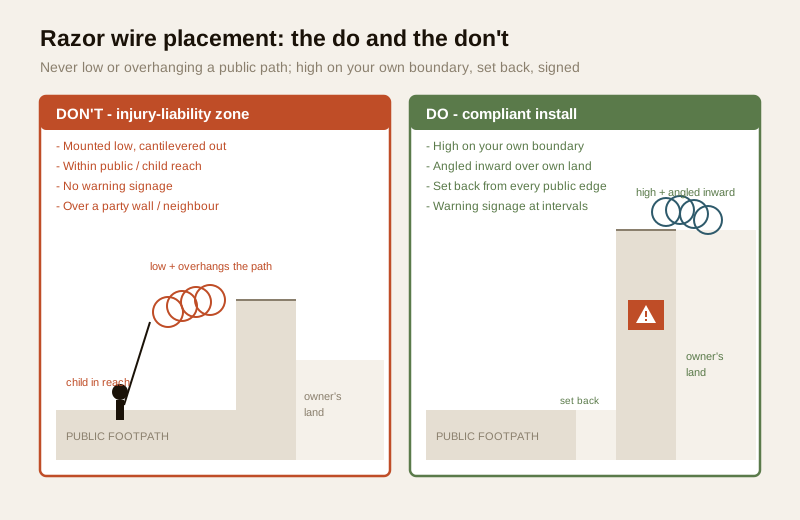
2. Never mount it low, overhanging, or within public reach. The classic and most dangerous mistake, seen all over India, is razor wire strung low on a boundary, leaning out over a public footpath or lane, or where anyone on the outside can touch it. Keep it:
- High on your own boundary, above head height, angled inward over your own land — never cantilevered out over the pavement or a neighbour's property.
- Set back from the public edge so a person walking past, or a child on the footpath, cannot brush against it or reach it.
- Off shared and party walls unless every affected party agrees in writing — a coil overhanging a neighbour's side invites both injury claims and boundary disputes.
3. Warn people it is there. Fix clear warning signage at intervals along any razor-wire boundary — a recognised hazard sign telling people the wall is topped with a cutting barrier. Signage does not erase liability, but an unmarked hazard is far harder to defend than a clearly warned one, and warning the public is simply the decent thing to do.
4. Check local municipal, RWA and development-authority rules. There is no single national razor-wire law, so the binding rules are local: municipal corporation or development-authority building bye-laws, cantonment or notified-area rules, and — inside a layout — the RWA or society by-laws. Some municipalities and many residential societies restrict or prohibit razor wire on residential boundaries or facing public roads, and some require it to sit within your setback and below a height. The local Police may also have a view where a boundary abuts a public way. Confirm what applies to your plot before you install — retrofitting or removing a coil after a complaint is expensive and public.
5. The life-safety interface — do not trap people in. A perimeter must never become a cage. Razor wire that seals a boundary with no quick, unobstructed escape route during a fire or emergency is a life-safety hazard to your own occupants and staff. Coordinate any razor-wire topping with egress: gates that open from inside without a key, a clear escape path, and nothing that would injure people fleeing in a panic.
| Do | Don't |
|---|---|
| Mount high on your own boundary, angled inward | Cantilever it out over a public footpath or lane |
| Set it back so the public cannot reach or touch it | Mount it low, at child height, or across a party wall |
| Fix clear warning signage at intervals | Leave it unmarked where people pass close |
| Check municipal / development-authority / RWA rules first | Assume it is allowed just because a shop sells it |
| Keep a clear internal escape route (egress) | Seal a boundary with no quick way out in an emergency |
| Use a licensed contractor with gloves and PPE | Have untrained hands string it, injuring the installer |
The humane and aesthetic downsides, honestly
Beyond the law, there is a plain question of decency and of how a place feels. Razor wire is designed to cut, and it does not distinguish between a burglar and a curious ten-year-old or a stray dog. Injuries to children and animals caught on razor wire are a real and recurring harm in India, not a hypothetical. A boundary that reads as hostile also changes a neighbourhood: it signals fear, it can lower how a street feels and even how properties around it are valued, and it rarely matches the welcome a home or a well-run community wants to project. None of this is an argument that razor wire is never justified — on the right industrial site it clearly is — but it is a strong argument for using the least aggressive topping that meets the assessed risk, and for reserving razor wire for places where the security need genuinely outweighs the human cost.
Kinder, safer alternatives that often do the same job
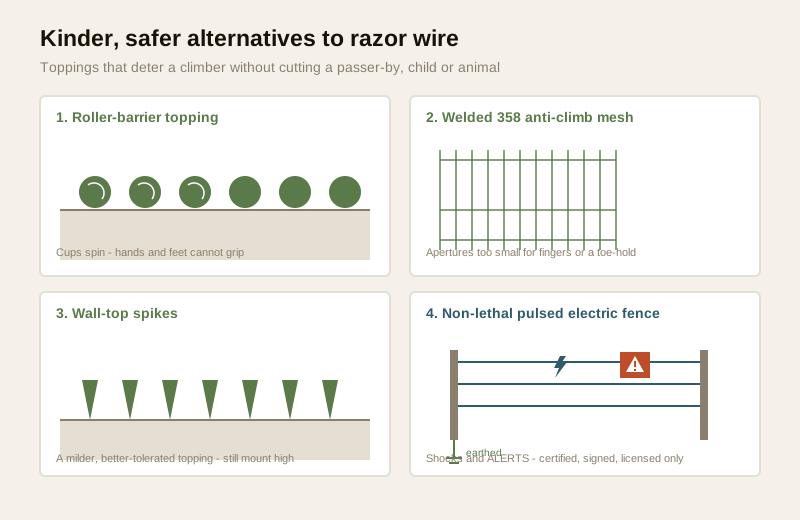
For most walls — and nearly every home — a gentler topping deters climbers with far less injury risk and legal exposure. Weigh these before defaulting to razor wire.
- Roller-barrier anti-climb toppings. A row of independently spinning cups or rollers along the wall-top: a climber's hands and feet cannot get purchase because the rollers simply turn. It stops the climb without cutting anyone, which makes it a strong, humane choice for schools, homes and public-facing boundaries. Covered in the anti-climb fencing guide.
- Welded 358 mesh ("prison mesh"). A high-security fence with apertures too small for fingers or a toe-hold and too tight to cut easily — a serious anti-climb barrier that injures no one who touches it. See security fencing.
- Wall spikes / anti-climb spikes. Plastic or metal spike strips along a wall-top deter climbing and are widely accepted as a milder, better-tolerated topping than razor wire — still to be mounted high and out of casual reach, with the same duty of care.
- Non-lethal, pulsed electric fencing. A certified non-lethal pulsed energizer fence delivers a sharp, safe, memorable shock and — crucially — can also alert you, adding detection that razor wire lacks. It must use an approved energizer to the applicable electric-fence safety standard, mandatory warning signage, proper earthing and a licensed installer, and some states or municipalities require permission for residential use. A mains-electrified or lethal fence is illegal and deadly — never that. Full detail in the electric fencing guide.
- A taller, smoother wall plus lighting and detection. Often the simplest answer: raise the wall within the permitted height, keep the face smooth and free of foot-holds, clear away climb aids (poles, trees, parked trucks, stacked material) next to it, and add lighting and perimeter detection. Height, smoothness and being seen deter more reliably than a cutting hazard.
Installation, PPE and upkeep
If, after the assessment, razor wire is genuinely the right topping, install and maintain it responsibly.
- Use a contractor, with PPE. Razor wire injures installers more often than intruders. It is unrolled and clipped under tension by trained hands wearing heavy gauntlet gloves, arm protection, eye protection and sturdy clothing, using the right tools. This is not a DIY afternoon; a slip strips skin. Engage a fencing contractor who does it routinely.
- Mount it properly. Fix it to sound brackets or a rigid extension arm on top of a solid wall or fence, angled inward over your own land, at a height and setback that keeps it out of public reach. A coil sagging onto a footpath is both useless and dangerous.
- Sign it and inspect it. Put up warning signage, then inspect after each monsoon: check for rust, sagging, a coil that has drifted outward over the boundary, or damage that has left a sharp end in reach. Replace corroded sections — a rusted coil is weaker and no less able to cut.
- Coordinate the other layers. Razor wire only earns its place inside a system: solid wall, secured gate, lighting, cameras, perimeter detection and a response plan. Use the home-security risk scorecard to check the whole boundary, not just the topping, and the wider electrical hub for any powered element such as lighting or an electric fence.
When to bring in a professional — and the law & liability. Before you buy a metre of razor wire, do three things: run an honest perimeter risk assessment to confirm the threat justifies it; check your municipal, development-authority and RWA rules (some restrict or ban it on residential or road-facing boundaries); and confirm you can mount it high, inward and set back from every public edge, with warning signage. Then hand the install to a licensed fencing contractor with proper PPE. Remember the occupier's duty of care: razor wire that injures a passer-by, child or animal — especially one mounted low, overhanging a path, or unmarked — can bring a real liability claim. When in doubt, choose a humane anti-climb topping instead. This is educational guidance, not legal advice.
Key takeaways
- Razor wire is a delay-and-deter topping, not a barrier or a detector — it crowns a solid wall or fence inside a layered perimeter with lighting, cameras and detection, and suits factories, warehouses, yards and sensitive sites far more than homes.
- Know the types: barbed wire (IS 278 : 2009), barbed tape, and concertina/spiral coil in flat-wrap, single or double/pyramid form — bigger blades and tighter coils mean a more serious barrier and more liability near people.
- The legal core is placement: mount it high on your own boundary, angled inward, set well back from any public path, never low or overhanging, with warning signage, and check local municipal, development-authority and RWA rules first — some restrict or ban it in residential areas.
- Injury liability is real: an occupier can be liable if razor wire harms a passer-by, child or animal, and it must never trap occupants inside during a fire — coordinate it with a clear escape route.
- Prefer the kinder alternative when it fits: roller-barrier toppings, welded 358 mesh, wall spikes or a certified non-lethal electric fence deter climbers without cutting anyone — use the least aggressive topping that meets the assessed risk.
References
- IS 278 : 2009 (Reaffirmed 2020), Galvanized Steel Barbed Wire for Fencing — Specification, Bureau of Indian Standards — the Indian standard for the barbed-wire family related to razor-wire toppings; verify the current edition via the BIS catalogue: https://www.services.bis.gov.in/
- National Building Code of India (SP 7 : 2026), Bureau of Indian Standards, together with your local municipal corporation or development-authority building bye-laws — for permitted compound-wall height, boundary setback and what may be mounted on a boundary facing a public road; these vary by city and authority, so confirm locally: https://www.services.bis.gov.in/
- Local Police and municipal / development-authority rules, and RWA or society by-laws — for any restriction on razor wire (and electric fencing) on residential or road-facing boundaries and the occupier's duty of care to passers-by; confirm what applies to your plot before installing.
- The applicable IS/IEC electric-fence energizer safety standard (for example the IEC 60335-2-76 family — verify) — relevant if you choose a non-lethal pulsed electric fence as an alternative topping; a mains-electrified or lethal fence is illegal.
This is an educational overview, not legal advice, and it is strictly about deterring and delaying an intruder, never about defeating a barrier. Razor wire carries real injury-liability and local-regulation risk: verify your municipal, development-authority, RWA and Police rules, confirm any standard's current status via the BIS catalogue, and engage licensed contractors before relying on anything here.
Export this guide
Related Guides — Deep-dive reading
The Complete Guide to Perimeter Security in India (2026): Walls, Barriers, Detection & Response
The definitive overview of perimeter security for Indian homes, plots and gated communities — how to layer deterrence, delay, detection and response from the boundary line inward so a wall becomes a system, not just a barrier.
SecurityElectric Fencing for Security in India (2026): The Legal, Non-Lethal Way to Deter & Alert
How a certified, pulsed, non-lethal electric fence lawfully deters and alarms at your perimeter, why a mains-electrified lethal fence is illegal and deadly, and the compliance every installation must meet.
SecurityElectric Fencing Legal Requirements in India (2026): Deterrent, Not Deadly
What separates a lawful security electric fence from a dangerous, illegal one. A plain-language guide for homeowners, farmhouses, societies and commercial sites to the safe pulsed energizer, warning signage, earthing, permissions and owner liability that decide whether your fence is legal.
SecurityRelated Tools — Try Free
Stamp Duty Calculator — All Indian States
Stamp duty + registration charges for all 28 states and 8 UTs — gender concessions, urban/rural variants, metro cess built in.
Stamp DutyHome Security Risk Scorecard
Score your home across six security layers — perimeter, entry points, lighting, detection, alarm and habits — and get a prioritised action plan.
Security ScorecardChild & Elder Home-Safety Audit
Room-by-room safety audit for households with children or seniors — 10 categories, 70+ checkpoints tagged by audience.
Safety Audit