
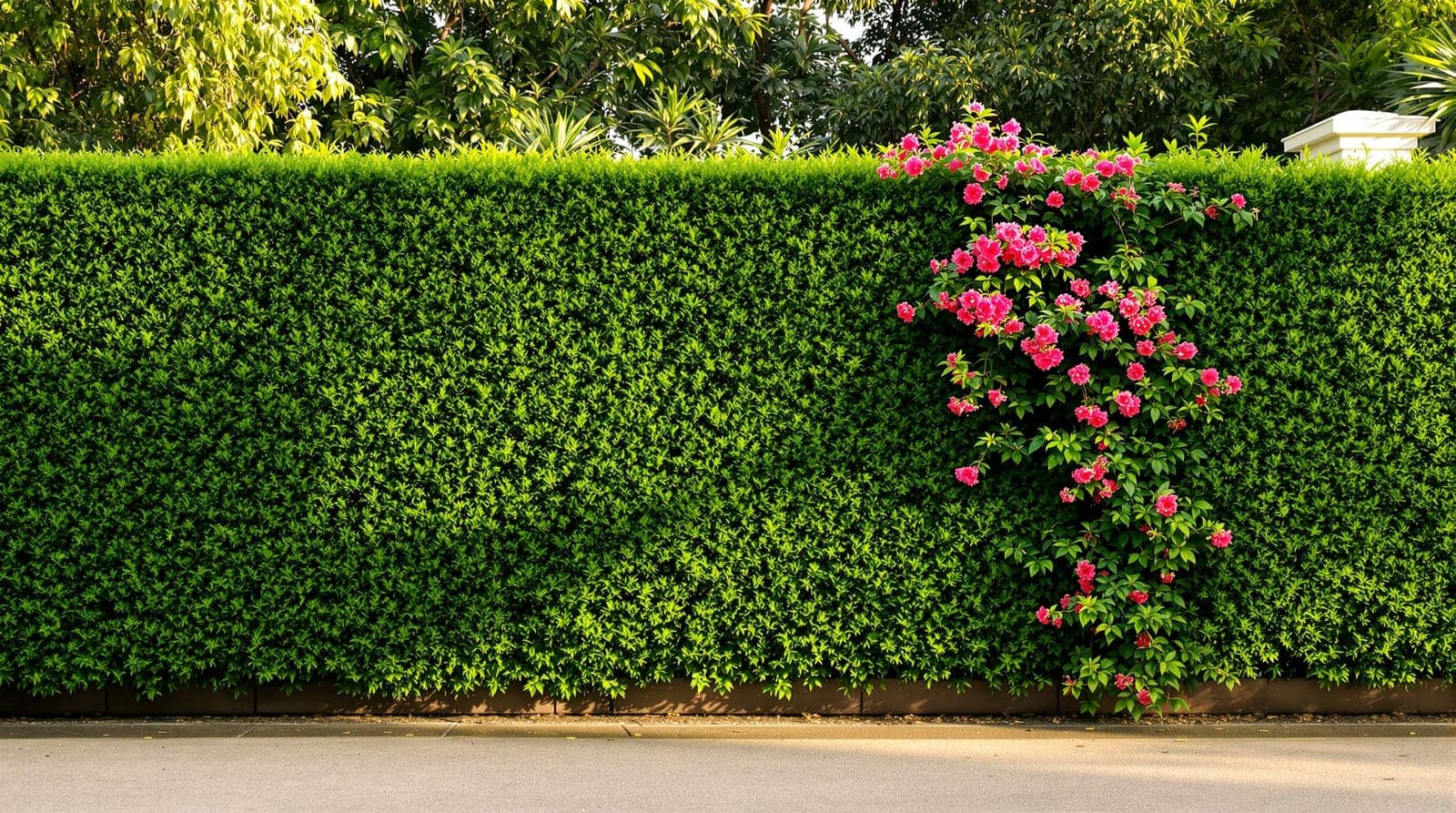
Green Boundaries & Boundary Plants
The living boundary — clipped and flowering hedges, screening trees, creeper-clad fences and bamboo, with the Indian boundary-plant palette, spacing, security and maintenance
A green boundary is a living edge to your plot — a clipped hedge, a flowering screen, a creeper-clad fence or a wall of bamboo — that does the job of a compound wall while staying cooler, breathing in the breeze, sheltering birds and bees, and costing far less over its lifetime than the brick-and-cement alternative. In a country where the standard reflex is to throw up a seven-foot RCC wall and be done with it, the green boundary is the quietly smarter choice for the part of your edge that does not need to stop a truck.
This guide is specifically about the planted boundary and the plants that make it. It is the horticultural companion to two sister guides: if you want to design the built wall itself — the brick, the stone cladding, the jaali, the gate — read Boundary Wall Design Ideas. If you want the broader strategy of sight-lines, what overlooks what, and how much privacy you actually need where, read Landscape Privacy Design. Here we stay in our lane: choosing, planting and growing the green edge.
Why a green boundary at all
A compound wall is permanent, instant and dumb. A green boundary takes time to grow but pays you back every year it is alive.
- It is cooler. A masonry wall in Delhi or Nagpur stores the afternoon sun and radiates heat into your garden well into the night. A hedge transpires, shades the ground and stays close to ambient temperature.
- It breathes. A solid wall blocks the cross-breeze your rooms depend on. A hedge filters air through while still cutting the view — you keep the evening monsoon breeze and lose the neighbour's stare.
- It is cheaper over time. A green boundary costs a fraction of a masonry wall to establish and needs no waterproofing, no plaster, no repainting every few years.
- It is habitat. Murraya, Hibiscus and Duranta pull in sunbirds, butterflies and bees; a Carissa or Ficus hedge gives small birds nesting cover. A dead wall gives them nothing.
- It softens or replaces. Use plants instead of a wall on the safe interior boundary, or to green and cool an existing wall you already have.
The honest trade-off is time and tending. A wall is finished the day the mason leaves. A hedge takes one to three years to become a real screen and wants clipping two to four times a year forever. Decide which edges deserve which treatment.
The types of green boundary
There is no single "hedge". Pick the form that suits each edge of your plot, the maintenance you will actually do, and how fast you need privacy.
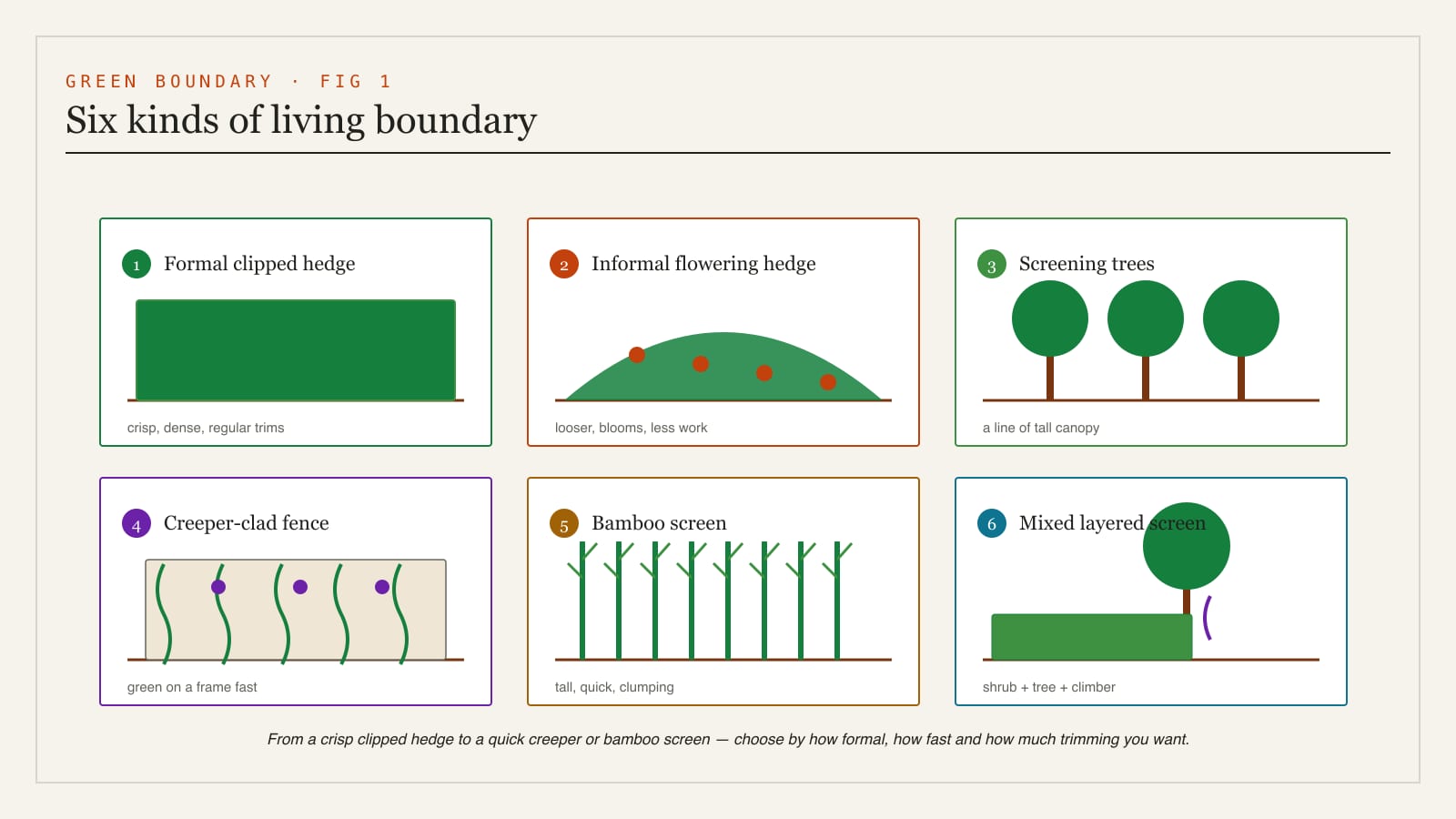
- Formal clipped hedge. A single species, planted close, sheared into a crisp wall of green — Ficus nitida, Duranta, Murraya or Thuja. Tidy, architectural, dense. Wants regular clipping (three to four times a year) to stay sharp.
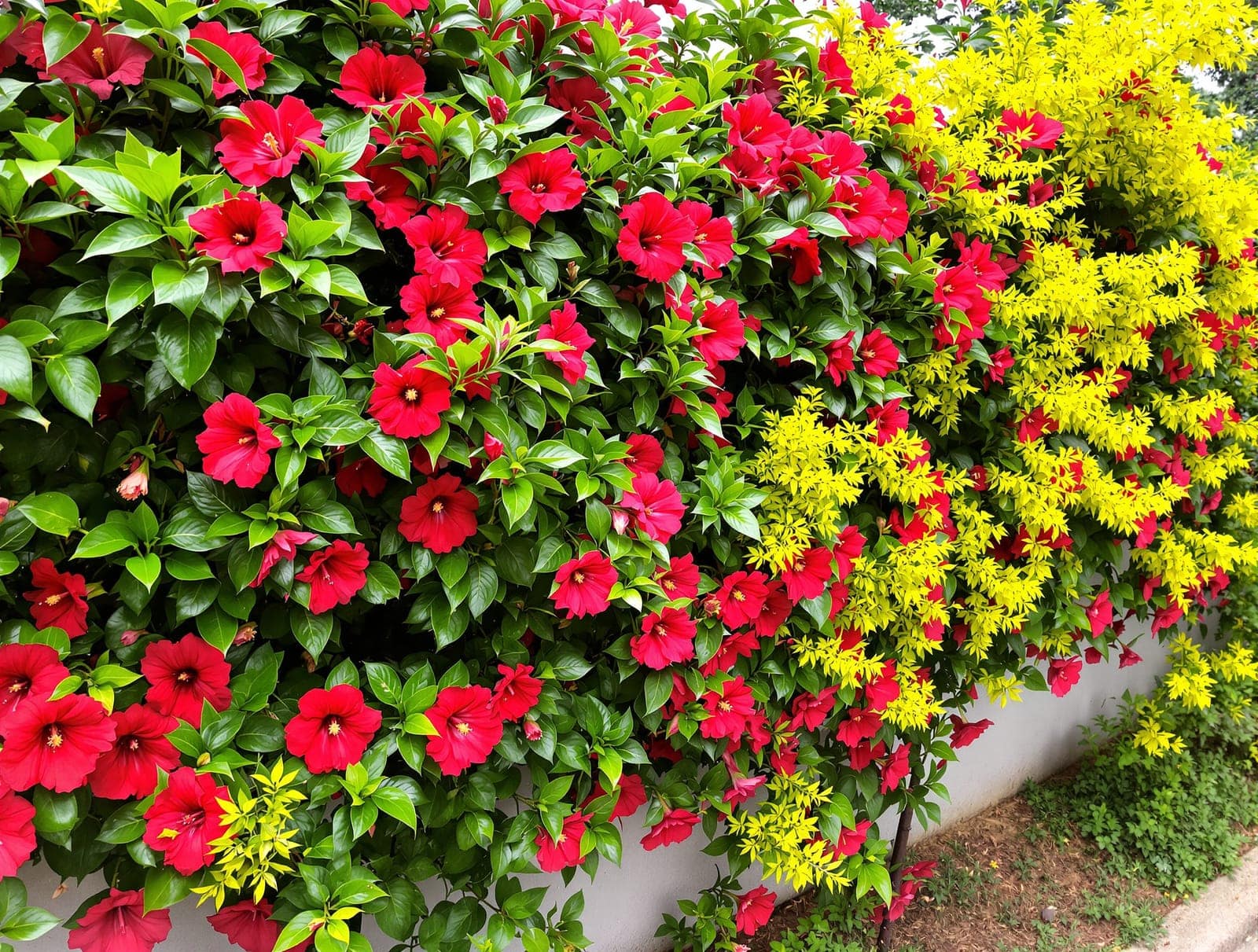
- Informal flowering hedge. Looser, taller, allowed to flower — Hibiscus, Tecoma, Clerodendrum, Lantana. Colour and pollinators, far less clipping, but it sprawls wider and reads softer.
- Line of screening shrubs or trees. Where you need height fast and a deep buffer, a row of fast tall shrubs or small trees (Syzygium, Polyalthia, large Ficus). More about blocking a distant view than edging the plot — for the species choice here, see Best Trees for Indian Homes.
- Creeper-clad wall or fence. A climber on a chain-link fence, mesh or trellis gives you a green screen in a single season — Madhumalti, Bougainvillea, Passiflora. The cheapest fast green; needs a structure to climb.
- Bamboo screen. Tall, vertical, evergreen and dramatic. Use clumping (sympodial) bamboo such as Bambusa species — never running bamboo, which invades. A magnificent tall screen on a narrow footprint.
- Mixed, layered living screen. The most natural and bird-friendly: a low front row, a flowering middle, a tall back row. Reads like a planting, not a hedge, and screens at every height. Wants the most space.
- Green wall. A vertical planted system bolted to a built wall — a different beast entirely, structural and irrigated. That belongs with the built edge; see Boundary Wall Design Ideas.
The Indian boundary-plant palette
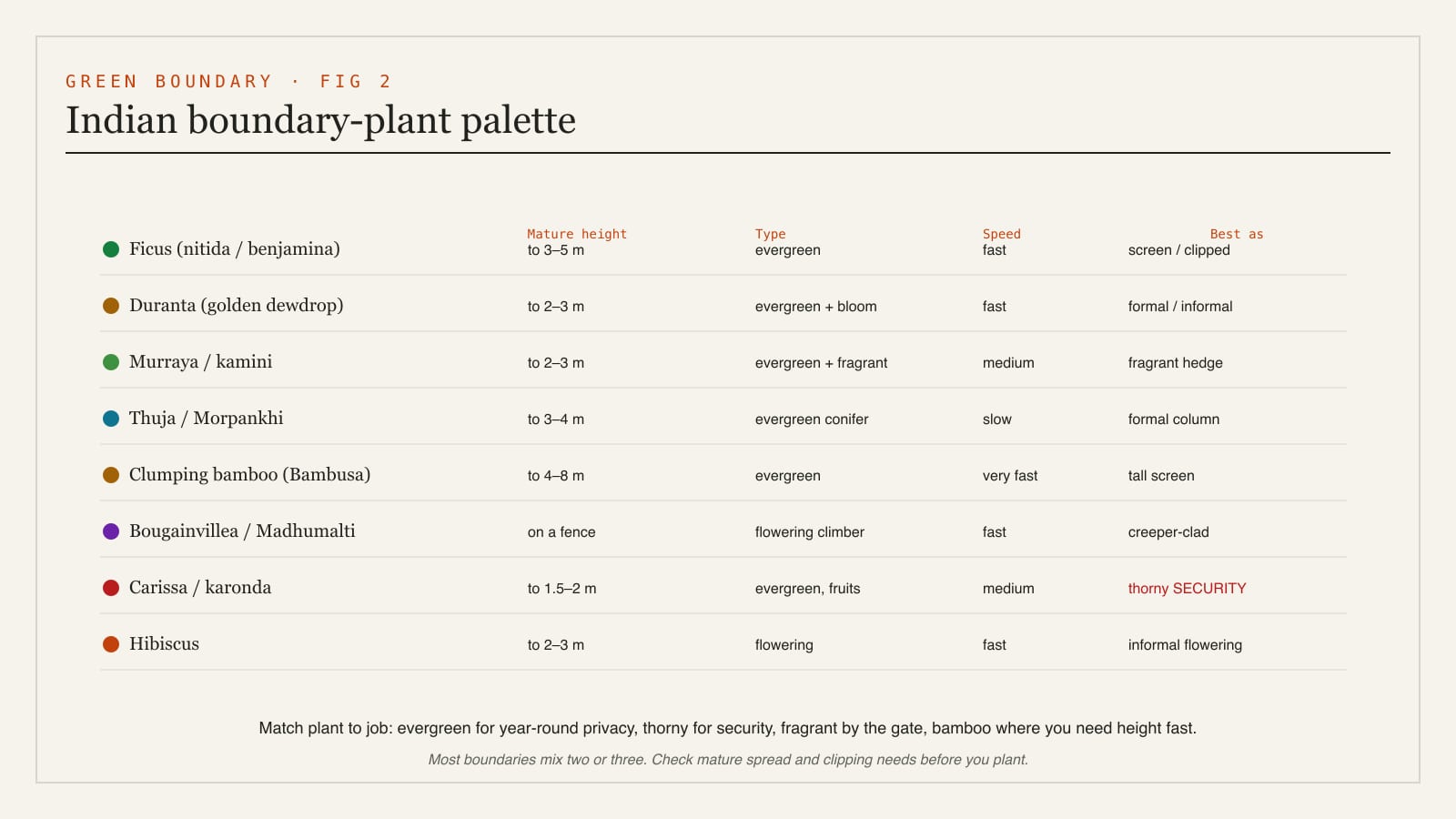
This is the heart of the matter. The right plant depends on your climate zone, how tall you need it, whether you want flowers, how fast you need cover, and whether security matters. The table below covers the workhorses you will actually find at Indian nurseries.
| Plant (common name) | Type | Mature height | Evergreen? | Flowering? | Growth speed | Thorny / security | Clipping needs |
|---|---|---|---|---|---|---|---|
| Ficus benjamina / nitida (weeping fig) | Shrub–tree | 2–4 m as hedge | Yes | No | Fast | No | High (formal) |
| Duranta erecta (golden dewdrop) | Shrub | 1.5–3 m | Yes | Yes (blue/white) | Fast | Mild thorns | Medium |
| Murraya paniculata (kamini / orange jasmine) | Shrub | 2–3 m | Yes | Yes (fragrant white) | Medium | No | Medium |
| Clerodendrum inerme | Shrub | 1.5–2.5 m | Yes | Yes (white) | Fast | No | Medium–high |
| Acalypha (copperleaf) | Shrub | 1–2 m | Yes | Foliage colour | Fast | No | Medium |
| Hibiscus rosa-sinensis | Shrub | 1.5–3 m | Yes | Yes (showy) | Fast | No | Low (informal) |
| Thuja / Morpankhi (oriental arborvitae) | Conifer | 2–4 m | Yes | No | Slow–medium | No | Low–medium |
| Bambusa (clumping bamboo) | Grass | 4–8 m+ | Yes | Rarely | Very fast | No | Thinning only |
| Bougainvillea | Climber/shrub | 3–6 m on support | Semi | Yes (vivid) | Fast | Yes (sharp) | Medium |
| Combretum indicum / Madhumalti (Rangoon creeper) | Climber | 4–8 m on support | Semi | Yes (fragrant) | Very fast | No | Low |
| Lawsonia inermis (Henna / Mehndi) | Shrub | 1.5–3 m | Yes | Yes (small fragrant) | Medium | Mild | Medium |
| Carissa carandas (Karonda) | Shrub | 2–4 m | Yes | Yes (white) | Medium | Yes (strong) | Low–medium |
| Lantana camara | Shrub | 1–2 m | Semi | Yes | Fast | Mild | Medium |
| Tecoma stans (yellow bells) | Shrub | 2–4 m | Yes | Yes (yellow) | Fast | No | Medium |
| Syzygium / Eugenia (jamun family) | Shrub–tree | 2–5 m as hedge | Yes | Minor | Medium | No | Medium–high |
A few honest notes on this list. Ficus gives the most dependable, dense, dark-green formal hedge in India — but its roots are vigorous, so keep it well away from compound walls, septic tanks and drains. Murraya is the connoisseur's hedge: glossy, well-behaved, and it perfumes the whole street when it flowers after rain. Thuja / Morpankhi stays naturally columnar with little clipping but is slow and dislikes waterlogging — happiest in the north and the hills. Lantana is tough and flowers endlessly but is a known invasive weed; in many regions it is better avoided in favour of native alternatives. And Bougainvillea wants full sun, a structure and almost no water once established — starve it and it flowers, pamper it and you get only leaves.
Matching plant to zone
- Hot-dry (Rajasthan, interior Gujarat, Vidarbha): Bougainvillea, Carissa, Tecoma, Lantana, Duranta — drought-hardy once established.
- Warm-humid (Mumbai, Chennai, Kolkata, coastal Kerala): Clerodendrum inerme, Hibiscus, Murraya, bamboo, Acalypha — they love the humidity.
- Composite (Delhi-NCR, central India): almost the whole palette works; Ficus and Duranta are the safe default hedges.
- Cool / hill stations: Thuja, conifers and temperate hedging do well; tropical species sulk in the cold.
Security hedges: the thorny green wall
A hedge can do real security work if you choose for it. The principle is simple: dense, low-branching, thorny growth that a person cannot push through, planted as a continuous barrier and ideally backed by a low fence or wall.
- Carissa carandas (Karonda) is the classic Indian security hedge — strong forked spines, edible fruit, evergreen, drought-tough.
- Bougainvillea trained as a dense thorny mass over a chain-link fence is brutal to climb and gorgeous in flower.
- Citrus and Pomegranate carry useful thorns and earn their keep with fruit.
- Agave and other architectural succulents make an aggressive low barrier in dry zones.
The honest reality: a hedge alone is not a wall. For a road-facing or vulnerable boundary, the right move is a defensive plant in front of, or growing through, a chain-link or low masonry barrier — the plant deters and screens, the structure stops. How much of your edge needs this level of defence is a sight-line and risk question best worked through in Landscape Privacy Design.
Hedge basics: how to actually grow one
Most disappointing hedges are not the wrong plant — they are the right plant, planted badly and abandoned.
Single or double row. A single row of well-grown plants is enough for most hedges up to about 2 m. For a thick, gap-free screen or a tall hedge, plant a staggered double row (zig-zag) — it closes the vertical gaps and gives depth.
Spacing. This is the most common mistake — people plant too far apart and wait years for the gaps to close, or too close and starve the plants. Rough guide:
| Hedge type | Plant spacing (in row) | Row spacing (double row) |
|---|---|---|
| Low formal (Duranta, Acalypha) | 30–45 cm | 30 cm |
| Medium formal (Ficus, Murraya) | 45–60 cm | 40–50 cm |
| Tall / informal flowering (Hibiscus, Tecoma) | 60–90 cm | 60 cm |
| Bamboo (clumping) | 1.2–2 m | single row only |
Planting. Dig a continuous trench, not individual pits — it lets roots run together and the hedge knit faster. Work in well-rotted cow manure or compost and a little neem cake against termites. Plant at the onset of monsoon (June–July) across most of India so the rains do the establishment watering for you; in the south, the post-monsoon cool season also works.
Establishment and watering. For the first year water deeply two to three times a week (less in monsoon), then taper to deep weekly watering as roots go down. A mulch of dry leaves or coco-husk along the row keeps the soil cool and cuts watering dramatically — a worthwhile habit in any Indian garden.
Formative pruning. Counter-intuitive but vital: cut a young hedge back hard in the first season. Tipping the leaders forces branching low down, which is what gives you a dense base rather than a leggy screen bare at the ankles. Skip this and you get a row of thin trunks with greenery only at the top.
Clipping and shape. Clip a formal hedge slightly wider at the base than the top (a gentle "batter"), so light reaches the bottom and it does not go bare below. Formal Ficus/Duranta want trimming three to four times in the growing season; an informal flowering hedge wants one hard prune after its main flush and otherwise just shaping. Use clean shears and never remove more than a third at once.
The honest time to maturity. Set expectations: a fast hedge (Ficus, Duranta, Clerodendrum) reads as a real screen in 12–18 months and is full at 2–3 years. Murraya and Thuja take 2–3 years to look established. Clumping bamboo can throw a tall screen in two to three seasons. A creeper on a fence is the only thing that gives near-instant cover — a single monsoon. There is no shortcut to a mature Ficus hedge; if you need privacy on day one, that edge wants a wall.
Combining green with a wall
The most practical Indian answer is rarely "all wall" or "all hedge" — it is both, layered.
- Hedge in front of a low wall. Build a low (3–4 ft) masonry wall for the dog, the road dust and the legal demarcation, and plant a hedge in front of or behind it for height, screening and softness. You get security and greenery without a towering blank wall.
- Creepers on the wall or gate. Madhumalti, Bougainvillea, Passiflora or money plant trained on wires up an existing compound wall green it instantly, cool it, and hide tired plaster. Fix stainless wires or a trellis a few inches off the wall — let the plant climb the support, not the plaster, so the wall stays sound.
- Planters along the base. A row of large terracotta or FRP planters with Acalypha, Hibiscus or ornamental grasses softens the foot of any wall where there is no planting bed — useful in tightly paved urban plots.
- Jaali plus green. A perforated jaali section in the built wall, with a creeper threaded through it, gives breeze, dappled privacy and living texture together. The jaali itself is a built-wall decision — design it via Boundary Wall Design Ideas.
Cost and maintenance: green versus built
Numbers move with city, plant size and labour, but the relationship is consistent: a green boundary is far cheaper to establish and a fraction of the wall to maintain — it just trades money for time and tending. Indicative ranges (2026, metro and tier-2 India):
| Item | Indicative cost | Notes |
|---|---|---|
| Hedge plants (nursery, small) | ₹15–₹60 per plant | Duranta/Acalypha cheap; Murraya/Thuja dearer |
| Hedge, planted, per running ft | ₹150–₹500 / rft | Includes plants, trench, manure, planting labour |
| Clumping bamboo (good size) | ₹400–₹1,500 per clump | Tall screen on a narrow footprint |
| Creeper + wires/trellis on fence | ₹100–₹300 / rft | Cheapest fast green screen |
| Chain-link fence (backing for security hedge) | ₹120–₹250 / rft | Pair with a thorny hedge |
| Built RCC/brick compound wall (6–7 ft) | ₹1,200–₹2,500+ / rft | Plus footing, plaster, paint, gate |
| Hedge maintenance (clipping, per year) | ₹20–₹60 / rft / year | A few clipping rounds + occasional feed |
| Wall maintenance | Repaint every 3–5 yrs + crack/seepage repair | Recurring and unglamorous |
So a 100 ft hedge might cost ₹20,000–₹50,000 established and a few thousand rupees a year to keep — against ₹1.5–₹2.5 lakh-plus for the same length in masonry, then repainting forever. The catch, again, is the year or two of growing and the lifelong clipping. For a fuller treatment of garden budgets including hardscape, irrigation and planting together, see the Landscape Cost Guide.
Putting it together
For a typical Indian plot, the smart pattern is layered and edge-by-edge: a low demarcation wall plus a thorny security hedge on the road and gate side; a tall clumping-bamboo or Ficus screen against an overlooking neighbour; an informal flowering hedge of Hibiscus and Duranta where you only want softness and pollinators; and creepers greening any blank existing wall. Plant at monsoon, prune hard while young, mulch the row, clip a little and often — and in two seasons you will have an edge that is cooler, alive and unmistakably yours, for a fraction of what the wall down the road cost.
References & further reading
- National Building Code of India (NBC) 2016, Part 10 — Landscape Architecture, Signs and Outdoor Display Structures. Bureau of Indian Standards.
- Bureau of Indian Standards, IS 9447 — Code of practice for landscaping and related horticultural works.
- M. S. Randhawa, "Flowering Trees" and the National Book Trust horticulture series — standard Indian references on garden and avenue species.
- K. L. Chadha (ed.), "Handbook of Horticulture," Indian Council of Agricultural Research (ICAR) — authoritative on Indian species, propagation and culture.
- Indian Council of Forestry Research and Education (ICFRE) bamboo cultivation guidelines — on clumping versus running bamboo and screen planting.
- "Hortus Third" and standard horticultural texts on hedging, formative pruning and hedge geometry (batter, spacing, establishment).
Export this guide
Related Guides — Deep-dive reading
The Best Trees for Indian Homes
A research-grade guide to choosing and placing trees around an Indian home — the real cooling and clean-air numbers, the right species for shade, flowers, fragrance and fruit, and the placement science that keeps roots out of your walls and drains.
LandscapeClimate-Responsive Landscape Design for India
Designing your garden to work with India's five climate zones — shade, water, air and planting palettes that fit hot-dry, humid, composite and cold
LandscapeCompound Wall Landscaping in India: Green Walls, Creepers and Hedges (2026)
A plain, India-grounded guide to softening a boundary wall with plants — climbers on a trellis, planted hedges and shrub screens, modular green walls on the wall face, and planter beds at the base — for beauty, privacy, cooling and dust, while keeping roots and damp off the structure and the wall protected behind the greenery.
Compound WallsRelated Tools — Try Free
Landscape Cost Calculator
Estimate a garden's cost — hardscape, softscape, lawn, irrigation, lighting and annual upkeep — by area, tier and city.
Budget CalculatorCross-Ventilation Analyzer
Estimate airflow and air changes per hour (ACH) from room size, window areas, layout, and local wind — with NBC 2016 Part 8 compliance check.
Ventilation CalculatorGarden Planning Toolkit
Get a tailored garden plan — planting layers, Indian species, features and a checklist — from your climate, space, sun and goals.
Planner