
Boundary Wall Design Ideas
The design and aesthetics of the compound wall — material and finish palette, jaali screens for privacy with breeze, green walls, height and byelaws, gate integration and cost
A boundary wall is the first sentence your home says to the street — and in India it has to whisper "welcome" while quietly doing the work of security, privacy, dust and noise control, all without turning your plot into a fortress. Most homeowners treat the compound wall as an afterthought: a grey plastered run topped with broken glass, built to a height and forgotten. That is a missed opportunity. The boundary wall is the largest single design surface most homes present to the public, and with the right material palette, a jaali screen, layered planting and a gate that belongs to the wall, it can become the most memorable thing about the house.
This guide is about the design and aesthetics of compound walls — materials, finishes, privacy-with-breeze screens, green walls, height and byelaw realities, and how the gate and wall read as one composition. It does not cover the engineering. For wind loads, footing depth, pier spacing and why poorly built compound walls collapse in monsoon, read the companion Structural Safety for Homeowners guide — get that right first, then come back here to make it beautiful.
What a boundary wall is actually for
Before choosing a finish, be clear about the jobs the wall must do — because they often pull in opposite directions.
- Security — deter intrusion, define the legal edge of your plot, control who enters. This pushes towards height and solidity.
- Privacy — keep the front verandah, parking and ground-floor windows out of casual street view. This also pushes towards solidity — but solidity kills breeze.
- Street face and identity — the wall is your home's public profile. It should relate to the house, not fight it.
- Buffer — a wall blunts road dust, traffic noise and headlight glare, which matters enormously on Indian arterial roads.
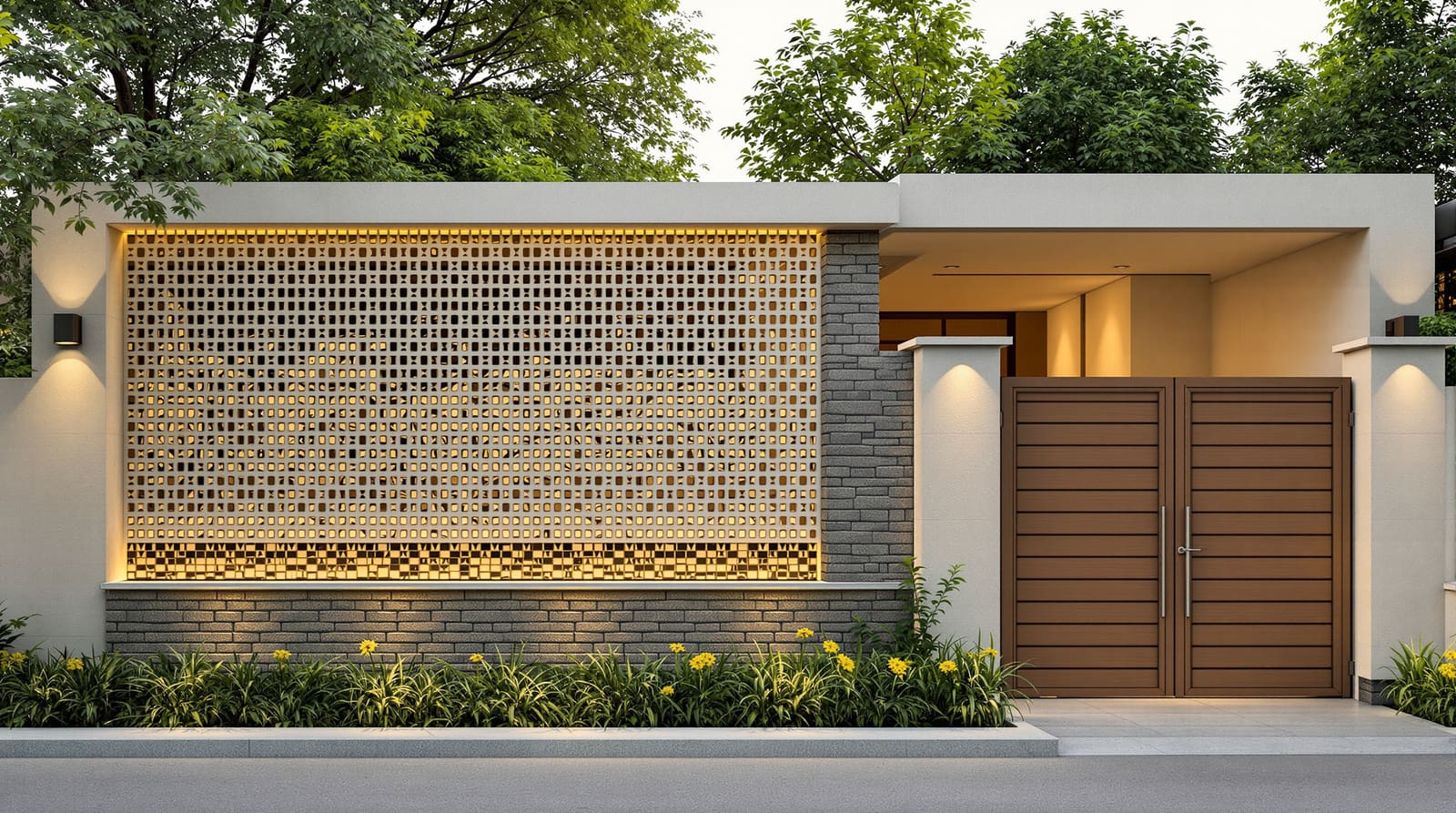
The central design tension is openness versus fortress. A 6-foot solid plastered wall is private and secure but reads as defensive, blocks cross-ventilation to the front of the plot, and traps heat against the house. A low see-through wall is friendly and breezy but offers little privacy. Almost every good Indian boundary wall resolves this with a layered section: a solid lower portion (privacy at sitting and standing height, a mounting surface, protection of the plinth) topped by a perforated or open upper portion (breeze, light, a softer silhouette). Decide the split deliberately — typically a solid base of 3 to 4.5 feet with screen or grille above.
Materials and finishes — the palette
Your finish choice sets the cost, the maintenance burden and the entire character of the street face. Here is the working palette for Indian homes.
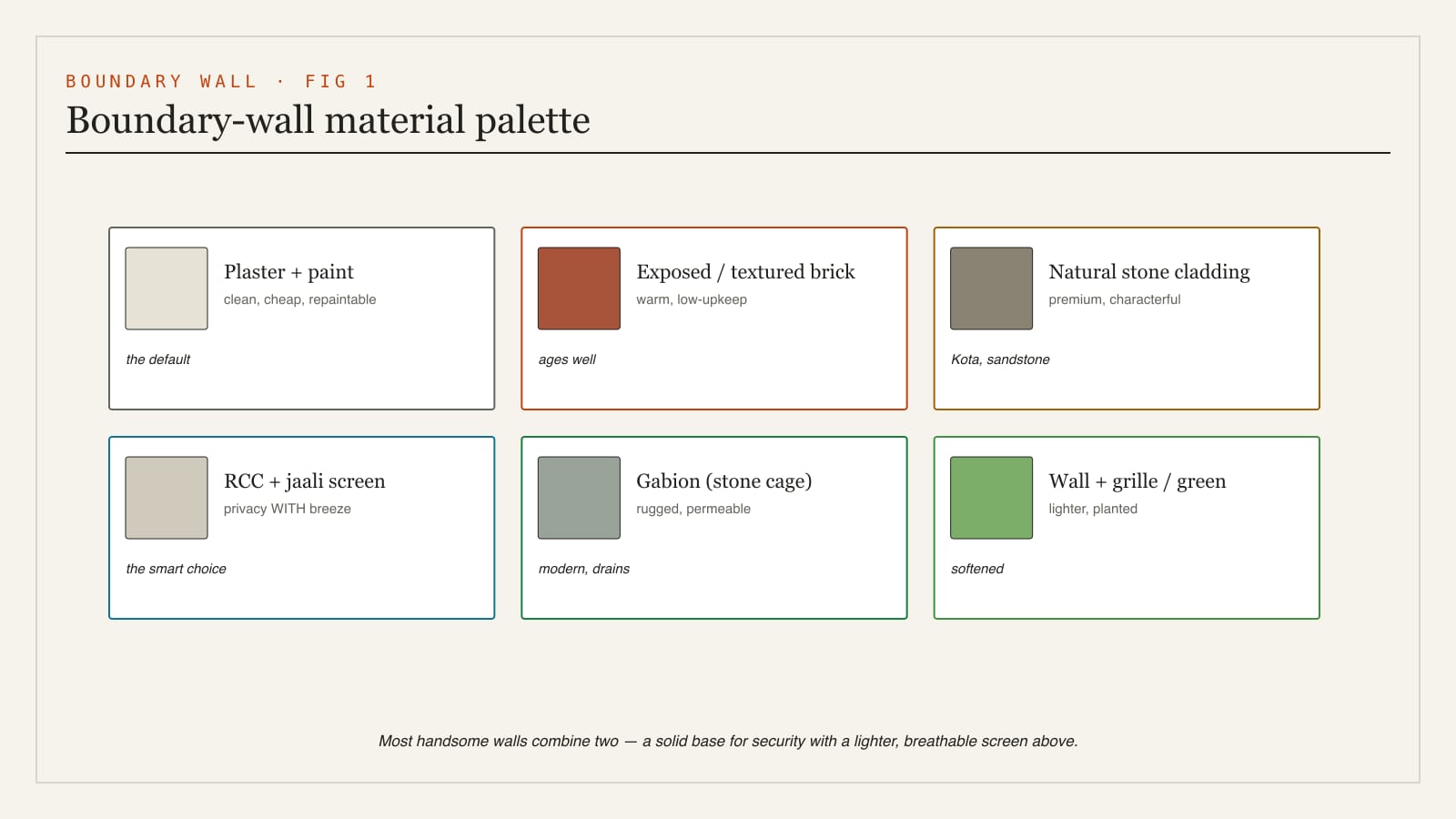
- Plastered and painted — the default. A brick or block wall, double-coat plaster, exterior emulsion or textured paint. Cheapest and most flexible for colour, but in our climate paint fades and grows algae on the shaded, monsoon-wet face within 2–3 years. Specify a quality exterior-grade weatherproof finish, not interior emulsion.
- Exposed / textured brick — leave good-quality wire-cut bricks exposed with a clear sealer, or use a brick-tile cladding over block. Warm, low-fade, ages gracefully. Beautiful with creepers.
- Natural stone cladding — Kota, Jaisalmer, Tandur, granite, slate or local stone over the structural wall. The premium, near-zero-maintenance choice. A stone base under a lighter screen is the most common "luxury" boundary idiom in India.
- RCC with jaali / perforated screens — a concrete frame holding precast jaali blocks or a cast screen. Modern, sculptural, and the best privacy-with-breeze answer (more below).
- Board-formed / exposed concrete — off-shutter concrete with a timber-board texture. Strong contemporary statement, demands excellent shuttering and waterproofing; expensive to get right.
- Gabion — wire cages packed with stone. Honest, textural, excellent for sloping or rocky sites and for absorbing road noise. Pairs well with steel and timber.
- Combination walls — a masonry/stone base with MS steel sections, mild-steel flat-bar grilles, laser-cut metal panels, or treated-wood/WPC battens above. The most versatile route to the openness-vs-fortress balance.
- Precast compound walls — RCC posts and panels, factory-cast and slotted together. Fast, economical for long perimeters and farm/plot edges; less refined for a front face but can be clad or planted over.
| Finish | Indicative cost (₹/sq ft of wall face) | Maintenance | Best for |
|---|---|---|---|
| Plastered + exterior paint | 120–250 | Repaint ~3–4 yrs; algae on damp face | Budget builds, rear/side walls |
| Exposed / textured brick | 200–400 | Low; re-seal occasionally | Warm, traditional and contemporary fronts |
| Natural stone cladding | 350–900+ | Very low | Premium street face, the solid base |
| Cast / precast jaali screen | 250–600 | Low | Privacy with breeze, upper register |
| Board-formed concrete | 400–800 | Low if waterproofed | Bold modern statement |
| Gabion | 300–600 | Negligible | Sloped sites, noise buffer, rustic-modern |
| MS / steel grille over base | 400–900 (steel portion) | Repaint/anti-rust 2–3 yrs | See-through security, layered look |
Costs are indicative finish costs over a built structural wall and vary widely by city, stone grade and steel section; treat them as planning bands, not quotes. For full perimeter budgeting see the Landscape Cost Guide.
Jaali and perforated screens — the Indian solution
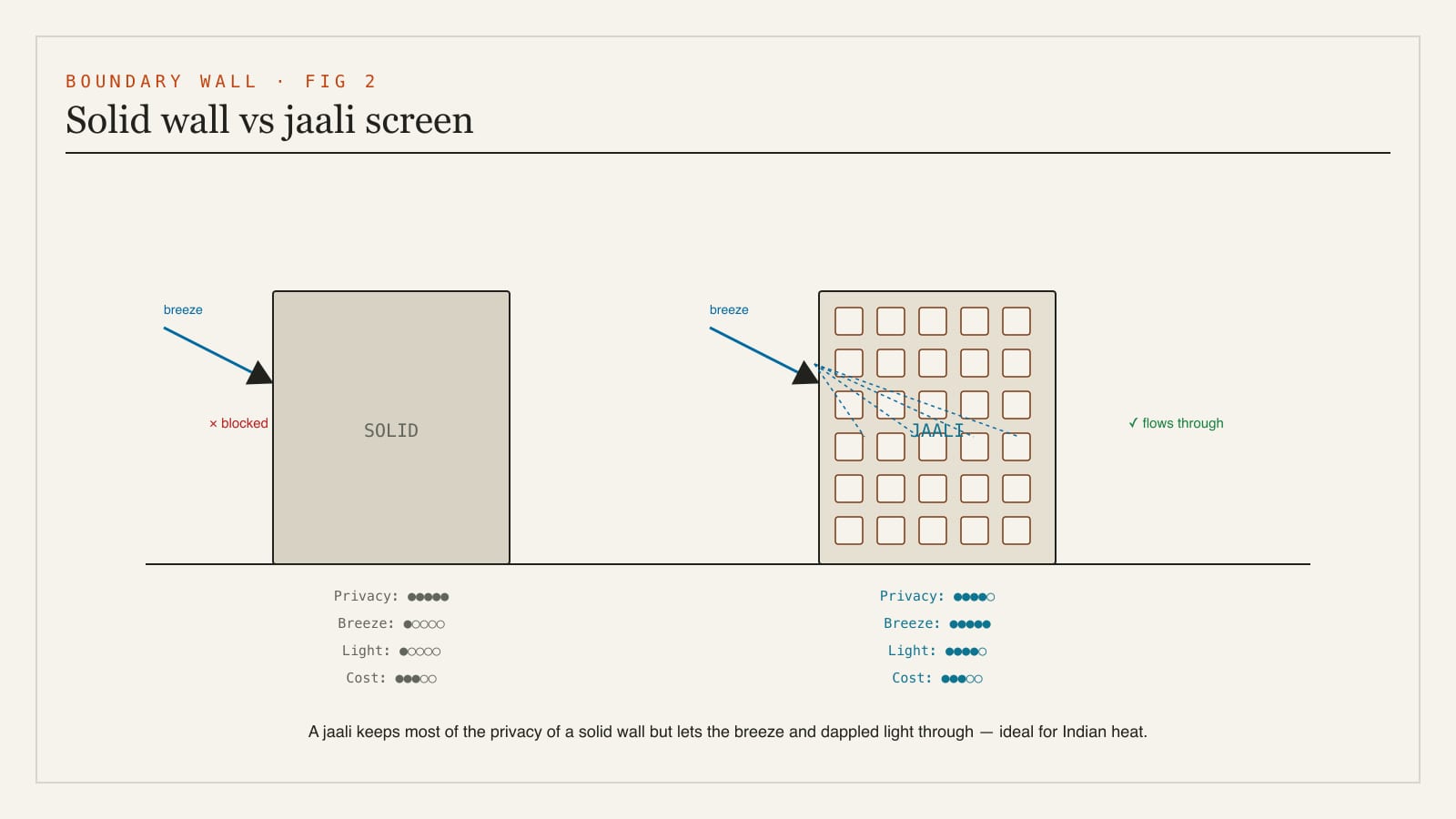
If there is one move that defines a designed Indian boundary wall, it is the jaali — the perforated screen. It is the elegant resolution to our central tension: it gives you privacy while letting breeze and filtered, dappled light through. On a hot, still street, a jaali upper register quietly ventilates the front yard in a way a solid wall never can, and the moving pattern of light it throws onto the ground and the house is itself an ornament.
Options, roughly cheapest to dearest:
- Clay jaali / terracotta blocks — traditional, breathable, beautiful patina.
- Concrete / cement jaali blocks — the workhorse; geometric patterns, cast in moulds, set into an RCC frame.
- Cast-in-situ RCC screen — a bespoke perforated concrete panel, custom geometry.
- Brick jaali — bricks laid with deliberate gaps in honeycomb or basket-weave bonds; very economical and characterful.
- Laser-cut MCP / Corten / MS panels — crisp modern patterns, including custom motifs.
The design lever is porosity — how much of the screen is open. A 30–40% open screen reads private from the street at an angle yet still breathes; push past 50% and you gain breeze but lose privacy. Orient the openings to your prevailing breeze (south-west monsoon wind on much of the coast and plateau) and remember that a jaali on the west or south face also shades the morning/evening sun off the front of the house.
Green walls and creeper-clad boundaries
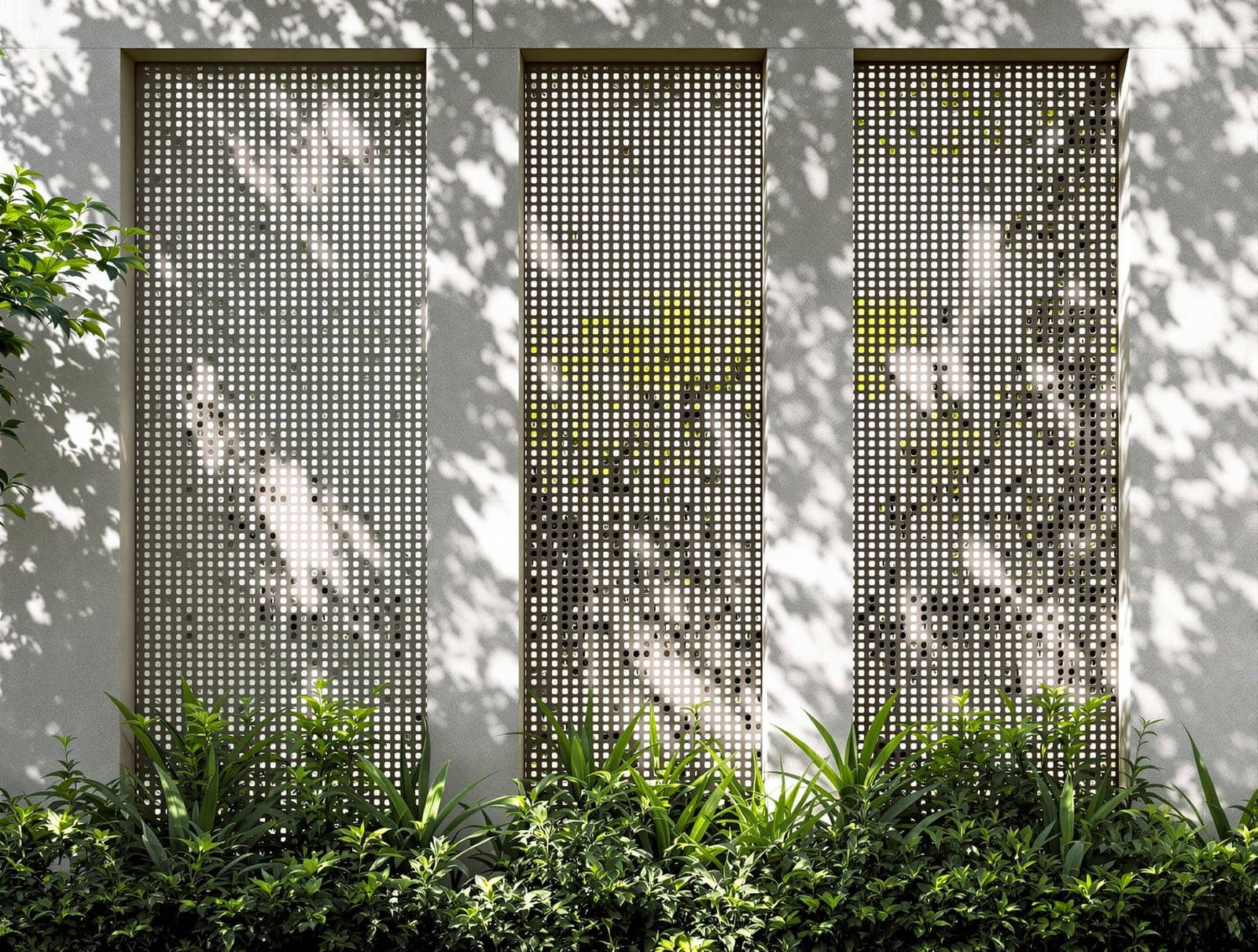
The most generous boundary wall is one that is partly alive. A planted edge cools the microclimate, traps dust, muffles noise and softens the hard line of masonry — and it is the single biggest difference between a wall that looks "built" and one that feels "settled".
- Creeper-clad walls — train a hardy climber up a base wall or grille. In India: Madhumalti (Rangoon creeper) for fragrant flushes, Bougainvillea for tough drought-hardy colour, Star jasmine and Madhavi lata for scent, Money plant and Boston ivy for green coverage. Use a trellis or stainless cable offset from the wall so roots and damp don't sit against the plaster.
- Planter-integrated walls — cast or attach a row of planters along the top or at staggered heights, or a continuous trough at the base.
- Modular living walls — felt-pocket or tray systems for a true vertical garden; these need irrigation (drip) and waterproofing behind, so reserve them for short, visible stretches rather than the whole perimeter.
A green boundary connects naturally to the broader site approach in Climate-Responsive Landscape Design, and pairs with a planted privacy strategy in Landscape Privacy Design.
Height, privacy and byelaws
Height is where design meets the law. Municipal byelaws cap compound wall height, and the cap differs by city and by whether the wall is on the front (road) edge or the side/rear.
- A common pattern: front compound walls limited to about 1.5 m (≈5 ft), with side and rear walls allowed up to about 1.8–2.4 m (6–8 ft). Some authorities require the front wall above a certain height to be see-through (grille/jaali) rather than solid, precisely to keep streets open and safe.
- Always check your local development control rules / the sanctioned setback before finalising — RWA and gated-layout rules may add their own caps.
| Wall portion | Typical permissible height | Design note |
|---|---|---|
| Front (road) wall | ~1.5 m solid, open above | Often must be see-through above the cap |
| Side / rear wall | ~1.8–2.4 m | More privacy latitude here |
| Solid base (front) | 0.9–1.4 m | Privacy at standing height + mounting surface |
| Screen / grille above | balance to permitted height | Breeze, light, friendly silhouette |
The takeaway: don't fight the byelaw with an illegal solid wall — use the see-through requirement. A solid stone or brick base for ground-level privacy, topped by a jaali or grille, satisfies the rule and looks far better than a flat tall wall.
Composing the gate with the wall
A common mistake is buying a gate separately from designing the wall, so the two clash. The gate is part of the boundary composition — it should share the material logic and rhythm of the wall.
- Match the language: a stone-and-jaali wall wants a gate with a stone-clad pier and a matching screen or slat infill, not a glossy gold-painted MS gate.
- Frame the entry: heavier piers, a lintel, a name-and-number plate and a focused light mark the gate as the one moment of emphasis along the run.
- Pedestrian + vehicle: plan a separate wicket gate so you are not heaving the main gate for every visitor.
- Swing space: confirm the gate clears the slope and the parked car; sliding or folding leaves suit tight frontages.
A well-composed gate is also the start of the journey to the door — think of it as the opening note that The Architecture of Pathways carries forward to the threshold.
Layered planting at the base
Even the best wall benefits from being grounded. A continuous hard line meeting bare earth or paving looks abrupt; a layered planting strip at the base softens it, hides the plinth and the gentle staining at the bottom of the wall, and reads as care.
- Layer it: a low ground-cover or seasonal flower band in front, a mid clump of shrubs or ornamental grass against the wall, and the occasional taller accent (a clipped Murraya, a slender bamboo) for vertical rhythm.
- Climate-fit species: choose drought-hardy, low-fuss plants for a strip that will get reflected heat off the wall — Ixora, Mussaenda, Tecoma, ornamental grasses, Duranta hedging.
- Drainage: keep soil and irrigation off the wall face; a small mowing/maintenance gap and a kerb prevent damp wicking into the masonry.
This base planting is part of the same vocabulary as a thought-through Front Yard Design Ideas and Villa Landscape Design.
Lighting the wall
Lighting transforms the wall from a daytime object into an evening one, improves security and signals "someone is home".
- Grazing / wall-wash: small ground-recessed uplights set close to the base graze across textured stone, brick or board-formed concrete and dramatise the texture. The rougher the finish, the better it grazes.
- Backlighting the jaali: a strip light behind a screen turns the perforation pattern into a glowing lantern after dark — one of the most striking, low-cost effects available.
- Gate and number: a focused down-light or a discreet sign light at the entry, plus a warm step/path light just inside.
- Specify for the weather: outdoor fittings on the wall should be rated IP65 or higher to survive monsoon driving rain and dust; use warm white (2700–3000 K) for a welcoming face, and put feature lighting on a separate switch/timer from security lighting.
Cost framing by type
Roughly, the finish drives the cost more than the structure. A budget plastered-and-painted run for side/rear walls keeps the perimeter affordable; reserve the spend for the front face — a stone base, a designed jaali register, a composed gate and lighting. A sensible strategy for most plots:
1. Build all walls structurally sound (see the structural guide — non-negotiable).
2. Finish side/rear walls plain (plaster + good exterior paint, or exposed brick).
3. Invest the design budget in the front face: stone/brick base + jaali or grille + gate + base planting + a little lighting.
This concentrates rupees where they are seen and felt, and is the same logic of spending-where-it-shows that runs through Backyard Design Ideas.
References & further reading
- National Building Code of India 2016 (NBC 2016), Part 10 — Landscape Development, Signs and Outdoor Display Structures, Bureau of Indian Standards — site boundaries, screening and outdoor structures.
- NBC 2016, Part 3 — Development Control Rules and General Building Requirements, BIS — setbacks and the framework for local compound-wall and height byelaws.
- IS 1077 (clay common burnt bricks) and IS 2185 (concrete masonry units), BIS — material standards for brick and block walls.
- IS 14735 / relevant BIS guidance on stone cladding and CPWD specifications for stone and plaster finishes — workmanship and finish benchmarks.
- Your local Development Control Regulations / municipal building byelaws (e.g. state Town & Country Planning or the city development authority) — the authoritative source for permissible compound-wall heights and see-through requirements.
- Indian Society for Trenchless Technology / ISOLA and recognised landscape-architecture texts on planting design and microclimate for the green-wall and base-planting recommendations.
Export this guide
Related Guides — Deep-dive reading
The Homeowner's Guide to Compound Walls and Gates in India (2026)
A plain-language, start-to-finish walkthrough of building a boundary wall and gate in India — plan and permit first, then material and height, foundation and structure, building and supervision, the gate, finishes, lighting and greenery, budget and long-term upkeep — with a stage-by-stage roadmap, a full planning checklist and answers to the questions every homeowner asks.
Compound WallsCompound Wall Finishes in India: Plaster, Texture, Cladding and Paint (2026)
A plain, India-grounded guide to choosing the exterior finish for a compound wall — plaster and exterior paint, textured coatings, stone, tile, laminate and HPL cladding, exposed brick, concrete and rubble stone, and decorative faces — compared on look, weather durability, maintenance and cost band, with the front wall treated as your street facade.
Compound WallsCompound Gate Design in India: Types, Materials and Sizing (2026)
The start-here guide to the gate as the moving part of your boundary wall — how it opens (swing, sliding, cantilever, folding, telescopic), what it is made of (MS, wrought iron, stainless, aluminium, wood), how wide it needs to be for your vehicle, how it is finished against rust, and the posts and footing that carry it. Decisions in order, with automation and security cross-linked, not rebuilt.
Compound WallsRelated Tools — Try Free
Cross-Ventilation Analyzer
Estimate airflow and air changes per hour (ACH) from room size, window areas, layout, and local wind — with NBC 2016 Part 8 compliance check.
Ventilation CalculatorMonsoon-Readiness Checklist
Pre-rain home audit across 9 categories — terrace, drains, waterproofing, electrical, HVAC, pest, vehicles, documents.
Seasonal AuditWindow Grill Design Selector
Pick a window grille style and material by priority — security, looks, budget, view — and estimate cost.
Window Tool