
Gravel vs Pavers — Which Outdoor Surface Wins?
A head-to-head on cost, drainage, maintenance, comfort, look and longevity — when to choose each for driveways, paths, patios and planting, plus hybrid options
For most Indian homes the honest answer is "both" — gravel where you want cheap, free-draining, informal ground around planting, and pavers where feet, wheels and furniture need a stable, level surface — and the art is knowing which goes where.
"Gravel versus pavers" is one of those decisions that looks like a taste call and is actually an engineering and lifestyle call. Get it right and you spend less, your monsoon water soaks away instead of pooling, and the surface ages gracefully. Get it wrong and you are raking stone off the lawn every fortnight, wobbling on a paved patio that has sunk at one corner, or watching your driveway turn into a slick of moss every July. This guide is a genuine head-to-head — not a materials encyclopaedia. For the deeper material catalogue see the pillar Outdoor Flooring Guide, and for stone specifics see Natural Stone in Landscape Design.
What each one actually is
Gravel here means any loose mineral aggregate spread over a prepared base: rounded river pebbles, angular crushed stone (the trade calls it "aggregate" or "metal", typically 10–20 mm or 20–40 mm), pea gravel, crushed granite, or decorative chips. It is not a single material so much as a category — loose, free-draining, and laid (not fixed) over a compacted sub-base, usually with a weed-suppressing geotextile membrane underneath and some form of edging to stop it wandering.
Pavers means any solid, individually laid unit set tight to its neighbours: precast concrete pavers and interlocking blocks, fired clay/brick pavers, natural stone flags (Kota, sandstone, granite, limestone, slate), and cobbles/setts. They sit on a sand or mortar bed over a compacted base, and the joints are filled with sand, fine grit or mortar. Pavers give you a continuous, walkable plane; gravel gives you a yielding, granular one.
That single structural difference — fixed plane versus loose particles — drives every trade-off below.
The head-to-head
Cost — install and lifetime
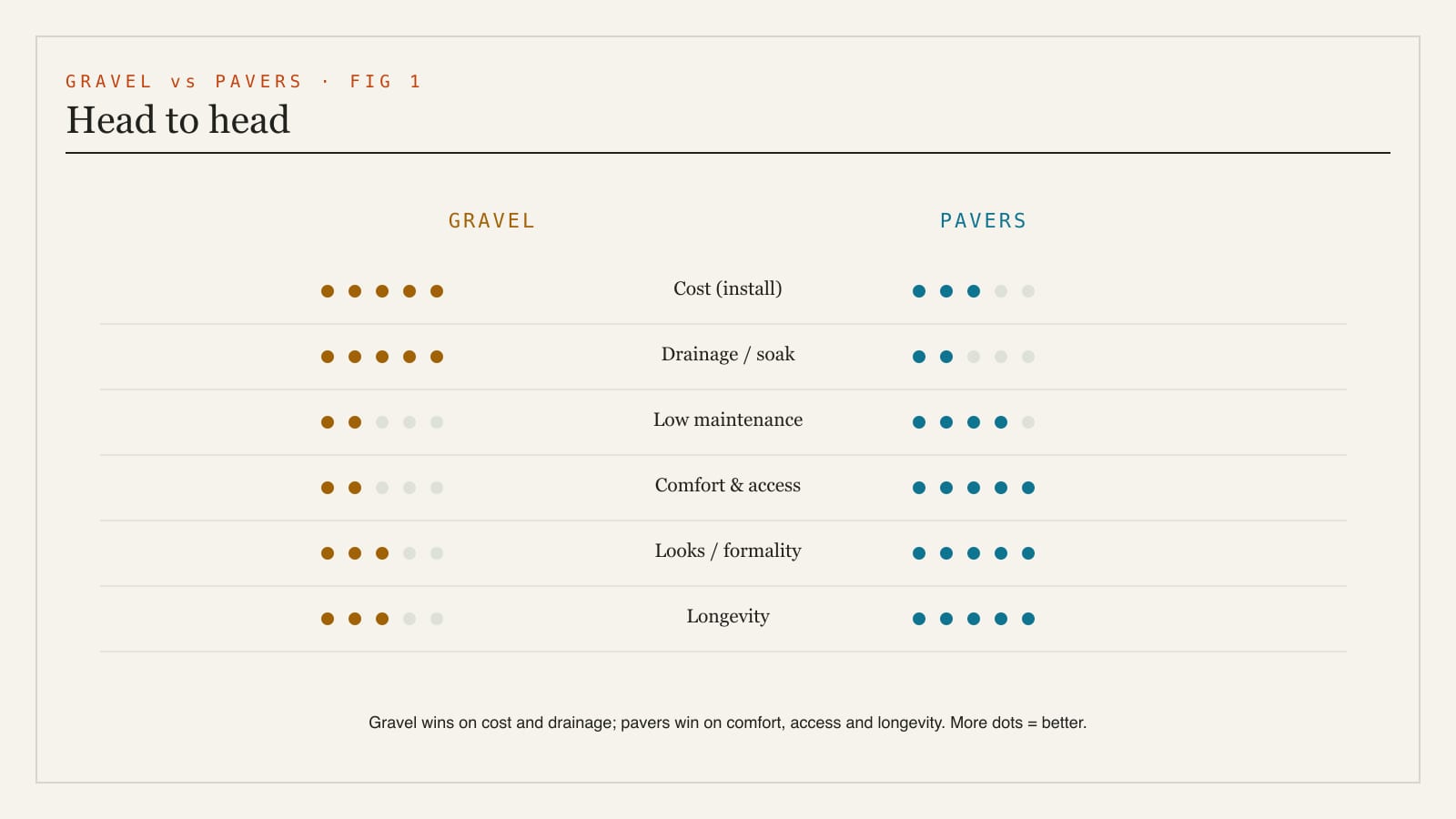
Gravel is the cheapest hard surface you can lay, full stop. The material is inexpensive; most of the cost is in doing the base properly (excavation, compacted sub-base, membrane, edging). Skimp on the base and you get ruts and migration, so the saving is real but not infinite.
Pavers cost more up front — more material, more labour, more skill — and the spread is enormous depending on what you pick. Concrete interlocking blocks are the budget end; natural stone flags are several times that.
| Surface | Indicative installed cost (₹/sqft) | Notes |
|---|---|---|
| Loose gravel / crushed aggregate over membrane + base | ₹60–150 | Material is cheap; base + edging is most of it |
| Pea gravel / decorative chips | ₹120–250 | Premium chips, imported colours dearer |
| Concrete interlocking pavers | ₹90–180 | Most popular driveway choice; wide quality range |
| Clay / brick pavers | ₹140–280 | Colour-fast, classic, slip-friendly |
| Kota / local sandstone flags | ₹150–300 | Workhorse Indian stone |
| Premium natural stone (granite, imported sandstone, slate) | ₹300–700+ | Patio / showpiece territory |
Lifetime cost flips the story. Gravel is cheap to install but never quite "done" — it needs topping up every two to four years as stone is lost to migration, kicked into beds, and trodden into the base. Pavers cost more once and then mostly behave for 20–40 years; the main lifetime cost is the occasional lift-and-relay where something settles. Over a 20-year horizon a well-laid paved path can work out cheaper per year than a gravel one that is topped and re-membraned repeatedly. For a fuller budgeting picture across the whole garden, see the Landscape Cost Guide.
Drainage and permeability — gravel's killer advantage
This is where gravel wins decisively, and in monsoon India it matters more than almost anything. Loose gravel over an open base is genuinely permeable: rain falls straight through, recharges the ground and does not run off. That is real Sustainable Urban Drainage (SUDS) behaviour — you reduce the load on overstretched stormwater drains, cut puddling, and put water back into the aquifer instead of sending it down the road. In cities where summer means tankers, that recharge is not abstract; it is your own borewell, later.
Solid pavers laid on mortar are effectively impermeable — water sheets off and has to go somewhere, which means you must design falls (a slope of roughly 1 in 60 to 1 in 80) and a channel or soakaway. There is a middle path: permeable paving systems, where the blocks are laid on open-graded aggregate with wide joints filled with grit, let water pass between the units. They cost more and need their voids kept clean, but they combine a walkable plane with much of gravel's drainage benefit. If your plot floods, slopes badly, or sits on clay, lead with permeability — see Climate-Responsive Landscape Design.
Maintenance — different chores, not "less work"
Neither is maintenance-free; they fail in different directions.
- Gravel: the loose stone migrates — into lawns, beds and gullies, and out of the gate on tyres and shoes. You rake it level periodically, top it up every few years, and stay on top of weeds (the membrane helps, but windblown seed germinates in the gravel itself, especially after monsoon). Leaves and organic litter settle in and rot down to a seedbed, so it needs blowing or sweeping clean. Edging is non-negotiable.
- Pavers: they settle. A badly compacted base, tree roots, or a saturated monsoon sub-base produces dips, lips and rocking units — a trip hazard and an eyesore. Weeds and moss colonise the joints (sand joints especially), and in our humidity the shaded faces go green and slippery. The fix is to brush in fresh jointing, occasionally lift and re-lay a settled patch, and pressure-wash or treat for algae before each monsoon.
A fair summary: gravel asks for little-but-often attention (raking, topping, weeding); pavers ask for occasional-but-skilled attention (re-jointing, re-laying, de-mossing).
Comfort and access — pavers win, clearly
If anyone will roll, wheel or balance on the surface, pavers are the right answer. Gravel is hostile to:
- Wheelchairs, walkers and prams — wheels sink and steer badly; it is effectively not accessible.
- Heels and dress shoes — they sink and turn ankles; not the surface for a portico or a much-used front path.
- Furniture — chairs and tables rock and gouge; a dining patio on gravel is a recipe for spilled drinks and scraped legs.
- Bare feet and the elderly — sharp angular chips are uncomfortable and unsteady.
Pavers give a level, firm, predictable plane that suits all of the above. This is why accessibility-led design and main circulation routes default to solid paving — a point developed in The Architecture of Pathways.
Look, feel, noise and security
Gravel reads informal, soft and naturalistic — it sits beautifully in a cottage-style, native-planted or kuccha-rustic garden and lets plants spill over its edges. It is also, usefully, noisy: the crunch underfoot is a low-tech security alarm announcing anyone approaching the house at night, which many Indian homeowners value. The flip side is that the same crunch is tiring on a route you walk twenty times a day.
Pavers read crisp, intentional and architectural; they hold pattern, colour and a sense of permanence, and they extend the language of the house out into the garden. They are quiet. They photograph well and they sell well — a paved frontage and patio reads as "finished" to a buyer in a way that gravel does not. See Villa Landscape Design for how paved planes structure a larger garden.
Longevity and heat
On longevity, well-laid pavers win outright — quality stone or concrete blocks last decades with minor upkeep. Gravel "lasts" indefinitely as a concept but degrades as a surface: it scatters, beds into the soil, and needs replenishing, so its effective life between interventions is short.
Heat is a draw with a twist. Dark concrete and dense stone store and re-radiate the harsh Indian sun, so a large dark-paved area becomes a heat island that warms the house and is unpleasant underfoot by afternoon. Light-coloured gravel and pale stone reflect more and run cooler; gravel's air-filled, permeable structure also holds less heat and any retained moisture cools it by evaporation. If a surface sits where it bounces heat into living rooms, lean pale and/or permeable. Pair either surface with shade and planting — see Outdoor Wellness Spaces and Best Trees for Indian Homes.
When to choose each
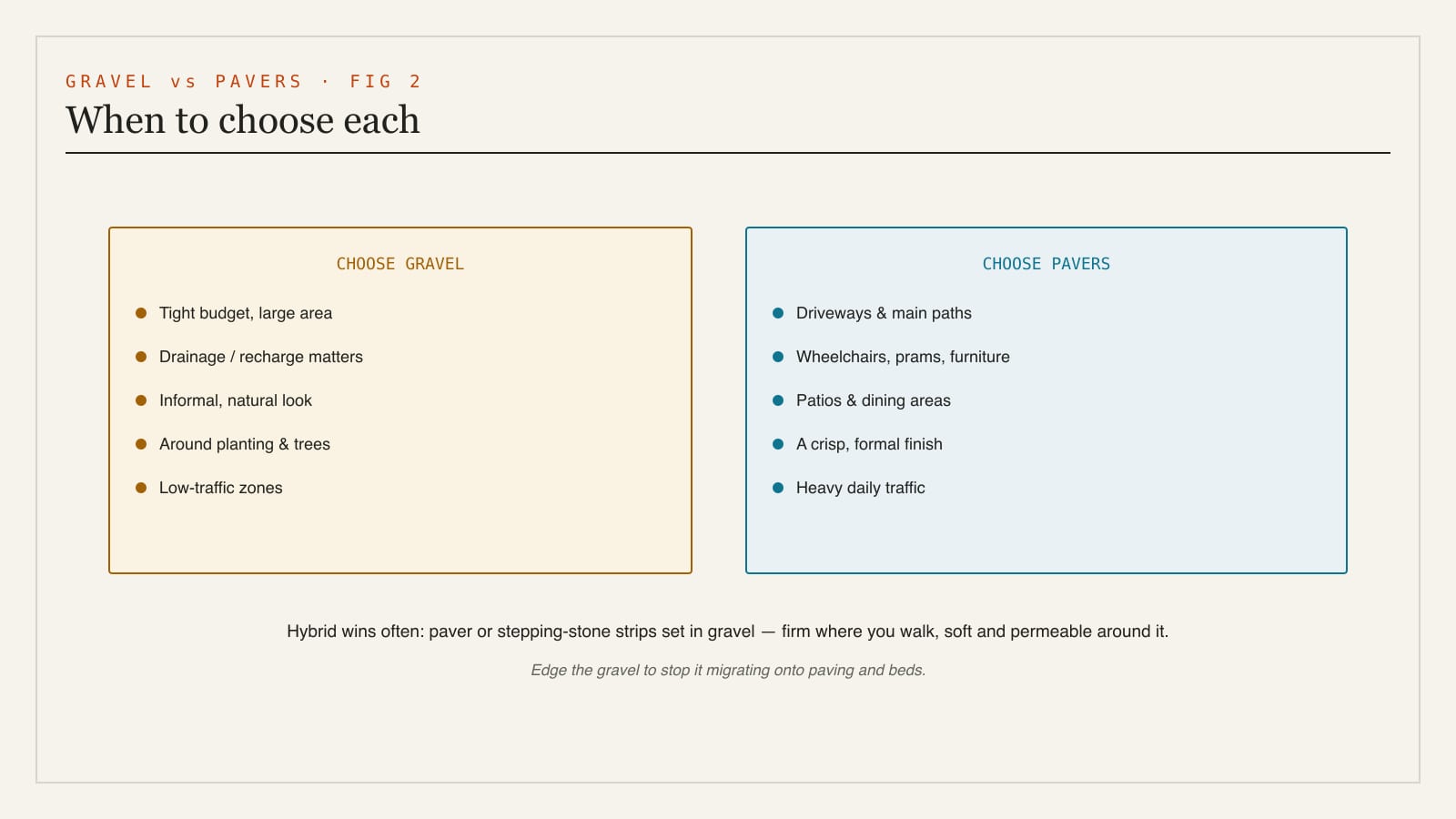
Choose gravel when:
- Budget is tight and you have a large area to cover.
- Drainage, runoff or recharge is the priority — sloping plots, clay soil, monsoon flooding.
- The area is informal and low-traffic — side returns, utility yards, occasional paths, mulch-substitute around shrubs.
- You want a permeable, breathable surface around planting (gravel mulch keeps roots cool and weeds down).
- You want the security "crunch" on an approach.
Choose pavers when:
- It is a driveway carrying car loads (loose gravel rutting under tyres is a constant battle).
- It is a main, daily path — front door, kitchen-to-gate, the route everyone actually uses.
- It is a dining or seating patio where furniture must stand level.
- Accessibility matters — wheelchairs, prams, elderly residents.
- You want a crisp, permanent, resale-friendly finish.
The smart move: hybrids
The best gardens rarely choose one. Hybrids give you gravel's economy and drainage exactly where they help and pavers' stability exactly where you need to plant your feet:
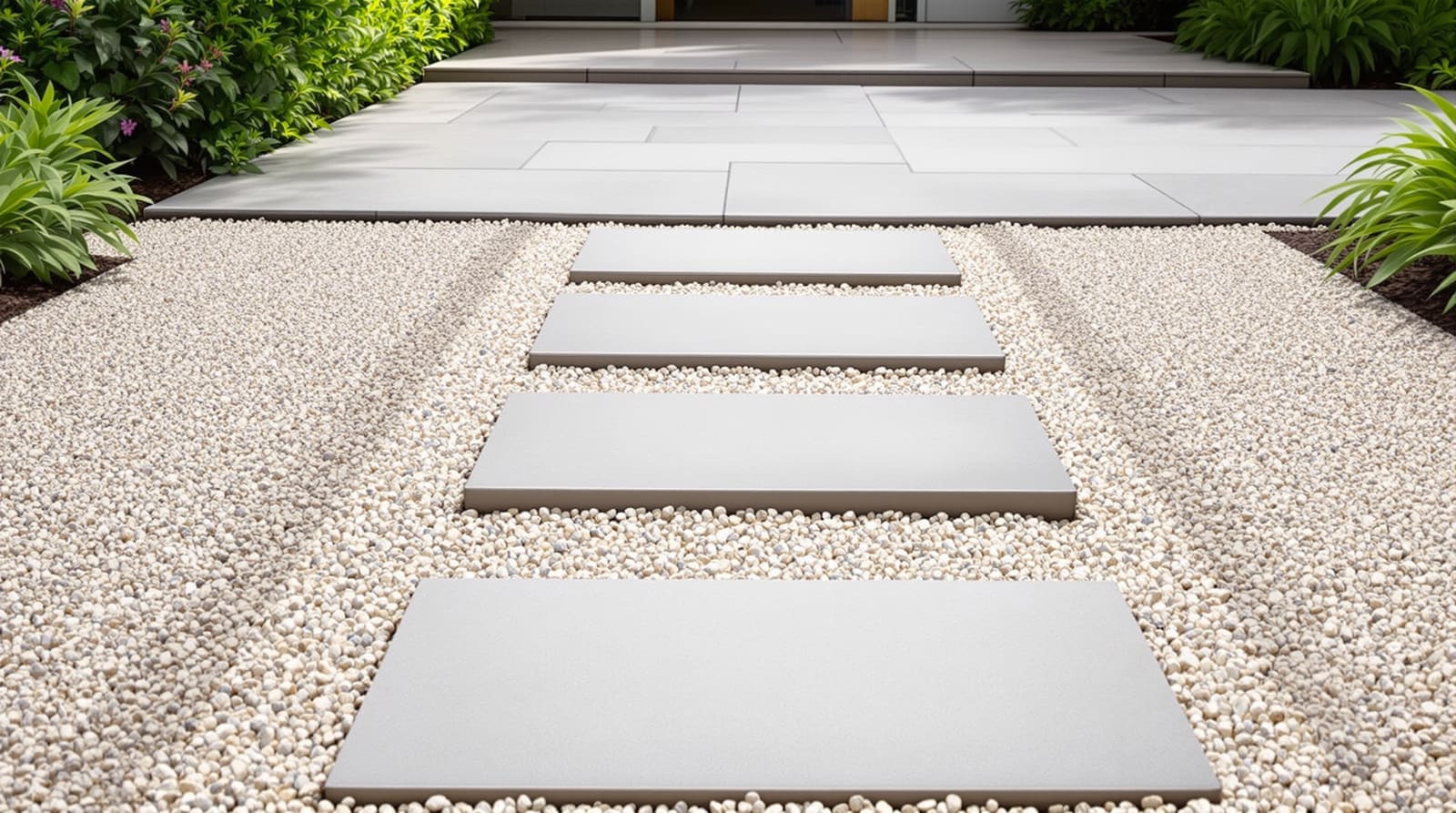
- Stepping pavers / stones set into gravel — a firm, level walking line through a gravel bed, so feet and wheels follow the slabs while rain still soaks through the gravel between them. The classic monsoon-friendly path.
- Paver strips in a gravel driveway — two wheel-tracks of concrete pavers carry the car; gravel fills the centre and verges, draining the run-off. Cheaper than full paving, far more stable than all-gravel.
- Gravel borders around solid paving — a paved patio ringed by a gravel margin that drains the run-off from the slab and softens the join to planting.
- Robust edging everywhere — steel, stone, brick-on-edge or concrete kerb to contain gravel and hold paver courses. The single most important detail in any gravel scheme.
Gravel also pairs naturally with Water Features in Landscape Design and informal Backyard Design Ideas, where its loose, permeable character is an asset rather than a compromise.
The verdict, by use case
| Use case | Winner | Why |
|---|---|---|
| Car driveway | Pavers (or paver-strip hybrid) | Gravel ruts and scatters under tyres |
| Main daily front path | Pavers | Level, accessible, low-fuss underfoot |
| Dining / seating patio | Pavers | Furniture must stand stable and level |
| Wheelchair / pram / elderly access | Pavers | Gravel is effectively impassable |
| Informal, low-traffic path | Gravel or stepping-stone hybrid | Cheap, charming, drains well |
| Area around planting / tree pits | Gravel | Permeable, cool-rooting, weed-suppressing |
| Sloping or flood-prone ground | Gravel / permeable paving | Soaks rain away, recharges ground |
| Tight budget, large area | Gravel | Lowest installed cost per sqft |
| Resale-driven frontage | Pavers | Reads "finished", holds value |
| Night security approach | Gravel | Audible crunch warns of footsteps |
The takeaway is not that one beats the other but that they answer different questions. Map your garden by how each zone is used — driven on, walked daily, sat on, planted, or simply drained — and the surface chooses itself. In most Indian homes that means a paved core of driveway, main path and patio, set in a generous, free-draining gravel matrix around the planting, with a few stepping stones to stitch them together.
References & further reading
- National Building Code of India (NBC) 2016, Part 10 — Landscaping, Signs and Outdoor Display Structures, Bureau of Indian Standards — guidance on outdoor surfaces, circulation and accessibility.
- NBC 2016, Part 3 — Development Control Rules and General Building Requirements, BIS — site drainage, ground coverage and permeability provisions relevant to hardscape.
- IS 15658:2006 — Precast Concrete Blocks for Paving: Specification, Bureau of Indian Standards — the Indian standard governing concrete paver quality, strength and abrasion.
- Interpaving / Interlocking Concrete Pavement Institute (ICPI) technical guidance — manufacturer-neutral best practice on base preparation, bedding and permeable paving systems.
- The SuDS Manual (CIRIA C753), CIRIA — authoritative reference on permeable surfaces, infiltration and sustainable drainage applicable to gravel and permeable paving.
- Time-Saver Standards for Landscape Architecture, Harris & Dines (McGraw-Hill) — detailing standards for paving, aggregate surfaces, edging and falls.
Export this guide
Related Guides — Deep-dive reading
Why Landscape Architecture Matters More Than the Building
How the green around, above and beyond your home out-cools, out-drains and out-appreciates the structure itself — at every scale from balcony to city.
LandscapeOutdoor Flooring Guide — Choosing the Right Surface
The broad chooser across every outdoor surface — natural stone, tile, deck, gravel, concrete and grass pavers — by slip, heat, drainage, upkeep and cost, and which suits which zone
LandscapeFlagstone Flooring in India: Crazy Paving, Stones, Cost & Laying Guide
Irregular flat stone pieces laid in a random crazy-paving jigsaw give courtyards, paths and rustic verandahs a natural, anti-skid, free-draining floor — here are the stones used, how it is laid, where it suits and what it costs.
Flooring & SurfacesRelated Tools — Try Free
Cross-Ventilation Analyzer
Estimate airflow and air changes per hour (ACH) from room size, window areas, layout, and local wind — with NBC 2016 Part 8 compliance check.
Ventilation CalculatorLandscape Cost Calculator
Estimate a garden's cost — hardscape, softscape, lawn, irrigation, lighting and annual upkeep — by area, tier and city.
Budget CalculatorRainwater Tank Sizer
How big should your rainwater tank be? Computes annual harvest, recommended tank capacity in litres, water-bill savings, and payback — for 10 Indian cities.
RWH Calculator