
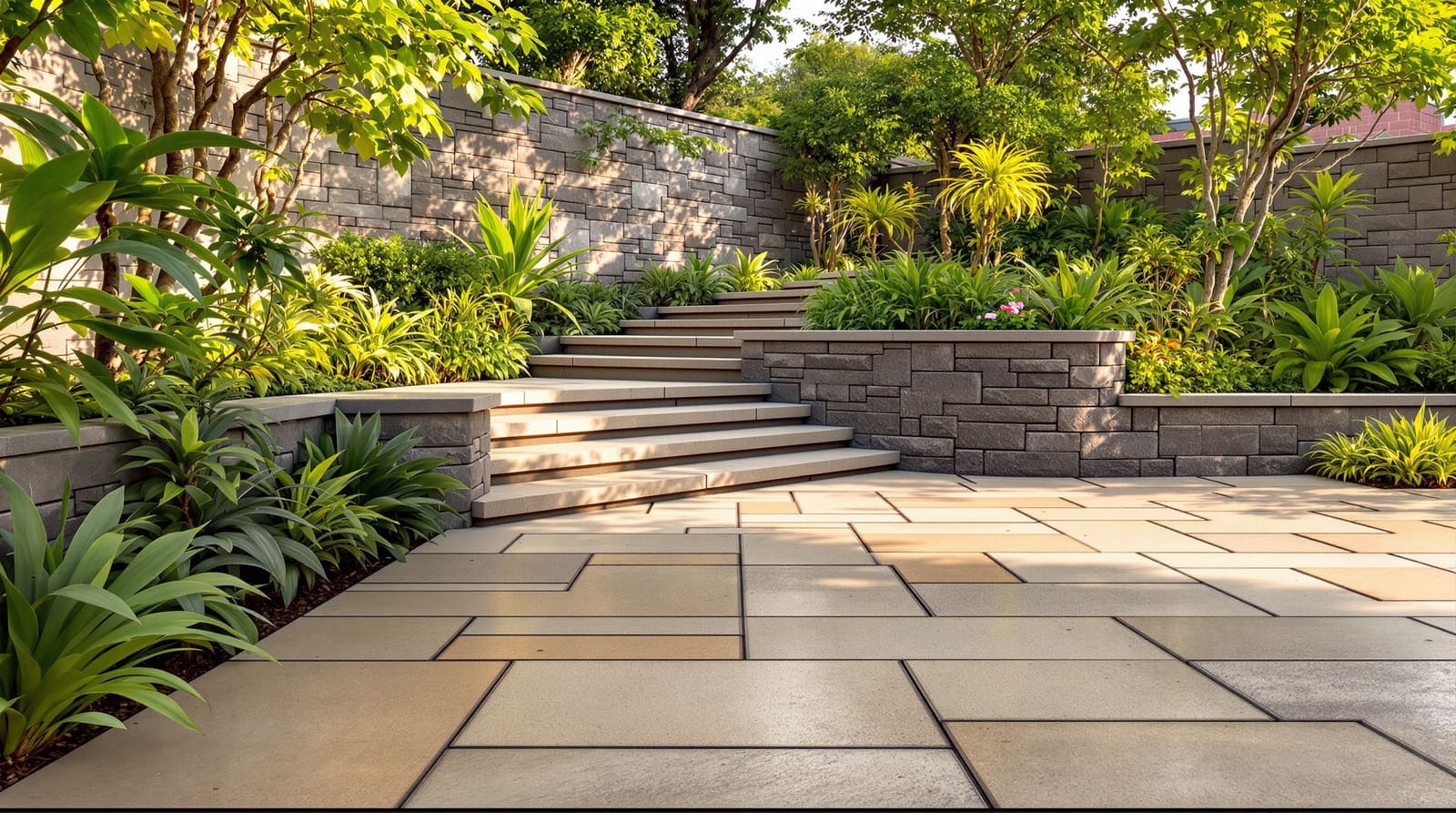
Natural Stone in Landscape Design
The Indian stone palette — Kota, granite, sandstone, slate, limestone, cobbles — finishes and grip, where each suits, sourcing, laying, sealing and cost
Natural stone is the one hardscape material that gets more beautiful as it ages — and in India we are spoilt for choice, with a homegrown palette of Kota, granite, sandstone, slate and limestone that costs a fraction of what the same stone fetches abroad. Used well, it ties a garden to its place, shrugs off the monsoon, and outlives almost everything else you put outdoors. Used carelessly — wrong stone, wrong finish, wrong laying — it stains, spalls, grows moss and turns lethal underfoot in the rains. This guide is about the material itself: choosing, finishing, sourcing, laying and maintaining natural stone across every hardscape element of an Indian garden.
If you want help deciding which hard surface to use where, start with our pillar Outdoor Flooring Guide; for the loose-vs-modular debate see Gravel vs Pavers; and for laying out routes and journeys read The Architecture of Pathways. This guide stays in its lane — the stone itself, not the path it builds.
Why natural stone in the first place
Concrete pavers, vitrified outdoor tiles and stamped concrete all have their place. But natural stone earns its premium for reasons that matter especially in our climate.
- Character and ageing. No two slabs are identical. Sandstone weathers to a soft patina, granite holds its colour for decades, Kota develops a lived-in sheen. Where a printed tile looks tired in five years, good stone looks better in twenty.
- Genuinely local and low-carbon. India quarries almost everything you need within a few hundred kilometres — Rajasthan sandstone, Karnataka/Andhra granite and limestone, Madhya Pradesh Kota and Mandana. Local stone means lower transport cost, lower embodied carbon, and a material that already "belongs" to the region.
- Thermal behaviour. Light-toned sandstone and Kota stay noticeably cooler underfoot than dark granite or any deep-coloured tile — a real consideration for a barefoot-friendly courtyard in a Nagpur or Ahmedabad summer.
- Resale and perceived value. Stone reads as permanent and premium. It lifts the feel of an entrance, a plinth or a villa landscape in a way few materials match for the money.
- Repairability. A cracked slab can be lifted and swapped. A spalled poured surface usually cannot.
The trade-off is that stone is unforgiving of bad decisions. The rest of this guide is about not making them.
The Indian stone palette
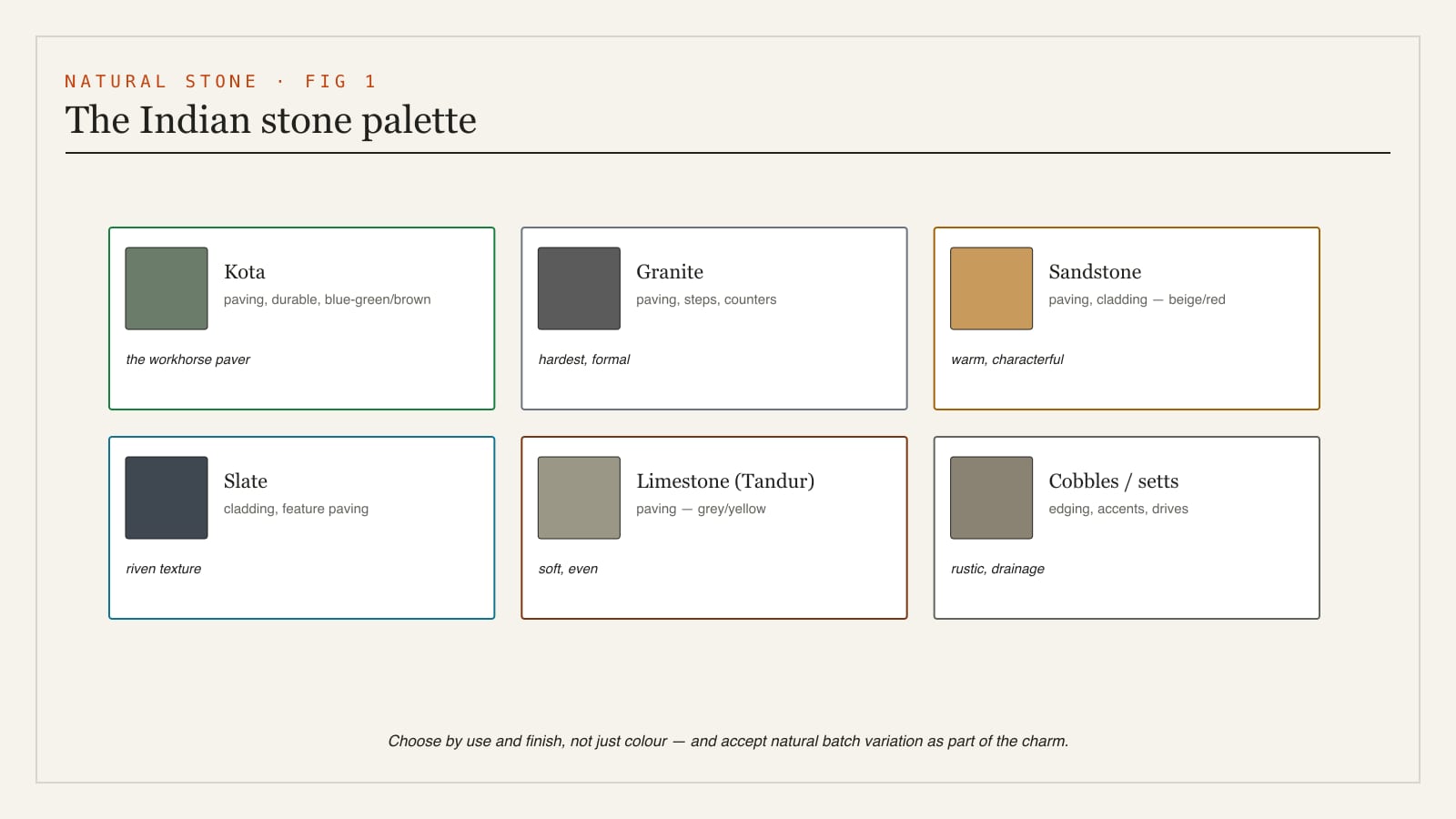
India's hardscape stones fall into four families — limestone (the Kota/Tandur/Shahabad group), granite, sandstone and slate — plus cobbles, setts and pebbles. Marble sits apart, with a strong caveat for outdoor use.
Limestone group: Kota, Tandur, Shahabad
Kota (Kotah) stone from Rajasthan is the workhorse of Indian landscaping — a fine-grained limestone in blue-green and brown, hard-wearing, cheap and forgiving. Honed Kota is a classic verandah and courtyard floor; natural-finish Kota is excellent for paths and utility paving.
Tandur (Telangana) is a pale grey-to-beige limestone, often sold polished as a marble substitute, but in a leather or honed finish it makes a handsome, cool terrace floor. Shahabad (Karnataka) is the grey limestone of countless South Indian courtyards — humble, tough, ages to a lovely soft grey.
Limestones are slightly porous and react to acids, so they need sealing and must never be cleaned with acid descalers.
Granite
India's granites are world-class and span Indian grey, jet/absolute black, tan-brown, and the pinks (Imperial/Ruby red). Granite is the most durable hardscape stone you can buy — near-zero porosity, frost-immune (irrelevant here but telling), and almost stain-proof. It is the right choice for high-traffic driveways, plinth cladding, step treads and pool copings. The catch: polished granite is dangerously slippery wet, and dark granite gets hot. Outdoors, specify flamed or leather finishes, and reserve black for shaded or accent use.
Sandstone
The signature stone of North Indian gardens, almost all quarried in Rajasthan and around Agra:
- Dholpur beige — soft warm cream, the default elegant paving stone.
- Jaisalmer yellow — golden, beloved for cladding and feature walls.
- Agra red and Mandana red (MP) — deep terracotta reds; Mandana is harder and excellent underfoot.
- Plus greys, browns and the multicolour "rainbow" sandstones.
Sandstone is moderately porous, takes a beautiful natural cleft finish, stays cool, and is a joy to lay. It does need sealing and is the most prone to algae and efflorescence of the common stones.
Slate
Indian slate (Himachal, Rajasthan) comes in black, grey, green, copper and multicolour. Its natural riven surface gives superb grip, making it a favourite for steps and sloped paving — but flaky lower grades delaminate in the monsoon, so insist on dense, well-bonded slate.
Cobbles, setts and river pebbles
Granite setts (cut cubes, roughly 100×100mm) are superb for driveways and decorative banding. Tumbled cobbles soften edges and drives. River pebbles (black, white, polished) are for drainage strips, tree pits and decorative infill — not for walking surfaces.
A word on marble
Marble outdoors is a frequent and expensive mistake. It etches with acid rain and lemon/cleaning agents, yellows, and polished marble is treacherous when wet. Confine it to covered, shaded thresholds — never open paving or steps.
| Stone | Character | Best uses | Cool underfoot? | Sealing need |
|---|---|---|---|---|
| Kota (limestone) | Blue-green/brown, hardy | Courtyards, paths, verandahs | Yes | Medium |
| Tandur / Shahabad | Pale grey limestone | Terraces, courtyards | Yes | Medium |
| Granite | Grey/black/tan, ultra-durable | Drives, treads, cladding, copings | No (hot if dark) | Low |
| Dholpur / Jaisalmer / Agra / Mandana sandstone | Beige/yellow/red, warm | Paving, cladding, feature walls | Yes | Medium–high |
| Slate | Riven, multicolour, grippy | Steps, sloped paving, cladding | Moderate | Medium |
| Granite setts / cobbles | Modular, rugged | Drives, banding, edging | No | Low |
| River pebbles | Smooth, decorative | Drainage strips, infill, tree pits | n/a | None |
Finishes — and the slip question
The same slab behaves completely differently depending on how its surface is worked. For a garden, finish choice is mostly a slip-and-grip decision — and in monsoon India, grip is non-negotiable.
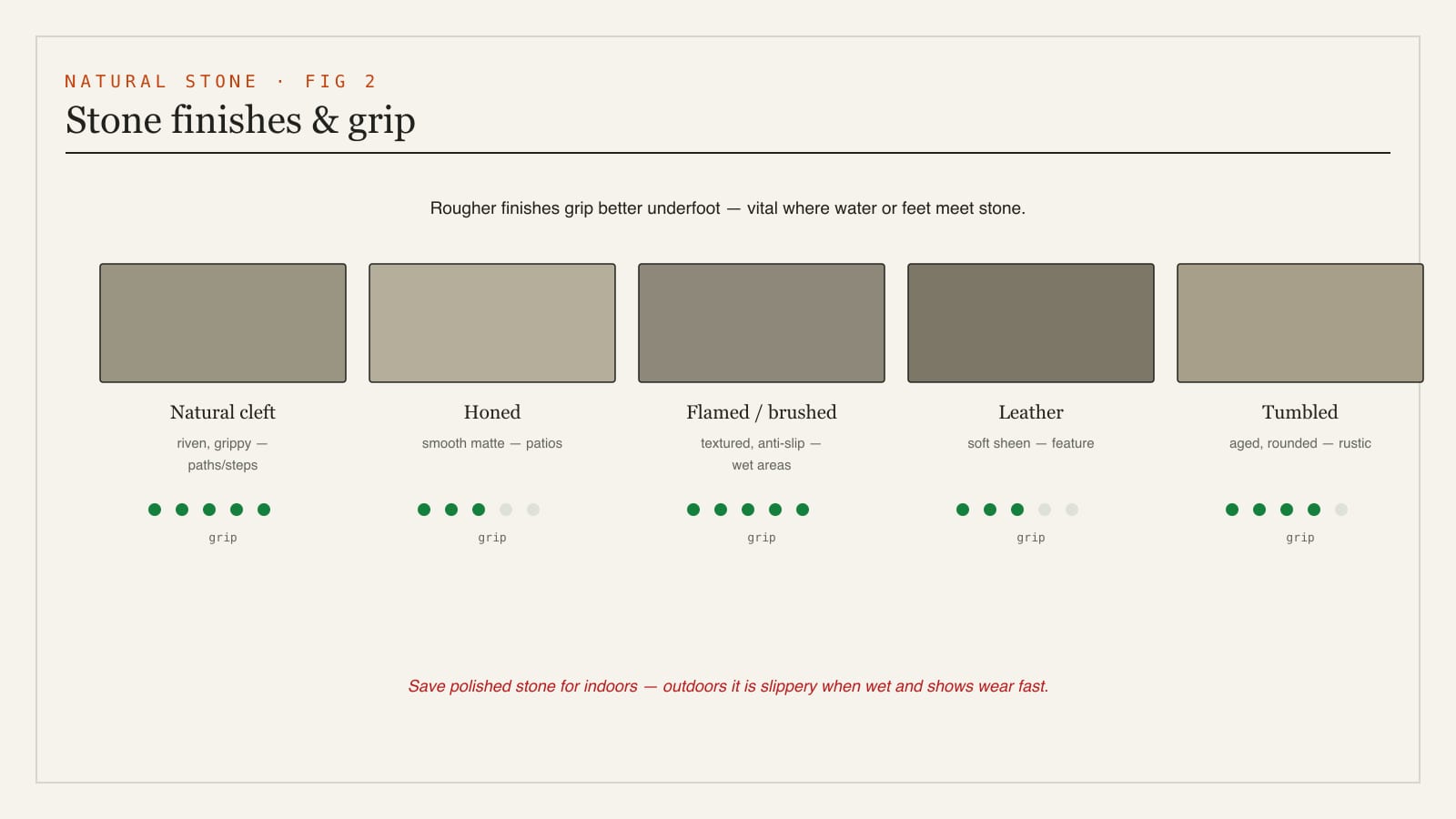
- Natural cleft / riven — the stone split along its bed, leaving a textured surface. Excellent grip, informal look. Ideal for sandstone and slate paving and steps.
- Honed — ground smooth and matte, not glossy. Elegant, easy to clean, moderate grip when dry but slippery wet. Good for covered verandahs; risky on open steps.
- Flamed (thermal) — granite blasted with a torch so the surface flakes to a rough, grippy texture. The default outdoor finish for granite paving, treads and drives.
- Brushed / antiqued — wire-brushed to a soft, low-sheen texture with decent grip; a refined alternative to flamed.
- Leather — brushed satin finish that hides marks and reduces the harsh glare of polish; good for Tandur and granite terraces.
- Tumbled — rolled with grit for rounded, worn edges; characterful for cobbles, setts and rustic paving.
- Sandblasted — uniformly roughened, very grippy; useful for ramps and pool surrounds.
- Polished / mirror — beautiful indoors, banned from your outdoor brief for any walking surface. Reserve for vertical cladding only.
A practical rule: ask suppliers for the stone's slip rating (look for a wet pendulum / PTV value of 36+, or a high-grip "R11/R12" class equivalent) for any surface that gets wet. For steps and pool copings, always specify flamed, riven or sandblasted, never honed or polished.
Where each stone earns its place
Hardscape is not one job. Match the stone and finish to the element:
| Element | Recommended stone / finish | Avoid |
|---|---|---|
| General paving (courtyard, terrace) | Kota honed/leather; sandstone natural cleft; flamed granite | Polished anything |
| Driveway | Flamed granite slabs or granite setts; Mandana red | Soft thin sandstone, slate |
| Steps & treads | Riven slate, flamed granite, Mandana — with bullnose/grooved nosing | Honed/polished |
| Boundary & retaining walls | Sandstone or stone cladding (random rubble / ledgestone) | Thin polished veneer |
| Plinth / feature wall cladding | Jaisalmer, Agra red, slate, granite | — |
| Edging | Granite kerb, sandstone strips, setts on edge | — |
| Pool coping | Flamed granite, sandblasted Kota (sealed) | Limestone unsealed, marble |
| Drainage / mulch strips | River pebbles | — |
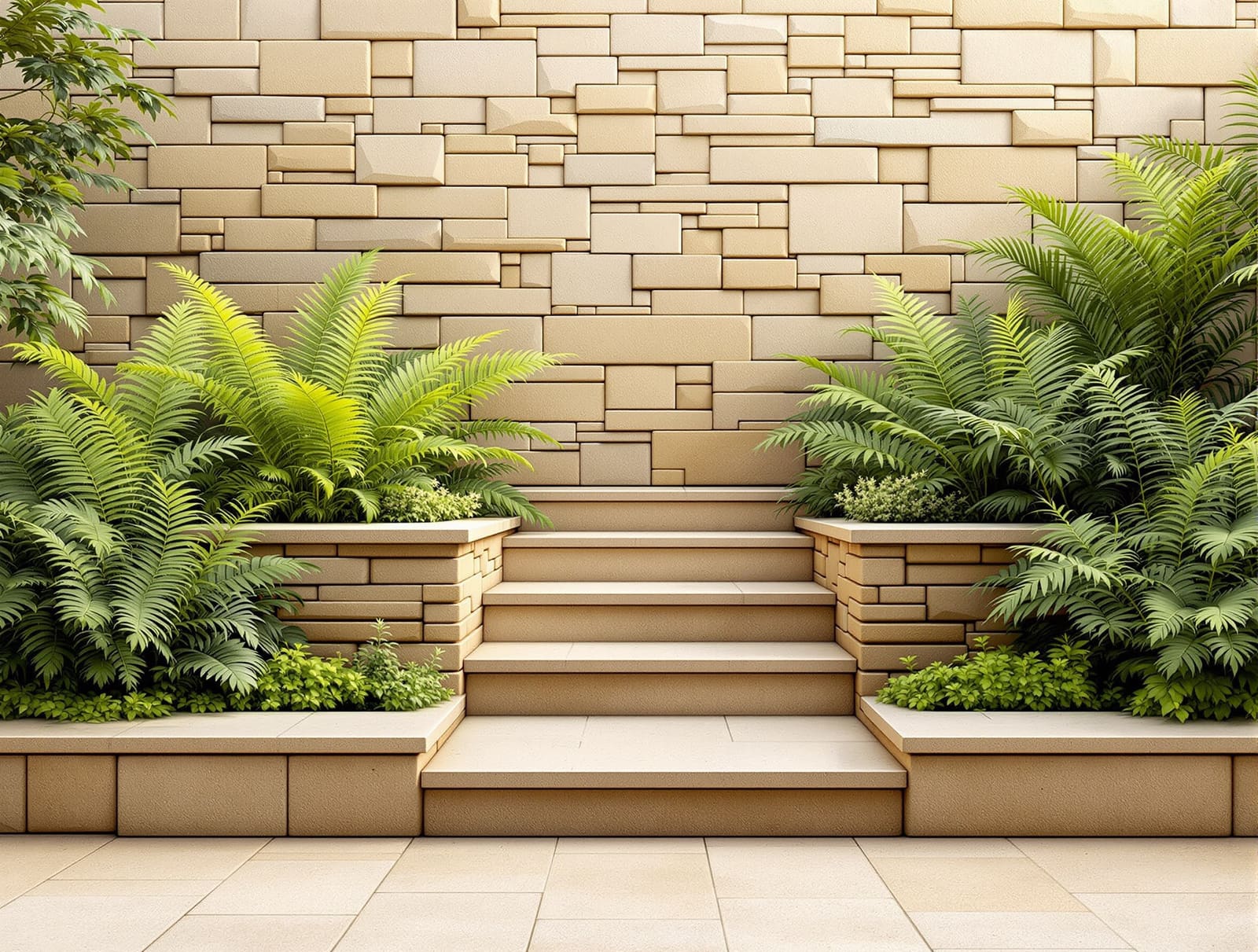
Stone cladding deserves a note: a boundary or retaining wall faced in random-rubble sandstone or ledgestone is one of the highest-impact moves in a garden, anchoring planting and softening a hard compound wall. Fix cladding mechanically (with copper/SS cramps or a proper render-and-adhesive system) for anything above sill height — adhesive-only veneer above 1.5m has a habit of peeling off in the first hard monsoon.
Sourcing and quality
This is where Indian projects most often go wrong. Stone is sold loose, by the lot, and quality varies enormously.
- Thickness and calibration. For paving, insist on calibrated slabs (uniform thickness, e.g. 25–30mm for pedestrian, 40–50mm for driveways). Uncalibrated stone means every slab is bedded by hand to a different depth — slow, costly and uneven. Cladding can be thinner (10–20mm).
- Batch / lot variation. Natural stone varies in shade and veining between quarry batches. Buy the whole job from one lot, order ~10% extra, and dry-lay and "shuffle" slabs from multiple crates before fixing so colour blends rather than patches.
- Flatness and edges. Check for bowing, chipped arrises and hairline cracks (tap-test: a dull thud can mean an internal crack).
- Testing. For large jobs, ask for water absorption (lower is better — granite under 0.5%, good sandstone under 3%), compressive strength and the slip value. Reputable processors test to IS 1124 (water absorption) / IS standards for building stones.
- Buy by area, account for wastage. Random/crazy-paving wastes more; rectangular calibrated paving wastes less.
A useful sequencing tip from our Landscape Cost Guide: finalise the stone before the design is frozen, because slab sizes drive joint layout and falls.
Laying basics
You are not laying the path — that is the pathways guide's job — but you should know enough to brief and check your contractor.
- Mortar bed vs sand-set. A full mortar bed on a concrete sub-base (the standard "rigid" method) is right for most Indian paving and all driveways and steps — it resists the heave and washout that sand-set suffers in heavy monsoon. Sand-set (over compacted base) suits cobbles, setts and informal paths with good drainage, and allows water to percolate.
- Joints. Tight 3–6mm joints for formal paving; wider raked joints for rustic. Use a polymer-modified or proprietary stone-jointing mortar, not raw cement (which stains stone edges). For permeable look, leave planting joints with creeping greens.
- Falls (slope). Every outdoor surface must drain. Lay a fall of 1 in 80 to 1 in 60 (roughly 1.5–2%) away from the building toward a channel or garden. Flat paving + monsoon = standing water, algae and slip. This single detail matters more than the stone you choose.
- Movement and sub-base. A properly compacted, well-drained sub-base is everything. Stone laid on a soft or waterlogged base will crack and lift regardless of quality.
Sealing and maintenance
Most Indian stone problems are maintenance failures, not material failures.
- Sealing. Seal porous stones (sandstone, Kota, limestone, slate) with a breathable, impregnating (penetrating) sealer — not a film-forming "wet-look" coating, which traps moisture and peels. Reseal roughly every 1–2 years, or when water stops beading. Granite usually needs little or none.
- Efflorescence — white salt bloom — is the most common monsoon complaint. It comes from salts in cement migrating up through the stone. Let it run its course over the first season, brush off dry deposits, and use a proper efflorescence remover; never seal a damp, efflorescing surface. Low-salt jointing mortar and good drainage prevent most of it.
- Algae and moss in shaded, damp spots: pressure-wash gently and treat with a stone-safe biocide; improve drainage and light to stop recurrence. Riven and textured finishes hold more grime but grip better — a fair trade for steps.
- Stains. Oil (driveways) and organic stains (leaf litter) lift with a poultice; never use acid (HCl/descaler) on limestone, Kota or marble — it etches them permanently. Mild pH-neutral soap is the everyday cleaner.
- Monsoon prep. Before the rains, clear joints and channels, check falls drain freely, and refresh sealer on exposed paving. After the monsoon, clean off algae before it sets.
Stone that is sealed, drained and cleaned twice a year will outlast every other material in your garden. See Climate-Responsive Landscape Design for how all of this fits a monsoon-and-sun climate.
What it costs (₹ per sqft, supplied)
Indicative 2026 ranges for the stone supplied; add ~₹60–150/sqft for laying (more for steps, cladding and intricate work), plus sub-base and sealer. Prices swing with finish, thickness, calibration and region.
| Stone (typical finish) | ₹/sqft (material) |
|---|---|
| Kota (natural / honed) | 35 – 90 |
| Shahabad / Tandur | 40 – 110 |
| Dholpur / common sandstone (cleft) | 55 – 130 |
| Jaisalmer yellow / Agra red sandstone | 70 – 160 |
| Mandana red (paving grade) | 70 – 150 |
| Slate (riven) | 60 – 150 |
| Indian grey granite (flamed) | 120 – 220 |
| Black / premium granite (leather/flamed) | 180 – 350 |
| Granite setts / cobbles | 70 – 160 |
| River pebbles (per 50kg bag) | 600 – 1,500/bag |
Rules of thumb: granite costs 2–3× sandstone but lasts longest and needs least care; sandstone and Kota give the best value-for-character; the laying, sub-base and sealing often add up to as much as the stone itself, so budget the system, not just the slab. For where stone sits within a full garden budget, cross-check the Landscape Cost Guide.
Bringing it together
Choose stone the way you would choose a tree: for the place, the climate and the long game. Pick a local stone, specify a grippy finish for anything that gets wet or stepped on, insist on calibrated slabs from one lot, lay it on a drained base to a real fall, and seal and clean it on a monsoon rhythm. Do that, and the granite drive, the sandstone terrace and the slate steps will still be beautiful when the rest of the garden has been replanted twice. For ideas on weaving stone into a complete scheme, see Backyard Design Ideas and Outdoor Wellness Spaces.
References & further reading
- National Building Code of India (NBC) 2016, Part 10 — Landscape Development, Signs and Outdoor Display Structures (Bureau of Indian Standards): paving, drainage and external works guidance.
- IS 1124: Method of Test for Determination of Water Absorption, Apparent Specific Gravity and Porosity of Natural Building Stones (BIS).
- IS 14223 (Part 1): Polished Building Stones and related BIS stone specifications.
- Centre for Development of Stones (CDOS), Jaipur — Indian dimensional-stone varieties, properties and processing resources.
- Time-Saver Standards for Landscape Architecture (Harris & Dines) — hardscape construction, paving detailing, falls and bedding methods.
- Indian Society of Landscape Architects (ISOLA) — professional resources and case studies on regional landscape materials.
Export this guide
Related Guides — Deep-dive reading
Limestone Flooring India: Honed Matte Stone, Colours, Cost and Care
The soft sedimentary stone family — beige, grey, blue and cream limestone with an elegant honed matte look, cool underfoot — plus its porosity, sealing needs, ₹/sq ft cost and where it suits Indian homes.
Flooring & SurfacesFlagstone Flooring in India: Crazy Paving, Stones, Cost & Laying Guide
Irregular flat stone pieces laid in a random crazy-paving jigsaw give courtyards, paths and rustic verandahs a natural, anti-skid, free-draining floor — here are the stones used, how it is laid, where it suits and what it costs.
Flooring & SurfacesSlate Flooring in India: Riven Stone, Colours, Cost & Sealing Guide
Indian slate is a layered, naturally anti-skid metamorphic stone for rustic interiors, courtyards, bathrooms and feature walls — here is how to choose, finish, seal and budget it.
Flooring & SurfacesRelated Tools — Try Free
Flooring Cost Calculator
Estimate the all-in cost of a floor — material, laying, wastage, skirting and GST — by area and material.
Flooring CalculatorLandscape Cost Calculator
Estimate a garden's cost — hardscape, softscape, lawn, irrigation, lighting and annual upkeep — by area, tier and city.
Budget CalculatorMonsoon-Readiness Checklist
Pre-rain home audit across 9 categories — terrace, drains, waterproofing, electrical, HVAC, pest, vehicles, documents.
Seasonal Audit