
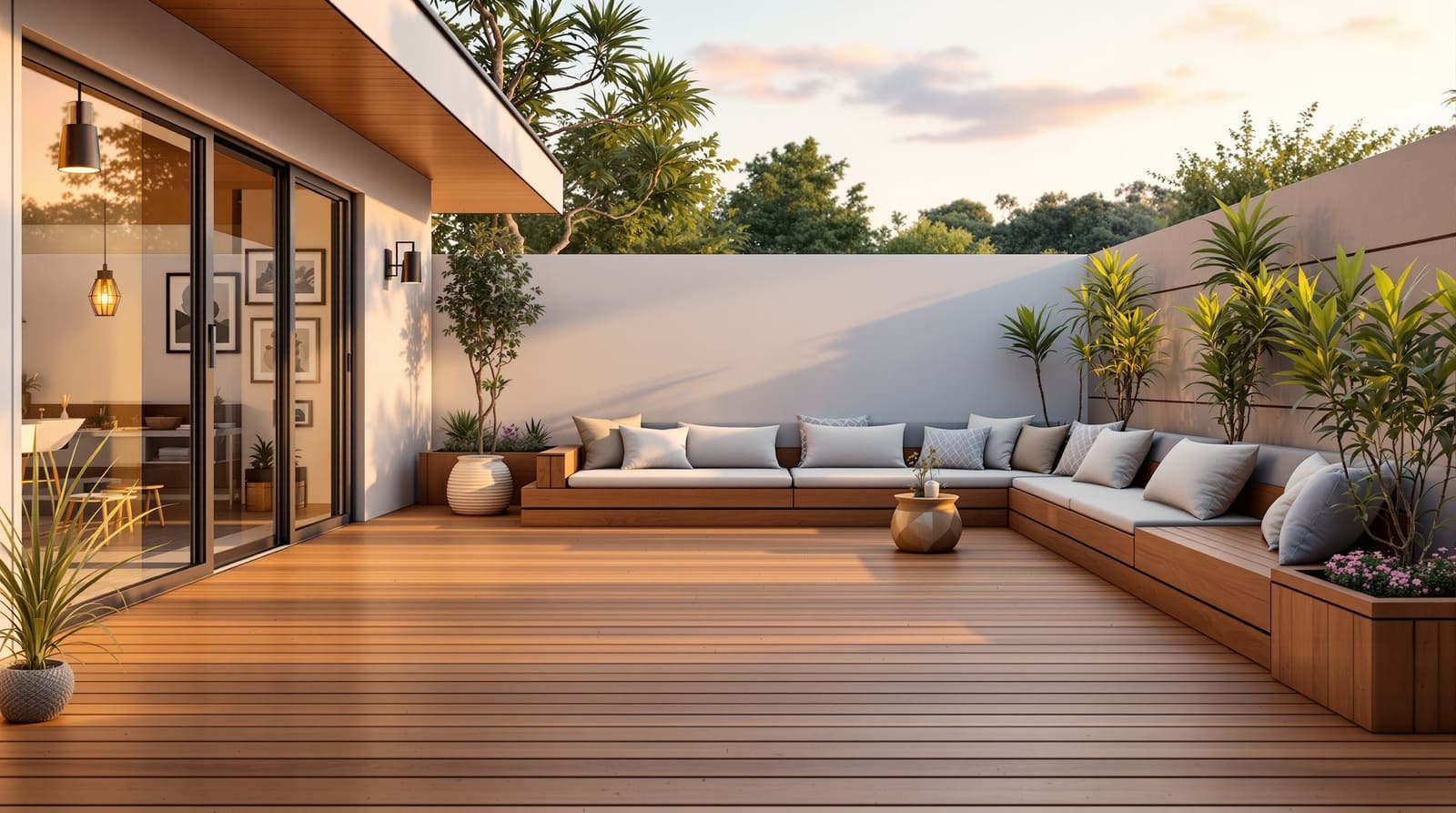
Wooden Decks for Indian Homes
Designing and building outdoor decks — hardwood vs composite, the deck section, ground clearance and drainage, slip and monsoon durability, maintenance and cost
A wooden deck is the one outdoor surface that invites you to take your shoes off — and in India, building one well is far less about the timber you choose and far more about the gap, the fall, and the air moving underneath it. A deck is a raised, ventilated platform of spaced boards over a frame, and that simple definition is what separates it from a tiled terrace or a stone patio. Get the section right and a deck shrugs off the monsoon for two decades. Get it wrong and you are looking at a cupped, slippery, termite-fed liability within two summers.
This guide is construction-led and general-purpose: lounging decks, dining decks, poolside decks, level-change platforms, and the increasingly common deck laid over a waterproofed terrace. If you specifically want a yoga or meditation platform, the brief treatment in Outdoor Wellness Spaces covers that ritual angle; here we are concerned with how decks are actually framed, drained, fixed and maintained across Indian conditions.
Why build a deck at all
Stone and tile are the default Indian outdoor surface, so it is worth being clear about what a deck does that they cannot.
- Warmth underfoot. Timber and composite store far less heat than dark stone or vitrified tile. A deck stays usable barefoot through more of the day, which matters in a country where outdoor living happens at the temperature extremes.
- Level changes made cheap and dry. Stepping a deck up or down to define a lounge, a dining zone or a planting edge is structural carpentry — a frame and boards — not the masonry, fill and waterproofing that a raised stone platform demands. Decks are the natural language of split-level gardens.
- A dry, drained floor over a wet substrate. Spaced boards drain instantly. This is the single best reason to deck a terrace: the boards sit on pedestals or sleepers clear of the slab, water runs through the gaps to the existing waterproofing below, and you walk on a dry surface even mid-monsoon. The deck protects the membrane from UV and foot traffic and is fully removable for inspection.
- Poolside grip and comfort. A correctly specified deck is less slippery wet than polished stone and far kinder to bare wet feet, which is why timber and composite dominate good pool surrounds.
Where a deck is the wrong answer: any surface that takes vehicle loads, anything in permanent ground contact without ventilation, and shaded, perpetually damp north sides where algae will out-pace your cleaning. There, paving wins — see Outdoor Flooring Guide for the full surface-selection logic.
Material choice — the real decision
Four families dominate the Indian market. The honest summary: hardwood looks best and ages most gracefully but demands maintenance; WPC composite is the low-effort default; bamboo composite is the value-and-sustainability pick; thermally-modified wood is the premium "real timber, less drama" option.
Natural hardwood (teak, sal, ipe, merbau)
Genuine dense hardwood — Burma/plantation teak, sal, imported ipe or merbau (Malaysian "kapur/keruing" is often sold as merbau) — is the benchmark for looks and feel. Density is what buys durability: ipe and merbau are extremely dense and naturally oily, resisting rot, termites and warping far better than soft species. Teak is the Indian classic for its silica content and stability. The trade-off is cost, sourcing ethics (insist on documented legal/plantation origin), and the maintenance commitment if you want to hold the colour. Hardwood also runs hotter in direct sun than composite and goes genuinely slippery when wet and dirty unless grooved or kept clean.
WPC / composite
Wood-plastic composite (a wood-flour + HDPE/PVC blend, sold as "WPC decking") is now the volume product in India. Capped/co-extruded boards — a hard polymer shell over the composite core — are markedly better than older uncapped boards for stain, fade and scratch resistance. Pros: no oiling, no termites, no rot, dimensionally stable, consistent colour, hollow profiles are lighter. Cons: it looks like what it is up close, it can get uncomfortably hot in full afternoon sun (choose lighter shades and co-extruded surfaces), cheap uncapped board fades and chalks, and it expands/contracts with temperature so gapping and fixing discipline matters.
Bamboo composite
Two things are sold under this name. Strand-woven bamboo (compressed bamboo strands in resin) is a genuine, very hard, real-material board — handsome and strong, though it needs finishing and is sensitive to standing water at the edges. Bamboo-plastic composite (BPC) behaves like WPC but with bamboo fibre. Both score well on sustainability — bamboo is fast-renewing — and BPC is often the best price-to-performance board on the market. Verify which one you are being quoted.
Thermally-modified wood
Heating ordinary timber (ash, pine, sometimes Indian species) to ~190–215°C in a low-oxygen kiln drives out the sugars and moisture that fungi and insects feed on. The result is a real-wood board that is dimensionally stable, rot- and insect-resistant and a warm chocolate-brown — without preservative chemicals. It is more brittle than unmodified wood, will silver if not oiled, and sits at a premium price, but it is the closest thing to "hardwood looks, composite-like behaviour."
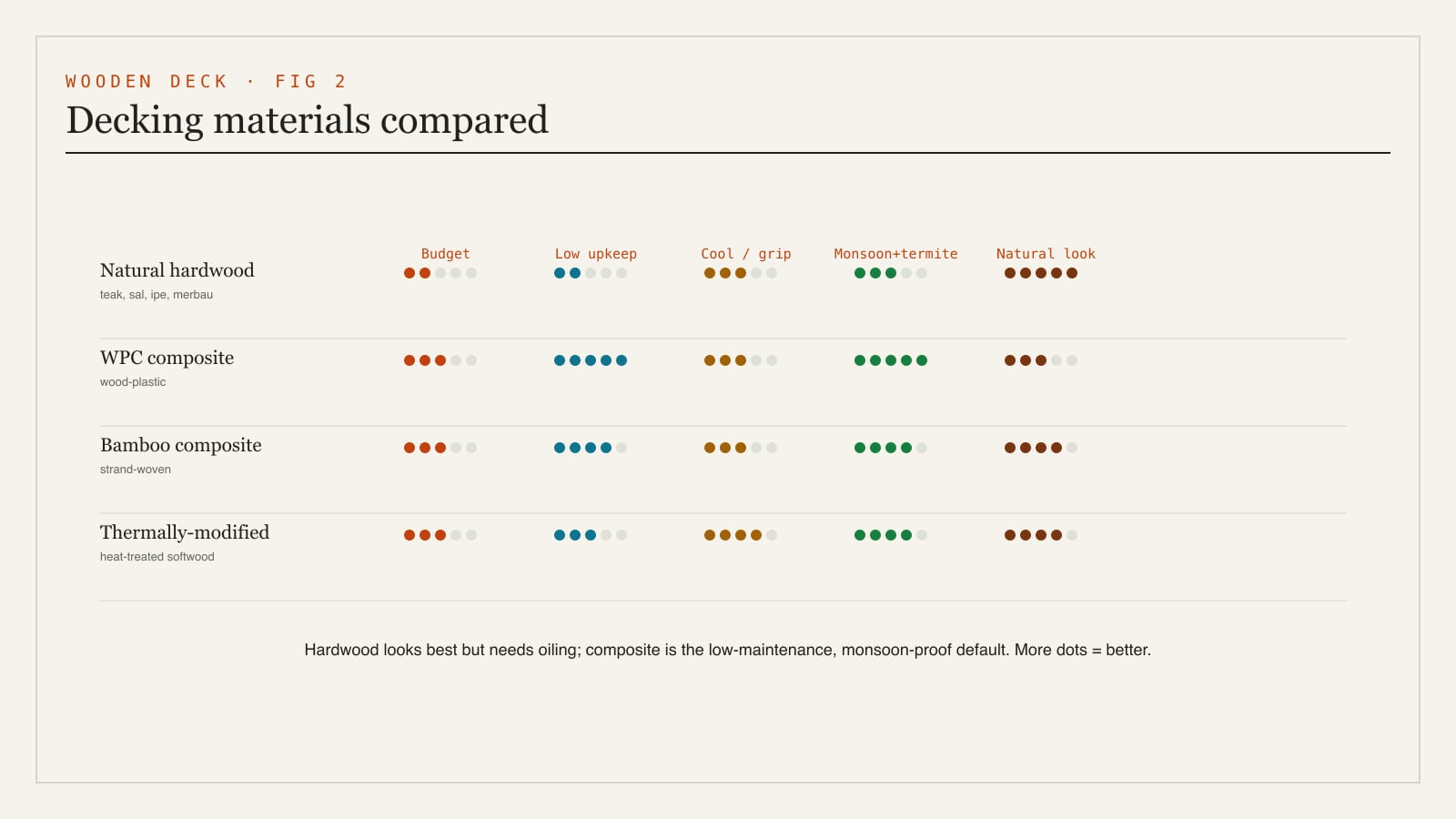
| Material | Look & feel | Maintenance | Heat in sun | Slip (wet) | Monsoon / termite / UV |
|---|---|---|---|---|---|
| Hardwood (teak/ipe/merbau/sal) | Best; ages beautifully | High — oil 1–2×/yr or let silver | Warm | Moderate; needs grooving + cleaning | Excellent if dense + detailed well; oily species resist termites |
| WPC / composite (capped) | Synthetic but tidy | Lowest — wash only | Hot (pick light/co-ex) | Good (textured) | Excellent; rot/termite-proof; capped resists UV fade |
| Bamboo (strand-woven / BPC) | Strong, characterful | Low–medium | Medium | Good | Good; verify type; protect cut edges |
| Thermally-modified wood | Real wood, even tone | Medium — oil to hold colour | Warm | Moderate | Very good; rot/insect-resistant, no chemicals |
₹ per sqft, India, supplied-and-fixed
Indicative 2026 ranges including substructure, fixings and labour; bare board cost is lower. Premium species, imports and pedestal terrace systems push the top end.
| Material | Board only (₹/sqft) | Supplied & installed (₹/sqft) |
|---|---|---|
| Sal / local hardwood | 200–400 | 450–750 |
| Teak (plantation/Burma) | 600–1,400 | 1,200–2,500+ |
| Ipe / merbau (imported) | 500–1,000 | 1,000–1,800 |
| WPC composite (uncapped) | 150–300 | 350–600 |
| WPC composite (capped/co-ex) | 280–550 | 550–950 |
| Bamboo (BPC / strand-woven) | 250–500 | 500–900 |
| Thermally-modified wood | 450–800 | 900–1,600 |
For how decking sits against paving, gravel and grass in a whole-garden budget, see the Landscape Cost Guide.
The deck section — where decks succeed or fail
The board is the part you see; the part that determines whether the deck survives is everything beneath it. Read this section before you read another word about colour.
Substructure and joists
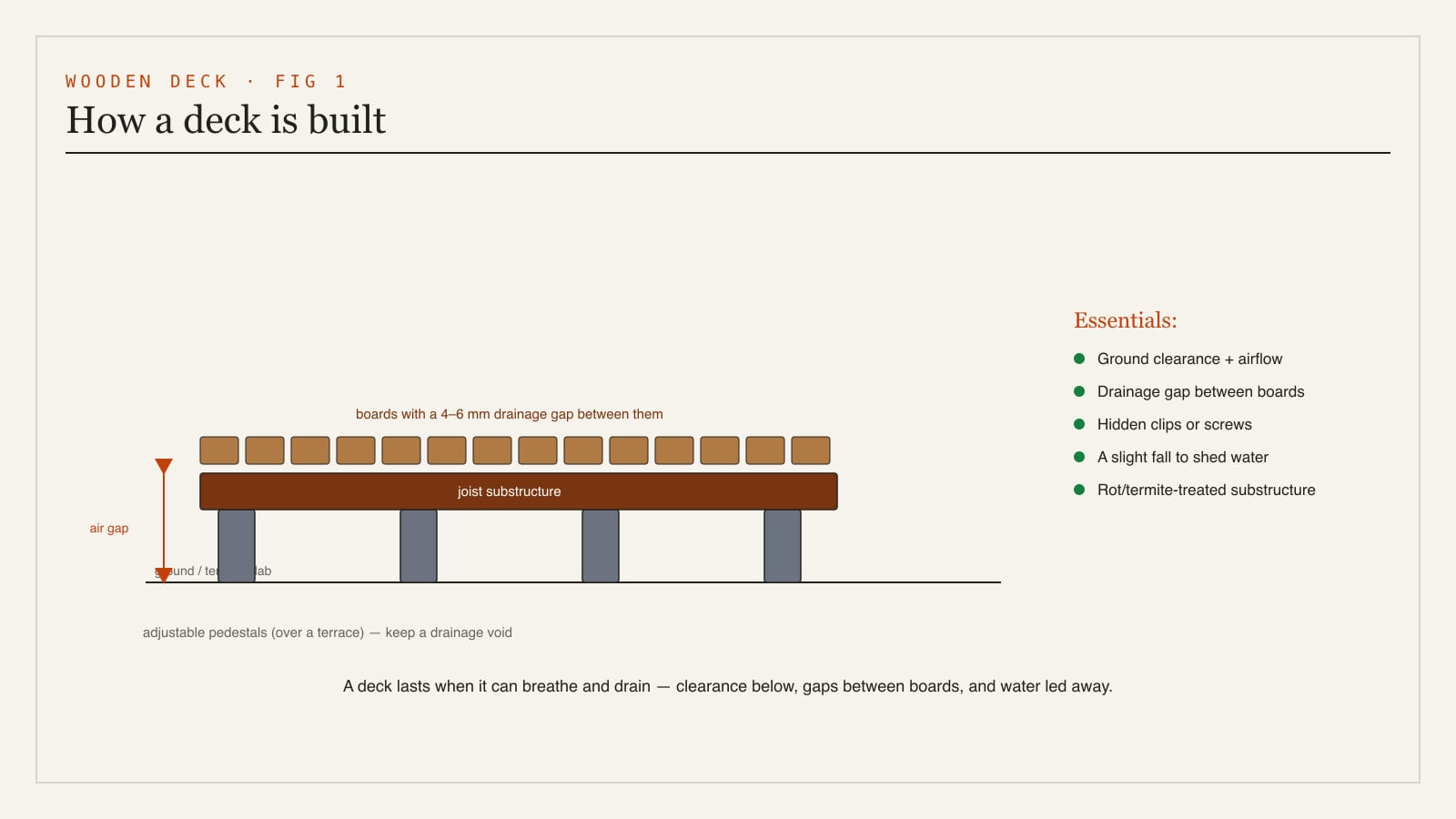
Boards span across joists at 300–400 mm centres (closer for softer boards, for diagonal patterns, and always near board ends). Joists sit on bearers/sleepers or on adjustable pedestals. The golden rule of Indian decking: the frame must be at least as durable as the board, ideally non-organic. Use treated/galvanised steel or aluminium subframes for terrace and poolside decks; if you use timber joists, they must be pressure-treated, kept off the wet, and ventilated. A teak deck on untreated softwood joists is a beautiful surface waiting to collapse.
Ground clearance and ventilation
Air must move under a deck. On grade, raise the frame on pads so there is at least 50–100 mm clearance, slope the ground beneath to drain, and lay a weed membrane over gravel rather than soil. Never trap a deck tight against a wall — leave a ventilation and drainage gap at every perimeter. Stagnant, unventilated air under a deck is the precondition for rot and termites; this is the failure mode that retires more Indian decks than monsoon ever does.
The drainage gap between boards
Boards are deliberately spaced — typically a 3–6 mm gap — so rain drains instantly and air dries the underside. Hardwood is laid tighter (it has moved toward equilibrium); composite is gapped a little wider to allow thermal movement and is also gapped at the board ends (follow the maker's expansion table for your temperature swing). Too tight and water sits and the deck cups; too wide and heels and furniture legs catch. The gap is not a tolerance — it is a designed drainage system.
Pedestal systems over terraces
The cleanest way to deck a waterproofed terrace or podium is an adjustable pedestal system: small screw-jack feet that carry the joists and level out the slab's drainage fall so the deck surface reads flat while water still runs to the existing outlets below. This keeps every fixing clear of the membrane, leaves the slab fully inspectable, raises the deck over the puddling line, and is completely reversible. It is the detail that lets you put a warm, dry floor over an ugly, wet terrace without ever penetrating the waterproofing.
Fixings — hidden clips vs screws
- Hidden clips sit in a groove on the board edge and screw down to the joist between boards. They give a clean, fastener-free surface, automatically set the gap, and let boards move — the standard for composite and premium hardwood.
- Face screws (stainless steel, countersigned, twin per joist) are stronger and cheaper but show on the surface and, in timber, are the entry point for water — pre-drill, use only stainless or coated screws (plain steel bleeds rust stains within one monsoon), and plug if you want them hidden.
Whatever you use, fix to a clean accessible frame so individual boards can be lifted and replaced.
Falls
A deck must shed water. Set a fall of roughly 1 in 80 to 1 in 100 (1–1.5%) across the boards, running boards in the direction of fall so the gaps channel water away from the house. On terraces, the pedestal heights follow the slab's own fall while keeping the deck top level. Standing water is the enemy of every decking material.
Slip and weathering through the monsoon
Wet timber with a film of algae or pollen is genuinely dangerous. Manage it by design, not just by mopping:
- Specify grooved/reeded or textured-surface boards for steps, pool edges and shaded runs.
- Keep the drainage gaps clear — a leaf-blocked gap turns the board into a puddle.
- Wash off the green before the monsoon, not after it has bedded in; a stiff brush and a deck/oxygen cleaner, never a harsh metal scraper.
- Accept that deep-shade, north-facing or under-tree decks will stay greener — composite or paving may simply be the safer surface there.
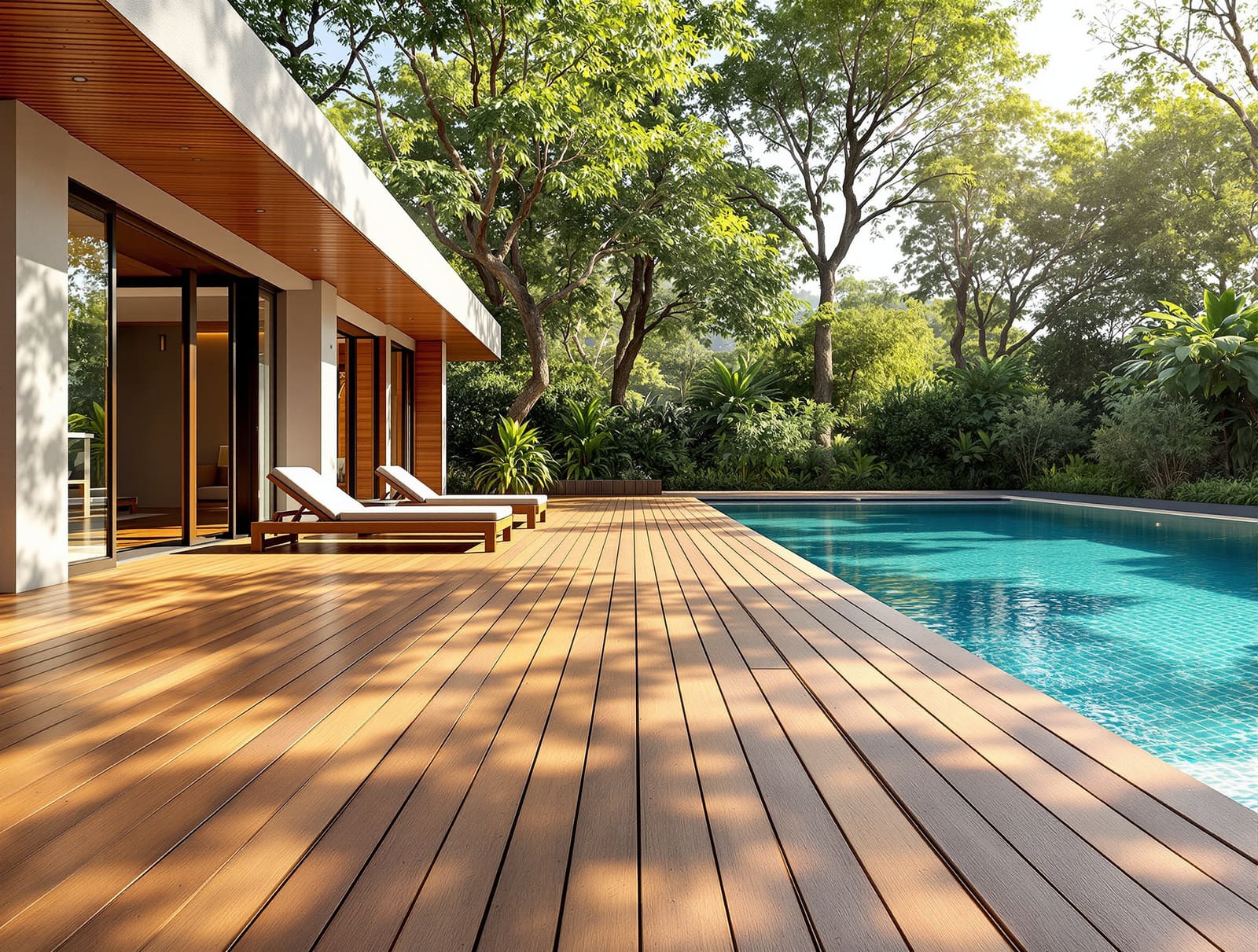
For poolside specifically, the deck must drain away from the coping, use a slip-rated textured board, and tolerate splash-out and pool chemicals — capped composite and dense oily hardwood both do this well.
Maintenance and the silvering choice
This is where homeowners are most often surprised, so decide upfront which deck you are signing up for.
Composite, bamboo composite and thermally-modified-if-you-let-it-grey are wash-only. Sweep, hose, occasional soapy scrub, clear the gaps. No oiling, no sanding.
Hardwood forces a choice:
- Oil it. Apply a penetrating decking oil (not film-forming varnish, which peels and traps moisture) once or twice a year — typically before and after the monsoon. This holds the rich colour, slows surface checking and keeps the board water-shedding. It is real, recurring work.
- Let it silver. Left unoiled, all natural timber UV-weathers to a soft silvery-grey patina. This is purely cosmetic — a dense hardwood is just as durable silver as it is golden — and many designers consider it the more honest, lower-effort finish. The mistake is starting to oil, stopping, and ending up with a blotchy half-and-half deck. Pick a lane and hold it.
Annual jobs for any deck: clear the drainage gaps and the perimeter ventilation gap, check the underside for trapped debris, re-seat any lifted clip or proud screw, and replace any single damaged board (the reason you fixed to an accessible frame).
Where decks suit — and where they do not
Good fits: terraces and podiums over waterproofing, poolside, level-change garden lounges and dining decks, balconies (pedestal tiles), and transition platforms linking house to garden. For how a deck reads as part of a whole composed garden — the lounge as a destination, the planting that frames it — see Villa Landscape Design and the layout ideas in Backyard Design Ideas. Pair the deck with the right Outdoor Furniture Planning so loungers and dining sets actually fit the platform you build.
Poor fits: driveways and any vehicle load; permanently shaded, never-drying north corners; surfaces in direct soil contact without ventilation; and anyone unwilling to either oil a hardwood deck or accept it going grey. In those cases, reach for paving.
References & further reading
- National Building Code of India (NBC) 2016, Part 10 — Landscaping, Signs and Outdoor Display Structures, Bureau of Indian Standards — for site landscaping, grading and outdoor structure provisions.
- IS 401: Code of Practice for Preservation of Timber and IS 1141: Code of Practice for Seasoning of Timber, Bureau of Indian Standards — treatment and seasoning requirements for outdoor timber in India.
- IS 4970: Key for Identification of Commercial Timbers, Bureau of Indian Standards — for identifying and specifying Indian hardwood species.
- Forest Stewardship Council (FSC) Chain-of-Custody / legal-origin documentation — for verifying responsibly sourced hardwood and bamboo.
- Timber Decking and Cladding Association (TDCA), UK — "Code of Practice for Timber Decking" — manufacturer-neutral guidance on joist spacing, ventilation, fixings and falls that translates well to Indian practice.
- Cathy Strongman, "The Sustainable Home" and standard landscape-construction texts (e.g. "Landscape Construction" by David Sauter) — for substructure, drainage and pedestal-system detailing.
Export this guide
Related Guides — Deep-dive reading
Patio Flooring in India: Best Decks & Outdoor-Seating Floors for Weather, Grip & Looks
How to floor a patio, deck or outdoor lounge in India so it shrugs off UV and monsoon, grips wet feet, stays barefoot-friendly and still looks like a place you want to entertain.
Flooring & SurfacesOutdoor Flooring Guide — Choosing the Right Surface
The broad chooser across every outdoor surface — natural stone, tile, deck, gravel, concrete and grass pavers — by slip, heat, drainage, upkeep and cost, and which suits which zone
LandscapeCast Iron Bathtub India: The Heirloom Tub, Weight & Slab Load, Enamel Care & Cost (2026)
Why an enamelled cast-iron bathtub is the heirloom tub — unbeatable heat retention, a quiet soak and a vitreous-enamel surface that shrugs off scratches and stains for decades — set against the one thing India buyers must plan for: the sheer weight on the slab, the crew it takes to carry it up, chip repair, the cost premium, and an honest verdict versus acrylic.
BathroomsRelated Tools — Try Free
Cross-Ventilation Analyzer
Estimate airflow and air changes per hour (ACH) from room size, window areas, layout, and local wind — with NBC 2016 Part 8 compliance check.
Ventilation CalculatorMonsoon-Readiness Checklist
Pre-rain home audit across 9 categories — terrace, drains, waterproofing, electrical, HVAC, pest, vehicles, documents.
Seasonal AuditDoor Material Comparison Tool
Compare 2–4 door materials on cost, durability, maintenance, security and moisture resistance.
Comparison Tool