
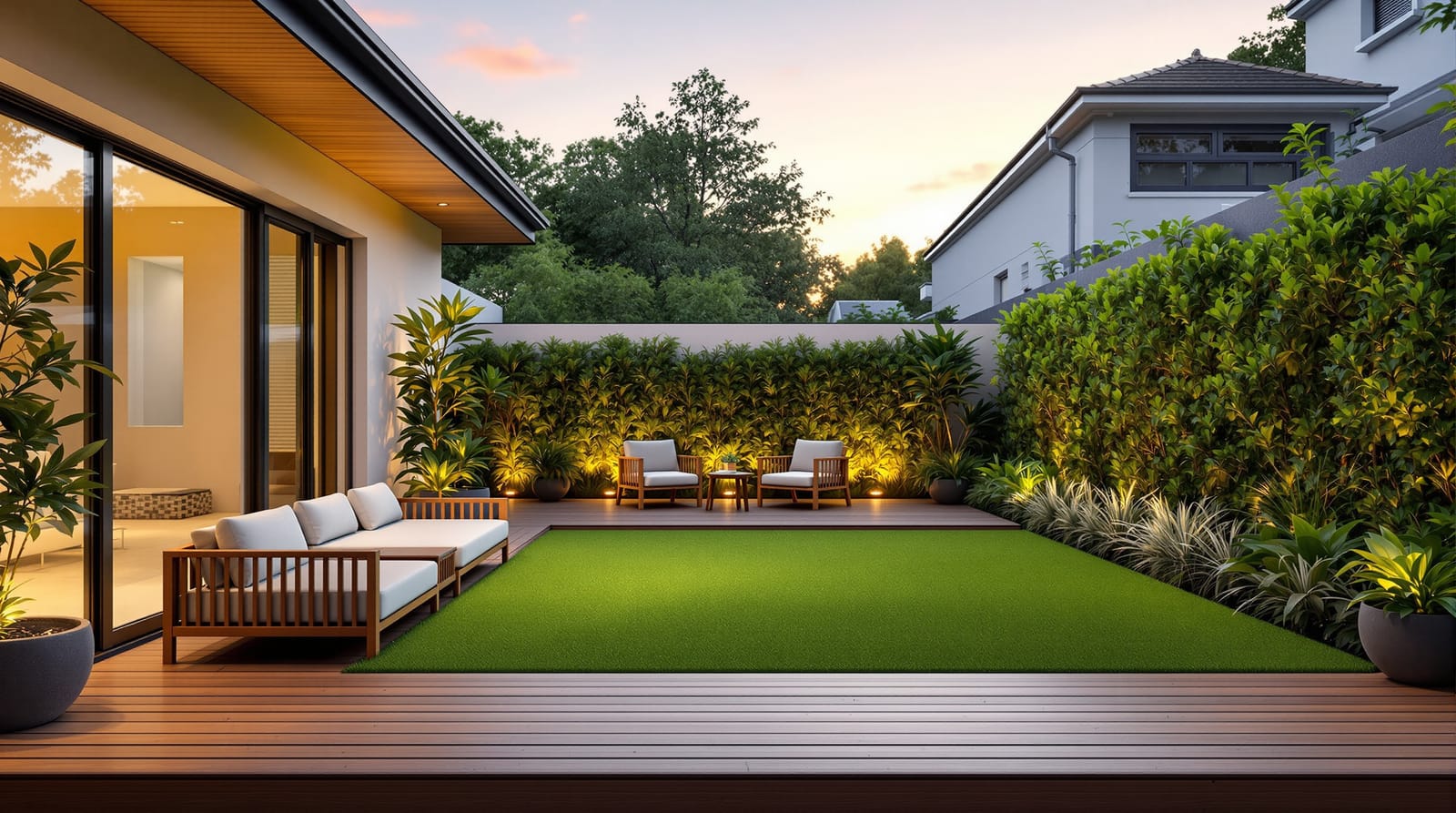
Backyard Design Ideas — Your Private Outdoor Room
Zoning the rear garden for dining, lounging, play and retreat — privacy, evening use, indoor-outdoor flow, and ideas for backyards small and large
Your front yard is for the street; your backyard is for your family — it is the one piece of outdoor ground that is truly private, flexible and lived-in every single day, so it deserves to be designed as a genuine outdoor room rather than left as a leftover patch behind the house.
Most Indian homes treat the rear garden as an afterthought: a strip of mud where the water tank sits, where the maid hangs the washing, and where nobody actually goes. Yet this is precisely the space with the most potential. It is screened from passers-by, it usually catches morning light, it spills directly off the kitchen and living room, and it is the natural setting for the things families really do outdoors — early chai, weekend dinners, children's play, festival gatherings, and the quiet half-hour after work when you just want to sit under the sky. This guide is about turning that neglected rear patch into the home's favourite room.
Why the backyard is the real living garden
The front garden does a public job — it frames the entry, manages the car, and shows a face to the street (we cover that in Front Yard Design Ideas). The backyard does the opposite. Because the boundary wall and the house itself shield it, you can do things here you would never do out front: leave cushions on the chairs, let children leave their cricket stumps standing, hang a hammock, eat with your hands off a low table, sit in your nightclothes with the morning paper.
That privacy changes the whole design brief. Out front you design for arrival and impression; out back you design for dwelling — comfort, shade, soft surfaces, places to put your feet up, and the ability to move a meal outdoors without ceremony. A good backyard is not a showpiece you look at; it is a set of habits you actually live.
This guide stays deliberately in one lane: the design and treatment of the private rear garden. If you want the underlying logic of how to slice any garden into activity areas — sun-mapping, adjacencies, how much space each function needs — that framework lives in Landscape Zoning for Family Activities. Here we assume you have a rear garden, and we focus on what to put in it and how to make it work morning, evening and through the monsoon.
The core backyard zones
A backyard that works almost always reads as a handful of distinct but connected zones rather than one undifferentiated lawn. Even a small rear garden of 3 × 6 m can hold three of these; a generous villa garden of 12 × 15 m can hold all five with breathing room. (For larger plots, see Villa Landscape Design.)
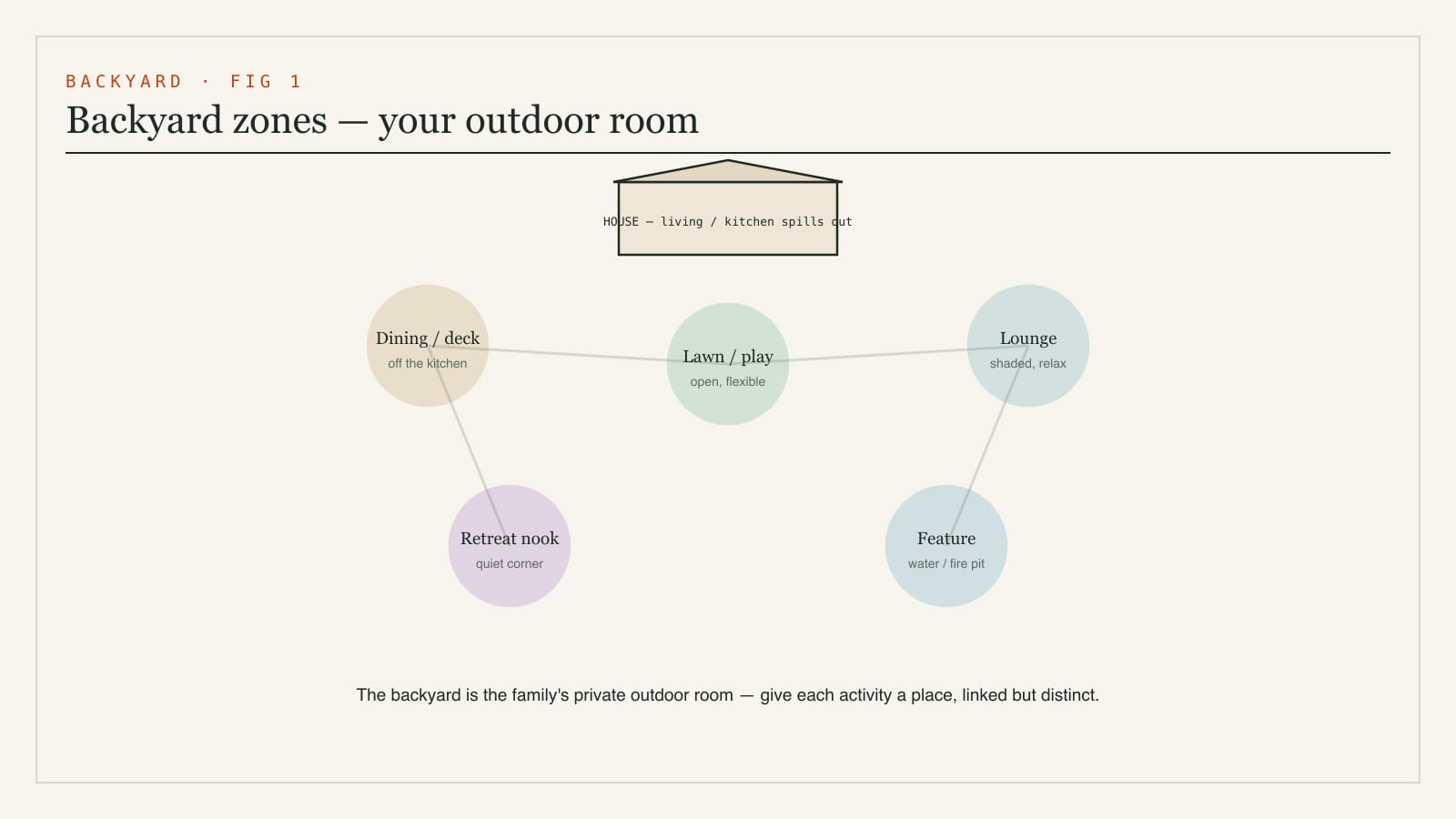
1. An outdoor dining or deck area
Place this directly off the kitchen or dining room so carrying food out is a two-step affair, not an expedition. A hard, level surface is essential — Indian-pattern stone (Kota, Tandur, Jaisalmer), anti-skid vitrified tiles rated for outdoors, or a timber/WPC deck if you want warmth underfoot. A 6-seater needs roughly 3 × 3 m clear; allow chairs to slide back without falling off the edge. This is the zone that earns its keep at breakfast and dinner.
2. A lounging and relaxing area
A softer, lower corner for sitting back rather than sitting up — a couple of weatherproof loungers, a low daybed, or built-in plinth seating with outdoor cushions. Tuck it against a wall or under a tree so it feels held and shaded. This is the spot for the after-work half-hour and weekend reading.
3. Lawn or play space
Open ground is precious for children, pets and floor-seated festival gatherings. A genuine lawn (Bermuda/"doob" or the soft, shade-tolerant Mexican grass Axonopus) needs sun and weekly mowing; if your rear garden is shaded or you travel often, consider a low-mow groundcover, a sand-and-grass play patch, or a rug-sized lawn surrounded by paving. Honest advice: a lush lawn in a small, partly shaded urban backyard is a maintenance trap — size it to what you will actually water and cut.
4. A green retreat corner
A pocket of dense planting with a single chair or a swing (jhula) — somewhere to disappear into greenery. This is where you layer fragrance and texture: raat ki rani (night-blooming jasmine), mogra, a curry leaf tree, ferns and Philodendron in the shade. It is small but does enormous work for how the garden feels.
5. A feature
One focal element that anchors the eye and the evening: a small water body (a wall spout into a pebble trough, or a lily urn), a fire pit / sigri corner for winter, or a sculptural planter. Pick one — a backyard with five competing features has none.
| Zone | Typical size | Best surface | Works best at |
|---|---|---|---|
| Outdoor dining / deck | 3 × 3 m (6-seater) | Stone, outdoor vitrified, WPC deck | Breakfast, dinner |
| Lounging corner | 2 × 2.5 m | Deck or paved with rug | Evening, weekends |
| Lawn / play | 3 × 4 m minimum to feel usable | Turf or groundcover | Daytime, festivals |
| Green retreat | 1.5 × 1.5 m | Gravel, stepping pads | Morning, dusk |
| Feature (water/fire) | 1 × 1 m to 2 × 2 m | Integrated into paving | Evening, winter |
Designing for evening and year-round use
Most Indian backyards are used after the sun loses its sting — early morning and after 6 pm. A garden that ignores the evening is half-built.
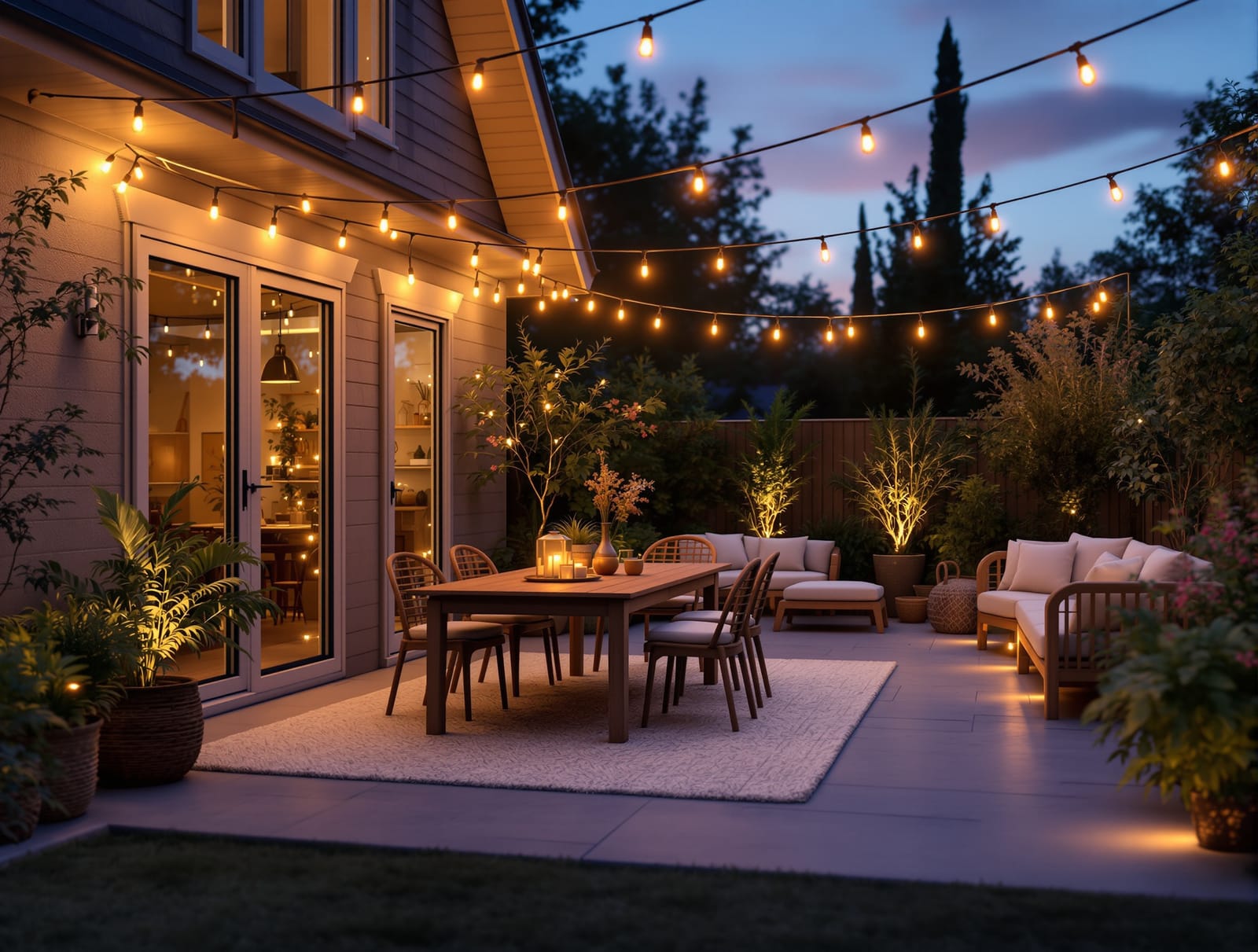
Lighting is the single biggest upgrade. Aim for warm light (2700–3000K), low and layered, never one harsh floodlight on a pole. A good kit: warm string/festoon lights over the dining zone (₹1,500–4,000), two or three low bollards or spike spots washing the planting (₹800–2,500 each), a downlight or two from the house eave, and a single uplight on your feature tree. Use IP65-rated fittings — monsoon humidity destroys cheap outdoor lights in a season. Solar lights are tempting but dim and short-lived in Indian rains; run a proper low-voltage circuit if you can.
Shade decides whether the garden is usable in April. A pergola (timber, MS section, or WPC) over the dining zone, planted with a Bougainvillea, Madhumalti (Rangoon creeper) or Passiflora, gives dappled shade that improves every year. For instant cover, a cantilever umbrella or a tensioned shade sail works. Orient the shade to block the harsh west sun, which is the real enemy of afternoon comfort across most of India.
Monsoon shelter is what separates a fair-weather garden from one used eight months a year. A roofed portion — even a 2 × 3 m polycarbonate or tiled lean-to off the rear wall — lets you sit out in the rain, which is one of the great pleasures of an Indian monsoon. Pair it with good drainage: a 1-in-100 fall on all paving away from the house, a perimeter channel or nahani drain, and gravel or permeable joints so water soaks rather than pools. Choose rust-proof or treated furniture; teak, powder-coated aluminium, WPC and synthetic rattan survive; mild steel and untreated MDF do not.
Privacy and screening from the neighbours behind
The thing that ruins many a backyard is the neighbour's first-floor window looking straight down into it, or a blank, ugly boundary wall on three sides. The fix is layered green screening, which also softens noise and the harsh reflected heat off compound walls.
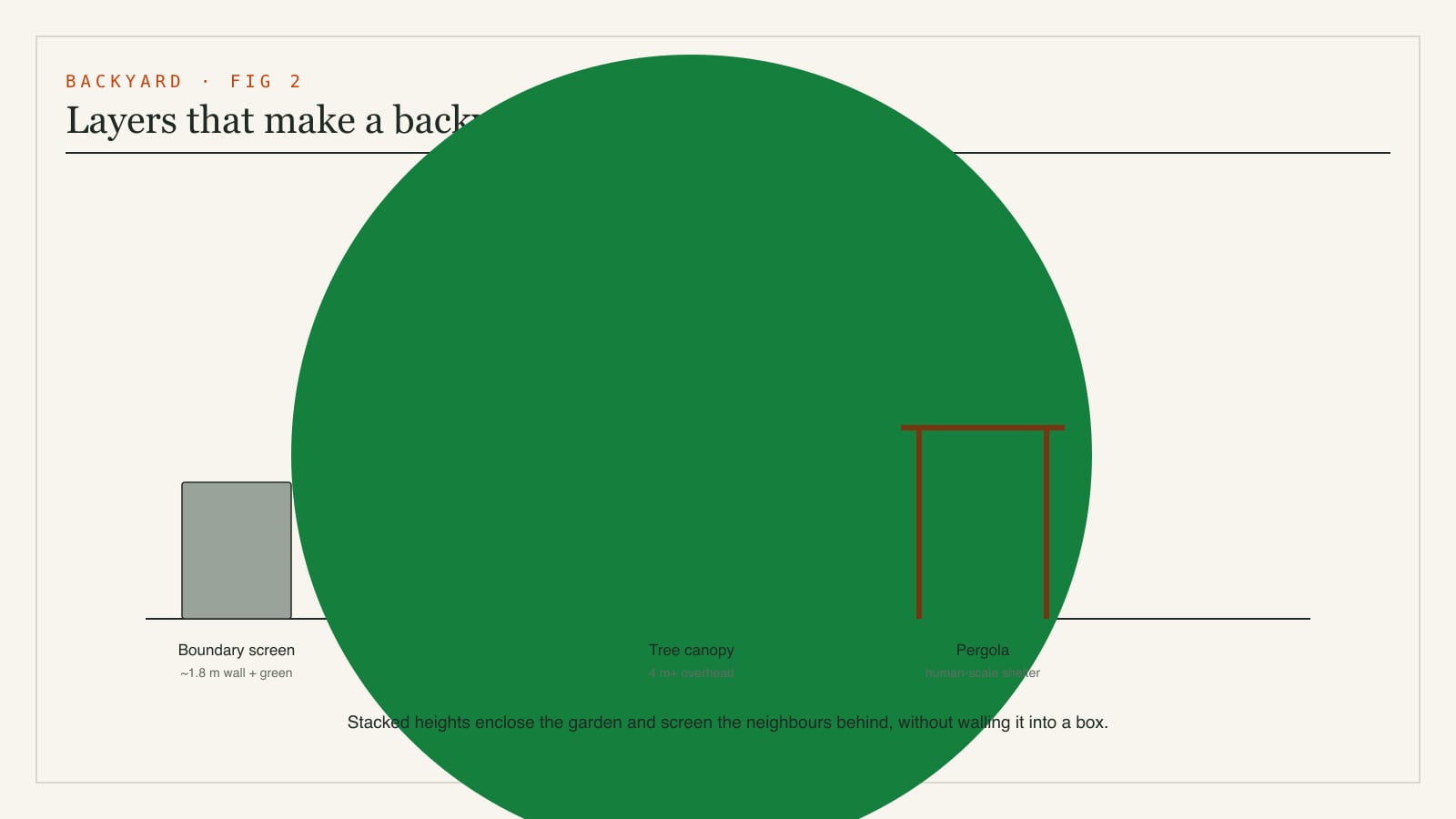
Think in four layers, from the boundary inward:
1. Boundary screen — a green wall or trellis on the compound wall: Ficus "green island" hedging, bamboo (clumping Bambusa species, never the running kind), or a creeper-clad mesh. This hides the wall and lifts the screen height.
2. Shrub band — a 0.5–1 m deep planting strip of medium shrubs (Tecoma, Hamelia, Duranta, Ixora) that gives a soft mid-level wall of green.
3. Tree canopy — one or two well-placed small trees to block overlooking windows and cast shade. Good rear-garden choices: Plumeria (frangipani), Tabebuia, Bauhinia, or a fruiting Citrus / guava. (See Best Trees for Indian Homes for root and size cautions near walls.)
4. Overhead layer — the pergola or a tree canopy that closes off the view from above, the most overlooked source of lost privacy in dense Indian neighbourhoods.
A boundary wall in most municipalities can go to about 1.8 m of solid masonry; height above that should be open trellis or planting, not solid wall, to stay within byelaws and not pick a fight with the neighbour. For a deeper treatment of sightlines, fencing and acoustic screening, see Landscape Privacy Design.
Connecting the backyard to the indoors
A backyard only gets used if it is easy to reach and visible from where the family already sits. The best rear gardens are an extension of the living and kitchen, not a separate destination you have to decide to visit.
- Spill-out from the living room: large sliding or folding doors, a flush threshold (no step or trip-lip), and the same or a similar floor level inside and out make the garden read as another room. Even a 100 mm step kills the spill-out feeling.
- A kitchen door to the dining zone so food, water and the inevitable forgotten spoon travel easily. This single adjacency is what makes outdoor dining a habit rather than an event.
- Visual connection: the green retreat or feature should be framed by a window you sit near, so the garden gives pleasure even from indoors.
- A continuous material — running the indoor stone out onto the patio, or echoing the timber — visually pulls the two together.
Getting this connection right is really a building-design decision, best made before construction; if you are at that stage, read Landscape Planning Before Building Design.
Small vs large backyard ideas
The principles are the same at every size; the editing is what changes.
| Small backyard (under ~4 × 6 m) | Large backyard (villa scale) | |
|---|---|---|
| Zones | Pick 2–3; let them overlap | All 5, clearly separated |
| Lawn | Skip or keep token; pave most of it | Generous lawn, defined edges |
| Seating | Built-in plinth / bench (saves space) | Loose furniture, multiple settings |
| Planting | Vertical — green walls, climbers, pots | Layered beds, specimen trees |
| Feature | One small wall spout or urn | Pool, large water body, fire pit court |
| Trick | Mirror-light colours, single material, diagonal layout to stretch the eye | Use paths and level changes to create rooms |
For a small backyard, the winning moves are: go vertical (the floor is precious, the walls are free); use one continuous floor material so the space reads bigger; build seating into the boundary rather than dropping furniture in the middle; and choose one multi-tasking zone — a deck that is dining and lounging — rather than cramming five. A 3 × 5 m courtyard-like rear garden can be a complete outdoor room with a corner deck, a green wall, a swing and a single wall water-spout.
For a large backyard, the risk is the opposite — a vast, flat, boring lawn. Break it with Outdoor Circulation Design: paths that lead somewhere, a level change or a low retaining wall, and clearly bounded "rooms" so the space has a sequence and surprises rather than being read in one glance.
Low-maintenance choices
A beautiful backyard you cannot keep up becomes an eyesore within a year. Build maintenance-thinking in from the start:
- Mulch every bed (bark, cocopeat, gravel) — it cuts watering and weeding by half.
- Drip irrigation on a timer is the best ₹8,000–20,000 you will spend; it removes the daily-watering chore that kills most gardens.
- Right plant, right place: hardy Indian natives and acclimatised species (Ixora, Tecoma, Plumeria, Sansevieria, Bougainvillea, lemongrass) over thirsty exotics.
- Reduce lawn: turf is the highest-maintenance surface there is. Replace it with paving, gravel, groundcovers (Wedelia, Cuphea) or a deck wherever a real lawn is not essential.
- Use durable, weatherproof materials so the garden ages gracefully rather than rotting and rusting.
For families wanting the garden to give something back, a few productive plants — a curry leaf tree, lemongrass, tomatoes in pots, a guava — fold neatly into the green retreat corner; see Edible Landscapes.
A worked example: a 6 × 9 m suburban backyard
Take a typical rear garden behind a 30 × 50 ft plot — about 6 m wide and 9 m deep, walled on three sides, with the kitchen and living room opening onto it from the north.
- Off the living room (the spill-out): a 3.5 × 3.5 m stone-paved patio, flush with the indoor floor, sliding doors, with a 3 × 3 m timber pergola over it carrying a Madhumalti creeper. Dining table for six. Festoon lights strung corner to corner.
- South-west corner (worst west sun): a 2 × 2.5 m lounging nook with built-in plinth seating against the wall, deeply shaded by a Plumeria, with two warm spike-lights.
- Centre: a small 3 × 3 m lawn of Mexican grass for the children and floor-seating at festivals — kept deliberately small to stay mowable.
- Far corner, framed by the kitchen window: the green retreat — a jhula, a curry leaf tree, raat ki rani for evening scent, ferns in the shade.
- Feature: a simple wall-mounted copper spout into a pebble trough on the east wall — gentle water sound, no pump-heavy pond to maintain.
- All three boundaries: the four-layer screen — Ficus hedge on the wall, a shrub band of Tecoma and Ixora, the Plumeria and curry-leaf canopy, and the pergola overhead — so no neighbour's window looks in.
- Services: drip irrigation on a timer, a perimeter drain falling away from the house, a small 2 × 3 m polycarbonate roof over part of the patio for monsoon evenings.
Costs scale with finish, but a backyard of this scale done well — paving, deck, pergola, lighting, planting and irrigation — typically lands between ₹6 lakh and ₹15 lakh, the higher end for premium stone, mature trees and a water feature. The cheapest version of the same layout, using budget paving and young plants, can be done for ₹2.5–4 lakh and will fill in beautifully over two or three seasons.
The takeaway
The backyard is the most generous gift in the house — private, flexible, and yours alone — and it rewards the same care you would give any indoor room. Zone it for the things your family actually does, design it hard for the evening and the monsoon, screen it green on every side, glue it to the kitchen and living room, and keep the maintenance honest. Do that, and the patch behind the house stops being where the water tank lives and becomes where the family lives.
References & further reading
- National Building Code of India 2016, Part 10 (Landscape Development, Signs and Outdoor Display Structures) — Bureau of Indian Standards. Authoritative guidance on planting, paving, drainage and outdoor space planning.
- ISOLA (Indian Society of Landscape Architects) — professional resources and best-practice guidance for Indian residential landscape design.
- ICAR–IIHR (Indian Institute of Horticultural Research, Bengaluru) — species selection, ornamental and edible planting suited to Indian climates.
- Royal Horticultural Society (RHS), "Encyclopedia of Garden Design" — principles of zoning, layering and outdoor-room design (adapt species to Indian conditions).
- CPWD Horticulture Manual / Harmonised Guidelines (accessibility for level thresholds and circulation) — Government of India references for paving falls, drainage and accessible outdoor surfaces.
Export this guide
Related Guides — Deep-dive reading
From Space to Place: Turning Empty Rooms into a Home
How to transform a bare builder flat into a warm, lived-in home — through scale, zones, layering, retreat corners and flow
Design EducationVilla Landscape Design — Indian Villa Gardens, Hardscape & Vastu Landscape (2026)
8 landscape zones · Climate-zone tree palette · Vastu landscape · NBC 2016 Part 10 · 1.5 acre worked example
Design StylesDesigning Adaptable & Universal-Design Homes
Accessibility, Aging-in-Place, and the Multi-Stage Family — Code, Anthropometrics, and Plan-Stage Discipline for Indian Residential Architects
Room PlanningRelated Tools — Try Free
Landscape Cost Calculator
Estimate a garden's cost — hardscape, softscape, lawn, irrigation, lighting and annual upkeep — by area, tier and city.
Budget CalculatorGarden Planning Toolkit
Get a tailored garden plan — planting layers, Indian species, features and a checklist — from your climate, space, sun and goals.
PlannerCross-Ventilation Analyzer
Estimate airflow and air changes per hour (ACH) from room size, window areas, layout, and local wind — with NBC 2016 Part 8 compliance check.
Ventilation Calculator