
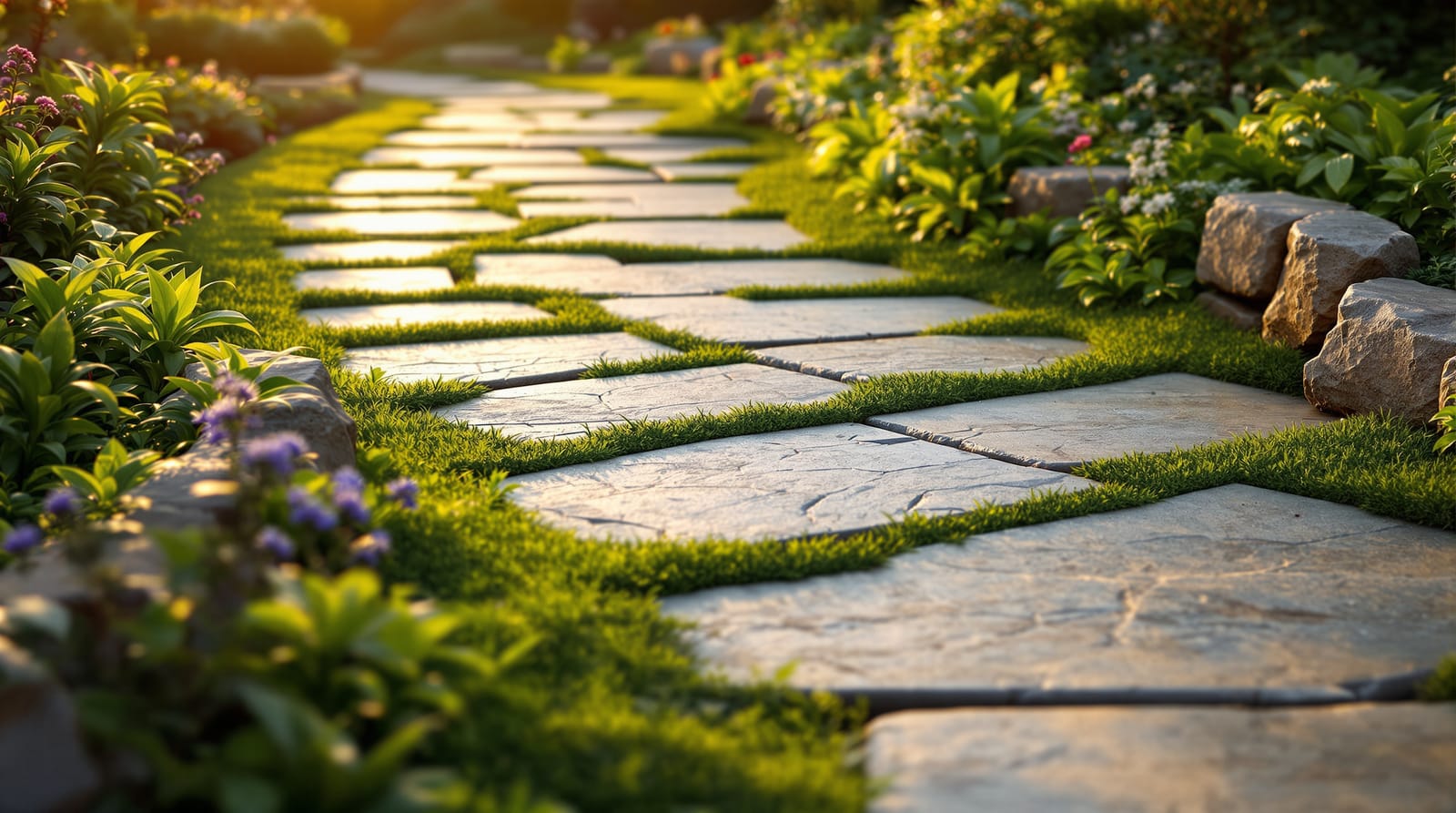
The Architecture of Pathways — Materials, Widths & Construction
The path as a designed, constructed element: width standards, the layers that make a path last, the paving palette, edges, steps, drainage and lighting
A path is architecture you walk on — and like any architecture, a good one is built up in layers, dimensioned for the body, drained for the monsoon and detailed at its edges, while a bad one is just stone laid on dirt waiting to sink, crack and weed over. Most Indian gardens get the route roughly right and the construction badly wrong, which is why so many home paths are heaving, puddled and shabby within two monsoons. This guide is about the craft of the path itself: how wide it should be, what it is made of, how it is built up from the soil, how its edges are held, how it climbs and how it drains. (If you want to think about where paths go and how the whole garden flows, that is a separate discipline covered in our sibling guide, Outdoor Circulation Design — here we stay strictly on the path as a constructed object.)
A path is architecture underfoot
We tend to judge a garden by its plants and its trees, but the path is the one element you touch with your whole body every single day. It sets the pace at which you move, tells your feet whether to hurry or linger, and quietly signals whether a home is cared for. A path that is true underfoot — level, firm, generous, well-edged — reads as quality even before you notice the planting around it. One that wobbles, ponds water or sprouts grass through its joints undermines everything else.
Treating the path as architecture means accepting that it has dimensions, a structural section, materials with real properties, and details that must be drawn and built, not improvised. The rest of this guide walks through each of those in turn.
Width: dimensioning for the body
Width is the single most common mistake. Indian home paths are routinely built too narrow — a 450 mm strip that looks fine empty but forces two people to walk single file, snags saris and dhotis on planting, and cannot take a wheelbarrow or a gas cylinder trolley. Width should be set by who and what uses the path, not by how much stone you want to save.
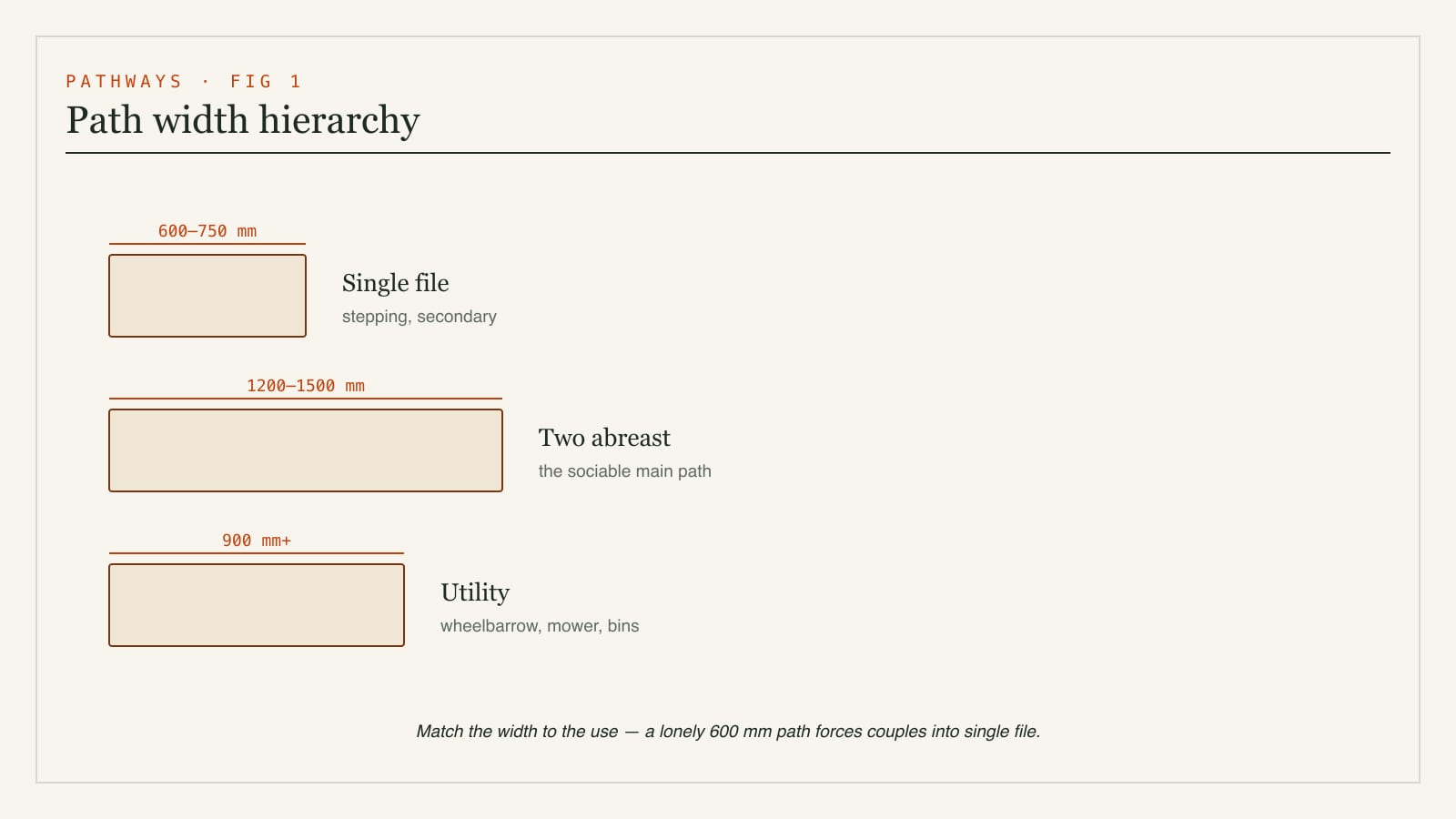
| Path type | Minimum clear width | Comfortable width | Notes |
|---|---|---|---|
| Single person, occasional | 600 mm | 750 mm | Stepping stones, secondary garden loops |
| Single person, daily / primary | 750 mm | 900 mm | Main route to a side gate or service yard |
| Two people side by side | 1,200 mm | 1,500 mm | Front approach, the "social" path |
| Utility / wheelbarrow / trolley | 750 mm | 900 mm firm + level | Must be smooth, no loose gravel, gentle gradient |
| Wheelchair accessible | 900 mm | 1,200 mm (1,500 mm passing) | Firm, slip-resistant, gradient under 1:20 |
A few rules of thumb worth internalising. The front approach — the path guests use — should comfortably take two people abreast, so aim for 1,200–1,500 mm; anything narrower makes arriving feel apologetic. Allow for planting overhang: lush Indian borders of ixora, hamelia or mussaenda will spill 150–300 mm into the path within a season, so a "1,200 mm" path with planting both sides behaves like 700–900 mm in use. And remember that width can deliberately change — a path that pinches to draw you through an arch and then opens onto a sit-out is using dimension as architecture. For how those dimensional moves connect into a whole, see Outdoor Circulation Design; for how the path relates to plot setbacks and the overall ground plan, see Residential Site Planning.
The anatomy of a path: why cheap paths fail
Here is the heart of it. A durable path is not a surface — it is a sandwich of engineered layers, each doing a job. The reason most Indian home paths fail is that they skip the layers and lay paving straight onto loose backfill or weak soil. The first monsoon saturates that soil, it consolidates unevenly, and the surface heaves, dips and cracks.
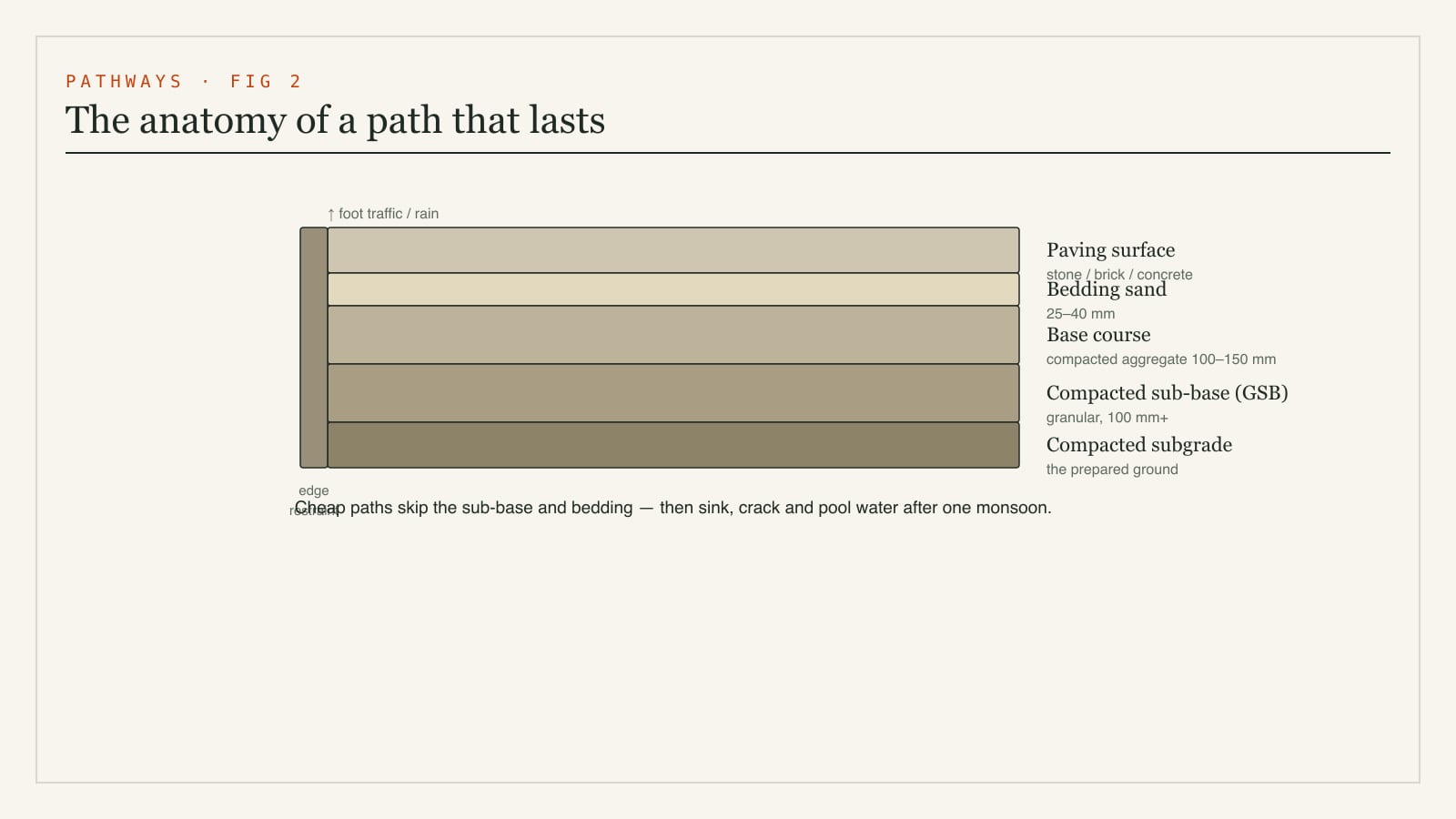
From the bottom up, a properly built rigid or semi-rigid pedestrian path looks like this:
- Subgrade (the native soil). Stripped of topsoil, organic matter and roots, then compacted. In black cotton (expansive) soil — common across the Deccan, parts of Maharashtra, Gujarat and Madhya Pradesh — this layer is treacherous: it swells when wet and shrinks when dry. Over black cotton soil, excavate deeper and replace the top with non-expansive murram or moorum, or detail a thicker granular sub-base.
- Sub-base — 100–150 mm of compacted granular material (40 mm down graded crushed stone / GSB, or well-graded moorum). This is the structural spine. It spreads load and, crucially, drains. Compact in layers with a plate compactor; this is the step everyone skips and everyone regrets.
- Base / bedding layer — 25–50 mm. For sand-set paving, a screeded bed of coarse sharp sand (not soft plastering sand). For mortar-set stone, a 25–40 mm cement-mortar bed (typically 1:4 to 1:6).
- Surface — the paving you see. Stone slabs, brick, concrete, or a bound/loose aggregate.
- Restraining edge. Without it the whole sandwich migrates sideways. More on this below — it is non-negotiable.
There are two philosophies. A rigid path (slabs or brick on a mortar bed over a concrete or thick GSB base, with mortar-filled joints) is durable, smooth and wheelchair-friendly, but impermeable and unforgiving if it ever cracks. A flexible / permeable path (units on a sand bed over an open granular sub-base, with sand or planted joints) flexes with minor movement, lets rain soak through, and is easier to lift and repair — ideal for India's monsoon, but needs a firm restraint and periodic joint topping-up. Choose deliberately; do not let the contractor default to a thin mortar screed on raw earth, which is the worst of both worlds.
The material palette
Material is where character, cost, comfort and maintenance all collide. Below is the honest comparison; the India-specific notes that follow matter as much as the table.
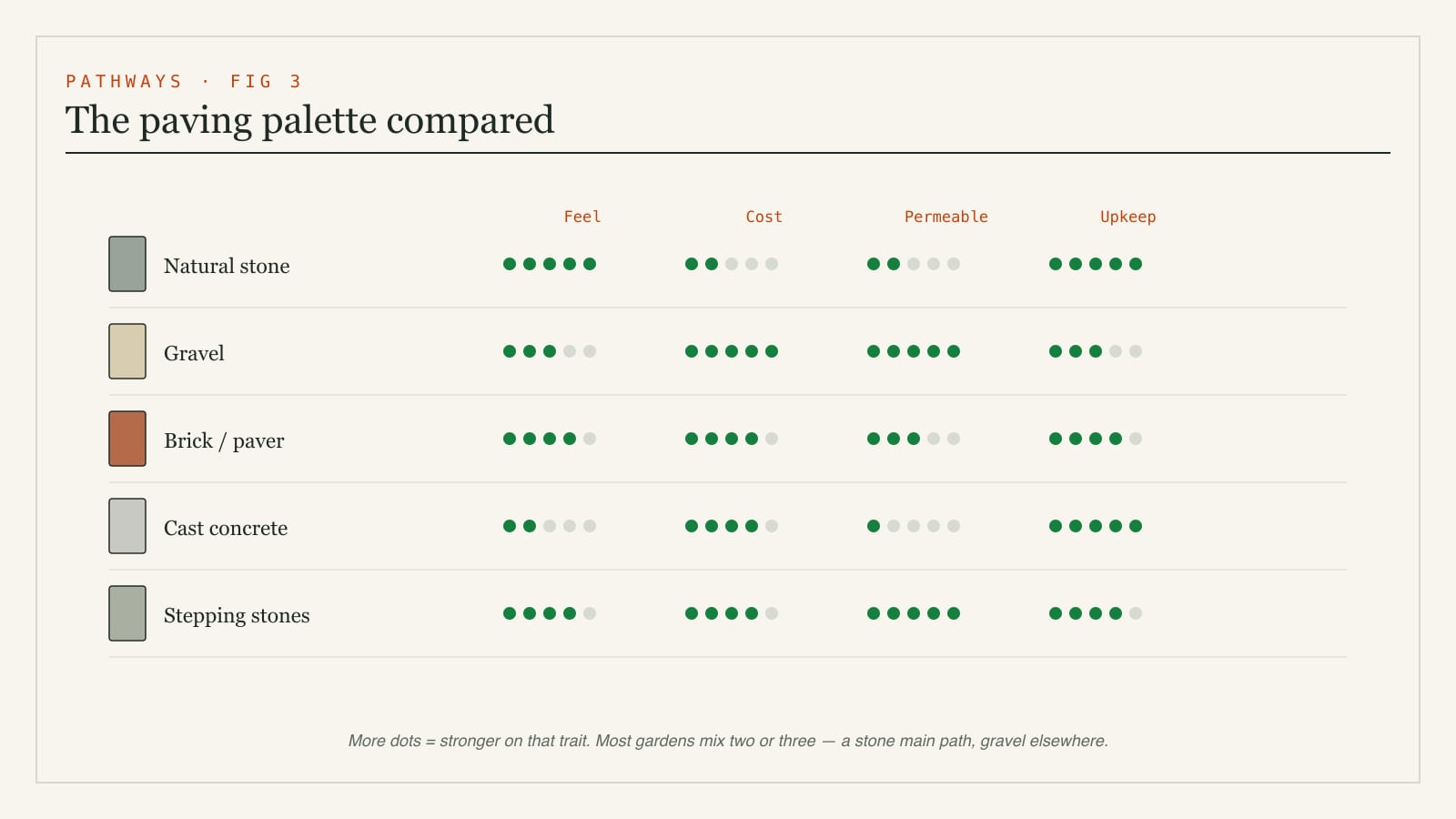
| Material | Feel underfoot | Permeability | Maintenance | Relative cost |
|---|---|---|---|---|
| Natural stone (Kota, granite, sandstone) | Solid, cool, premium | Low (mortar joints) to medium (sand joints) | Low; reseal Kota periodically | Medium–high |
| Loose gravel / pea shingle | Crunchy, informal, soft | High | Medium; rakes, scatters, weeds | Low |
| Clay / fired brick | Warm, textured, characterful | Medium (sand joints) | Medium; moss in shade | Low–medium |
| Cast / stamped concrete | Firm, uniform, modern | Low | Low–medium; can crack, stain | Low–medium |
| Stepping stones in planting/gravel | Playful, slow, light | Very high (open between) | Low–medium; level individual stones | Low–medium |
Natural stone — the Indian realities
India is one of the world's great stone countries, and the home gardener is spoilt for choice — but each stone has quirks.
- Kota stone (from Rajasthan) is the workhorse: a blue-grey to greenish limestone, hard-wearing, affordable and quintessentially Indian. Honed or leather-finished Kota is handsome and not too slippery; the highly polished mirror finish, however, is dangerously slick when wet and wrong for an outdoor path. Kota etches with acidic cleaners and benefits from a breathable sealer.
- Granite is the premium choice — near-indestructible, available across South India in greys, blacks and speckled tones. Specify a flamed or leather (antique) finish outdoors, never mirror polish, which becomes a skating rink in the monsoon. It is the most expensive of the common options and the heaviest to handle.
- Sandstone (Rajasthan / Madhya Pradesh — Dholpur beige, Mandana red, Raj green, autumn brown) is warm, naturally riven and beautifully textured, with good natural slip resistance. It is softer and more porous than granite, so it can stain and needs sealing, but for a garden it often looks the most at home.
- Cuddapah / Tandur grey limestone is a budget cousin to Kota, common in the South.
A practical detail: outdoors, always favour a riven, flamed, sandblasted or leather finish over polish. Slip resistance in our wet season is not optional.
Gravel, brick, concrete and stepping stones
Gravel is the most underrated path material in India — cheap, permeable, instantly informal, and wonderful at suppressing dust when used as a 20–40 mm bound or loose layer over a firm sub-base. Use angular crushed aggregate (it locks together) rather than rounded river pebble (which rolls), and always edge it firmly or it walks into your beds. It is not wheelchair-friendly and not ideal where you trundle trolleys daily.
Clay brick, laid in herringbone or basketweave, gives a warm, fine-grained, very Indian texture and ages gracefully; use hard, well-fired bricks (not soft table-moulded ones that spall) and expect some moss in shaded, north-facing stretches.
Cast-in-situ concrete is the cheapest firm surface; lift it out of "grey slab" territory with an exposed-aggregate finish, a board-marked texture, saw-cut control joints in a considered grid, or a banker-mason's grit finish. Stamped concrete imitating stone usually reads as fake — spend the difference on real Kota if you can.
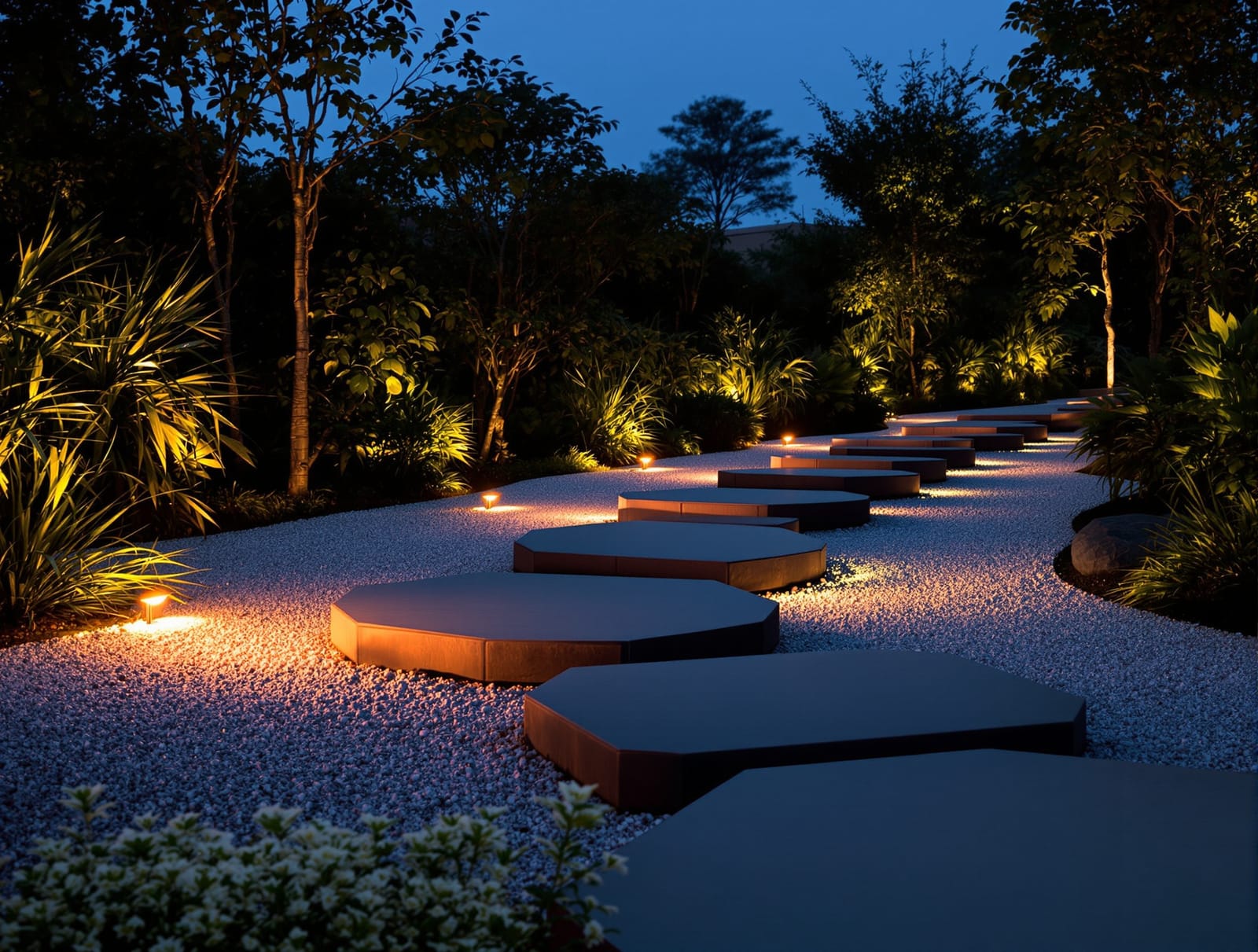
Stepping stones are less a path than a rhythm: individual pads (large Kota/granite slabs, cut rounds, or precast pads) set into lawn, gravel or groundcover. They deliberately slow you and tread lightly on the ground — but each must be bedded dead level and set with a comfortable stride centre-to-centre (around 600 mm) or they trip rather than guide.
Edges and restraints
The edge is the most under-appreciated detail in path building, and the most common point of failure. Every flexible path must be physically restrained along both sides, or the units creep outward, the joints open, and the path "spreads" and sinks at the margins. Even rigid paths benefit from a defined edge for crispness and to stop adjacent soil and mulch washing across.
Common edge details for Indian gardens:
- Concrete haunching — a hidden 1:4 concrete toe poured against the buried edge of the outermost paving unit. Invisible, strong, the default for stone and brick.
- Soldier-course brick or stone-on-edge — a row of units set vertically as a visible, decorative kerb.
- Granite or Kota edging strips — a clean architectural line; can also act as a mowing strip flush with the lawn so the mower runs over it.
- Steel or aluminium edging — crisp, contemporary, excellent for holding gravel and stepping-stone beds; powder-coat or use corten for rust tolerance.
- Timber edging — only treated hardwood or genuine WPC; ordinary deodar/pine rots within a couple of monsoons.
A flush mowing edge (paving or a stone strip set level with the turf) is worth its small cost on any lawn-adjacent path: it kills the tedious chore of hand-trimming grass against the path edge.
Steps, ramps and transitions
Wherever a path changes level, detailing becomes a safety matter.
Steps. Outdoor steps are shallower and broader than indoor stairs because we take them at a relaxed pace and often in low light. A comfortable garden tread is 300–450 mm deep with a riser of just 100–150 mm; never exceed about 175 mm outdoors. Keep risers equal — an odd "rogue" riser is a classic fall. The old garden-designer's formula, 2 × riser + tread ≈ 650 mm, gives a relaxed outdoor gait. Light every step (see lighting below), give the leading edge a contrasting or textured nosing, and avoid single steps, which people simply do not see — make it two or rework it into a gentle ramp.
Ramps. For accessibility, gas cylinders, prams and ageing parents, a ramp beats steps. A gradient of 1:20 (5%) needs no handrail and feels effortless; 1:12 (8.3%) is the absolute steep limit and should have a handrail and level landings every 9 m. Surface ramps in a firm, slip-resistant finish — flamed granite or broom-finished concrete, never polished stone or loose gravel.
Transitions — the joints between path and lawn, path and drive, path and threshold — are where water and dirt collect and where edges chip. Detail them deliberately: a flush change of material, a recessed channel drain at a doorway, a level transition (no lip) at any accessible entry.
Drainage and permeability — the monsoon test
In India, drainage is not a technicality; it is the difference between a path you can use in July and a 20-metre puddle. Two principles govern everything:
1. Shed the water. Every paved path needs a crossfall of about 1 in 60 to 1 in 80 (roughly 1.5–2%) — a barely perceptible tilt to one side, or a slight crown to both — so rain runs off rather than ponds. Falls must lead the water to a planted bed, a soakaway, a swale or a channel drain, never towards the house plinth.
2. Let it soak where you can. Impermeable paving sheds large volumes fast and, multiplied across a plot, contributes to the urban flooding our cities now suffer every monsoon. Wherever the path's job allows, prefer permeable construction: gravel, sand-jointed or planted-jointed paving, or open stepping stones over an open granular sub-base, so rain percolates back into the ground and recharges it. This dovetails with whole-plot rainwater strategy — see Sustainable Water Management in the Landscape.
For low spots and the foot of ramps, a linear channel (slot) drain with a removable grating, falling to a soakpit or the storm line, keeps the path usable through the heaviest cloudburst. And keep the path surface slightly proud of adjacent lawn and beds so silt and mulch wash off it, not onto it.
Joints, planting and lighting
These three small details separate a built path from a designed one.
Joints. The gap between units can be mortar-filled (rigid, weed-free, formal), sand or polymeric-sand filled (flexible, semi-permeable, the units can be lifted), or — most charmingly — planted. A planted joint, with a low creeping species seeded into a sand-and-grit fill, softens stone instantly and reads as established and loved.
Planting in and beside the path. Indian species that thrive in path joints and edges include creeping wood-sorrel and dwarf mondo grass in shade; for sunny crevices, low sedums and portulaca; and for fragrant, walkable edges, sweet alyssum or a clipped band of cuphea. Set tougher, non-staining, non-thorny planting hard against the path and save the soft spillers for where you want overhang. Avoid bottle-brush, bougainvillea and anything thorny or fruit-dropping right at the edge of a daily route. For choosing what grows well alongside, see Best Trees for Indian Homes, and for tying the path into a richer, sensory garden, Biophilic Landscape Design.
Lighting. A path used after dark needs to be lit at the ground plane — you light the surface and the steps, not people's eyes. Use low bollards (300–600 mm), recessed in-ground uplights at intervals, or discreet step-lights tucked under nosings. Warm white (2,700–3,000 K), low glare, and stagger fittings so the path reads as a gentle rhythm of pools rather than a runway. Every single step, level change and turn must be lit.
Realistic costs in India
Costs vary widely by city, stone source and labour, but as a 2026 planning guide for the finished, fully built-up path (excavation, sub-base, bedding, surface, edging and basic jointing — supply and lay), expect roughly:
| Path build-up | Indicative cost (₹ per sq ft, supplied & laid) |
|---|---|
| Bound gravel over compacted sub-base | ₹120–250 |
| Cast-in-situ concrete, plain to exposed-aggregate | ₹150–350 |
| Clay brick on sand bed, edged | ₹200–400 |
| Kota / Cuddapah stone, honed, mortar-set | ₹250–500 |
| Sandstone, riven, sand or mortar joints | ₹350–650 |
| Granite, flamed/leather finish | ₹500–1,000+ |
To these, add restraint edging (₹80–300 per running foot depending on detail), channel drains where needed, and path lighting (₹1,500–6,000 per fitting installed). The figures look higher than the "₹60 a foot" quotes you will hear — but those quotes are for stone on raw earth, which is precisely the path that fails. The layered build-up is the cost of a path that survives a decade of monsoons. Spend it once, properly, rather than three times in patches.
Bringing it together
A path well built is quiet competence underfoot: the right width for two to walk and talk, a sub-base that does not heave, a stone that grips in the rain, an edge that holds its line, a fall that sheds the monsoon, joints that have grown a little green, and a soft glow at every step come evening. Get the construction and the detailing right, and the path disappears into the pleasure of walking your own garden — which is exactly what good architecture underfoot is supposed to do. For how these well-made paths join into a coherent journey across the whole plot, continue with Outdoor Circulation Design; to weave them into restful, lingering places, see Outdoor Wellness Spaces.
References & further reading
- Ian Thompson, Landscape Architecture: A Very Short Introduction — Oxford University Press. Clear grounding in landscape as designed, constructed space.
- Time-Saver Standards for Landscape Architecture (Harris & Dines) — McGraw-Hill. The standard reference for path sections, gradients, step and ramp dimensions, and edge details.
- Indian Society of Landscape Architects (ISOLA) — professional body; resources and member practices on Indian landscape construction.
- Royal Horticultural Society (RHS) — practical guidance on path construction, materials and planting in joints (rhs.org.uk).
- Indian Roads Congress / Bureau of Indian Standards guidance on granular sub-base compaction and paving (for the engineering of the layered section).
- Bonica / leading Indian nurseries and ICAR–IIHR (Bengaluru) horticulture resources — for species suited to path edges and joints in Indian conditions.
Export this guide
Related Guides — Deep-dive reading
Modern Construction Materials Transforming Indian Homes
From clay brick and river sand to AAC, fly-ash, TMT steel, ready-mix and M-sand — how the materials that build an Indian house have changed, what is driving it, and how to choose well.
ConstructionThe Best Trees for Indian Homes
A research-grade guide to choosing and placing trees around an Indian home — the real cooling and clean-air numbers, the right species for shade, flowers, fragrance and fruit, and the placement science that keeps roots out of your walls and drains.
LandscapeConstruction Aggregates in India: Sizes, Quality & Selection (2026)
What coarse aggregate actually does in concrete, how to pick the right nominal size (10mm, 20mm, 40mm), and the field and lab checks that separate strong stone from a bad load - a specify-and-select guide for Indian homes.
Building MaterialsRelated Tools — Try Free
Rainwater Tank Sizer
How big should your rainwater tank be? Computes annual harvest, recommended tank capacity in litres, water-bill savings, and payback — for 10 Indian cities.
RWH CalculatorGarden Planning Toolkit
Get a tailored garden plan — planting layers, Indian species, features and a checklist — from your climate, space, sun and goals.
PlannerCircadian Light Meter
Patient-centric circadian lighting visualizer for Indian healthcare design — time-of-day × intensity → CCT, melanopic lux (EML / mEDI), melatonin suppression, and an alertness curve. Calibrated against WELL v2 L03 Circadian Lighting Design, CIE S 026:2018, Brainard 2001, and Lucas et al. 2014.
Circadian Tool