
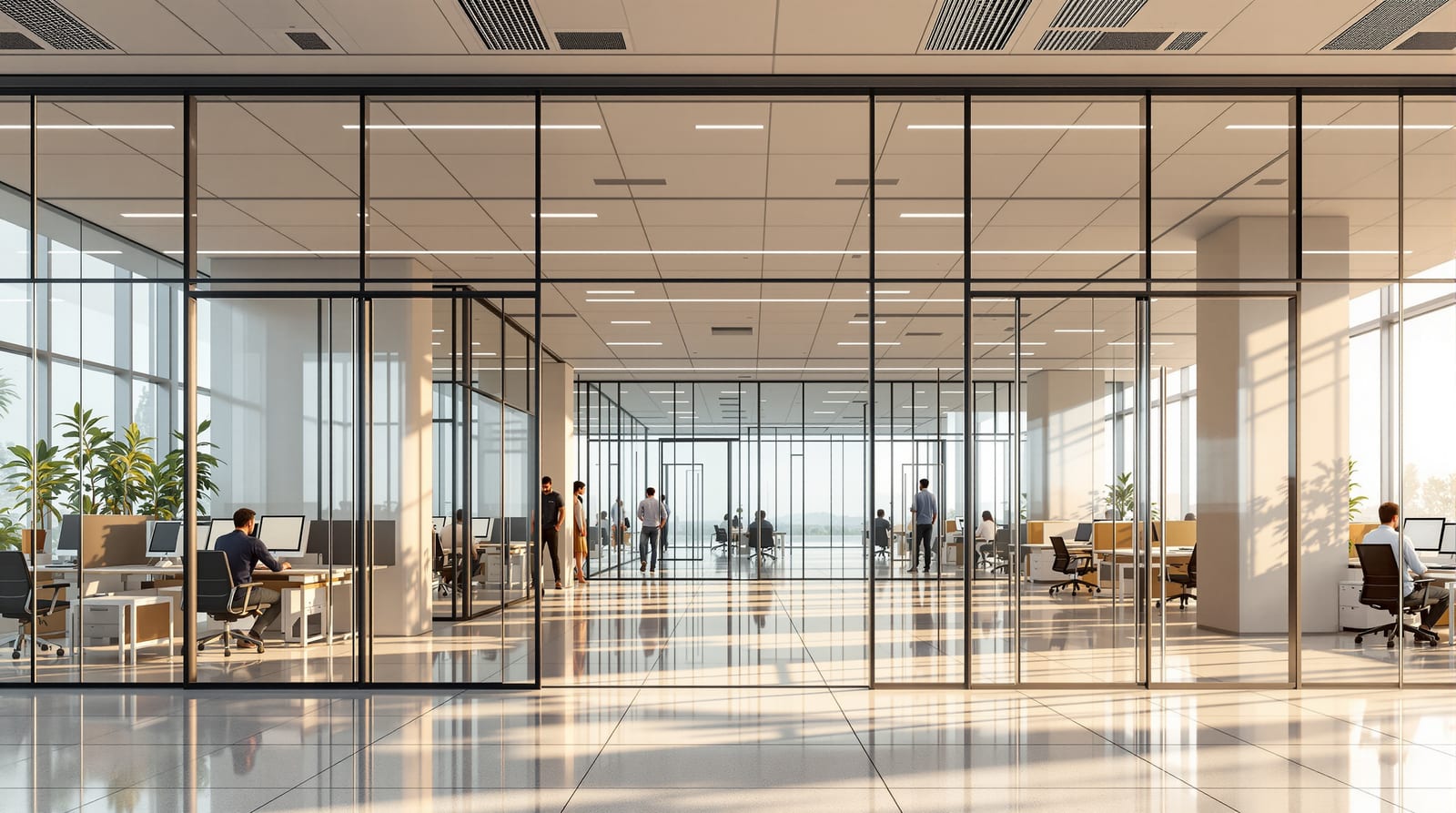
Office Glass Partition Door in India: Framed, Frameless, Acoustic and Demountable Systems (2026)
How to specify glass partition walls with integrated doors for Indian offices - frameless vs aluminium-framed, single vs double glazing for acoustics, patch fittings and floor springs, manifestation film, and rupee costs per sq ft and per door.
Walk into almost any new corporate fit-out in Gurugram, Bengaluru or Hyderabad and the cabins, conference rooms and director's office are no longer brick or gypsum boxes. They are walls of glass with a glass door cut into them. The glass partition door is the single detail that defines the modern Indian workplace: it gives every enclosed room privacy and acoustics while letting daylight and sightlines flow right through the floor plate. Done well it looks effortless. Done badly it rattles, leaks sound, fogs the floor spring with grease, and someone walks into it.
This guide is about specifying the door inside a glass partition system properly for an Indian office - how the glazing, the framing, the swing or slide, the patch fittings, the floor spring, the lock and the manifestation film all have to be decided together. It is the application layer. For the door type itself, lean on the deep guides: this page links them rather than repeating them.
What a glass partition door actually has to do
A glass partition is a non-load-bearing internal wall, and the door is the part of that wall that opens. Before you pick anything, write down what this particular partition has to deliver, because the answers pull in different directions:
- Daylight and transparency - the whole reason to use glass. Borrowed light reaches interior workstations, the floor feels larger, and managers stay visible. This argues for frameless or slim-framed, clear or lightly frosted glass.
- Acoustics - a cabin you can take a call in, a conference room nobody can eavesdrop on. This argues for double glazing, full-height seals, drop seals at the door bottom and careful detailing. Acoustics and pure transparency are the central trade-off.
- Privacy - separate from acoustics. You can have an acoustically sealed room that is fully transparent, so privacy is solved with frosting, manifestation bands or switchable film, not glass thickness.
- Fast, reconfigurable fit-out - tenants reorganise teams every 18-24 months. Demountable, modular partition systems let you move a cabin wall without wet trades. Drywall cannot do this.
- Brand image - the reception and boardroom partition is a brand statement; logos and frosting patterns get printed onto the manifestation film.
- Safety - glass at door height in a workplace must be toughened (safety) glass, and it must be marked so people see it. This is non-negotiable.
Once those priorities are ranked for the specific room, the system almost chooses itself.
Frameless vs aluminium-framed
This is the first big fork.
Frameless partitions use toughened glass panels with the door held by patch fittings (top and bottom corner clamps) and a floor spring buried in the slab. There is no vertical frame around the leaf - just glass, slim patch hardware in satin or polished steel, and a slim head channel. It is the cleanest, most premium look, ideal for reception, the boardroom and the CEO cabin. It demands a level slab (the floor spring must be set true), accurate toughened glass with pre-drilled cut-outs, and skilled installers. See the deep mechanics in frameless glass doors in India and the broader glass doors guide.
Aluminium-framed systems wrap each glass panel and the door leaf in a powder-coated or anodised aluminium profile. The frame carries the hinges (so no floor spring is strictly needed), improves acoustic sealing because gaskets sit in the frame, and is more forgiving of out-of-level slabs. It is the workhorse of large cabin farms and coworking floors - faster, cheaper per square foot, and the basis of most demountable systems. The trade-off is a visible frame line. This sits within the wider family of partition doors in India.
A common hybrid: frameless glass walls for the showcase rooms (reception, boardroom) and framed demountable for the back-of-house cabin grid.
Single vs double glazing - the acoustic decision
The number one complaint about glass cabins in India is sound leakage. People specify a beautiful frameless wall, then discover the manager's calls carry to the workstations outside. Acoustics live mostly in the glazing and the seals, not the framing.
- Single glazing - one toughened pane, typically 10 mm or 12 mm. Gives roughly STC 28-32. Fine for visual separation, focus pods and rooms where some sound transfer is acceptable. Cheapest and the most transparent (one less reflection).
- Double glazing - two toughened panes with an air gap (often with different pane thicknesses to break resonance), sealed in a frame. Gets you into the STC 38-45 range, enough for confidential conference rooms and director cabins. Needs a framed system to house the cavity and gaskets.
Glazing alone is wasted if the door perimeter leaks. A door is the acoustic weak point of any partition: specify perimeter gaskets and an automatic drop seal at the bottom of the leaf, and avoid undercuts. For genuinely confidential rooms, treat it as a system and read soundproof doors in India. For a quick STC-versus-cost view across the room, the acoustic door selector tool helps frame the brief.
Sliding vs swing within the partition
The door inside the partition can swing or slide, and the choice is about space, acoustics and traffic.
- Swing (hinged on patch fittings + floor spring) - the default for cabins and conference rooms. The floor spring is a hydraulic closer set into the slab that self-closes the heavy glass leaf smoothly and holds it open at 90 degrees if specified. Best acoustic seal (the leaf compresses against the jamb), cleanest frameless look. Needs swing clearance inside the room.
- Sliding (surface-mounted top track, or telescopic) - saves floor area, good for tight cabins, pantries and rooms where a swinging leaf would foul furniture. Acoustically weaker because a sliding leaf cannot compress against seals as tightly, though brush and fin seals narrow the gap. For the mechanism, see sliding doors in India.
Plan the swing direction and clearance early; an office door planner or door swing planner avoids the classic clash where two glass doors meet at a corner.
Patch fittings, floor springs and patch locks
Frameless glass doors are held and controlled by a small family of hardware, and getting it right is most of the quality difference:
- Patch fittings - top and bottom corner clamps in cast stainless or brass that grip the toughened glass and carry the pivot. They come as a kit matched to glass thickness (10/12 mm) and the floor spring.
- Floor spring - the hydraulic pivot closer concealed in the slab. It controls closing speed, latch action and hold-open. Choose the load class for the leaf weight and width; a 1000 mm wide 12 mm glass leaf is heavy. Specify and locate it during slab work, because retrofitting into a finished floor is messy. See floor springs in India.
- Patch lock / patch indicator lock - a lock body integrated into the bottom or side patch that throws a bolt into the floor or jamb; conference rooms often use a vacant/engaged indicator. Access-controlled rooms get an electric strike or maglock tied to the building access control system.
- Pull handles - back-to-back stainless or timber pulls, sized for the leaf.
For the full hardware vocabulary across the office, link out to the door hardware guide; this page only covers the partition-specific kit.
Frosting, manifestation and branding film - and the safety rule
Clear glass at door height is a hazard: people walk into it. Indian best practice (and a safety duty under workplace norms) is to mark glazed doors and full-height glass with a visible manifestation - a band, logo or pattern at roughly eye and waist level so the glass reads as a surface.
Manifestation film does triple duty:
- Safety marking - the visibility band that stops walk-through accidents. Treat it as mandatory on any clear full-height partition door.
- Privacy - frosting bands or full-pane frost give a cabin privacy without losing borrowed light. For permanent frost, see frosted glass doors in India; for on-demand privacy, switchable PDLC (smart) film goes opaque at the flick of a switch for boardrooms.
- Branding - printed logos, gradient dots, geometric patterns on the reception and meeting-room glass.
All glass in and around the partition door must be toughened (safety) glass - it shatters into blunt granules, not shards. Verify the BIS/manufacturer mark on each pane.
Demountable and modular systems for reconfiguration
If the office expects to churn its layout, specify a demountable partition system rather than site-built glass. These use a kit of aluminium profiles, gasketed glass panels and click-fit door modules that can be dismantled and reassembled on a new grid without demolition, dust or repainting. The cost premium per square foot is repaid the first time a department moves. This is a core reason coworking space doors lean heavily on framed demountable glass, and it suits any tenant on a fit-out budget that values flexibility.
System comparison: glazing, acoustics and cost
The table prices the partition as a SYSTEM, in rupees per square foot of partition wall, plus the door leaf and hardware separately, because that is how Indian vendors quote. All indicative, ex-GST, varies by city, glass brand, hardware and height.
| System | Typical glazing | Acoustics (approx STC) | Look / flexibility | Partition ₹ / sq ft | Door + hardware ₹ / leaf | Best for |
|---|---|---|---|---|---|---|
| Frameless single-glazed | 10-12 mm toughened | 28-32 | Premium, minimal; site-built | 700-1,300 | 18,000-45,000 (patch + floor spring) | Reception, boardroom, CEO cabin |
| Aluminium-framed single | 10-12 mm toughened in profile | 30-34 | Visible frame; semi-demountable | 550-1,000 | 12,000-28,000 (frame hinge or floor spring) | Cabin farms, meeting rooms |
| Framed double-glazed (acoustic) | 2 panes + air gap | 38-45 | Framed; best for confidentiality | 1,100-2,200 | 22,000-55,000 (with seals + drop seal) | Director cabins, confidential conference |
| Demountable modular framed | 10-12 mm or double | 30-42 | Reconfigurable kit-of-parts | 900-1,800 | 15,000-40,000 | Coworking, churn-heavy tenants |
| Switchable (PDLC) glass | 10-12 mm laminated + film | follows base glazing | On-demand privacy | add 2,500-4,500 / sq ft for film | as base + wiring | Boardroom, MD cabin |
Add 18% GST. Floor springs run roughly ₹4,000-12,000 each; patch lock sets ₹3,000-9,000; manifestation/branding film ₹120-400 per sq ft; switchable film is the big cost. For a tailored figure, the glass partition door calculator and the commercial door cost calculator estimate by area and spec.
A glass partition door in section
The drawing shows the anatomy of a frameless swing door in a glass partition: the head channel, the fixed glass panels either side, the door leaf on patch fittings, the floor spring set into the slab, and the manifestation band at eye level.
Do and don't
- Do rank acoustics vs transparency for each room before quoting - it decides single vs double glazing.
- Do specify and locate floor springs during slab/screed work; retrofitting later means breaking finished floors.
- Do treat the manifestation band as a safety requirement on every clear full-height door, not just decoration.
- Do use framed demountable systems where the layout will churn - it pays back at the first reconfiguration.
- Don't assume a frameless single-glazed wall is confidential; it is not - it is a visual divider only.
- Don't forget the door perimeter; gaskets and a drop seal matter more than glass thickness for door acoustics.
- Don't mix mismatched patch fittings and floor springs from different kits - they are sized as matched sets to the glass thickness and leaf weight.
How this fits the rest of the office
A glass partition is one room's answer in a larger office door strategy. The reception storefront, server room, fire-rated stair doors and entrance all follow different rules - see office doors in India for the floor-wide picture, office cabin door and conference room door for the rooms most often glazed, and server room door for the one room that should NOT be glass. For the building-by-building view, the master doors by space guide maps every space to its driver.
Frequently asked questions
How thick should office glass partition glass be?
For internal partitions and doors, 10 mm toughened is the common minimum and 12 mm is preferred for door leaves and tall panels because it is stiffer and quieter. Double-glazed acoustic systems use two panes (often 8 mm + 10 mm) with an air gap. All must be toughened safety glass.
Will a glass cabin actually be soundproof?
A single-glazed frameless wall is not - expect roughly STC 28-32, fine for focus but not confidentiality. For private calls and confidential meetings, use a framed double-glazed system (STC 38-45) with perimeter gaskets and a door drop seal. Acoustics depend as much on the door perimeter as on the glass.
Do I need a floor spring, or will hinges do?
Frameless glass doors need a floor spring - it is the pivot and the self-closer for a heavy glass leaf, and it gives the clean look. Aluminium-framed leaves can run on frame-mounted hinges or a closer instead, which is cheaper and avoids cutting the slab.
Is manifestation film legally required?
Marking glazed doors and full-height glass with a visible band is established safety practice in Indian workplaces to prevent walk-through injuries, and fit-out specs and many corporate landlords mandate it. Treat it as required on any clear full-height partition door; it doubles as privacy and branding.
How much does an office glass partition cost in India?
Indicatively, framed single-glazed partition runs about ₹550-1,000 per sq ft, frameless ₹700-1,300, and acoustic double-glazed ₹1,100-2,200, plus ₹12,000-55,000 per door leaf with hardware, all ex-GST and varying by city, glass brand and height. Use the glass partition door calculator for a tailored estimate.
Export this guide
Related Guides — Deep-dive reading
Frameless Glass Doors in India: 12 mm Toughened Glass, Patch Fittings & Floor Springs
How frameless glass doors work for Indian homes and offices — patch fittings, floor springs, patch locks, safety manifestation, planning holes before toughening, and what glass plus hardware really costs.
Home Doors & EntrancesHome Office Door India: Acoustic, Glazed & Space-Saving Picks for WFH (2026)
How to choose a door for a study, home office or WFH room in an Indian home — balancing call privacy and acoustics, borrowed light and a professional on-camera look, lockable security for documents and gear, and tight-flat space-saving.
Home Doors & EntrancesOffice Doors in India: Zone-by-Zone Selection Guide with Costs (2026)
From the glass entrance to cabins, conference rooms, glass partitions, server rooms and fire exits - the right office door for every zone in India, the driver that decides it, and indicative per-door costs.
Home Doors & EntrancesRelated Tools — Try Free
Interior Budget Planner
Live room-wise and component-wise cost breakdown in ₹ with contingency, GST, and PDF summary.
Budget CalculatorAcoustic Privacy (STC) Visualizer
Indian healthcare acoustic visualizer — compare wall assemblies and noise sources, see received SPL after STC attenuation, and check FGI 2018 / IS 1950 / NABH speech-privacy compliance with live dual-canvas waveform.
Acoustic ToolAluminium Door Cost Calculator
Estimate an aluminium door cost by opening size, profile grade, finish, glazing and type, with fitting and GST.
Door Calculator