
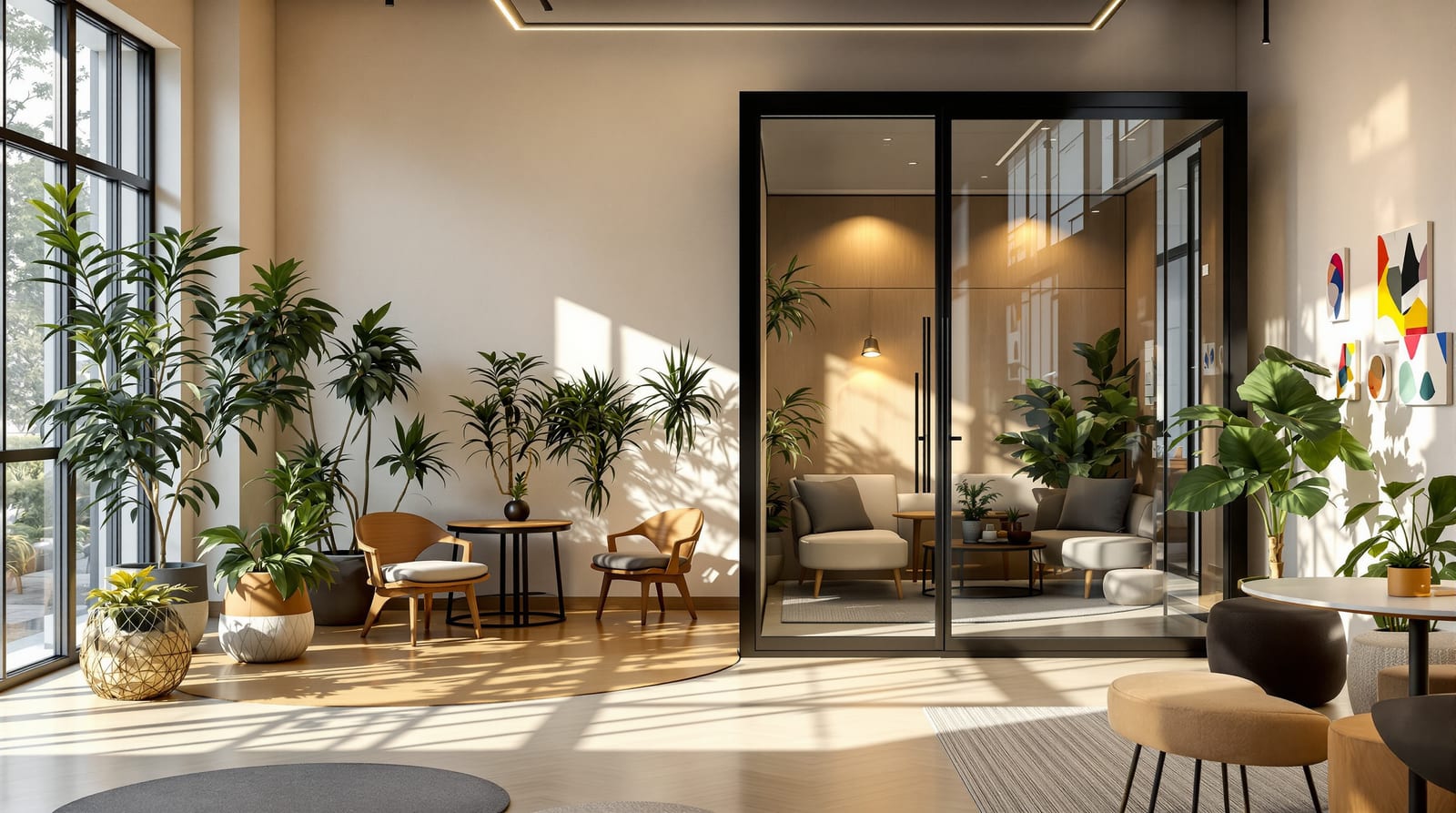
Coworking Space Doors in India: Phone Booths, Glass Cabins & Access Control (2026)
A zone-by-zone door plan for Indian coworking spaces — acoustic phone-booth doors, demountable glass cabin partitions, app-based access-controlled entrances and code-compliant fire exits, with ₹ per door and per booth.
A coworking space lives or dies on two things its members feel within five minutes: can I take a call without disturbing anyone, and can I get in at 11 pm with my phone. Doors decide both. They also decide how fast you can re-stripe a floor when a 4-seat startup becomes a 14-seat team, how on-brand the place photographs for Instagram, and whether the fire marshal signs off. No other building type asks a door to be acoustic, demountable, access-controlled, design-led and code-compliant all at once — and at a price that survives high member churn.
This guide plans doors zone by zone for an Indian coworking floor: the signature acoustic phone-booth pod, the glass cabins and meeting pods, the 24x7 access-controlled entrance, branded frosted manifestation, demountable partitions you can reconfigure in a weekend, and the fire exits that keep the whole thing legal. It complements the broader office doors guide and the doors-by-space master guide rather than repeating door-type theory — follow the links for any type you want in depth.
What makes coworking doors different
A private office buys doors once for one tenant. A coworking operator buys doors for a rotating cast of members who pay for experience and expect to move desks, cabins and even whole walls every quarter. That changes the brief:
- Acoustics are the product. Members tolerate open desks but revolt over calls. The phone-booth door and the meeting-pod door are the two most-used, most-judged doors on the floor.
- Reconfigurability beats permanence. Demountable, dry-installed glass partitions with re-hangable doors let you change the layout without masonry, dust or downtime — critical when occupancy and team sizes swing.
- Access control is non-negotiable. Members expect app or card entry, often 24x7, with an audit trail and the ability to revoke a leaver instantly. The entrance and any premium cabins lean on door access control.
- Branding is built into the glass. Frosted manifestation film does double duty: privacy plus logo, plus the mandatory NBC vision marking on full-height glass.
- Fire code applies fully. A coworking floor is a commercial occupancy under NBC 2016 — escape doors open in the direction of travel, fire-rated stair doors, panic hardware where occupant load demands.
Zone-by-zone door recommendations
1. Phone booths and focus pods (the signature door)
The single-occupant phone booth is the defining coworking element, and its door is the hardest-working component. It must seal a tiny volume to roughly STC 28–34 so a member can take a video call while someone sits a foot away outside. The realistic choice is a small acoustic single-glazed or laminated-glass leaf with a full perimeter gasket and an automatic drop-seal at the bottom — a self-closer keeps it shut. For the acoustic build-up principles see soundproof doors; the booth door is essentially a miniature acoustic door plus a ventilated, well-sealed shell.
Practical tips: keep the leaf narrow (600–700 mm) so it does not eat the booth, add a vision strip so the booth never feels like a coffin, and budget for a quiet fan — sealing the door without ventilation makes the pod unusable.
2. Private cabins and team rooms
Cabins for resident teams want a frameless glass door hung in a glass partition wall: floor spring or patch fittings, 10–12 mm toughened glass, and frosted manifestation for privacy and branding. Where a cabin needs real confidentiality (HR, founder rooms), step up to a sealed solid-core or double-glazed acoustic leaf rather than a single frameless sheet.
3. Meeting pods and conference rooms
Same glass-cabin language, but acoustics matter more — see the dedicated conference-room treatment in the office doors guide. A double-glazed acoustic glass door with perimeter seals hits the confidentiality bar; a double-leaf gives wide access for large pods.
4. The main entrance — access controlled and 24x7
The front door sets the first impression and the security posture. Most Indian coworking entrances use an automatic or manual frameless glass door fitted with access control: app/Bluetooth unlock, RFID card or QR, integrated with the member-management system so a cancelled membership loses access instantly. For after-hours self-entry, an electric strike or maglock on a fail-safe circuit is standard, with the fire panel releasing it on alarm.
5. Reconfigurable / demountable partitions
This is where coworking diverges most from a fixed office. Demountable aluminium-framed glass partition systems carry doors that can be unhung and re-hung as the layout changes — see partition options in the office doors guide. Choose a system where the door and the glazing share the same modular grid so you reconfigure without cutting glass.
6. Fire exits, stairs and back-of-house
Escape routes need fire-exit doors and fire-rated stair doors per NBC 2016 — outward swing on the escape path, panic/push-bar hardware where occupant load requires it, self-closers, and clear egress width sized to the floor's headcount. Service and electrical rooms take fire-rated doors.
Recommended door by zone — suitability, acoustics and cost
Indicative 2026 supply-and-fit ranges, ex-GST, varying by size, glass thickness, hardware and city. Add 18% GST.
| Zone | Recommended door | Why | Typical acoustics | ₹ (supply + fit) |
|---|---|---|---|---|
| Phone booth / focus pod | Acoustic glass single leaf + drop-seal + self-closer | Seals tiny volume for calls; vision strip avoids claustrophobia | STC 28–34 | 18,000–45,000 per booth door (pod shell extra) |
| Private cabin | Frameless toughened glass + frosted film | Light, premium, demountable, branded | STC 25–30 | 18,000–40,000 per door |
| Meeting / conference pod | Double-glazed acoustic glass, single or double leaf | Confidential talk + premium look | STC 35–42 | 30,000–70,000 per door |
| Main entrance | Frameless / automatic glass + access control | First impression + 24x7 self-entry + instant revoke | n/a | 60,000–1,80,000+ incl. controller, reader, strike |
| Demountable partition door | Aluminium-framed glass on modular grid | Re-hang on reconfigure; no masonry | STC 30–38 | 22,000–55,000 per door |
| Fire / stair exit | Steel/timber fire-rated + panic bar + closer | NBC 2016 egress, life safety | n/a | 18,000–45,000+ per leaf |
| Service / electrical | 60–90 min fire-rated flush | Compartmentation | n/a | 12,000–35,000 per door |
A phone booth and a glass cabin, side by side
The drawing below contrasts the two signature coworking doors — the sealed acoustic pod door and the demountable frameless glass cabin door.
Hardware and standards checklist
- Hardware: door closers on booth, cabin and fire doors; floor springs/patch fittings on frameless glass; access readers and electric strikes/maglocks on the entrance and premium cabins; panic bars on fire exits; drop-seals on acoustic pods. Link the hardware guide rather than over-specifying here.
- Access: integrate door access control with the member-management app so onboarding and offboarding control the door automatically; keep fail-safe release wired to the fire alarm.
- Manifestation: full-height glass must carry visible marking (frosted band/logo) per safety practice — make the branding do this job.
- Egress (NBC 2016): escape doors open in the direction of travel, panic hardware by occupant load, fire-rated stair doors, egress width sized to headcount; do not lock or chain the only exit even for 24x7 security.
- Accessibility (RPwD 2021): the entrance and at least the main circulation doors need ≥900 mm clear width, lever handles and threshold ≤12 mm.
Do and don't
- Do make the phone-booth door acoustic with a drop-seal — it is the door members judge you on.
- Do standardise cabin doors on one demountable glass system so reconfiguration is a weekend, not a renovation.
- Don't rely on a single frameless sheet for HR/founder confidentiality — step up to acoustic glass.
- Don't let access control compromise egress: the entrance must fail safe and the fire exits must never be access-gated shut.
- Don't forget ventilation in sealed booths — a silent door with no airflow makes the pod unusable.
- Don't treat manifestation as optional decoration; it is both branding and a safety requirement.
Plan budgets with the commercial door cost calculator, and for the wider picture see the office doors guide and the doors-by-space master guide.
Frequently asked questions
What is the best door for a coworking phone booth?
A small acoustic glass leaf (600–700 mm) with a full perimeter gasket, an automatic drop-seal at the bottom and a self-closer, targeting roughly STC 28–34, plus a vision strip and pod ventilation. Treat it as a miniature acoustic door — see soundproof doors.
How do members get 24x7 access?
Through access control integrated with the coworking membership app — Bluetooth/QR/RFID unlock with an audit trail. The lock must be fail-safe and released by the fire alarm so it never blocks escape.
Can I reconfigure cabins without breaking walls?
Yes — use demountable aluminium-framed glass partition systems where doors share the glazing grid and can be unhung and re-hung. This is the main reason coworking floors avoid masonry partitions; see the partition section of the office doors guide.
What does a coworking door fit-out roughly cost per door?
Indicatively in 2026: frosted frameless cabin doors ₹18,000–40,000, acoustic phone-booth doors ₹18,000–45,000 per booth, conference/meeting pods ₹30,000–70,000, and an access-controlled glass entrance ₹60,000–1,80,000+ including controller and reader (ex-GST, varies by size, glass and city).
Do coworking spaces need fire-rated doors?
Yes — as a commercial occupancy under NBC 2016, escape routes need fire-exit doors that open outward with panic hardware, fire-rated stair doors, and fire-rated doors on electrical and service rooms.
Export this guide
Related Guides — Deep-dive reading
Office Glass Partition Door in India: Framed, Frameless, Acoustic and Demountable Systems (2026)
How to specify glass partition walls with integrated doors for Indian offices - frameless vs aluminium-framed, single vs double glazing for acoustics, patch fittings and floor springs, manifestation film, and rupee costs per sq ft and per door.
Home Doors & EntrancesLibrary Door in India: Quiet, Access-Controlled and Anti-Theft Reading-Room Entrances (2026)
Doors for public, college and corporate libraries in India - acoustic silence, RFID security gates, controlled single entry and a calm scholarly look, with zone-by-zone choices and costs.
Home Doors & EntrancesOffice Doors in India: Zone-by-Zone Selection Guide with Costs (2026)
From the glass entrance to cabins, conference rooms, glass partitions, server rooms and fire exits - the right office door for every zone in India, the driver that decides it, and indicative per-door costs.
Home Doors & EntrancesRelated Tools — Try Free
Acoustic Privacy (STC) Visualizer
Indian healthcare acoustic visualizer — compare wall assemblies and noise sources, see received SPL after STC attenuation, and check FGI 2018 / IS 1950 / NABH speech-privacy compliance with live dual-canvas waveform.
Acoustic ToolEmergency-Egress Checker
A life-safety self-check that access-controlled doors on escape routes still let people out in an emergency.
Egress CheckWindow Hardware Cost Calculator
Estimate window hardware cost — hinges, handles, locks, rollers and multipoint gears.
Window Calculator