
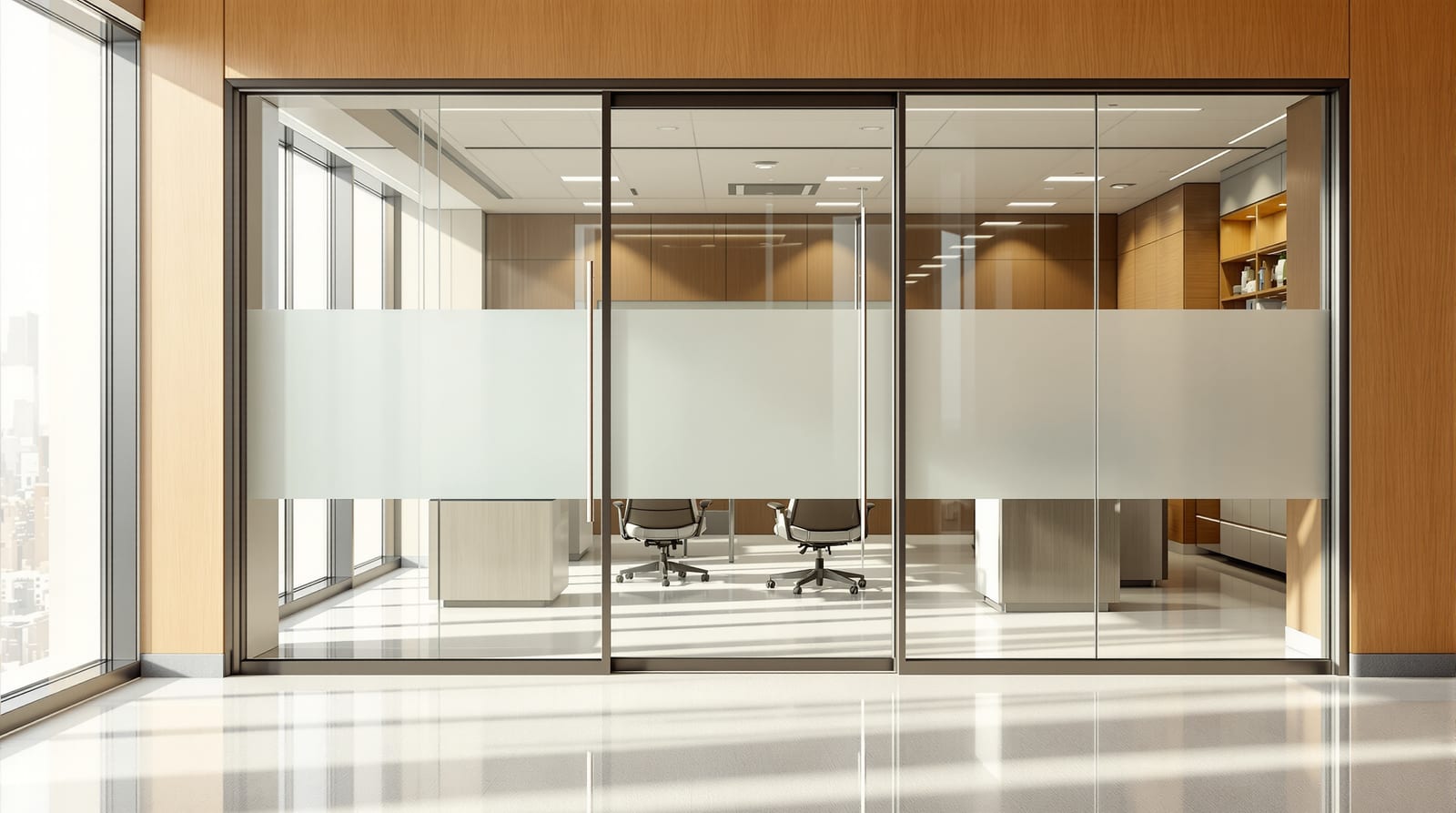
Office Cabin Door in India: Privacy, Acoustics and the Professional Look (2026)
How to choose the manager or executive cabin door in India - solid flush, full-height glass with frosting, or glass-with-blinds - balancing confidential acoustics, privacy, status and rupee budget.
The cabin door is the most loaded door in any Indian office. It has to do three jobs at once that pull in different directions: keep a confidential conversation confidential, signal the occupant's seniority, and still let the floor feel open and connected. A purchase manager closing a vendor negotiation, an HR head running an exit interview, a founder on an investor call - all of them are sitting behind one door, and the wrong choice is felt every single day.
This guide is about the manager and executive cabin door specifically - the single private office, not the open floor or the conference room. For the whole-floor view see the office doors guide; for shared meeting spaces see the conference room door guide; and for the demountable wall systems that frame these cabins, the office glass partition door guide. Here we go deep on the four real contenders and the trade-off that should actually decide between them.
What a cabin door has to deliver
Strip away the showroom talk and a cabin door is judged on four drivers. Rank them for your specific occupant and the answer almost picks itself.
- Acoustics (confidentiality). This is the one most people under-buy. A hollow flush door or a single-glazed glass leaf with a 10 mm undercut leaks speech badly - colleagues outside can follow an HR conversation or a salary discussion word for word. Real privacy needs mass, a seal at the perimeter and a drop seal or threshold at the bottom. If confidential conversations happen behind the door, acoustics is your number-one driver - read the soundproof doors guide before you spend.
- Visual privacy vs. connection. Modern Indian offices want managers visible and approachable, not bunkered. The tension is between a fully opaque door (maximum privacy, can feel closed-off) and clear glass (maximum connection, zero privacy). Frosted film, a frosted band, switchable glass and integral blinds all exist to dial this in.
- Status and image. The cabin door is a status object. A solid teak or veneer flush leaf reads "senior and permanent"; a frameless full-height glass door reads "modern, transparent leadership". This is a legitimate driver - just be honest that it is the one talking when budget creeps up.
- Budget (rupees per door). Costs range from a basic laminate flush leaf at a few thousand rupees to a frameless toughened-glass door with a floor spring and patch fittings well past forty thousand. Multiply by the number of cabins on the floor and this driver gets loud quickly.
Two more things every cabin door needs regardless of type: a self-closing closer so cabins never sit half-open, and a lever handle with a lock (lever, not knob - it is the accessible and the comfortable choice, and it suits a privacy or office cylinder). More on hardware below.
The four contenders, ranked
1. Solid-core flush with laminate or veneer - the privacy and value champion
A solid-core (particle or block-board core) flush leaf finished in laminate or natural veneer is the default executive cabin door across India, and for good reason. The core mass gives genuinely better acoustics than any single-glazed glass leaf, the veneer finish carries real status, and it is the cheapest serious option. Specify a solid core (not hollow), a good perimeter gasket and an automatic drop seal if confidentiality matters. See the flush doors guide for core and finish choices, and the laminate doors guide for finish durability.
Best for: HR, finance, legal, founders - any cabin where confidential conversations are routine. Weakness: it blocks light and sightlines, so a small frame-mounted vision panel is often added.
2. Full-height frameless glass with frosted film - the modern image champion
A toughened-glass door (frameless, on patch fittings and a floor spring, or framed in slim aluminium) is what most new corporate fit-outs reach for. It floods the cabin with borrowed light, reads as transparent and contemporary, and pairs visually with glass partition walls. The privacy problem is solved with frosted film or acid-etched glass - either a full frost or, more commonly, a frosted band at sitting/eye height so the occupant gets privacy at the desk while the cabin still feels open above and below. See the glass doors guide, the frosted glass doors guide and the frameless glass doors guide.
Best for: leadership cabins where image and openness matter and conversations are rarely top-secret. Weakness: even with film, a single 10-12 mm glass leaf is acoustically mediocre - it stops casual overhearing, not a determined eavesdropper.
3. Glass with integral blinds (or switchable glass) - the privacy-on-demand option
Double-glazed units with blinds sealed inside the cavity let the occupant flip between open and private at will, with no dust on the slats. Switchable (PDLC) smart glass does the same electrically - clear at the touch of a switch, frosted otherwise - and is the showpiece choice for CEO cabins. Both cost notably more than plain frosted glass and the smart-glass premium is steep.
Best for: senior cabins that need both openness most of the time and full privacy on call. Weakness: cost; and switchable glass is opaque to light, not sound, so acoustics still depend on the glazing build-up.
4. Panel or moulded door - the traditional executive look
A timber panel or moulded-skin door suits heritage, government, legal and old-money corporate interiors where a more formal, panelled aesthetic is wanted. Acoustically similar to a solid flush leaf when solid-cored. See the panel doors guide. Best for: formal/traditional offices. Weakness: dated for a startup or tech floor.
Option comparison for the Indian cabin
The table ranks privacy, acoustics, image and cost so you can match the door to the occupant. Costs are indicative per 3x7 ft door, 2026, plus 18% GST; vary by size, finish and city.
| Cabin door option | Visual privacy | Acoustics (confidential talk) | Image / status | Indicative cost per door |
|---|---|---|---|---|
| Solid-core flush, laminate | High | Good (best value for sound) | Professional | 4,000-9,000 |
| Solid-core flush, veneer | High | Good | High (warm, senior) | 7,000-16,000 |
| Frameless glass + frosted film | Medium (band) to High (full frost) | Fair | High (modern, open) | 18,000-40,000 |
| Glass with integral blinds (DGU) | On demand: High | Fair to Good (if double-glazed) | High | 28,000-55,000 |
| Switchable PDLC smart glass | On demand: High | Fair | Showpiece | 55,000-1,20,000+ |
| Timber panel / moulded | High | Good (if solid core) | Formal / traditional | 6,000-18,000 |
Rule of thumb: if confidentiality is the point of the cabin, start with a solid flush door and add seals; if image and a connected floor are the point, start with frameless glass and a frosted band. Only step up to integral blinds or switchable glass when the occupant genuinely needs to toggle between the two.
Privacy vs. visibility - the frosted band concept
The single most useful trick in modern cabin design is the frosted band: a horizontal stripe of frosting (or applied film) running across a glass door and the adjacent partition at roughly 1000-1700 mm from the floor. It hides the seated occupant and anyone at the visitor chair, while leaving clear glass above (so the cabin reads open and gets light over the partition) and below (so the floor feels connected). It is far cheaper than full frost or switchable glass and is the default in most Indian corporate fit-outs.
The diagram contrasts a frosted-band glass cabin door with a solid flush leaf.
Hardware every cabin door needs
- Closer (self-closing). A surface overhead closer with adjustable speed keeps cabins from sitting ajar and gives a controlled close. For glass doors a floor spring does the same job and disappears into the floor. Specify soft-close / latching action so the door does not slam - important next to a quiet floor. See the door closers guide.
- Lever handle + lock. A lever handle (not a knob) on a mortise body with a privacy or office cylinder; lever handles are the accessible and comfortable choice. For glass doors, a patch lock or a pull handle with a privacy cylinder.
- Seals for acoustics. Perimeter gaskets plus an automatic drop seal at the threshold are what actually make a cabin confidential - the door type matters less than whether it is sealed.
- Access control (optional). Senior or secure cabins may add a smart lock or card reader - covered in the broader office doors guide.
Standards and clearances
Cabin doors should give a clear opening width of at least 900 mm so they are accessible (NBC 2016 / RPwD 2021), with a lever handle and a low threshold (12 mm or less). Glass doors must use toughened (safety) glass and carry manifestation - a visible marking or the frosted band itself - so people do not walk into a clear leaf. Cabins on or near a fire-escape route must not block egress; coordinate with the floor's fire-rated doors and exit strategy. For where the cabin door sits in the wider building-by-building picture, see the doors-by-space guide.
Do and don't
- Do decide your number-one driver (acoustics / privacy / image / budget) before you look at samples - it stops the showroom deciding for you.
- Do specify a solid core and perimeter seals if confidential conversations happen behind the door.
- Do use a frosted band on glass doors - it is the cheapest way to balance privacy and openness.
- Don't buy a hollow flush leaf for an HR or finance cabin; it leaks speech.
- Don't assume frosted glass is soundproof - frost blocks sight, not sound.
- Don't skip the closer; half-open cabins look unmanaged.
Frequently asked questions
Solid flush or glass for a cabin door in India?
Pick by your top driver. If the cabin hosts confidential conversations (HR, finance, legal, founder calls), choose a solid-core flush door in laminate or veneer - it gives the best acoustics for the money and reads as senior. If image and an open, connected floor matter more and conversations are rarely secret, choose frameless glass with a frosted band. Plenty of offices mix both across the floor.
Is a frosted glass cabin door soundproof?
No. Frosting (etched glass or applied film) only blocks sightlines for visual privacy - it does nothing for sound. A single toughened-glass leaf is acoustically mediocre whether clear or frosted. For real speech privacy you need mass (a solid door or double glazing), perimeter seals and a drop seal at the bottom. See the soundproof doors guide.
How much does an office cabin door cost in India?
A laminate solid-flush cabin door runs about 4,000-9,000 per door; veneer 7,000-16,000; a frameless toughened-glass door with frosted film, patch fittings and a floor spring about 18,000-40,000; glass with integral blinds 28,000-55,000; and switchable smart glass from around 55,000 upward. All indicative for a 3x7 ft door in 2026, plus 18% GST, varying by size, finish and city.
What is a frosted band and why is it used?
A frosted band is a horizontal stripe of frosting or film across a glass cabin door and partition, usually around 1000-1700 mm high. It hides the seated occupant and the visitor while leaving clear glass above and below, so the cabin still gets light and feels connected to the floor. It is the cheapest way to balance privacy with openness, and it doubles as the safety manifestation that stops people walking into the glass.
Do cabin doors need a closer?
Yes - fit a self-closing closer (a surface overhead closer for solid doors, a floor spring for glass) so cabins never sit half-open and close in a controlled way. Specify a soft-close or latching action so the door does not slam next to a quiet floor. See the door closers guide.
Export this guide
Related Guides — Deep-dive reading
Office Glass Partition Door in India: Framed, Frameless, Acoustic and Demountable Systems (2026)
How to specify glass partition walls with integrated doors for Indian offices - frameless vs aluminium-framed, single vs double glazing for acoustics, patch fittings and floor springs, manifestation film, and rupee costs per sq ft and per door.
Home Doors & EntrancesGuest Room Door in India: Privacy, Quiet and Smart Picks Without Overspending (2026)
How to choose a guest bedroom door for an Indian home - privacy and acoustics so visitors feel comfortable, but budget-sensible for a room used only now and then: solid-core flush for quiet, panel or laminate for looks, the right privacy lock, simple soundproofing, and a finish that matches the rest of your doors - with picks ranked and indicative rupee costs.
Home Doors & EntrancesLibrary Door in India: Quiet, Access-Controlled and Anti-Theft Reading-Room Entrances (2026)
Doors for public, college and corporate libraries in India - acoustic silence, RFID security gates, controlled single entry and a calm scholarly look, with zone-by-zone choices and costs.
Home Doors & EntrancesRelated Tools — Try Free
Acoustic Privacy (STC) Visualizer
Indian healthcare acoustic visualizer — compare wall assemblies and noise sources, see received SPL after STC attenuation, and check FGI 2018 / IS 1950 / NABH speech-privacy compliance with live dual-canvas waveform.
Acoustic ToolAccessible Door Checker
Check a door against wheelchair-accessibility guidance — clear width, threshold, handle and closer force per RPwD 2021.
Compliance ToolDoor Hardware Cost Estimator
Estimate the all-in hardware cost for a door — hinges, lock, handle, closer, bolts, stopper and fitting — with GST.
Door Calculator