
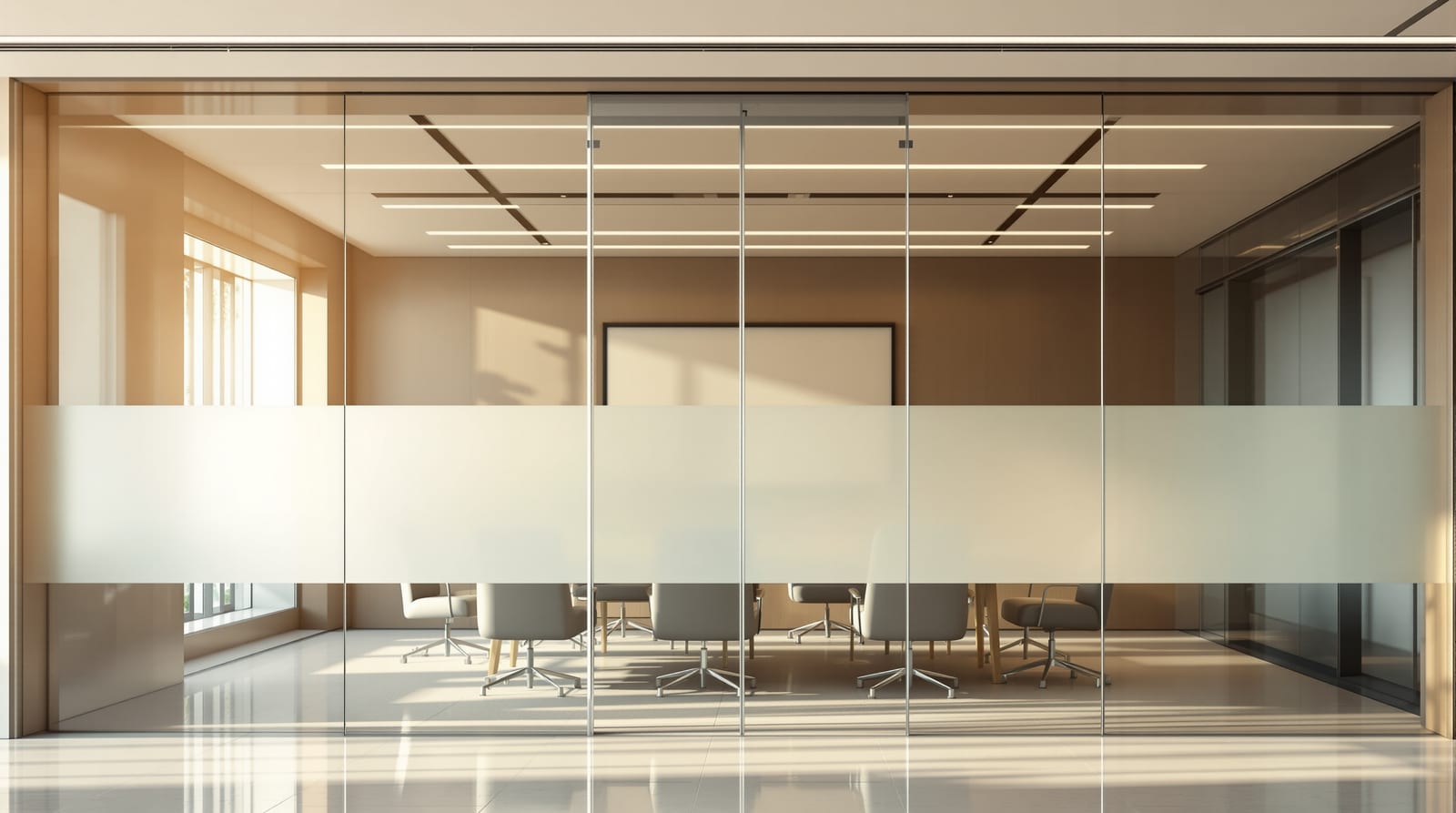
Conference Room Door in India: Acoustic, Glass & Boardroom Options (2026)
How to specify a meeting-room door that keeps conversations confidential, looks premium and still lets light in — with acoustic glass, sealed solid-core and double-leaf boardroom options.
The door is where most conference rooms quietly fail. The glass partition looks crisp, the table seats twelve, the screen is 85 inches — and then someone outside the room can hear every number being discussed in the quarterly review. In an Indian office fit-out, the conference room door is rarely a styling decision. It is a confidentiality decision dressed up as a styling decision, and the two pulls — keep sound in, let light through — fight each other on every project.
This guide is about choosing that one door well. It assumes you already know the basic door families; if you do not, start with how to choose doors in India and types of doors in India, then come back. Here we rank the realistic conference-room options on the only three things a facilities head actually argues about: acoustics, look, and rupees per door.
What a conference room door must do
A meeting-room or boardroom door carries a heavier brief than an ordinary cabin door. Five demands drive the spec, roughly in order of how often they get a project in trouble.
Sound confidentiality — the one that matters. Salary discussions, M&A talk, client commercials, legal strategy, board resolutions. If the corridor can hear it, the room has failed its primary job. Sound leaks through three paths: the door leaf itself (mass and core), the perimeter gaps (head, jambs, and especially the floor), and flanking paths around the partition. A heavy leaf with no seals is almost pointless — most conference-room sound escapes under the door. Acoustic performance is rated as STC (Sound Transmission Class); a decent cabin door is STC 28-32, a serious conference door wants STC 35-45, and a true boardroom or recording-adjacent room pushes STC 45-52. For the physics and the seal detailing, soundproof doors in India is the companion read.
Professional impression. The conference room is where clients are walked. The door is part of the brand. Frameless toughened glass with a clean patch fitting and a floor spring reads premium; a hollow flush door with a builder handle does not. This is why so much of corporate India defaults to frameless glass doors here even though solid is acoustically easier.
Light and openness versus privacy. Glass lets the room feel connected to the floor and lets daylight through to interior corridors — both genuinely valuable. But a fully transparent boardroom has no visual privacy, and confidential decks end up readable from outside. The standard resolution is a frosted or manifestation band across viewing height, or switchable (smart) glass that goes opaque on demand. See frosted glass doors in India for film, etched and ceramic-frit options.
Boardroom scale. A large boardroom often wants a double-leaf door — a 1.4-1.8 m wide opening reads important, eases moving in catering trolleys and AV flight cases, and gives a proper entrance for a big meeting. Double leaves need a meeting stile with seals or an astragal to stay acoustically honest, or one leaf is normally bolted shut.
Accessibility and code. Even a single conference door should give a clear width of at least 900 mm (RPwD 2021), use a lever handle reachable from a wheelchair, and keep the floor threshold under 12 mm — which is exactly where acoustic floor seals get tricky, because the best acoustic detail (a fixed threshold) and the accessibility limit fight each other. The usual answer is an automatic drop-down seal that retracts above 12 mm when the door is open.
The realistic options, ranked
Four door types cover almost every Indian conference room. Pick by how much sound confidentiality the room genuinely needs.
1. Acoustic double-glazed glass door (frameless or framed). Two toughened panes with an air gap and laminated interlayer, full perimeter brush-plus-gasket seals, and a drop seal at the floor. This is the premium boardroom default: it looks like a glass partition, photographs beautifully, and with proper seals reaches STC 38-45. Single-glazed frameless glass alone, despite the price, only manages STC 28-34 because it has mass but leaks at every edge — so the seals, not the glass, do the acoustic work. Add a manifestation band or switchable film for privacy.
2. Solid-core flush door with acoustic seals. A heavy laminated or veneered flush door (ideally a rated acoustic-core leaf) with full-perimeter seals and a drop seal. Acoustically the easiest and cheapest route to STC 40+, and warmer in feel — but it is opaque, so the room loses its light and connection to the floor. Common where confidentiality clearly outranks display (legal, finance, HR rooms). A vision panel keeps it from feeling like a vault.
3. Double-leaf boardroom door. Two leaves, glass or solid, on a 1.4-1.8 m opening, with a sealed meeting stile or rebated astragal. The statement entrance for large boardrooms and the practical answer for moving AV and catering. Acoustically it is only as good as its central seal — a flush butt-meeting of two leaves leaks badly. Pair with double doors in India for the hardware detail.
4. Automatic sliding glass door. For AV-heavy or hybrid rooms where a swinging leaf would foul the table or camera rig, an automatic glass door gives a clean, hands-free, accessible entrance. Sliders are the hardest to seal acoustically (they cannot clamp a perimeter the way a swing leaf does), so they suit rooms where openness beats absolute confidentiality, or where a telescopic sealed acoustic slider is budgeted.
Comparison: acoustics, look and cost per door
Costs are indicative for a standard single 3x7 ft (≈900 x 2100 mm) opening, supply-and-fit, India 2026, excluding 18% GST; double-leaf and switchable glass add substantially. Acoustic figures assume the seals are actually installed — without them, drop two STC bands.
| Door option | Typical STC (sealed) | Look / openness | Indicative ₹ per door | Best for |
|---|---|---|---|---|
| Single-glazed frameless glass + seals | 28-34 | Premium, fully open | 22,000-55,000 | Display-first meeting rooms |
| Acoustic double-glazed glass + seals | 38-45 | Premium, open + privacy band | 45,000-1,10,000 | Boardrooms wanting look + sound |
| Switchable (smart) glass door | 30-40 | Premium, opacity on demand | 90,000-2,50,000+ | Showcase boardrooms, on-demand privacy |
| Solid-core flush + acoustic seals | 38-48 | Opaque, warm, vision panel optional | 12,000-35,000 | Confidentiality-first rooms |
| Double-leaf glass/solid + sealed stile | 35-45 | Statement entrance | 55,000-1,80,000 | Large boardrooms, AV/catering access |
| Automatic acoustic sliding glass | 30-40 | Open, hands-free | 1,50,000-3,50,000+ | AV/hybrid rooms, accessibility |
For broader benchmarking against other glass options, cross-check glass doors in India.
Hardware that makes the acoustics real
The leaf is half the job. A conference door under-performs on hardware far more often than on leaf choice.
- Full perimeter seals. Compression or brush seals at head and both jambs. Without them, even a heavy leaf is STC 30.
- Automatic drop-down floor seal. A spring-loaded seal that drops on closing and lifts on opening. This single component routinely adds 4-6 STC and keeps the threshold under the 12 mm accessibility limit.
- Floor spring or concealed closer. For frameless glass, a quality floor spring (Dorma, Geze, Ozone-grade) controls the heavy leaf and returns it to a sealed closed position. A door left ajar seals nothing.
- Lever handle / pull, lever within reach. Lever (not knob) at accessible height; a long pull bar on frameless glass reads premium.
- Optional access control. Confidential boardrooms increasingly add a card or smart lock so the room is not open to the whole floor.
The detailing of closers and seals is covered in the door hardware guide for India — specify there, don't improvise on site.
Standards and the accessibility trade-off
Conference rooms are part of an office and inherit office code. Keep the clear opening at or above 900 mm, the lever handle reachable, and the threshold at or under 12 mm (RPwD 2021). NBC 2016 governs the wider egress picture, but the conference door itself is rarely an exit door — do not let an acoustic floor detail create a permanent trip lip. The automatic drop seal exists precisely to resolve this: sealed when shut, flush when open. For the full accessibility checklist, see accessible doors in India. And remember that a glass door, however framed, sits inside the broader office doors strategy and the floor-wide logic of doors by space in India.
Do and don't
- Do budget the seals and floor seal as a line item, not an afterthought — they are where confidentiality is won or lost.
- Do add a frosted manifestation band on all glass (privacy plus a safety marking so people don't walk into it).
- Don't assume thick frameless glass is soundproof; without seals it leaks like any other door.
- Don't spec a butt-meeting double leaf for a confidential boardroom without a sealed stile or astragal.
- Do match the door's confidentiality grade to the room's use — a casual huddle room does not need an STC 48 vault, and a legal boardroom should not get a single-glazed showpiece.
Frequently asked questions
What STC rating does a conference room door need?
For an ordinary meeting room, aim for STC 35-40, which keeps normal conversation unintelligible in the corridor. For a confidential boardroom — finance, legal, HR, board discussions — target STC 45-50. The leaf matters, but the perimeter and floor seals make or break the rating: an unsealed STC 45 leaf behaves like STC 30 in the wall.
Glass or solid for a conference room door — which is better?
It is a trade-off. Solid-core flush with seals reaches high STC cheaply and feels warm, but it is opaque and loses the room's light and connection to the floor. Acoustic double-glazed glass matches most of that performance while staying open and premium, at a higher cost. Choose solid when confidentiality clearly outranks display, glass when the room is client-facing.
How do I keep a glass boardroom confidential but still open?
Three routes. A frosted or etched manifestation band across viewing height blocks readable detail while keeping daylight. A full frosted or ceramic-frit panel gives more privacy. Switchable (smart) glass stays clear and turns opaque at the flick of a switch — the most flexible and the most expensive. See frosted glass doors in India.
Do conference rooms need double doors?
Only large boardrooms genuinely benefit — a 1.4-1.8 m double-leaf opening eases AV and catering access and makes a statement entrance. Most meeting rooms are fine with a single sealed leaf. If you do go double, insist on a sealed meeting stile or astragal, or the acoustics collapse at the centre joint.
What does a good conference room door cost in India?
For 2026, a sealed solid-core flush door runs roughly ₹12,000-35,000; an acoustic double-glazed glass door ₹45,000-1,10,000; a double-leaf boardroom door ₹55,000-1,80,000; switchable smart glass ₹90,000 and well past ₹2,50,000. All exclude 18% GST and vary by size, finish, hardware and city. The seals and floor spring are a meaningful slice of the total — budget them upfront.
Export this guide
Related Guides — Deep-dive reading
Soundproof Doors in India: How Doors Leak Sound, STC Ratings, Seals & Real Costs
A door is the weakest acoustic link in any wall - and it usually leaks through the gaps, not the panel - so here is how to actually quieten a bedroom, home theatre or street-facing room, from a 1,500-rupee seal kit to a proper acoustic door.
Home Doors & EntrancesGuest Room Door in India: Privacy, Quiet and Smart Picks Without Overspending (2026)
How to choose a guest bedroom door for an Indian home - privacy and acoustics so visitors feel comfortable, but budget-sensible for a room used only now and then: solid-core flush for quiet, panel or laminate for looks, the right privacy lock, simple soundproofing, and a finish that matches the rest of your doors - with picks ranked and indicative rupee costs.
Home Doors & EntrancesUniversal Design Doors for Indian Homes: Inclusive Doors That Work for Everyone (2026)
How to design and specify doors that serve children, the elderly, pregnant women, the injured and wheelchair users by default - generous width, lever handles, near-flush thresholds, low-force closing, contrast and good lighting - without your home ever looking medical.
Home Doors & EntrancesRelated Tools — Try Free
Acoustic Privacy (STC) Visualizer
Indian healthcare acoustic visualizer — compare wall assemblies and noise sources, see received SPL after STC attenuation, and check FGI 2018 / IS 1950 / NABH speech-privacy compliance with live dual-canvas waveform.
Acoustic ToolAccessible Door Checker
Check a door against wheelchair-accessibility guidance — clear width, threshold, handle and closer force per RPwD 2021.
Compliance ToolOffice Door Planner
Generate a recommended office door schedule and budget by zone — cabins, meeting rooms, server room and entrance.
Door Tool