
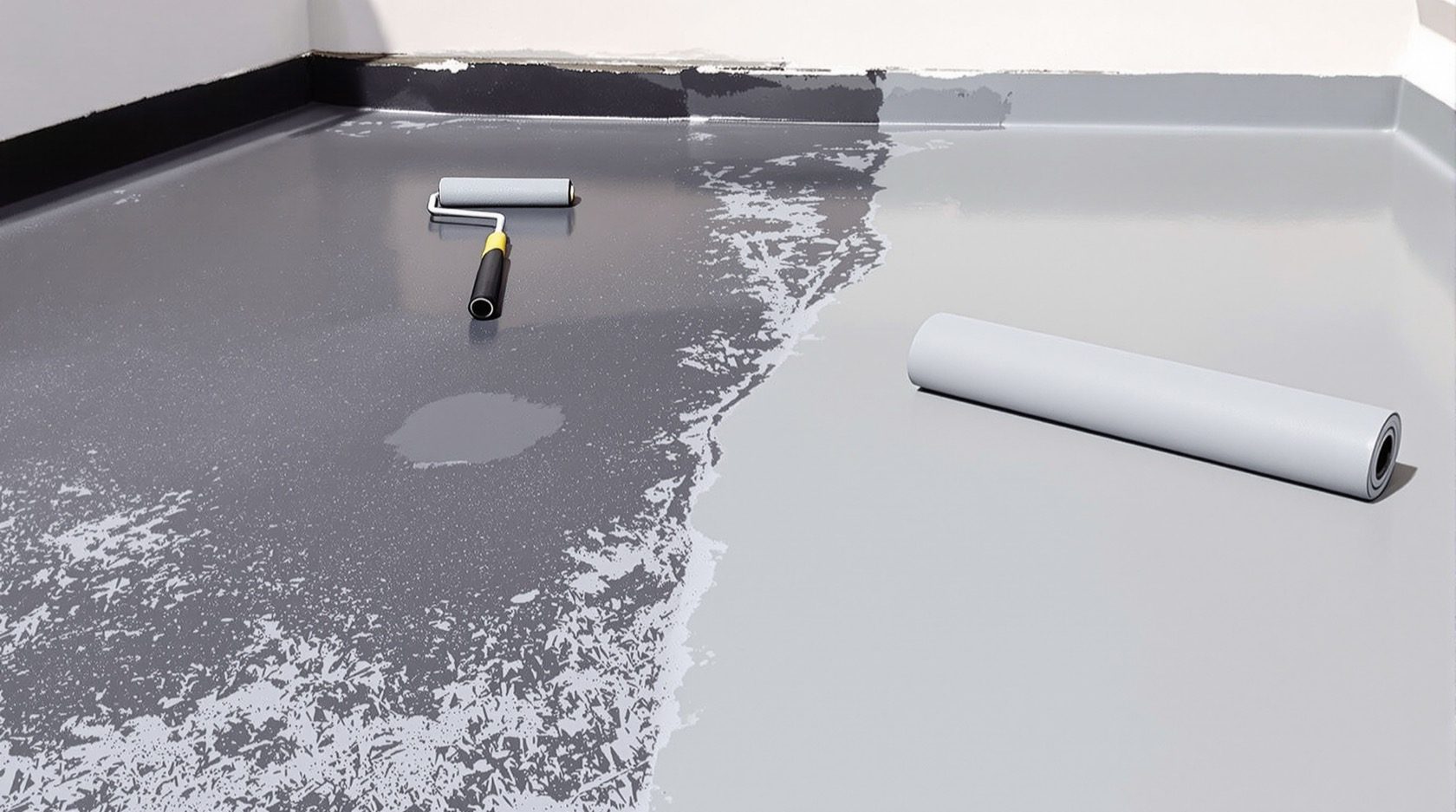
Membrane vs Liquid Waterproofing: Which Is Right for Your Roof?
Sheet membranes rolled and lapped over the slab, or a liquid coating brushed on as one seamless film? A balanced, India-grounded comparison for flat roofs and terraces across joints, thickness, complex shapes, UV, repair, skill, life and cost.
Once you have decided your flat roof or terrace needs waterproofing, the very next fork is how to lay it: as a sheet membrane — factory-made rolls unrolled, lapped and stuck down over the slab — or as a liquid-applied coating brushed, rolled or sprayed on to cure into one seamless film. Both are proven, both are everywhere on Indian roofs, and both fail in the same way when the surface underneath was not prepared. Neither is simply "better." The right pick depends on the shape of your roof, how many pipes and drains break through it, the crew you can hire, and what you are willing to spend now versus later.
This guide is the head-to-head on the Roofing Knowledge Hub and a companion to the broader roof waterproofing guide and the flat-roof waterproofing guide. It compares the two families honestly across the eight things that actually decide a terrace — joints, thickness control, complex-shape fit, UV exposure, repairability, skill dependence, service life and cost — and ends with a clear "choose sheet if… / choose liquid if…" verdict. It also makes the case that many of the best jobs quietly use both.
Scope & safety. This guide helps you understand, weigh and choose between waterproofing systems and do safe ground-level checks. Specifying the system for your slab, torch-applying membranes, mixing and building up coatings, and any work at height are qualified professional work for a licensed roofing contractor and, where the roof structure is involved, a structural engineer. Torching involves open flame; solvent coatings involve fumes. Nothing here replaces a site-specific specification or an on-site professional. Get local quotes.
The short answer
There is no universal winner. Sheet membranes give you a guaranteed, factory-uniform thickness and long life, and they shine on large, simple, open flat roofs — but every roll has laps, and laps are the line that can open up. Liquid coatings cure into a joint-free monolithic film that hugs drains, upstands, pipes and awkward corners beautifully, and they are easy to recoat — but the finished thickness rides entirely on how many coats the crew actually applied. On a big empty terrace, lean sheet. On a small, cut-up terrace full of penetrations, lean liquid. On many roofs, the smartest answer combines them.
What each family actually is
Before scoring them, be precise about what you are comparing.
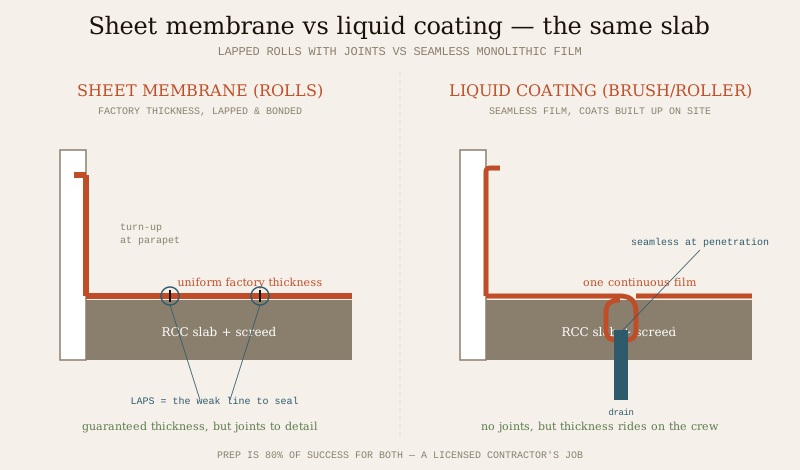
A sheet membrane is a waterproof layer made in a factory and delivered as rolls, so its thickness is controlled and consistent before it ever reaches your roof. The common families in India are:
- Torch-applied bitumen membranes — polymer-modified bitumen in APP (plastomeric, heat-tolerant) or SBS (elastomeric, more flexible in cold) grades, typically 3–4 mm thick, unrolled and bonded by melting the underside with a gas torch, with overlaps torched together. The workhorse of Indian terraces and podiums.
- Synthetic single-ply sheets — HDPE, TPO or EPDM, laid loose, mechanically fixed or adhered, with laps hot-air-welded or taped. Common on larger commercial and industrial roofs and under green roofs and podiums.
A liquid-applied coating arrives in tins or drums and is built up on site into a continuous film that cures in place, seamless by nature. The common families are:
- Acrylic (water-based) — easy, low-odour, UV-stable, good on exposed terraces; lower elongation, so best over sound, stable surfaces.
- Polyurethane (PU) — tough, highly elastic, bridges hairline movement, walkable; the premium exposed-terrace choice, but moisture-sensitive during cure and needing careful surface prep.
- Cementitious / polymer-modified cement — rigid, breathable, bonds hard to concrete; excellent in wet boxes, sunken slabs, tanks and basements, but not for surfaces that flex.
- Bituminous coatings — brush-grade bitumen emulsions; cheap and quick, usually protected under a screed rather than left bare.
The one structural difference — a factory-made sheet with laps versus a site-built film with no joints — is the root of almost every trade-off below.
The head-to-head — the eight things that decide it
Here is the whole comparison in one table. Read down the column that matters most for your roof; neither family wins every row, which is exactly why the choice depends on your terrace and your priorities.
| Criterion | Sheet membrane (rolls) | Liquid coating (brush/roller/spray) | Edge |
|---|---|---|---|
| Joints & seams | Has laps at every overlap — the classic point of failure if poorly welded/torched | Seamless, monolithic film — no joints anywhere | Liquid |
| Thickness control | Guaranteed factory-uniform thickness (e.g. 3–4 mm) | Depends on coats applied — thin, patchy spots if the crew skimps | Sheet |
| Complex shapes | Hard to dress neatly around drains, pipes, upstands, tight corners | Excels at penetrations, drains, upstands & odd geometry | Liquid |
| UV & exposure | Bitumen needs a mineral cap or screed protection; some sheets UV-stable | Acrylic/PU are UV-stable and can be left exposed and walkable | Draw |
| Repairability | Patch a lap or blister with heat; larger repairs are messier | Easy — clean, prime and recoat in place; overcoat when due | Liquid |
| Skill dependence | High but bounded — torching/welding is skilled, thickness is fixed | High and unbounded — result rides entirely on coats & workmanship | Sheet (slightly) |
| Service life | Long — commonly ~10–20+ years when detailed & protected well | Good — commonly ~5–15 years by type, easily extended by recoat | Sheet |
| Cost per m² | Moderate; economical over large simple areas | Wide range — acrylic cheap, PU premium; detailing adds labour | Depends |
Indicative, for typical Indian homes. A licensed contractor confirms the system, detailing, thickness and cost for your specific slab, exposure, penetrations and budget. Try the waterproofing material calculator and the roof cost calculator for ballpark quantities.
Reading the scores — where each family genuinely wins
The table is easy to skim but easy to misread, so here is the honest weighting, scored side by side.
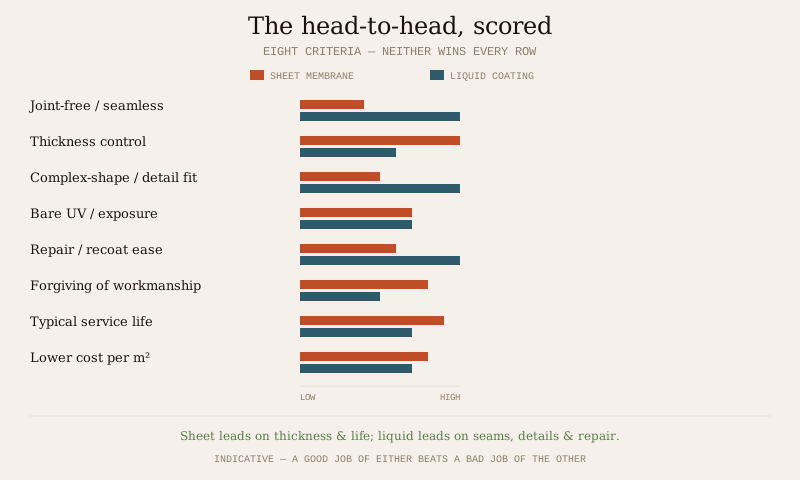
Where the sheet membrane clearly wins is thickness and life. Because the waterproof layer is made in a factory, you know exactly how thick it is — a 4 mm APP membrane is 4 mm everywhere, not 4 mm in the middle and a whisper at the edges. Over a large, open, simple flat roof with few penetrations, that guaranteed thickness plus a mineral cap or protective screed buys a long, low-drama service life. This is why podiums, basements, big terraces and industrial roofs so often go sheet.
Where the liquid coating clearly wins is seams and complex shapes. A terrace crowded with drains, vent pipes, planters, AC plinths and stepped upstands is a nightmare of cuts and laps for a sheet, and every one of those cuts is a potential leak. A liquid film simply flows around all of it as one continuous skin — up the parapet, into the drain throat, around the pipe collar — with no joint to open. It is also the easiest system to maintain: when the coating tires, you clean, prime and recoat in place, no stripping required. For cut-up Indian terraces, that seamlessness is often decisive.
The rows that read "draw" or "depends" are genuinely close. On UV, a UV-stable PU or acrylic left exposed can match a mineral-capped membrane; a bare, unprotected bitumen sheet will not last in the sun. On cost, a cheap acrylic undercuts a sheet while a premium PU with heavy detailing overtakes it — so neither family owns the price rung outright.
The India and monsoon angle
Our climate stress-tests both families, and the failure stories are the same on either side.
- Heat and UV. Rooftop surface temperatures on an Indian terrace swing brutally. Any bare bitumen must be protected; any exposed coating must be a genuinely UV-stable grade, not a cheap tinted bitumen emulsion sold as one. Pair either with a reflective cool-roof finish where the terrace is exposed.
- Monsoon and ponding. Waterproofing is your second line of defence; slope and drainage are the first. Neither a membrane nor a coating is designed to sit under standing water indefinitely. Get the fall right (about 1 in 100) and keep the outlets clear, or the best system will still be tested to destruction. See the flat-roof waterproofing guide.
- Prep is 80% of the job for both. The single biggest cause of failure — the blistering, peeling and debonding that plagues terraces — is almost always trapped moisture or a dirty, unsound, unprimed surface, not the product. A liquid coating on damp concrete blisters; a sheet torched over dust delaminates. Whichever you choose, the surface prep, the primer and the corner detailing decide the outcome far more than the brand on the tin.
Cost — more subtle than a single rate
"Which is cheaper?" has no one answer, because the two families overlap and the detailing often costs more than the field.
- Sheet membranes sit in a moderate band and get cheaper per square metre the larger and simpler the roof, because the crew can roll fast across open field with few cuts.
- Liquid coatings span a huge range: a basic acrylic can be the cheapest option going, while a multi-coat premium PU with reinforcement fabric at the junctions can cost as much as or more than a sheet. On a cut-up terrace, the labour of dressing every penetration is where the money goes — and that is exactly where liquid earns its keep.
Do not choose on the field rate alone. Ask any quote to spell out: system and grade, number of coats or membrane thickness, how upstands, drains and pipes are detailed, and the protection layer. A suspiciously cheap "waterproofing" number almost always means too few coats, no primer, or bitumen left bare in the sun. Budget waterproofing as a lifetime line item, not a one-time cost, and never let it be the corner that gets cut.
The honest cons of each
- Sheet membranes are only as good as their laps and terminations. A poorly torched seam, a lap left short, an upstand not turned up and clamped, or an over-heated membrane can all leak; and dressing a sheet around a forest of pipes is genuinely awkward. Torching is an open-flame operation demanding a certified crew.
- Liquid coatings are only as good as the thickness the crew actually laid. Skip a coat, thin it with too much water or solvent, or brush it over damp concrete, and you get pinholes, thin spots and blisters. Because there is no factory reference, honest supervision — ideally a wet-film gauge and a fixed coats-and-coverage spec — matters enormously.
Choose sheet if… / Choose liquid if…
No hedging. Here is the decision, with the panel below turning it into a side-by-side you can hand to your contractor.
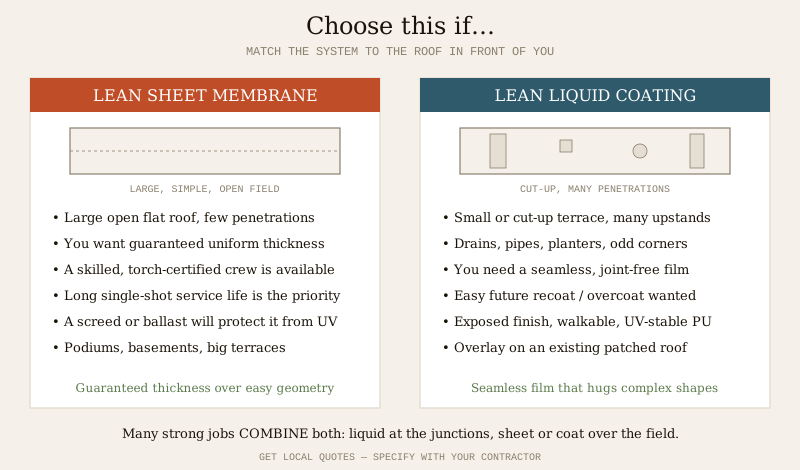
Lean SHEET MEMBRANE if…
- Your roof is large, simple and open with few penetrations — a big terrace, podium or basement.
- You want a guaranteed, uniform thickness you can specify and verify.
- A skilled, torch- or weld-certified crew is available and supervised.
- You want the longest single-shot service life and will protect it with a screed, ballast or mineral cap.
- The membrane will be buried or covered (under a screed, tiles, green roof or podium deck) rather than left bare.
Lean LIQUID COATING if…
- Your terrace is small or cut-up, with many drains, pipes, planters, upstands and odd corners.
- You need a seamless, joint-free film that hugs complex geometry with no laps to open.
- You value easy future maintenance — clean, prime and recoat in place when it tires.
- You want an exposed, walkable, UV-stable finish (a good PU or acrylic) without a separate protection layer.
- You are overcoating an existing patched roof where stripping back to slab is impractical.
Many good jobs combine the two
The choice is not always either/or. Some of the most robust Indian terraces sensibly hybridise the families, assigning each part the system that suits its job:
- Liquid at the junctions, sheet or coat over the field. Dress every drain, pipe collar, upstand and internal corner with a reinforced liquid coating — where seamlessness matters most — then run a sheet membrane or a field coating across the open expanse where thickness and speed matter most.
- Sheet plus a liquid overcoat to renew UV protection or re-detail tired terminations without stripping the field.
- Cementitious in the wet boxes, membrane or PU on the deck — matching the rigid, breathable coating to sunken slabs and the flexible system to the open roof.
This is not a compromise so much as good specification. If you are torn, ask your contractor to price a hybrid scheme — it often costs a little more than the cheapest single system and buys you the best behaviour at exactly the points where roofs actually leak.
The one-line answer
If your roof is a large, simple, open flat roof or podium and you can hire a skilled crew, lean sheet membrane for its guaranteed thickness and long life — and protect it from the sun. If your terrace is small or cut-up with many drains, pipes and upstands, lean a liquid coating for its seamless, complex-shape-hugging film and easy recoating — and insist on a fixed coats-and-thickness spec so it is actually as thick as promised. For many Indian roofs the honest answer is a hybrid: liquid detailing where the joints are, sheet or coating over the field. Whichever you pick, remember that prep is 80% of success and application is a licensed contractor's job — choose on your roof's shape, exposure and penetrations, not on the cheapest field rate.
Where to go next
- The whole subject in one map: Roof Waterproofing Guide · Flat-Roof Waterproofing Guide.
- Why waterproofing fails — and how to avoid it: Blistering, Peeling & Debonding.
- Get the fall and outlets right first: Roof Drainage Guide.
- Design the deck it sits on: Flat Roof Design Guide · Terrace Roof Design Guide.
- Keep it working: Roof Maintenance Guide · Roof Defects Guide.
- Hire the right crew: Roofing Contractor Guide.
- Zoom out: The Ultimate Guide to Roofing Systems · How to Choose a Roof · Roofing Knowledge Hub.
- Estimate it: Waterproofing Material Calculator · Roof Cost Calculator.
References
- National Building Code of India (SP 7), Bureau of Indian Standards — guidance on roofs, damp-proofing and waterproofing of buildings; verify the current edition via the BIS catalogue.
- IS 1346: Code of Practice for Waterproofing of Roofs with Bitumen Felts — Bureau of Indian Standards; verify current status via the BIS catalogue.
- IS 2645: Integral Cement Waterproofing Compounds — Specification — Bureau of Indian Standards; verify current status via the BIS catalogue.
- IS 3067: Code of Practice for General Design Details and Preparatory Work for Damp-Proofing and Waterproofing of Buildings — Bureau of Indian Standards; verify current status via the BIS catalogue: https://www.services.bis.gov.in/
This is an educational overview. Specifying a waterproofing system, torch-applying membranes, building up liquid coatings and any work at height are qualified professional work — engage a licensed roofing contractor for your project, and verify any standard's current status via the BIS catalogue before relying on it.
Export this guide
Related Guides — Deep-dive reading
When Waterproofing Blisters, Peels or Cracks: Reading a Failing Roof Coating
How to recognise the ways a terrace waterproofing layer fails — blisters and bubbles, alligatoring and surface crazing, peeling and de-bonding, pinholes, open membrane laps — what each one reveals about the root cause, and the honest recoat-versus-full-re-waterproof decision. Read it from a safe vantage; the assessment and every bit of the work belong to a licensed waterproofing contractor.
RoofingCementitious Waterproofing India: Coatings, Coats & Cost (2026)
How cement-based waterproofing coatings work in Indian bathrooms — one- vs two-component, polymer-modified slurries, surface prep, number of coats, curing, where they suit sunken slabs and wet areas, and where their low flexibility lets you down, with rupee costs.
BathroomsSheet Membrane Waterproofing India: Self-Adhesive, HDPE, PVC, TPO & Torch-Applied Bathroom Systems
How pre-formed sheet and membrane waterproofing works in an Indian bathroom — self-adhesive bituminous, HDPE, PVC and TPO sheets and torch-applied bitumen, with laps, primers, corner and penetration detailing, where sheets beat liquids, and ₹ costs.
BathroomsRelated Tools — Try Free
Monsoon-Readiness Checklist
Pre-rain home audit across 9 categories — terrace, drains, waterproofing, electrical, HVAC, pest, vehicles, documents.
Seasonal AuditRainwater Tank Sizer
How big should your rainwater tank be? Computes annual harvest, recommended tank capacity in litres, water-bill savings, and payback — for 10 Indian cities.
RWH CalculatorMaterial Decision Framework (M-Score)
Score 30+ Indian construction materials across cost, durability, climate fit, maintenance, and sustainability.
Materials