
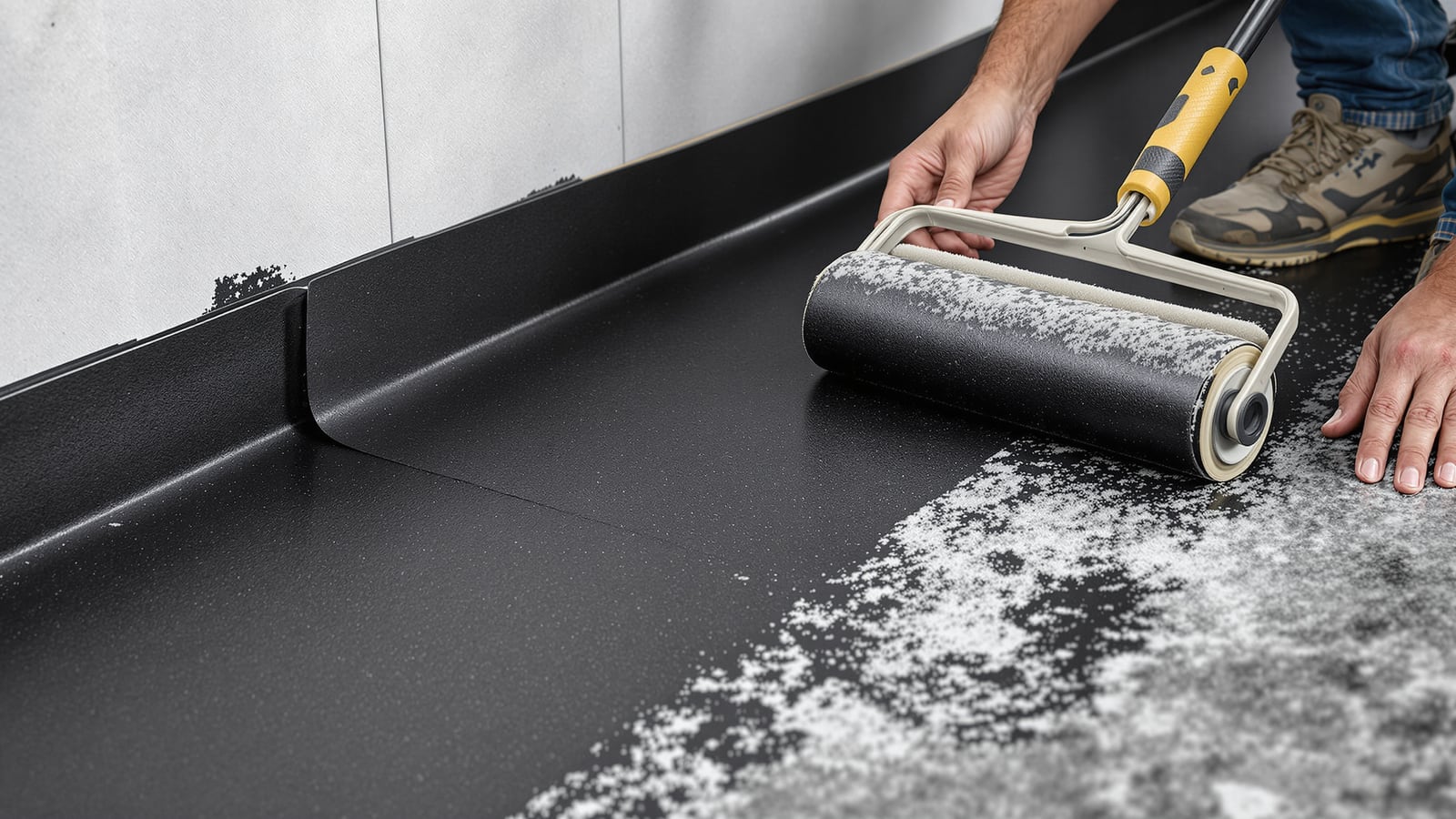
Sheet Membrane Waterproofing India: Self-Adhesive, HDPE, PVC, TPO & Torch-Applied Bathroom Systems
How pre-formed sheet and membrane waterproofing works in an Indian bathroom — self-adhesive bituminous, HDPE, PVC and TPO sheets and torch-applied bitumen, with laps, primers, corner and penetration detailing, where sheets beat liquids, and ₹ costs.
A liquid waterproofing coat is only as thick as the painter made it that morning. A sheet membrane arrives already the right thickness — 1.2, 1.5, 2 or 4 mm of uniform, factory-controlled material on a roll — and your only job on site is to lap, bond and detail it correctly. That single difference is why architects reach for pre-formed sheets on large, flat, high-consequence surfaces: podium slabs, terraces over living space, water tanks and the sunk portions of big bathrooms. This is the sheet-and-membrane chapter of the Studio Matrx bathroom hub.
Read it alongside the bathroom waterproofing guide for India, which is the pillar for the whole topic. For the material-family overview see waterproofing membrane types in India, and for the alternative approach — brush-and-roller coatings — see the liquid waterproofing membrane guide. This page is specifically about the pre-formed roll goods you unroll and bond, not the ones you paint on.
A sheet membrane moves the quality control from your site to a factory. You are no longer trusting the coat thickness — you are trusting the laps, the primer and the corners. Get those three right and the field of the sheet takes care of itself.
What counts as a sheet membrane
A sheet (or pre-formed) membrane is a waterproofing barrier manufactured to a controlled thickness and delivered in rolls, then bonded to the substrate on site. The four families you will meet in Indian practice differ mainly in the base polymer and in how they stick down.
| Membrane type | Typical thickness | How it bonds | Best home use |
|---|---|---|---|
| Self-adhesive bituminous (SBS) | 1.2–1.5 mm | Peel-and-stick to primed surface | Bathroom sunk slab, small terraces |
| Torch-applied bitumen (APP) | 3–4 mm | Flame-melted underside, roller-pressed | Large terraces, tanks, podiums |
| HDPE / pre-applied | 0.4–1.2 mm | Loose-laid or self-adhesive lap | Basement rafts, retaining walls |
| PVC / TPO single-ply | 1.2–2.0 mm | Hot-air welded seams | Flat roofs, large wet decks |
The bituminous families (self-adhesive and torch-applied) are the ones you will most often see used inside and under an Indian bathroom. HDPE is a basement and below-grade material; PVC and TPO are single-ply roofing membranes that occasionally serve very large wet decks or terrace bathrooms. All four share the same logic: a continuous factory-made skin whose only weak points are the joints you make on site.
The three details that decide everything
Because the field of the sheet is factory-perfect, almost every sheet-membrane failure happens at one of three man-made details: the laps, the corners and the penetrations. The diagram sets out the anatomy.
Substrate first — the Indian reality
Before any primer, the sunk slab has to earn the membrane. Break off laitance and shutter fins, fill honeycombs, and grind the surface flat: a sheet bridges small voids but telegraphs sharp ridges, which become puncture points under the screed. In our climate two site habits matter most. First, dryness — a slab cast in the monsoon can hold moisture for a week, and a sheet trapped over damp concrete blisters as the water tries to escape; test with a plastic-sheet patch overnight before you commit. Second, falls — form the 1:80 to 1:100 slope towards the trap in the substrate, because a membrane cannot correct a flat floor and standing water is what eventually finds the one weak lap. Hard-water scale and grit tracked in during construction should be washed off, not left to sit under the primer.
Primer first, always
Bituminous sheets do not stick to bare, dusty concrete. The slab must be cured, dry, dust-free and coated with a compatible bitumen primer (solvent- or water-based) that is allowed to become tacky before the sheet goes down. Skipping primer is the single most common site shortcut, and it is why membranes later "tent" and lift. On a green or damp Indian sunk slab, use a water-based primer and wait for the sheen to dull.
Laps — the seam that holds the water
Adjacent rolls must overlap, not butt. The overlap is bonded so that water riding down the slope always crosses the seam onto the upper sheet, never into it — like tiles on a roof.
- Side laps: 75–100 mm, fully bonded (self-adhesive) or torch-fused (APP).
- End laps: 100–150 mm, staggered so four sheets never meet at one point.
- Roll the seam: press every lap with a silicone roller so no air is trapped; a bituminous lap should show a fine bead of squeezed-out compound.
- Shingle the slope: always lap in the direction water flows, upper sheet over lower.
Corners and upstands
Water collects at the wall-floor junction, so this is where you reinforce. Form a fillet (a 25 mm triangular bitumen or mortar cove) at the internal corner so the sheet is never asked to fold sharply, then carry the membrane a minimum of 150 mm up the wall as an upstand — 300 mm behind a shower. External corners and the four bottom corners of the sunk portion get an extra reinforcing patch before the main sheet.
Penetrations
Every waste, trap and supply pipe is a hole in your barrier. Cut the sheet to fit, then dress a separate collar patch or preformed pipe boot around the pipe and seal it down onto the field membrane. Floor traps get a puddle flange the membrane is clamped or bonded into. Never rely on the field sheet alone to hug a pipe.
Torch-applied vs self-adhesive
Both are bitumen; the difference is how they melt and bond, and therefore where they belong.
| Factor | Self-adhesive (SBS) | Torch-applied (APP) |
|---|---|---|
| Bonding | Peel backing, press down | LPG torch melts underside |
| Flame on site | None — safe indoors | Open flame — ventilation + care |
| Typical thickness | 1.2–1.5 mm | 3–4 mm |
| Skill needed | Moderate | Skilled applicator only |
| Best for | Bathrooms, small terraces | Terraces, tanks, podiums |
| Failure risk | Poor primer / cold lap | Scorched sheet / missed lap |
For an occupied Indian flat, self-adhesive is usually the sensible bathroom choice: no open flame near timber doors and PVC pipes, no LPG cylinder in a small wet room, and thickness that still comfortably beats a thin liquid coat. Torch-applied bitumen earns its place on the big flat areas above — the terrace over the bathroom, the overhead tank, the podium — where a 4 mm skin and a fused lap justify the extra risk of a flame.
Where sheets beat liquids — and where they don't
Sheets and liquid membranes are not rivals so much as tools for different geometries. The decision tree makes the call.
Sheets win when the area is large, mostly flat and uninterrupted: a terrace over a bedroom, an overhead or underground tank, a podium deck, a big villa bathroom floor. Here the factory thickness is a genuine guarantee, coverage is fast, and there are few penetrations to fuss over. A 1.5 mm sheet will not vary the way a hand-applied coat does.
Sheets struggle in a small, complicated Indian bathroom crammed with a WC trap, floor trap, health-faucet supply, shower drain and three internal corners — every one of which needs cutting and a collar. In that geometry a self-levelling liquid membrane simply flows around the obstacles seamlessly. That is why many good Indian bathroom specs are hybrid: a sheet across the flat sunk slab for guaranteed body, with a liquid coat lapped up the corners, upstands and around every penetration.
Pros, cons and ₹ cost
| System | Pros | Cons | Applied cost (₹/sq ft) |
|---|---|---|---|
| Self-adhesive bituminous | Guaranteed thickness, no flame, quick | Lap discipline critical, primer needed | ₹70–130 |
| Torch-applied APP 3–4 mm | Very robust, thick, long life | Flame risk, skilled labour only | ₹90–160 |
| HDPE pre-applied | Excellent below-grade, root-resistant | Overkill for a bathroom | ₹80–150 |
| PVC / TPO single-ply | Welded seams, UV-stable roofs | Needs welding kit, large areas only | ₹120–220 |
Costs are indicative applied rates (material plus labour, mid-2020s) and vary with brand, city and slab preparation. A small 40 sq ft bathroom sunk slab in self-adhesive sheet lands around ₹3,000–5,500 in membrane, before screed and tiling. Whatever you choose, budget for a flood/ponding test — plug the drains, fill to 25–50 mm and hold 24–72 hours before you allow any screed. A sheet membrane that passes the flood test is worth ten that merely look neat.
For the bigger picture — waterproofing chemistry, box-type tanking, and how membranes sit under tiles — return to the bathroom waterproofing guide for India, compare families in waterproofing membrane types in India, and weigh the alternative in the liquid waterproofing membrane guide. The house-wide view lives in the Studio Matrx waterproofing guide.
References
- National Building Code of India (NBC) 2016, Part 6 (Structural Design) and Part 9 (Plumbing Services) — waterproofing and damp-proofing of wet areas and sunk slabs.
- IS 13826 — Bitumen-based felts / methods of test for waterproofing membranes.
- IS 3067 — Code of practice for general design details and preparatory work for damp-proofing and waterproofing of buildings.
- IS 1609 — Code of practice for laying damp-proof treatment using bitumen felts.
- Bureau of Indian Standards (BIS) — product standards for polymer-modified bituminous, HDPE, PVC and TPO membranes.
- CPWD Specifications and CPHEEO Manual — waterproofing treatment schedules and flood-test acceptance practice for institutional works.
Export this guide
Related Guides — Deep-dive reading
Membrane vs Liquid Waterproofing: Which Is Right for Your Roof?
Sheet membranes rolled and lapped over the slab, or a liquid coating brushed on as one seamless film? A balanced, India-grounded comparison for flat roofs and terraces across joints, thickness, complex shapes, UV, repair, skill, life and cost.
RoofingBathroom Leak Prevention India: Detailing the Junctions That Stop Water Reaching the Flat Below
Bathroom leaks almost never come from a broken pipe — they come from a badly detailed junction. Here is how to get the wall-floor corner, pipe penetrations, floor trap, nahani trap and door threshold right, plus the flood test that catches a leak before you tile.
BathroomsBathroom Waterproofing Failure in India: Causes, Diagnosis & Fixes (2026)
Why bathroom waterproofing fails in Indian homes — poor surface prep, thin coats, missed junctions, no membrane turn-up, damage during tiling — how to read the symptoms, and whether a surface fix or a full redo is the right remedy.
BathroomsRelated Tools — Try Free
Cross-Ventilation Analyzer
Estimate airflow and air changes per hour (ACH) from room size, window areas, layout, and local wind — with NBC 2016 Part 8 compliance check.
Ventilation CalculatorMonsoon-Readiness Checklist
Pre-rain home audit across 9 categories — terrace, drains, waterproofing, electrical, HVAC, pest, vehicles, documents.
Seasonal AuditBathroom Waterproofing Calculator
Work out waterproofing material (kg/L) and cost for a bathroom by area, wall band, system type and coats — cementitious, acrylic, PU or SBR.
Bathroom Calculator