
Cementitious Waterproofing India: Coatings, Coats & Cost (2026)
How cement-based waterproofing coatings work in Indian bathrooms — one- vs two-component, polymer-modified slurries, surface prep, number of coats, curing, where they suit sunken slabs and wet areas, and where their low flexibility lets you down, with rupee costs.
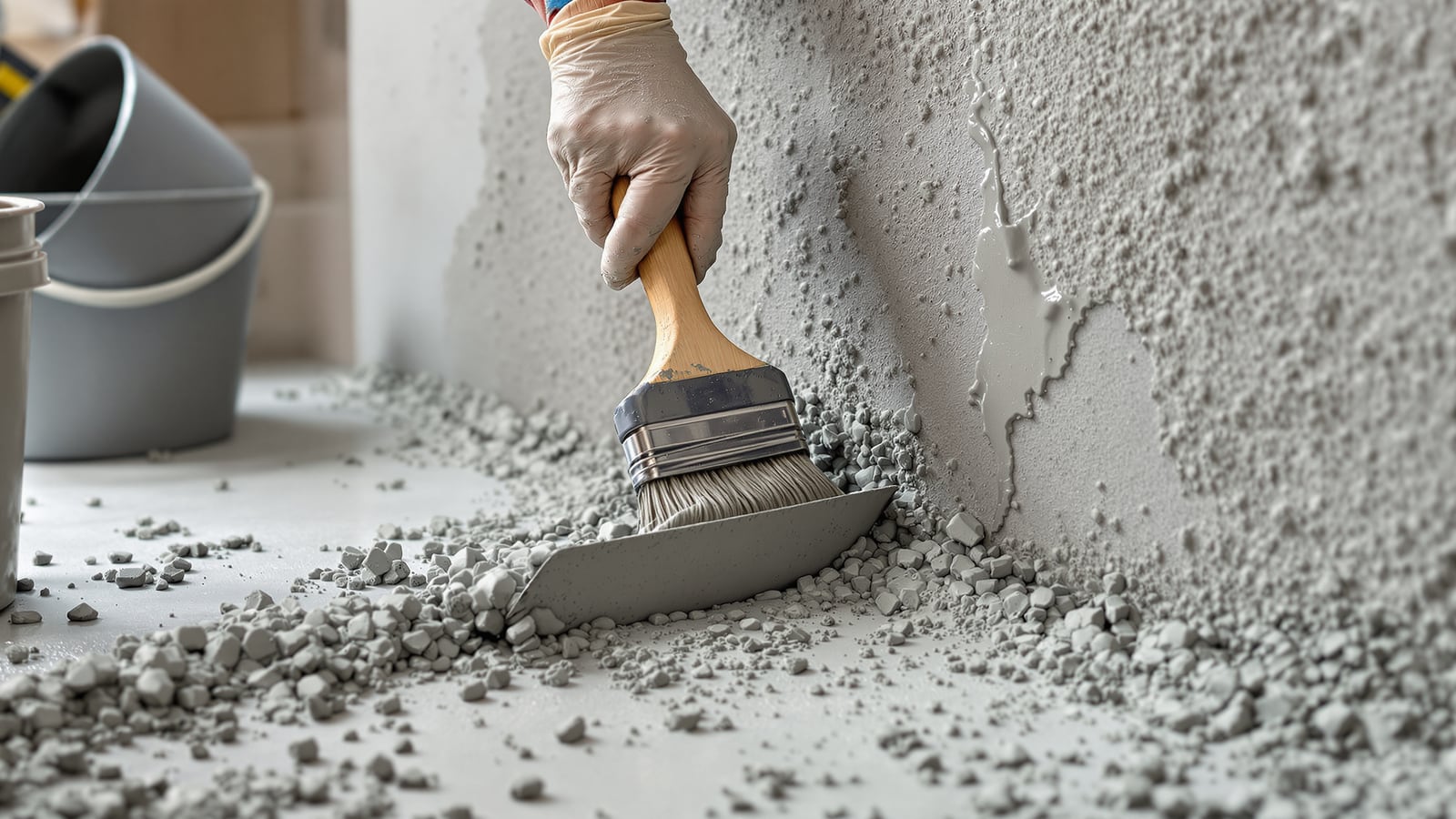
Cementitious waterproofing is the workhorse of the Indian bathroom. It is the grey slurry a mason brushes across a sunken slab before the plumbing goes back and the screed goes down — cement, fine sand, chemical additives and, in the good systems, a polymer liquid that turns brittle mortar into a flexible, bonded skin. It is cheap, forgiving, breathable and available in every hardware shop from a metro to a mofussil town, which is exactly why it is specified more than any other system in Indian homes. Understood and applied properly it will keep a bathroom dry for a decade or more. Applied as an afterthought — one thin coat, no prep, no curing — it cracks with the slab and quietly feeds the leak below.
This guide is India-first. It assumes a health-faucet WC that keeps a corner permanently wet, hard water, monsoon humidity that never lets a wall dry, and an apartment slab shared with a neighbour underneath. It sits under the bathroom waterproofing guide for India, which frames the whole system; here we go deep on just the cement-based coating layer. For the flexible sheet alternatives read waterproofing membrane types for India, and for the paint-like coatings read liquid waterproofing membranes for India.
Cementitious waterproofing does not float on top of the slab — it becomes part of it. That bond is its great strength and its one weakness: whatever the slab does, the coating does too.
What "cementitious" actually means
Cementitious (cement-based) waterproofing is a coating whose binder is cement. Water finds it hard to pass through a dense, well-cured cement matrix, and modern products push that further with two families of chemistry:
- Polymer-modified slurries. Cement and graded sand are mixed with an acrylic or SBR polymer liquid (or a re-dispersible polymer powder). The polymer bridges the pores and, crucially, adds a little flexibility and elongation so the coat can span hairline cracks instead of snapping over them.
- Crystalline (capillary) coatings. Reactive chemicals in the cement grow crystals deep inside the concrete's own pore network when they meet water, blocking capillaries from within. These are self-sealing against later hairline cracks and are common on the water-facing side of tanks and rafts.
Most bathroom work uses the polymer-modified type. It bonds to a damp substrate (a big advantage in India, where nothing is ever bone-dry), breathes so trapped vapour can escape rather than blister, and can be tiled over directly. What it is not is a rubber membrane: even the best cement coat stretches only a few percent, so it manages hairline shrinkage cracks, not moving structural ones.
One-component vs two-component
The single biggest choice on the shelf is how many parts you mix. It maps almost exactly onto how much movement the coat can tolerate.
| One-component (1K) | Two-component (2K) | |
|---|---|---|
| Supplied as | Pre-blended powder; add clean water | Powder (Part B) + polymer liquid (Part A) |
| Flexibility / elongation | Low — roughly 0–1% | Moderate — roughly 5–15% depending on brand |
| Crack bridging | Minimal; hairline only | Good; bridges fine shrinkage cracks |
| Best for | Priming, negative-side damp, budget jobs | Sunken slabs, wet areas, terraces, tanks |
| Ease of use | Simplest; harder to over-water | Fixed A:B ratio must be respected |
| Cost | Lower | 20–40% higher |
The rule of thumb: anywhere the surface can flex or see standing water — a sunken slab, the shower zone, a terrace, a tank — specify a two-component, polymer-rich product. Reserve one-component powders for priming, for damp-proofing a plaster face, or for genuinely budget secondary bathrooms. Paying 30% more for the two-part system is the cheapest insurance in the whole bathroom.
Where cementitious coatings suit — and where they do not
Cementitious coatings are ideal on rigid, well-cured RCC — the sunken portion of a slab, the concrete walls of a wet zone, a raft, an overhead tank. They fail where the substrate moves: a live structural crack, an expansion joint, the sharp internal angle where floor meets wall, or a lightweight slab that flexes underfoot. The honest answer at those points is not to trust the cement coat alone but to reinforce the junction with a fibre-mesh band or a strip of flexible membrane, then coat over it. Think of cementitious as the continuous field and a flexible product as the belt-and-braces at every corner, drain and joint.
Surface preparation — where most failures start
A cement coat is only as good as the surface it grips. Rushing prep is the single commonest cause of debonding and leaks.
1. Clean and sound. Remove laitance, curing compound, oil, paint and loose material. The surface must be structurally sound, not crumbling.
2. Fill and fillet. Rake out and fill honeycombs, tie-holes and cracks with a polymer repair mortar. Form a fillet (coving) about 40–50 mm at every floor-to-wall junction so water never meets a sharp 90° angle.
3. Saturate — but no puddles. Cementitious systems need a saturated surface-dry (SSD) substrate: damp to the touch, with no standing water. Pre-wetting stops the concrete from sucking water out of the fresh slurry and killing its cure.
4. Prime if specified. Some two-component systems want a bonding primer or a scratch coat on very smooth or very porous concrete.
5. Test the fall first. Confirm the slab already falls toward the drain — the coating waterproofs, it does not correct a flat or reverse slope.
Coats, thickness and curing
The coating is never a single pass. Apply it as at least two coats, the second brushed at right angles to the first so no pinhole runs straight through. Key numbers to hold your applicator to:
- Coats: minimum 2; three for the shower zone, tanks and terraces.
- Coverage / thickness: roughly 1.2–2.0 kg/m² per coat, building a total dry film of about 1.0–2.0 mm. Follow the datasheet — thin, over-watered coats are the classic failure.
- Recoat window: let the first coat firm up (touch-dry, usually 4–6 hours) before the second; do not let it fully cure and glaze over.
- Wall height: carry the coat at least 300 mm up dry-area walls and 1.2–1.5 m up wet-area walls (full height in a shower or wet room).
- Curing: cement chemistry needs water. Moist-cure the finished coating for 2–3 days and keep it out of direct sun and foot traffic while it hardens.
- Test before you bury it. Do a 48–72 hour flood (ponding) test on the sunken floor before the screed goes down. This is the one step nobody should skip; finding a leak now costs a bucket of water, finding it later costs the ceiling below.
Limitations you must design around
Cementitious waterproofing has one honest weakness — low elongation. Because it is bonded and cement-based, it stretches only a little before it cracks:
- It cannot bridge moving or structural cracks. Over a live crack it will re-crack. Reinforce such lines with mesh or a flexible strip, or switch systems there.
- It needs a rigid substrate. On a flexing timber or thin lightweight floor, a flexible sheet or liquid membrane is the safer call — see waterproofing membrane types.
- It is not for permanent ponding on an exposed face or long UV exposure — always protect it with screed and tiles.
- It must be cured. Skipped curing gives a weak, chalky, permeable coat that looks fine and leaks quietly.
In practice the best Indian bathrooms do not choose cement or flexible — they layer them: a cementitious slurry as the continuous, breathable, tile-friendly field, with a flexible membrane or liquid coating reinforcing the junctions, drains and any crack-prone lines. This is exactly the belt-and-braces logic set out in the bathroom waterproofing guide and the broader waterproofing guide.
What it costs in India
Prices vary by brand, polymer content and city, but 2026 ball-park material rates for a two-component bathroom-grade coating land in these bands. Add labour and prep separately.
| Item | Typical rate (material) |
|---|---|
| One-component powder slurry | ₹35–70 per kg |
| Two-component polymer system | ₹90–180 per kg (Part A + B) |
| Crystalline coating | ₹120–220 per kg |
| Applied cost, sunken bathroom (2 coats + prep, mesh at junctions) | ₹90–160 per sq ft |
| Applied cost, full wet-zone tanking (3 coats, walls to 1.5 m) | ₹150–260 per sq ft |
| Polymer repair mortar for haunching / fillets | ₹40–90 per kg |
A typical 35–45 sq ft sunken bathroom floor in a two-coat two-component system therefore runs roughly ₹4,000–9,000 in coating material, a rounding error against the cost of tearing out tiles and re-doing a leaking slab. Common products used as examples across these bands include Dr. Fixit (Pidilite) cementitious and crystalline ranges, Fosroc brush-applied polymer coatings, and MYK Laticrete two-component and self-sealing systems — all brand-neutral illustrations; specify to the datasheet and IS references, not the label.
Quick do / don't
- Do use a two-component polymer system for sunken slabs and wet zones; keep one-component for priming and budget dry areas.
- Do cove every junction, band drains and pipes with mesh, and cross-apply two coats.
- Do moist-cure 2–3 days and flood-test 48–72 hours before the screed.
- Don't over-water the mix, apply one thin coat, or trust cement alone over a moving crack or a flexing floor.
References
- National Building Code of India (NBC) 2016, Part 9 (Plumbing Services) and Part 7 (Construction Practices & Safety) — damp-proofing and wet-area construction guidance.
- IS 2645: Integral Cement Waterproofing Compounds — Specification — the BIS standard for waterproofing admixtures used in cementitious systems.
- IS 456: Plain and Reinforced Concrete — Code of Practice — concrete quality, cover and curing that underpin any bonded coating.
- IS 3067: Code of Practice for General Design Details and Preparatory Work for Damp-Proofing and Waterproofing of Buildings.
- IS 13182 / IS 12200 — waterproofing and crack-repair practice references (BIS).
- CPWD Specifications and CPHEEO Manual — government workmanship and wet-area detailing benchmarks.
- IGBC / GRIHA green-building manuals — moisture management and durable wet-area detailing credits.
Export this guide
Related Guides — Deep-dive reading
Bathroom Leak Prevention India: Detailing the Junctions That Stop Water Reaching the Flat Below
Bathroom leaks almost never come from a broken pipe — they come from a badly detailed junction. Here is how to get the wall-floor corner, pipe penetrations, floor trap, nahani trap and door threshold right, plus the flood test that catches a leak before you tile.
BathroomsWaterproofing Failures Explained: Why Systems Fail and How to Spot It
Why waterproofing so often leaks again within a year or two — the weak links in the system, the junctions that really fail, the flood test everyone skips, and how to tell a real repair from a cosmetic patch.
Structural SafetyBathroom Waterproofing Chemicals in India: Compounds, Admixtures & Sealants
A brand-neutral guide to the integral compounds, crystalline admixtures, acrylic bonding agents, primers and PU/silicone sealants that keep an Indian bathroom dry — what each does, where it goes, dosage and ₹ cost.
BathroomsRelated Tools — Try Free
Bathroom Waterproofing Calculator
Work out waterproofing material (kg/L) and cost for a bathroom by area, wall band, system type and coats — cementitious, acrylic, PU or SBR.
Bathroom CalculatorMonsoon-Readiness Checklist
Pre-rain home audit across 9 categories — terrace, drains, waterproofing, electrical, HVAC, pest, vehicles, documents.
Seasonal AuditRainwater Tank Sizer
How big should your rainwater tank be? Computes annual harvest, recommended tank capacity in litres, water-bill savings, and payback — for 10 Indian cities.
RWH Calculator