
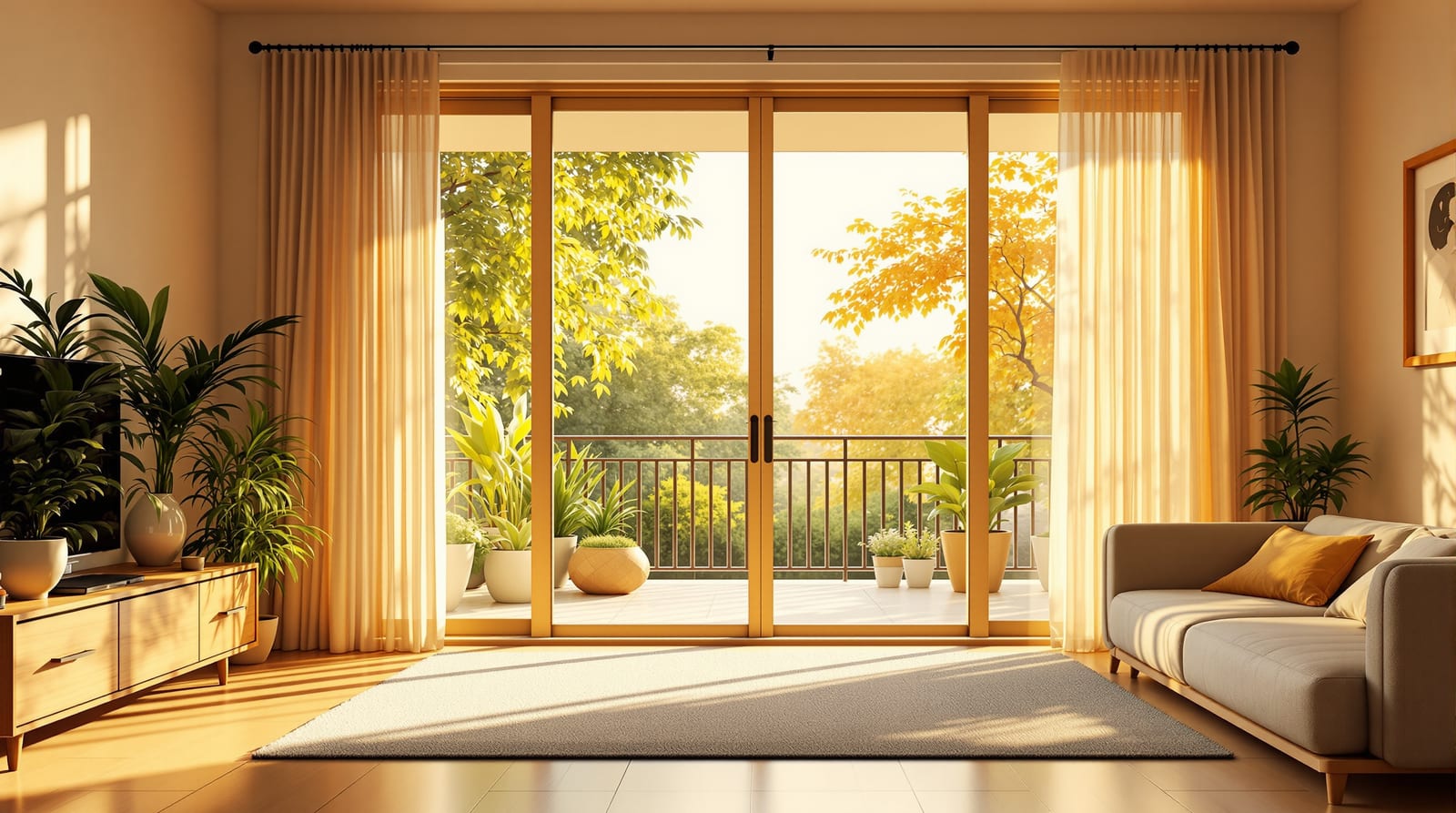
Living Room Door in India: Best Doors for Light, Flow and Space (2026)
How to choose the doors in and around your living room - balcony sliders, French and bi-fold doors, glass partitions and pocket or barn doors to the dining and foyer - ranked by light, openness, space-saving and flow, with indicative rupee costs.
The living room is the one space in an Indian home where the doors are less about closing the room off and more about opening it up. You rarely hang a solid swing door at the mouth of a drawing room. Instead, the doors that define a living room are the ones around its edges - the wide opening to the balcony or garden that floods the sofa in morning light, the partition that lets you separate living from dining when guests arrive, and the transition from the foyer that sets the first impression. Get these openings right and a 12 x 15 ft hall feels twice its size. Get them wrong and you lose light, flow and floor space all at once.
This guide treats the living room as a set of openings rather than a single door. For each one we name the recommended door type, the single driver that should decide it, indicative 2026 rupee costs and the hardware that makes it work. We complement the door-type guides rather than repeat them - when you want the full detail on any one type, follow the link.
What a living room door actually has to do
Unlike a bedroom or bathroom door, a living room opening is rarely chosen for privacy or security. The drivers that matter here are different, and they usually conflict, so you are always trading one against another.
- Light - the living room is the daytime heart of the home, so the opening to the balcony or garden should pull in as much daylight as possible. This pushes you toward glass.
- Openness and view - large frameless or slim-framed glass keeps the eye travelling outward, making the room feel bigger and connected to the outside.
- Flow - on festival days and family gatherings the living, dining and foyer become one continuous space. Doors that fold, slide or pocket away give you that flow on demand.
- Space-saving - a swing door eats a quarter-circle of precious floor. Sliders, pockets and barn doors give you that floor back, which is why they dominate compact Indian flats.
- Design continuity - the living room is the most-seen room, so the doors must read as part of the design language, not an afterthought. Matching the partition to the foyer and the slider profile to the windows keeps it coherent.
- Acoustics and dust - a real consideration in Indian cities. A glass slider to the balcony cuts traffic noise and dust; an open arch does not. If you back onto a busy road, sealing matters.
You will notice security and fire code barely feature here - those belong to the main entrance door and to fire-rated doors on stairwells, not to internal living room openings. The living room's job is to feel generous.
The four openings of a living room
Think of the living room as having up to four door decisions. Most homes have two or three of them.
1. Living room to balcony / garden - the big light-and-view opening.
2. Living room to dining - the flexible partition that joins or splits the two.
3. Living room to foyer / entrance lobby - the transition and first impression.
4. Living room to passage / other rooms - a regular interior door, usually flush or panel.
1. The balcony or garden opening - go for glass that moves
This is the single most important door in the room, because it controls light. The choice is between four glass-led options, ranked here for a typical Indian living room.
- Sliding doors are the default for most flats. Two to four large glass panels slide on a track, taking zero floor space and giving a wide glazed opening. uPVC or aluminium frames seal out dust and noise. This is the safest, most practical pick for a balcony in an apartment.
- Bi-fold doors concertina fully to one side, so the whole wall opens and the balcony merges with the living room. Brilliant for villas and large terraces where you genuinely want the indoor-outdoor flow. Costs more and needs a clear stacking zone.
- French doors - a pair of glazed doors that swing open - suit a more classic or villa look opening to a garden or deck. They need swing clearance, so they fit independent homes better than tight flats.
- A fixed glass door wall with one operable leaf maximises uninterrupted view where you mostly want light, not constant access.
For an apartment balcony in India, a uPVC or aluminium sliding door is almost always the right answer: dust seal, noise seal, no floor lost, easy to operate. Reserve bi-fold and French for villas with the space and budget to enjoy the full opening.
2. The living-to-dining partition - separate on demand
In open-plan Indian flats the living and dining share one volume, which is great until you want to host a card party in one half while children do homework in the other. A movable partition door solves this.
- Pocket doors slide cleanly into a wall cavity and vanish when open - the most elegant living-to-dining divider, with zero floor footprint, but it must be planned at the masonry stage because the cavity has to be built into the wall.
- Barn doors slide on an exposed wall-mounted track. No cavity needed, so they retrofit easily, and a teak or fluted barn door becomes a design feature in itself. They need clear wall to one side to park against.
- Partition doors and sliding glass partitions give a semi-transparent split that keeps light flowing between the two zones while cutting sound and visual clutter.
- Folding doors stack to one side and are useful where you want a wide opening that fully clears.
Driver here is flow with space-saving: you want the option to divide without ever losing floor area, which rules out swing doors and points firmly at sliding, pocket or barn solutions.
3. The foyer transition - first impression and design continuity
Many Indian homes leave the living-to-foyer opening as an open arch or a half-height partition. Where you do want a door - to contain air-conditioning, block direct sightlines from the entrance, or follow Vastu preference for a screened drawing room - a half-glazed door or a decorative sliding partition keeps it light. Match its material and finish to the main door and the room's interior doors so the eye reads one design story from the threshold inward.
4. Doors to passages and other rooms
The plain interior openings off the living room - to a passage, study or guest room - are usually flush doors or panel doors in laminate, veneer or membrane finish, chosen to match the room's palette. These are covered fully in our interior doors by room guide.
Recommendation table - which door for which living room opening
| Opening | Best door option | Use it when | Indicative cost (per door, +18% GST) | Why it wins |
|---|---|---|---|---|
| Balcony / garden | uPVC or aluminium sliding door | Apartment balcony, dust and noise to seal, no floor to spare | uPVC 6,000-16,000; aluminium 8,000-25,000 | Maximum glass and light, zero floor lost, seals city dust and traffic noise |
| Balcony / garden | Bi-fold door | Villa or large terrace, want the whole wall to open | aluminium bi-fold approx 25,000-55,000+ | Fully opens to merge indoor and outdoor for gatherings |
| Garden / deck (classic look) | French doors | Independent house with swing clearance | 14,000-40,000 per pair by glazing and frame | Symmetrical classic look, generous double opening |
| Living to dining | Pocket door | New build / renovation, want divider to disappear | 12,000-30,000 incl. cavity kit | Vanishes into the wall; nothing lost when open |
| Living to dining | Barn door | Retrofit, no wall cavity, want a feature | 12,000-35,000 in teak/engineered wood | Mounts on the surface, becomes a design statement |
| Living to dining | Sliding glass partition | Want to split zones but keep light flowing | 18,000-45,000 (toughened glass + floor spring) | Semi-transparent split, keeps the volume feeling open |
| Living to foyer | Half-glazed sliding / decorative door | Contain AC, screen the entrance view | 9,000-22,000 | Light transition that continues the design language |
| Living to passage/study | Flush or panel door | Plain interior opening | flush 3,000-9,000; panel 4,000-14,000 | Quiet, matches palette, cost-effective |
Costs are indicative for 2026 and vary by size, finish, glazing and city. Use the door cost calculator for a sized estimate.
A living room plan view - the two key openings
The sketch below shows the two decisions that matter most: a sliding glass door to the balcony (no floor lost, full light) and a sliding partition between living and dining (split on demand).
Hardware that makes living room doors work
The door is only half the job - the hardware decides whether it glides for a decade or jams in a monsoon.
- Floor springs for frameless glass. A frameless toughened-glass partition or door rides on a concealed floor spring (Dorma, Godrej, Ozone are common in India) with patch fittings top and bottom. Budget for the floor spring separately; it is what gives the smooth swing and self-close.
- Soft-close and quality tracks for sliders. Spend on a good top-hung track and soft-close mechanism for sliding and pocket doors - the cheap channel track is what fails first. Soft-close stops the slam and protects glass edges.
- Tandem rollers and a clean threshold. A low or flush threshold (keep it under 12 mm for an accessible home) keeps the floor continuous between living and balcony and avoids a trip line.
- Discreet handles and locks. Living room doors rarely need heavy security, so slim flush pulls or recessed handles suit the clean look. Full hardware detail is in our door hardware guide.
Sizing and standards
A habitable-room door in India should give a clear opening of at least 900 mm (NBC 2016), and a balcony slider is usually far wider - a 1.8 to 2.4 m glazed opening is common in living rooms. If you want the home to be wheelchair-friendly, keep a clear width of 900 mm, use lever handles and a threshold of 12 mm or less, per RPwD 2021 - see accessible doors. Use the door size calculator to confirm leaf sizes for your opening before ordering glass.
Do and don't for living room doors
- Do lead the balcony opening with glass - it is the room's light source.
- Do plan a pocket cavity at the masonry stage if you want a disappearing living-to-dining partition; it cannot be added neatly later.
- Do invest in the track, floor spring and soft-close - the moving hardware, not the panel, is what fails.
- Don't hang a swing door where a slider, pocket or barn door would save floor - in a compact flat that quarter-circle of floor is real.
- Don't mix four different door styles around one room; match profiles and finishes for design continuity.
- Don't skip dust and noise sealing on a road-facing balcony - an unsealed open arch will cost you in cleaning and quiet.
Not sure which combination suits your plan and budget? The door selector by space tool walks you from your room and priorities to a shortlist, and the wider doors by space guide covers every other room and building type.
Frequently asked questions
What is the best door for a living room balcony in India?
For most apartments, a uPVC or aluminium sliding door is the best choice - it gives maximum glass and daylight, takes zero floor space, and seals out the city dust and traffic noise that an open arch lets in. In a villa with room to spare, a bi-fold door that opens the whole wall is the more dramatic option.
How can I separate my living and dining without losing space?
Use a sliding door rather than a swing door. A pocket door disappears into the wall (plan the cavity during construction), a barn door slides on a surface track for easy retrofit, and a sliding glass partition splits the zones while keeping light flowing. All save the floor that a hinged door would eat.
How much does a living room door cost in India?
It depends entirely on the opening. A plain interior flush door runs 3,000-9,000; a uPVC balcony slider 6,000-16,000; aluminium 8,000-25,000; a frameless glass partition with floor spring 18,000-45,000; and an aluminium bi-fold 25,000-55,000 or more - all per door, plus 18% GST, varying by size, glazing and city. Use the door cost calculator for a sized figure.
Do I need a door between the living room and the foyer?
Not always - many Indian homes use an open arch. Add a half-glazed sliding or decorative door only if you want to contain air-conditioning, screen the entrance sightline, or follow a Vastu preference for a screened drawing room. Keep it light and match it to the main door for a continuous look.
Should living room doors be glass or solid?
The openings to the outside (balcony, garden) should be glass to bring in light and view. The openings to plain interior spaces - a passage or study - are usually solid flush or panel doors. The living-to-dining divider is best as semi-transparent glass or a slim-framed partition, so the volume stays open even when split.
Export this guide
Related Guides — Deep-dive reading
Dining Room Door in India: Best Partition & Opening Choices (2026)
How to choose the right door for the dining area of an Indian home - kitchen-dining partitions that trap cooking smells and smoke while keeping flow, plus open dining-to-living and dining-to-garden options - ranked picks, drivers and indicative costs.
Home Doors & EntrancesFrench Doors for Indian Homes: Glazing, Security, Cost & Monsoon Sealing
The double-leaf glazed door that opens a living room to a balcony or garden - where it works, how to specify the glass, frame and seals, what it costs, and how it stacks up against sliding and bi-fold.
Home Doors & EntrancesDouble Doors in India (2026): Two-Leaf Entrances, Proportions, Hardware & Cost
When a double-leaf door makes sense for Indian main entrances, pooja rooms and master suites, plus active/inactive leaf hardware, the Vastu note on even panels, security at the meeting stile and the rupee premium over a single door.
Home Doors & EntrancesRelated Tools — Try Free
Door Cost Calculator
Estimate the all-in cost of a door — leaf, frame, hardware, fitting and GST — by type, material and size.
Door CalculatorWindow Hardware Cost Calculator
Estimate window hardware cost — hinges, handles, locks, rollers and multipoint gears.
Window CalculatorAcoustic Privacy (STC) Visualizer
Indian healthcare acoustic visualizer — compare wall assemblies and noise sources, see received SPL after STC attenuation, and check FGI 2018 / IS 1950 / NABH speech-privacy compliance with live dual-canvas waveform.
Acoustic Tool