
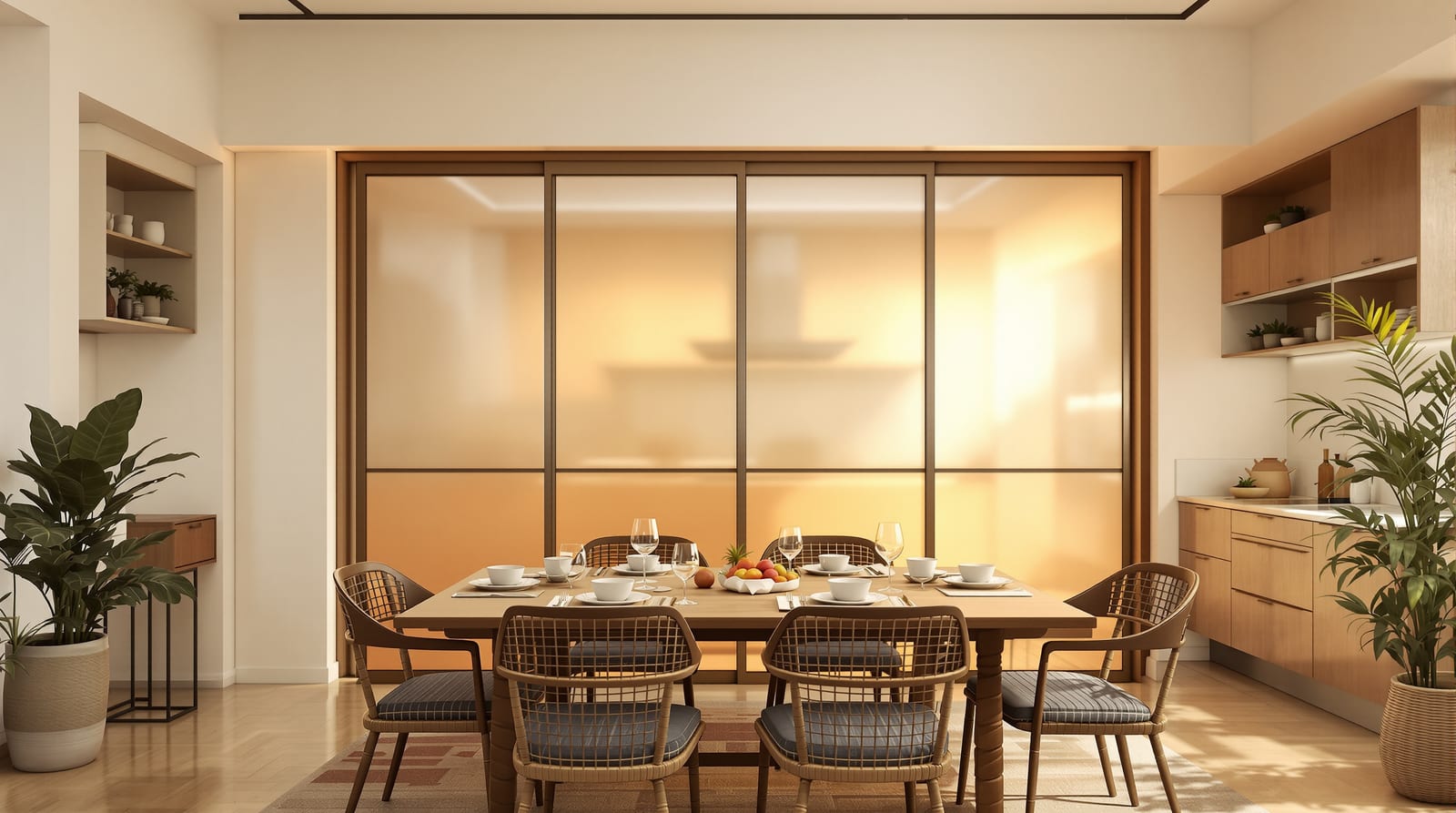
Dining Room Door in India: Best Partition & Opening Choices (2026)
How to choose the right door for the dining area of an Indian home - kitchen-dining partitions that trap cooking smells and smoke while keeping flow, plus open dining-to-living and dining-to-garden options - ranked picks, drivers and indicative costs.
In most Indian homes the dining room does not really need a door of its own - it needs a door to manage its two neighbours. On one side sits the kitchen, where a tadka of mustard seeds, a deep-fried batch of pakoras or a slow Sunday biryani fills the air with smoke, oil mist and aroma. On the other side sits the living room, where you want light, conversation and a sense of openness to flow freely. The dining area is the hinge between cooking and gathering, and the right door is the one that lets you switch between "open and social" and "sealed and smell-free" in a single gesture.
That is why a "dining room door" in India is almost always one of three decisions: the kitchen-to-dining partition (the big one), the dining-to-living opening (usually kept open, sometimes a wide partition), and the dining-to-courtyard or garden door (light, ventilation, indoor-outdoor living). This guide ranks the realistic options for each, with the drivers that should decide it and indicative 2026 costs. We will link to the full door-type guides rather than repeat them - this page is about which door for the dining space, and why.
What the dining space actually demands from a door
Before picking a style, get clear on what you are solving for. For the dining area, four drivers dominate, and they often pull against each other:
- Smell and smoke containment. Indian cooking is high-aroma and high-grease. If the kitchen is even semi-open to the dining and living areas, frying, tempering and grilling will travel onto curtains, sofas and clothes. A door that seals well (full-height, gasketed, glazed) is the single biggest reason dining homes add a partition.
- Flow and openness. The modern Indian family eats, talks, helps in the kitchen and entertains across these spaces. You want the partition open most of the time and closed only while heavy cooking is on. Disappearing doors win here.
- Space-saving. Dining rooms are often tight, with chairs that pull out and people moving around the table. A hinged door that swings into the room steals a chunk of usable floor. Sliding, pocket and bi-fold doors save that space.
- Light and looks. A solid wall or solid door between kitchen and dining makes both feel boxed-in. Glazed partitions keep the home bright and connected even when closed, and let a cook keep an eye on children at the table.
Secondary concerns: a clear width of at least 900 mm so the path stays comfortable when carrying serving dishes, easy cleaning (grease wipes off glass and laminate, not raw timber), and soft-close hardware so a door pulled shut mid-conversation does not slam.
The kitchen-to-dining partition: ranked picks
This is the heart of the decision. Here are the realistic options for an Indian home, ranked by how well they balance smell containment, flow, space-saving and openness.
1. Sliding glass partition (top all-rounder). A two- or three-track sliding door in toughened glass with slim aluminium framing is the most popular modern answer. It seals the cooking smells reasonably well when closed, slides fully open for flow, steals zero floor space, and keeps both rooms bright. Slim-profile and frameless systems look premium; brush seals on the meeting stile improve smell containment. This is the default recommendation for most open-plan Indian kitchens.
2. Pocket door (best for tight plans). A pocket door slides into a cavity inside the wall and disappears completely when open - the ultimate space-saver for a snug dining area. Choose it when you want the partition gone entirely most of the time but available for heavy-cooking days. The catch: the wall cavity must be planned at construction or major renovation, and a glazed pocket leaf needs a sturdy track. Excellent flow and space-saving; smell containment is good if the leaf is full-height with seals.
3. Bi-fold / folding glass partition (best for wide openings). A bi-fold door (or wider folding door system) concertinas to one side, opening up a wide kitchen-dining threshold almost entirely. Ideal when you have a broad opening and want a dramatic open/closed switch. Glazed bi-folds keep light flowing. They cost more and the folded stack does occupy a little space at the jamb, but for big openings nothing else opens as wide.
4. Frameless / framed glass door (best for looks and light). A fixed-pattern glass door - hinged or frameless - turns the partition into a design feature: maximum brightness, full visual connection, easy to wipe clean. Pure single or double swing glass doors seal smells well when shut but do swing into a room, so pair with a sliding or pocket mechanism if floor space is tight.
5. Double-swing door (best for a working butler's-pantry feel). A double-swing door that pushes open both ways and self-returns is the classic café-and-hotel kitchen door - hands-free when you are carrying dishes, and it slaps shut behind you to keep smells in. Great for a busy household that cooks heavily and wants a quick in-out. It does need swing clearance on both faces, so it suits a doorway-style opening rather than a wide partition.
6. Solid flush or panel door (budget seal). If you simply want to shut the kitchen off and do not care about visual openness, a solid flush door or panel door with seals gives the best smell containment for the lowest cost. The trade-off is a darker, more closed-in kitchen and dining. Many families use a laminated flush door here for grease-wipe cleaning.
Door option, use and cost at a glance
| Door option | Best for | Smell containment | Flow / space-saving | Indicative cost per door (2026) |
|---|---|---|---|---|
| Sliding glass partition | Default open-plan kitchen-dining | Good (with seals) | Excellent / excellent | Rs 18,000 - 45,000 |
| Pocket door (glazed or solid) | Tight plans, want it to disappear | Good | Excellent / best | Rs 20,000 - 50,000 + cavity cost |
| Bi-fold / folding glass | Wide openings, big open/closed switch | Good | Best (opens widest) / good | Rs 25,000 - 60,000 |
| Frameless / framed glass door | Light and looks, easy cleaning | Good when shut | Good / fair (swing) | Rs 18,000 - 55,000 |
| Double-swing door | Heavy cooks, hands-free in/out | Very good | Good / fair (swings both ways) | Rs 8,000 - 22,000 |
| Solid flush / panel door | Budget, maximum seal | Best | Fair / poor (swing) | Rs 3,000 - 14,000 |
Costs are indicative for a standard 3 x 7 ft door including frame and basic fitting, and vary by size, finish and city; add 18% GST. Frameless glass and motorised systems sit at the top of each range. Estimate your own with the door cost calculator.
Glazed versus solid: the core trade-off
Almost every dining partition decision comes down to glass versus a solid leaf:
- Glazed (toughened glass, framed or frameless): keeps both rooms bright, preserves the open feel even when shut, lets a parent watch children at the table while cooking, and wipes clean of grease in seconds. It seals smells well but a touch less perfectly than a solid gasketed door, shows fingerprints and water spots, and costs more. For most modern Indian homes the openness is worth it.
- Solid (flush, panel, engineered): seals smells best, costs least, and gives privacy - but boxes in both spaces and makes the kitchen feel like a separate utility room. Good for homes that cook very heavily, or where the kitchen doubles as a messy prep zone you would rather hide.
A common middle path is a part-glazed leaf - a solid lower rail (hides splashes, takes knocks from chair backs and serving trolleys) with a glazed upper panel for light. Always specify toughened (tempered) safety glass for any glazed door near a dining table where chairs, children and dishes are in motion.
A quick partition-options plan
The diagram below shows the four space-saving ways to put a door between an Indian kitchen and dining area, and how each one behaves when open.
Dining-to-living: usually open, sometimes a wide partition
Between the dining and the living room, most Indian homes want no door at all - this is the social core, and openness is the point. Where a separation is wanted (for a formal dining room, or to close off the living during a family meal), the right tool is a wide glazed sliding or bi-fold partition that lives mostly open and closes only when needed. Avoid a single hinged door here; it cramps both rooms. For the full room-by-room logic across the home, see interior doors by room and the master doors-by-space guide.
Dining-to-courtyard or garden: light and ventilation
If your dining opens to a balcony, courtyard or garden - a lovely arrangement for breakfast and weekend lunches - the door should maximise glass and cross-ventilation while keeping out dust, insects and monsoon rain. A glazed sliding or bi-fold door is ideal; specify toughened glass, weather seals and a low threshold of 12 mm or less so it is comfortable to step over with a tray. uPVC or thermally broken aluminium frames handle Indian climate and rain better than untreated timber here.
Hardware that makes a dining door work
The mechanism matters as much as the leaf:
- Soft-close. For sliding and pocket doors, a soft-close damper stops the leaf slamming when pulled shut mid-meal, and protects glass. Strongly recommended.
- Floor spring (for frameless glass swing doors). Frameless glass needs a floor spring and patch fittings for a controlled, self-returning swing.
- Double-action hinges (for double-swing). A double-swing door needs gravity or spring hinges that self-centre after you push through carrying dishes.
- Slim seals and brush strips. The single upgrade that most improves smell containment on glazed partitions - meeting-stile and bottom brush seals.
- Easy-clean handles. Choose stainless steel or anodised aluminium pulls that wipe clean of cooking grease.
For the full picture, see the door hardware guide.
Do and do not
- Do lead with smell containment if you fry, temper and grill often - a well-sealed glazed sliding or double-swing door pays off daily.
- Do keep a clear width of at least 900 mm so two people and a serving dish pass comfortably.
- Do specify toughened safety glass for any glazed dining door near chairs and children.
- Do add soft-close on sliding and pocket leaves.
- Do not put a single hinged door that swings into a tight dining room - it steals floor and blocks chairs.
- Do not use raw, unfinished timber where it meets cooking grease; choose laminate, glass or a wipeable finish.
- Do not forget that a pocket door needs its wall cavity planned before you build or finish the wall.
Frequently asked questions
What is the best door between an Indian kitchen and dining room?
For most homes, a slim-framed toughened-glass sliding partition with brush seals and soft-close. It contains cooking smells and smoke when closed, slides fully open for flow, saves floor space and keeps both rooms bright. If the plan is very tight, a glazed pocket door is the best space-saver; for heavy cooks, a self-closing double-swing door.
How do I stop cooking smells reaching the dining and living areas?
Combine a full-height, well-sealed door with good kitchen ventilation. Choose a glazed sliding, pocket or double-swing door with meeting-stile and bottom seals so it closes the opening fully, and run a strong chimney or exhaust while cooking. A solid flush door seals best of all if you do not mind a closed-in kitchen.
Glass or solid door for the dining partition?
Glass keeps both spaces bright, lets you watch children at the table while cooking, and wipes clean of grease - it seals smells well, costs more and shows fingerprints. Solid seals smells best and costs least but boxes in both rooms. A part-glazed leaf with a solid lower rail is a popular compromise. See the glass doors guide.
How much does a dining-kitchen partition door cost in India?
Indicative 2026 ranges per standard door: solid flush or panel Rs 3,000 - 14,000, double-swing Rs 8,000 - 22,000, sliding glass partition Rs 18,000 - 45,000, frameless glass Rs 18,000 - 55,000, bi-fold glass Rs 25,000 - 60,000, and a glazed pocket door Rs 20,000 - 50,000 plus the wall-cavity cost. Add 18% GST; figures vary by size, finish and city.
Do I even need a door between dining and living?
Usually not - this is the social heart of the home and openness is the point. Add a wide glazed sliding or bi-fold partition only if you want a formal dining room or the option to close the living off during meals. For the full room-by-room logic, see interior doors by room and the kitchen-focused kitchen door guide.
Export this guide
Related Guides — Deep-dive reading
French Doors for Indian Homes: Glazing, Security, Cost & Monsoon Sealing
The double-leaf glazed door that opens a living room to a balcony or garden - where it works, how to specify the glass, frame and seals, what it costs, and how it stacks up against sliding and bi-fold.
Home Doors & EntrancesKitchen Door Design for Indian Homes (2026): Options, Materials & Layout
How to choose a kitchen door that survives grease, smoke and hands-full traffic — swing, sliding, glass-panel, Dutch and folding options for open and closed Indian kitchens.
Home Doors & EntrancesDouble Doors in India (2026): Two-Leaf Entrances, Proportions, Hardware & Cost
When a double-leaf door makes sense for Indian main entrances, pooja rooms and master suites, plus active/inactive leaf hardware, the Vastu note on even panels, security at the meeting stile and the rupee premium over a single door.
Home Doors & EntrancesRelated Tools — Try Free
Window Hardware Cost Calculator
Estimate window hardware cost — hinges, handles, locks, rollers and multipoint gears.
Window CalculatorDoor Cost Calculator
Estimate the all-in cost of a door — leaf, frame, hardware, fitting and GST — by type, material and size.
Door CalculatorAluminium Door Cost Calculator
Estimate an aluminium door cost by opening size, profile grade, finish, glazing and type, with fitting and GST.
Door Calculator