
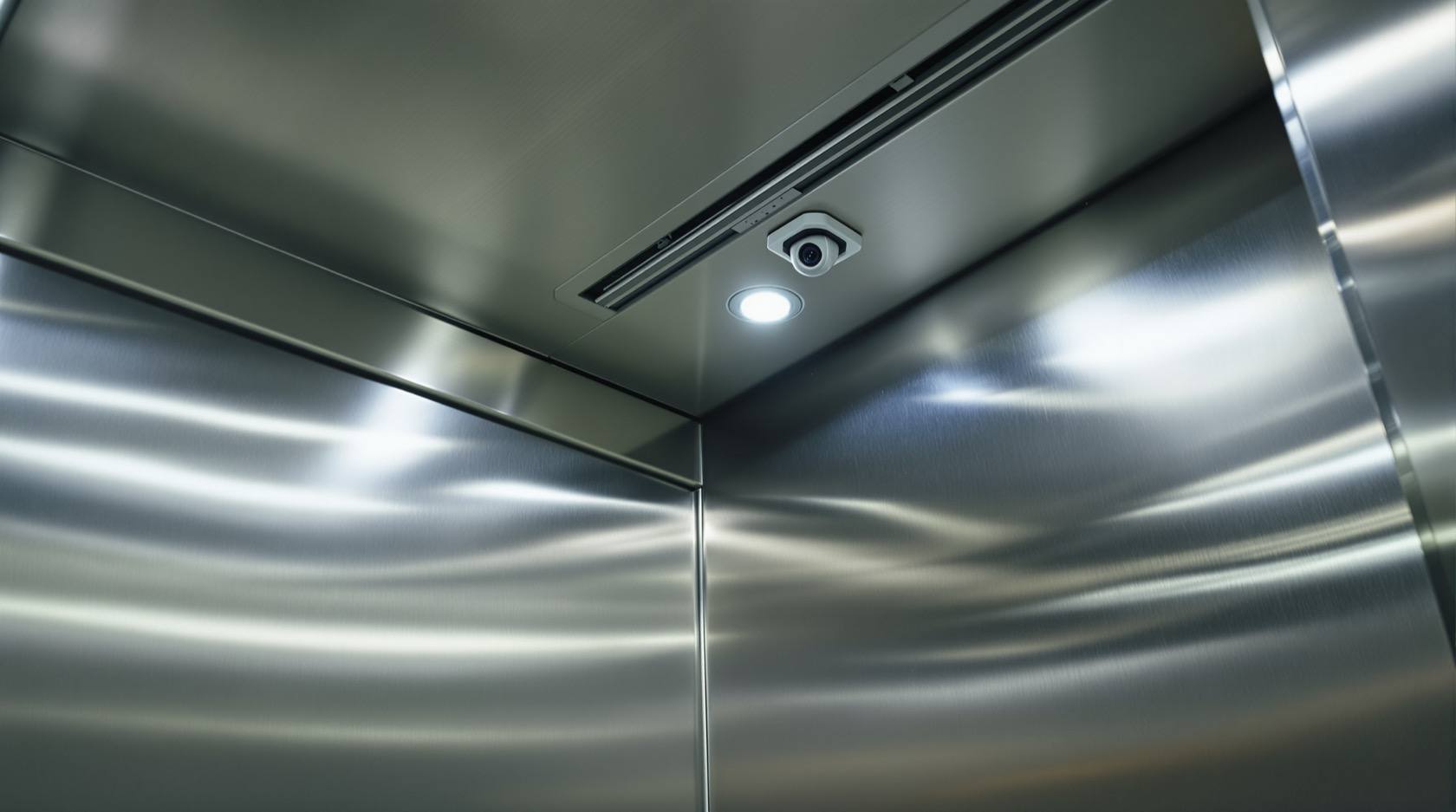
Lift CCTV in India (2026): The Camera Inside the Car
Why a camera in the lift car matters, how a vandal-resistant car camera differs from ordinary indoor CCTV, how its picture leaves a moving car, and how to get the privacy, DPDP and life-safety questions right.
A lift is the one part of a building where a person is completely alone with strangers, in a small metal box, with the doors shut and no one outside able to see in. For a minute or two nobody in the world can watch what happens. That is exactly why the harassment complaint, the vandalised panel, the tailgater who followed a resident in, the scratched mirror and the sudden scuffle so often trace back to the lift car and leave no witness. A lift CCTV camera is the only eye in that box. It does two honest jobs: it deters, because people behave differently when they know they are seen, and it gives evidence when something still happens.
This guide is part of Studio Matrx's lifts and staircases security library and the broader security hub. It is about the camera inside the car specifically: why it is not just another indoor camera, how the picture gets out of a moving car, how it fits the building's wider CCTV, and the two questions that decide whether it is a good idea or a bad one, privacy and life-safety.
Scope & safety. This is planning and specifying guidance, not an installation manual. A camera in a lift car is fitted by the licensed lift contractor, as an addition to a certified lift, never as a DIY job you wire into the shaft. It must not interfere with the lift's safety circuits or the emergency phone, egress and rescue always win. It is also privacy-sensitive: a lift car is a semi-private space, so the camera must be declared, positioned to cover the space not to spy on people, its footage access-restricted and its retention limited, never a hidden camera. This is educational guidance, not legal advice.
Why a camera in the lift car matters
Most of a building's CCTV watches open, shared space, the gate, the lobby, the corridor, the parking. The lift car is different in one decisive way: it is enclosed and unobserved. When the doors close, the lobby camera can no longer see in, and there is no passer-by, no guard line of sight, nothing. Whatever happens inside happens in private.
In Indian buildings that gap shows up again and again:
- A resident reports being harassed or intimidated in the lift and it is one person's word against another, because there was no camera.
- The car panel, mirror or interior finish is repeatedly vandalised and nobody can say by whom.
- A stranger tailgates a resident into the car and rides up to a floor they should never reach, defeating the lift access control at the door.
- A child or an elderly resident is stuck or unwell in the car and, without a view, the guard cannot see the situation to respond.
A car camera closes that gap. The deterrent alone changes behaviour, and when something does happen, there is finally a record. That is why, in the wider picture of gated-community security and the ultimate home-security plan, the lift car has become one of the standard camera positions, not an optional extra.
A lift-car camera is not an ordinary indoor camera
You cannot take a shelf indoor camera, screw it to the car ceiling and call it done. The lift car imposes four constraints that an ordinary room does not, and they shape what you specify. It is worth reading this alongside the general indoor CCTV guide, which covers the room case this one departs from.
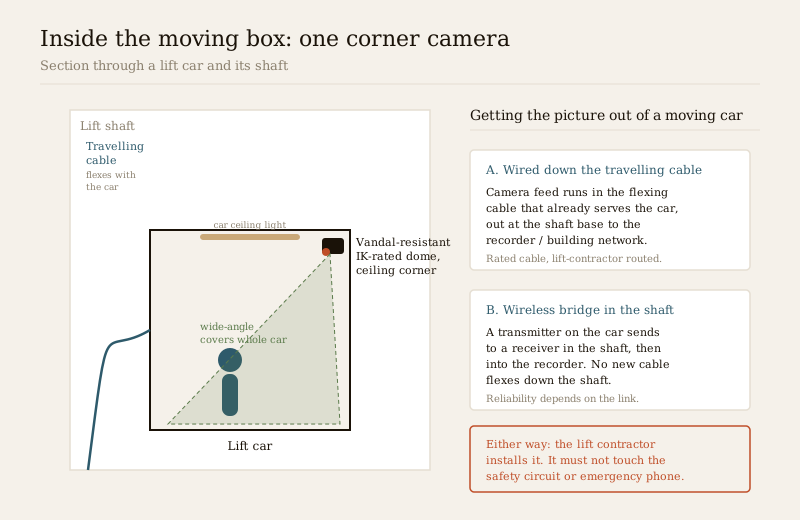
It is a tiny space seen from very close. The car is small and the camera sits close to everyone in it, so a narrow-angle lens is useless, half the car falls outside the frame. A car camera is a wide-angle unit mounted in the ceiling corner so a single lens covers the whole car, floor to door, corner to corner, with people seen from above rather than face-on.
It is a prime vandalism target. The lift car takes more abuse than almost any surface in a building, panels are kicked, mirrors scratched, and a visible camera invites someone to try to blind or break it. So the car camera should be a vandal-resistant, IK-rated housing, a small hardened dome rather than an exposed unit. IK rating is the impact-resistance scale, and the vandal-proof camera and IK-rating guide explains how to read it and match it to the risk. The car is exactly the place that justifies a higher IK housing.
It moves, and it takes its own light with it. An ordinary camera is bolted to a wall in a room with fixed lighting. This one travels up and down a shaft in a box lit only by the car's own ceiling light, which is dim and can vary. The camera has to hold a usable picture in that lighting through the whole travel, so low-light performance matters more here than in a well-lit lobby, without inventing any number for it, test the actual picture in the actual car.
Its signal has to escape a moving car. This is the constraint that has no equivalent in a normal room, and it deserves its own section.
| Ordinary indoor camera | Lift-car camera | |
|---|---|---|
| Space | A room, seen at a distance | A small box, seen from very close |
| Lens | Often standard angle | Wide-angle, to cover the whole car |
| Housing | Standard | Vandal-resistant, IK-rated dome |
| Lighting | Fixed room lighting | The car's own dim, travelling light |
| Signal path | Fixed cable to a fixed point | Out of a moving car (see below) |
| Who installs | CCTV installer | Lift contractor, on a certified lift |
Getting the picture out of a moving car
A camera bolted to a wall has an easy life, its cable runs to a fixed point. A camera in a lift car is travelling up and down a shaft, so its picture has to reach a stationary recorder somehow. There are two common approaches, and the choice is the lift contractor's to make and stand behind, not something to fabricate specs around.
Wired down the travelling cable. Every lift already has a flexible travelling cable, a bundle that hangs in a loop and flexes as the car moves, carrying power and signals between the car and the shaft. The camera's feed can run in a suitably rated cable routed alongside it, out at the shaft base to the building's recorder or network. It is a robust, wired path, but it is lift-contractor work, the cable has to be rated and routed so that constant flexing over years does not fail it or foul the moving parts.
A wireless bridge in the shaft. Instead of running a new cable down the flexing loop, a transmitter on the car sends the picture to a receiver fixed in the shaft, which then joins the building network. It avoids adding a cable to the travelling loop, but the picture is only as reliable as the wireless link inside a metal shaft, so it must be proven in place, not assumed.
Both approaches end the same way: the feed reaches the building's recorder. Neither one is a licence to touch the lift's own wiring. The camera and its cabling are an addition routed by the lift contractor so they stay clear of the safety circuit, the door and traction control, and the emergency phone line, which brings us to the life-safety rule.
Life-safety: an addition to a certified lift, never a modification
A lift is a certified life-safety machine. Anything added to it, a camera included, must not compromise what keeps people safe. Two rules are non-negotiable.
- It is installed by the lift contractor, as an addition, not a DIY modification. A CCTV installer does not open the car top, run cable in the shaft or wire into the car. That is the licensed lift contractor's work, and it should be done so the lift's certification and warranty stay intact. You specify the camera and where its picture should go, they install and stand behind it.
- It must not interfere with the lift's safety systems or the emergency phone. The camera's power, cabling and any wireless kit must be kept clear of the lift's safety circuits, door and motion control, and especially the emergency phone or intercom in the car, the one thing a trapped person relies on. A camera that degrades the emergency phone has made the lift less safe, which is the opposite of the point. Pair the camera with reliable lift emergency communication, never at its expense.
The camera watches; it must never trap, delay a rescue, or silence the call button. If a proposal cannot show that the emergency phone and safety systems are untouched, it is the wrong proposal.
The privacy and DPDP dimension: this is where most lift cameras go wrong
A lift car is not a public street. It is a semi-private, enclosed space where people are briefly alone, and pointing a camera into it is genuinely intrusive if handled carelessly. Under the Digital Personal Data Protection Act, 2023, the footage is personal data, and the difference between a lawful, fair camera and an unlawful, creepy one is entirely in how you run it. A lift camera is justified for safety, but only when it is done right.
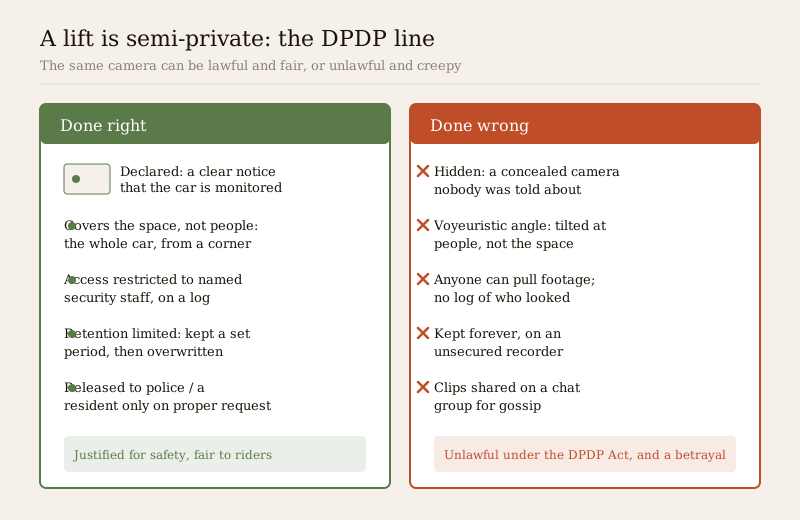
- Declare it, always, never conceal it. A clear notice that the lift car is monitored must be posted where riders can see it. A hidden camera in a semi-private space is not clever security, it is a serious wrong and, in a space like a lift, potentially unlawful. If you would not put up the sign, you should not put up the camera.
- Cover the space, not the person. The camera is there to watch the car, from a ceiling corner, seeing the whole space from above. It is never tilted to frame people voyeuristically. The justification is safety of the space, and the angle should show that.
- Restrict who can see the footage, and log it. Access is limited to named security staff, the facility manager or the RWA security lead, and every viewing is recorded. Footage is not a chat-group amusement, sharing a lift clip for gossip is a betrayal of the residents and a DPDP breach.
- Keep it a limited time, then let it go. Set a sensible retention period after which recordings are overwritten, rather than hoarding lift footage forever on an unsecured box. Release to police or a resident only on a proper, recorded request.
Get this wrong and the same camera that should protect people becomes the thing that harms them. In a society, the RWA is effectively the data fiduciary for this footage and should treat it with that seriousness. The right side of the figure above is the whole standard: declared, space-covering, access-restricted, retention-limited.
Making the car camera actually useful: record it and watch it
A camera nobody watches or records is theatre. The most common failure in Indian buildings is not the absence of a lift camera, it is a lift camera whose feed goes to a recorder that is full, or offline, or that nobody ever reviews. The car camera only earns its place when it is part of a working system.
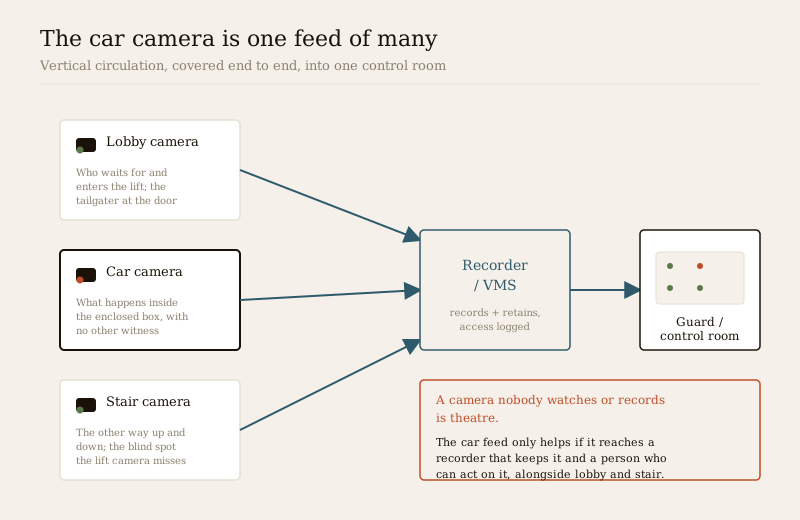
- It must reach the recorder and stay recorded. The car feed joins the building's recorder or video management system alongside every other camera, with enough storage and retention to be there when an incident is reviewed, and health monitoring so a dead lift camera is noticed, not discovered weeks later.
- It must reach a person. In a monitored building the car view sits on the guard's or control room's wall alongside the lobby and gate, so a live problem can be seen and acted on. This is the same control-room logic as the whole building security systems picture, one plan, one recorder, one place watching.
- It is one feed of three for the lift core. The car camera answers what happens inside; the lift-lobby camera answers who waits for and enters the lift, and the staircase camera covers the other way up and down, the blind spot the lift misses. Together they cover the building's vertical circulation, which is the whole point of the lift and staircase security pillar.
Pair the car camera with access and communication
The car camera is a witness, not a control. It records what happened; it does not decide who may ride or help someone in trouble. It works best paired with the two controls that do:
- Access control decides who reaches which floor. Lift access control and floor-restricted lift access stop the tailgater the camera merely records, so a stranger cannot ride to a floor they should not reach. Camera plus access is far stronger than either alone.
- Emergency communication helps the person in the box. The lift emergency communication call button and intercom are how a trapped or distressed rider reaches help, and, as above, the camera must never come at their expense. Ideally the guard who sees the car on screen is the same one who hears the call.
For the architectural context of lifts in a home or building, the residential elevator handbook sets out where the lift sits in the design; the security layer here rides on top of that.
Standards and where the rules come from
There is no fabricated number in this guide, and there should be none in your specification either. The frameworks that actually govern this work, all to be checked for the current edition and your local bye-laws, are:
- IS 14665 (Bureau of Indian Standards) on the installation and maintenance of electric traction lifts, the base standard for the lift the camera is added to.
- National Building Code of India, SP 7:2026, Part 4 for fire and life-safety and means of escape, and Part 8 Section 5 for the installation of lifts, the reason the camera must never compromise safety or egress.
- State Lift Acts (Maharashtra, Karnataka, Tamil Nadu, Delhi and others) that license lifts and lift contractors, which is who must install the camera.
- DPDP Act, 2023 for the notice, access-restriction and retention obligations that make the footage lawful.
Key takeaways
- A lift car is an enclosed, unwatched box, a lift CCTV camera is the only eye in it, deterring incidents and giving evidence where the lobby and stair cameras cannot see.
- A car camera is not an ordinary indoor camera, it is a wide-angle, vandal-resistant IK-rated dome in the ceiling corner, working in the car's own dim travelling light, whose picture must escape a moving car.
- The picture leaves the car either wired down the flexing travelling cable or via a wireless bridge in the shaft, both installed by the lift contractor, neither touching the safety circuit or emergency phone.
- Life-safety first, the camera is an addition to a certified lift fitted by the licensed lift contractor, never a DIY modification, and never at the expense of the emergency phone.
- Privacy is where lift cameras go wrong, declare it with clear notice, cover the space not people, restrict and log footage access, limit retention, and never conceal a camera in this semi-private space, that is the DPDP standard.
- The car camera only helps if it is recorded and watched, and paired with lift access control and emergency communication, alongside the lobby and stair cameras.
Where to go next
- Test your building's lift, lobby and stair coverage with the home security risk scorecard.
- Read the lift and staircase security pillar for the whole vertical-circulation plan.
- Cover the rest of the lift core, the lift-lobby camera, the staircase camera, and general indoor CCTV.
- Match the housing to the risk with the vandal-proof and IK-rating guide.
- Add the controls, lift access control, floor-restricted lift access, and lift emergency communication.
- See the whole picture in the building security systems guide and the gated-community security guide.
References
- Bureau of Indian Standards, IS 14665 (installation and maintenance of electric traction lifts) and National Building Code of India, SP 7:2026, Part 4 (fire and life-safety, means of escape) and Part 8 Section 5 (installation of lifts), verifiable via the Bureau of Indian Standards at https://www.services.bis.gov.in/. Verify the current edition.
- State Lift Acts (e.g. Maharashtra, Karnataka, Tamil Nadu and Delhi lift acts) for licensing of lifts and lift contractors, verify your state's current Act and rules.
- Digital Personal Data Protection Act, 2023 (India), lawful basis, notice, access restriction, minimisation and retention for CCTV footage. Ministry of Electronics and Information Technology.
- Lift OEM and CCTV manufacturer documentation, vandal-resistant and IK-rated camera datasheets and lift-car camera installation guidance, the published basis for how a car camera and its signal path are fitted.
This guide is educational and does not constitute legal, fire-safety or engineering advice; lift work, camera installation in a lift car, and privacy compliance must be handled by licensed professionals and reviewed for your specific building and state.
Export this guide
Related Guides — Deep-dive reading
Lift and Staircase Security in India (2026): The Complete Guide to Securing Vertical Circulation
A pillar guide to securing the lift and the staircase together: how to control who reaches which floor, watch the pinch points, keep help reachable and design out blind spots, without ever locking anyone in or blocking escape.
SecurityLift Lobby Security in India (2026): The Control Point Where Public Becomes Private
The lobby is where an outsider is screened, a visitor is verified before the inner door, and access to the lifts and stairs is granted or denied. This guide shows how to design the entrance lobby and the upper lift lobbies so the guard sees who enters, a waiting resident feels safe, and egress always wins.
SecurityCCTV Recording Failure in India (2026): Live View Works but Nothing Was Saved
You open the recorder to pull footage of an incident and there is nothing there, even though every camera shows a crisp live picture. A calm, ordered guide to why an Indian CCTV system records live but saves nothing, and how to fix it before the next incident.
SecurityRelated Tools — Try Free
Home Security Risk Scorecard
Score your home across six security layers — perimeter, entry points, lighting, detection, alarm and habits — and get a prioritised action plan.
Security ScorecardApartment Interior Planning Checklist
51-item checklist across structural, ceiling, lighting, furniture, storage, electrical, kitchen, bathroom.
ChecklistApartment Video Door System Planner
Enter flats, entrances, floors and guard desk for a first-pass building intercom plan — door stations, indoor monitors, guard station, the right architecture and an indicative cost band.
Building Planner