
Lift Emergency Communication in India (2026): The Phone That Must Answer
The life-safety system that lets someone trapped in a lift reach help: the alarm button, the two-way voice that connects to a manned point answering 24x7, the backup power that keeps it alive in a mains cut, and the responder and testing habit without which the hardware is just a box on the wall.
A lift stops. The lights flicker to the dim emergency glow, the car sits between two floors, and the person inside reaches for the one thing that now matters more than anything else in the shaft: the button that calls for help. In India this is not a rare event. Power cuts are routine, maintenance is often patchy, and a lift that stalls between floors on a hot afternoon is an ordinary Tuesday in thousands of buildings. Lift emergency communication is the system that decides whether that stall is a short, managed wait or a frightening, dangerous ordeal. A working two-way phone turns a scary moment into a calm one. A dead one leaves a person shouting into a metal box that no one can hear.
This guide is part of Studio Matrx's lift and staircase security library and the complete guide to lift and staircase security. It explains the components that let a trapped person reach a human, why every one of them must keep working on backup power, the difference between an alarm that only rings and real communication to someone who answers, and the part that gets forgotten most often: the responder and the testing habit behind the hardware.
Scope & safety. This is a life-safety system, not a gadget. You can plan, specify and run the process around it, but the emergency-communication device, its wiring into the lift and its backup power are installed, integrated and certified by the licensed lift contractor and electrician, never a DIY job in the shaft or car panel. Egress always wins: a lift must never trap a person, communication must work in a power cut, and nothing in a security or access scheme may block a call for help. This is educational guidance, not legal, fire-safety or engineering advice.
Why entrapment is common in India, and why the phone is the point
Entrapment does not mean the lift is broken in a dangerous way. Modern lifts are designed so that a person stuck inside is safe, sitting in a ventilated car that cannot fall. The danger is rarely the machine. It is the wait, and what the wait does to a frightened person, a child, an elderly resident with a heart condition, or someone who needs the toilet or their medicine.
Two Indian realities make entrapment ordinary. First, frequent power cuts: when the mains drops, an older lift without automatic rescue simply stops wherever it is. Second, patchy maintenance: worn contacts, a door sensor out of alignment, a controller fault, and the car halts. Neither is exotic. What separates a good building from a bad one is not whether the lift ever stops, but whether the person inside can instantly reach someone who will help.
That is why the emergency phone, not the alarm bell, is the heart of this guide. A bell says "something is wrong here." A working two-way phone says "someone knows, someone is coming, stay calm." The gap between those two sentences is the entire subject.
The components of a real communication system
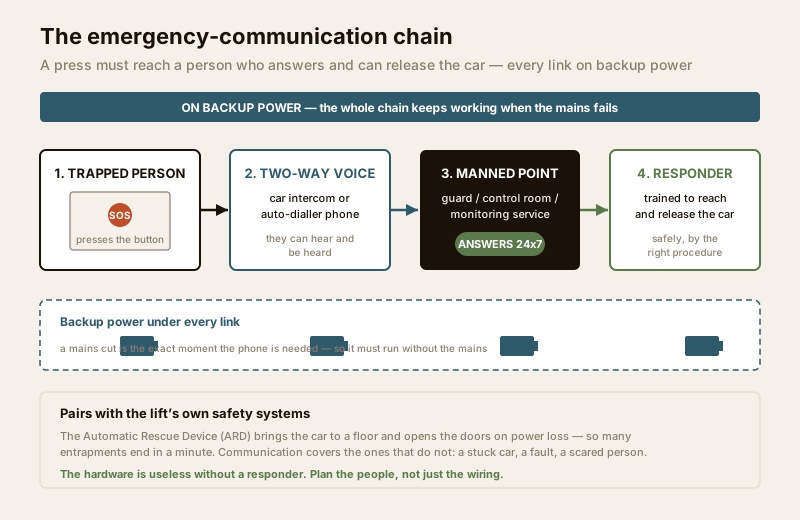
A complete lift emergency-communication system is a chain, and it is only as strong as its weakest link. Every link must also keep working when the mains fails, because a mains failure is often the very thing that trapped the person.
The in-car alarm button and bell
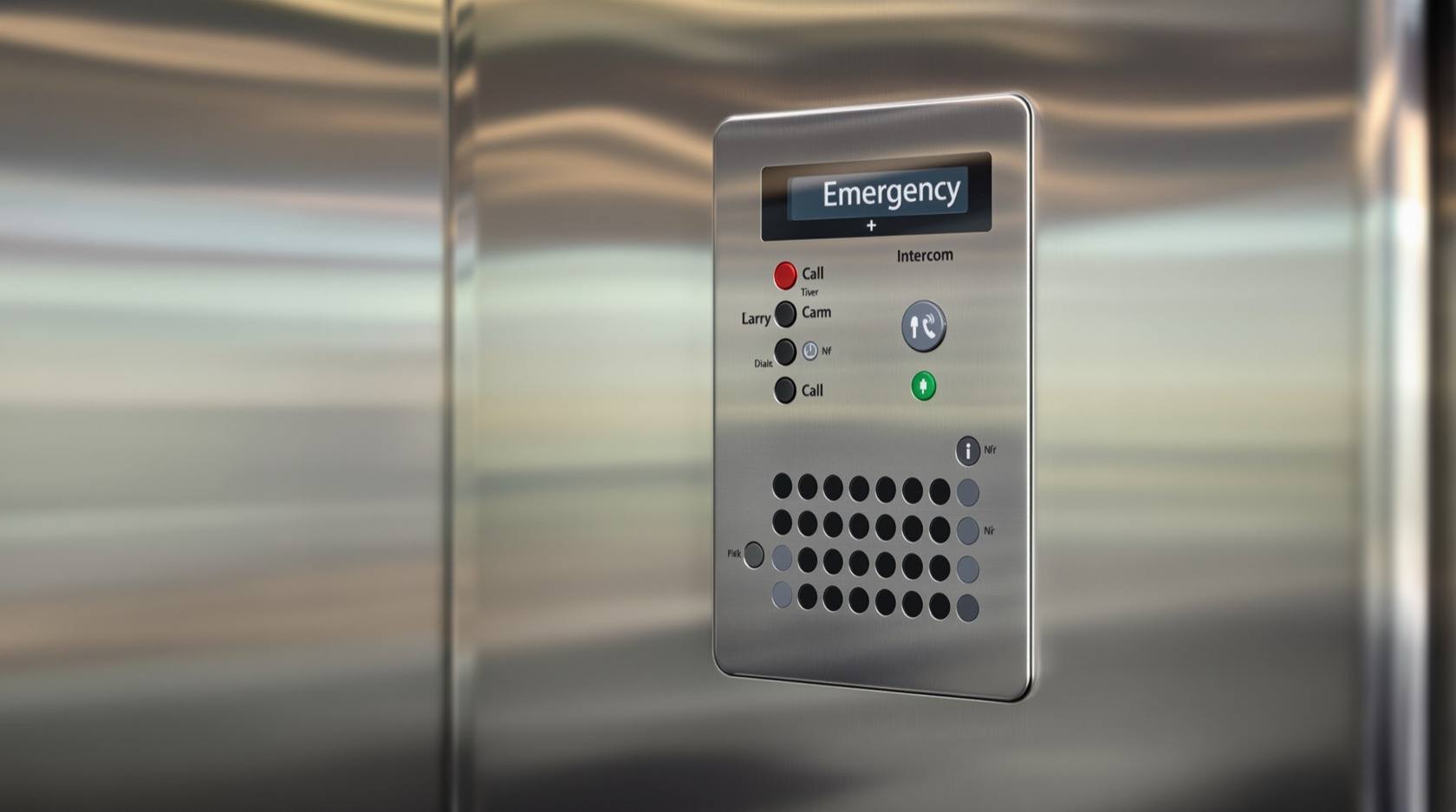
Every lift car has an alarm button, usually the bell symbol on the panel. On its own it does one thing: it sounds an alarm. In a good system it does more, it also initiates the voice call, but the button and bell alone are not communication. They are a request for communication. Treat the bell as the first step of the chain, never the whole chain.
Two-way voice: the car intercom or auto-dialler phone
This is the component that actually saves the situation. Two-way voice means the person in the car can both hear and be heard. There are two common forms:
- A car intercom hard-wired to a fixed point, typically the security desk or a control room, so pressing the button opens a voice channel to a phone or panel that a guard picks up.
- An auto-dialler emergency phone, a unit built into the car that, when the button is pressed, automatically telephones a stored number (and then the next number if that one does not answer), and opens hands-free voice once the call connects.
Either way, the promise is the same: the trapped person speaks, a person answers, and the two can talk. That two-way link is what turns fear into reassurance and lets the responder learn what is actually wrong and which car to go to.
The manned point that actually answers 24x7
Here is the link that buildings get wrong most often. The voice has to reach a point that is staffed around the clock and where someone will actually pick up, at 2 a.m., on a festival night, during the power cut. That manned point can be:
- the building's own security guard or control room, staffed 24x7;
- a facility-management control desk covering several buildings; or
- a professional lift-monitoring service the contractor or society subscribes to.
A car intercom that rings a desk which is empty every night is not communication. The whole design question is not "does the phone dial" but "who answers, and are they always there." For the wider staffing and control-room picture, see the building security systems guide and the gated-communities security guide.
Backup power: working at the exact moment it is needed
A mains cut is one of the commonest reasons a lift stops, so the emergency-communication system must not depend on the mains. It runs on its own battery or the lift's backup supply, sized to keep the phone and its link alive through a realistic outage. This is not optional and it is not an add-on: a communication system that dies with the mains fails precisely when it is needed. The battery is also, as we will see, one of the first things to quietly go flat, which is why it is tested on a schedule.
Alarm that just rings vs communication that responds
The single most important distinction in this guide is between an alarm and communication. They are not the same thing, and confusing them costs people dearly.
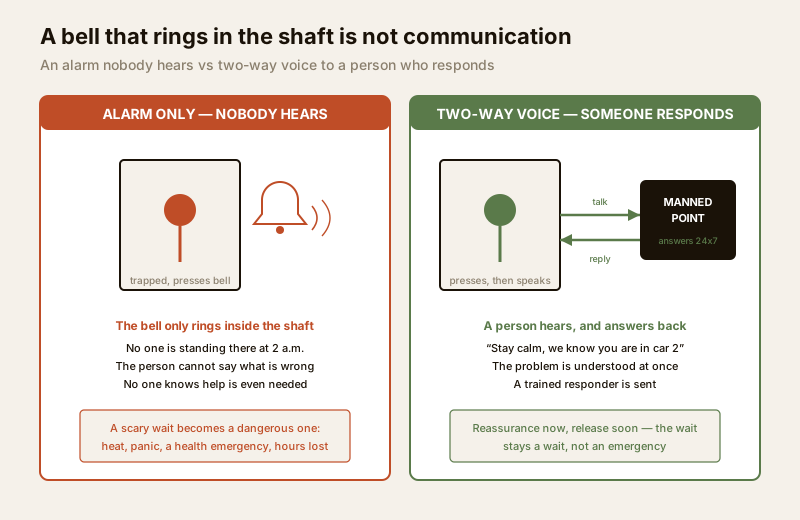
An alarm bell that only rings inside the shaft is close to useless. In an empty building at night, or a society where the watchman is at the far gate, the sound simply echoes in the machine room and dies. Worse, it gives the trapped person a false sense that help is on the way when nobody has heard a thing. The person cannot describe what is wrong, cannot say which car they are in, cannot say that the child with them is panicking or that they need medicine. All they can do is press a button and hope.
Two-way voice replaces hope with contact. The moment a human voice answers, the person knows they are not alone. The responder learns the facts, calms the person, and dispatches help to the right car. The table below sets the two side by side.
| Alarm bell only | Two-way communication | |
|---|---|---|
| What it does | Makes a sound | Connects two people who can talk |
| Reaches | Whoever happens to be near the shaft | A manned point that answers 24x7 |
| Trapped person can | Press and hope | Explain the problem, be reassured |
| At night / in an empty building | Often unheard | Still reaches a staffed desk or service |
| Tells responder which car / what is wrong | No | Yes |
| Adequate as the primary system | No | Yes |
The takeaway is blunt: an alarm bell is a supplement, never the whole answer. Specify two-way voice to a manned point as the baseline, and treat any lift where the bell is the only link as a system waiting to fail someone.
Auto-diallers and GSM phones: for sites without a manned room
Not every building has a 24x7 control room. A small society, a standalone commercial block, a building whose guard covers the gate but not a desk, none of these has a person permanently sitting by a phone. For these, the emergency phone reaches out instead of waiting to be answered.
- An auto-dialler stores a list of numbers, the manager, the maintenance contractor, a committee member, a monitoring service, and calls them in sequence. If the first does not answer, it tries the next, and the next, until someone picks up and can talk to the trapped person hands-free.
- An IoT / GSM-connected lift emergency phone carries its own SIM and mobile connection, so it does not depend on a wired line or an on-site room at all. It can dial out, and many can also be monitored remotely by a service that sees the call and speaks to the person.
These are genuinely useful for sites without a manned room, but they carry a caveat that must be designed for, not assumed away: a dead SIM is a dead phone. If the SIM is unpaid, expired, deactivated, or there is no mobile signal in the shaft, the phone that looks fine on the wall will fail silently the moment it is needed. The number list also rots, people leave, phones change, the contractor switches. A GSM lift phone is only as alive as its SIM, its signal and its number list, and all three have to be checked on the same schedule as the battery.
The process behind the hardware: who actually answers and releases
This is the part that no amount of equipment can replace. The finest emergency phone in the world is useless if the call reaches no one who can help, or if whoever answers has no idea how to safely get the person out. Communication hardware is only the front half of a system whose back half is people and procedure.
- Someone must answer. Define the manned point, guard, control room, or monitoring service, and make sure it is genuinely staffed 24x7, with a backup if the primary is away.
- They must know how to reach the trapped person. The person who answers should be able to identify the building and car, keep the trapped person talking and calm, and know exactly whom to call next.
- Someone must be trained to release the car safely. Manually releasing a stuck lift, bringing it to a floor and opening the doors, is a specific procedure with real hazards. Only a person trained by the lift contractor should do it; an untrained rescue can injure the rescuer or the trapped person and must never be improvised.
- The number list must be current and posted. A short, maintained list, security desk, lift contractor's emergency line, manager, is worth more than the fanciest dialler with stale numbers. Keep it updated and displayed where the responder can see it.
The blunt rule: the hardware is useless without a responder. When you specify a communication system, specify the human process in the same breath, or you have bought a box that dials into silence. This process discipline is the same one that runs through emergency access planning.
Pairing with the ARD and the lift's own safety systems
Emergency communication does not work alone. It sits alongside the lift's safety systems, and the two together are what make an entrapment a non-event.
The most important partner is the automatic rescue device (ARD), sometimes called an automatic rescue system. On a power failure, the ARD uses a battery to bring the car slowly to the nearest floor and open the doors, so the person simply walks out, often within a minute, with no rescue call needed at all. Where the lift has an ARD, many power-cut entrapments end themselves. Communication then covers the cases the ARD cannot: a mechanical fault, a controller trip, a door that will not open, or a frightened person who needs to hear a voice even while the car is being brought down. The ARD and its interaction with fire recall and evacuation are covered in the lift fire-safety planning guide; read the two together, because an entrapment during a fire is a different, coordinated scenario.
Communication also connects to the wider lift and building picture, the lift CCTV that lets a responder see the car, the lift access control that must never interfere with a call for help, and the emergency door release on the escape routes around the lift lobby. None of these may ever be arranged in a way that traps a person or silences a call.
Testing and maintenance: the single most important habit
If you remember one thing from this guide, remember this: test the emergency phone on a schedule, and write down that you did. Almost every real-world failure of lift emergency communication is not a design flaw, it is a maintenance lapse that stayed invisible until the day it mattered.
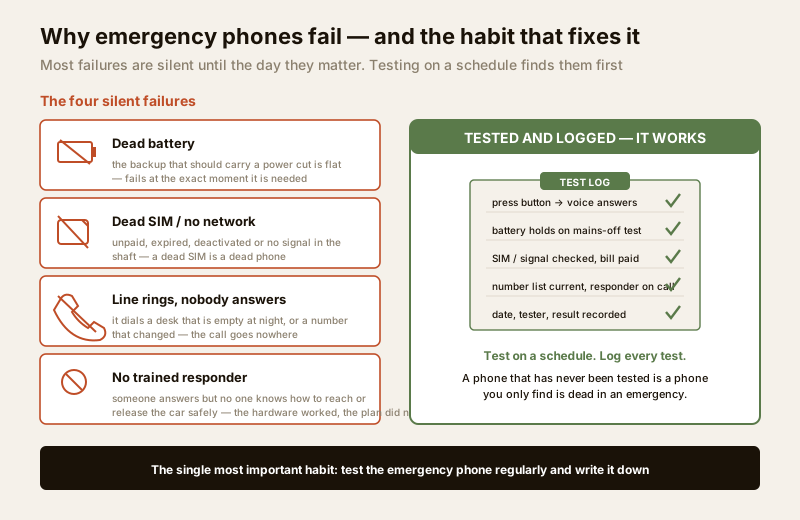
The common failure modes are painfully mundane:
- a dead battery, so the phone works on the mains but dies in the power cut it exists to cover;
- a dead SIM or no network, so a GSM phone that has never been checked cannot dial;
- an unanswered line, dialling a desk that is empty at night or a number that changed months ago; and
- no trained responder, so the call connects but nobody can safely release the car.
None of these shows up unless you test. A test is simple: press the button, confirm the voice connects to the manned point and both sides can hear, confirm it still works with the mains switched off, confirm the SIM and signal on a GSM unit, and confirm the number list and the responder are current. Then log it, date, tester, result, so the building can prove the phone was alive and catch a battery before it dies. Fold the test into the lift's maintenance contract and the building's regular safety routine.
| Failure mode | What actually went wrong | The test that catches it |
|---|---|---|
| Dead battery | Backup flat, fine on mains | Press the button with the mains switched off |
| Dead SIM / no signal | Card unpaid, expired or no shaft signal | Test-dial and check the SIM status and bill |
| Unanswered line | Empty desk at night, or a stale number | Test at odd hours; verify the number list |
| No trained responder | Hardware works, nobody can release the car | Confirm a trained responder is on call now |
| Inaudible / invisible signal | A person cannot hear or see the acknowledgement | Include accessibility in the test |
Accessibility: reachable, audible and visible
An emergency-communication system must work for everyone who might ride the lift. That means the call button is reachable, including from a wheelchair, not only at standing eye height. It means the system gives both an audible and a visible signal, so a person who cannot hear still sees that the call has been placed and acknowledged, and a person who cannot see still hears it. A voice link with a light that confirms "call received" serves both. Where a person cannot use the standard controls, the manned point and the lift CCTV let the responder confirm the situation another way. Treat accessibility as part of the specification, not an afterthought, and verify it in the same routine test.
Key takeaways
- Lift emergency communication is a life-safety system, not an accessory: in a country of frequent power cuts and patchy maintenance, a working two-way phone is what turns an entrapment into a managed wait rather than a dangerous one.
- The chain is a button and bell, two-way voice, a manned point that answers 24x7, and a trained responder, and every link must keep working on backup power because a mains cut is often what trapped the person.
- An alarm that only rings in the shaft is not communication; specify real two-way voice to a point that is genuinely staffed around the clock.
- Auto-diallers and GSM lift phones suit sites without a manned room, but a dead SIM, no signal or a stale number list is a dead phone, design and test for that.
- Pair communication with the automatic rescue device and the lift's safety systems, and remember the hardware is useless without a responder, plan the people and the number list, not just the wiring.
- Test the emergency phone on a schedule and log it: most failures are dead batteries, dead SIMs, unanswered lines or no responder, all invisible until you test. Make the signal audible and visible, and the button reachable.
Where to go next
- Complete guide to lift and staircase security, the pillar this sits under.
- Lift CCTV, so a responder can see the car during a call.
- Lift access control, floor control that must never block a call for help.
- Lift fire-safety planning, the automatic rescue device, fire recall and evacuation.
- Emergency door release and emergency access planning for the escape routes and process around the lift.
- Building security systems guide and gated-communities security guide for the control-room and staffing context.
- Score your building's readiness with the Studio Matrx home security risk scorecard.
References
- IS 14665 (Bureau of Indian Standards), Electric traction lifts, installation, operation and maintenance provisions relevant to emergency signalling and communication, verify the current parts and edition at https://www.services.bis.gov.in/.
- National Building Code of India (SP 7:2026), Part 4 on fire and life-safety and means of escape, and Part 8 Section 5 on the installation of lifts, verify the current edition and read alongside local bye-laws.
- State Lift Acts and Rules (for example Maharashtra, Karnataka, Tamil Nadu and Delhi), for lift licensing, mandatory safety features and inspection, apply the Act in force in your state.
- Digital Personal Data Protection Act, 2023, where a lift call is recorded or monitored, handle that data with notice, minimisation and restricted access. Ministry of Electronics and Information Technology.
- Lift contractor and emergency-communication device documentation (auto-dialler and GSM lift-phone datasheets, monitoring-service terms), for backup-power duration, SIM and connectivity requirements and testing procedure for your specific installation.
This guide is educational and does not constitute legal, fire-safety or engineering advice; lift emergency-communication equipment, its backup power and any manual rescue must be installed, tested and certified by the licensed lift contractor and electrician for your specific building.
Export this guide
Related Guides — Deep-dive reading
Security for People Living Alone in India (2026): Calm, Practical Habits When There Is No Second Person to Notice
Living alone is an ordinary and growing part of Indian life - the student in a new city, the working single, the elder whose children are abroad, the person after a separation. It does not call for fear. It calls for a few deliberate habits, because there is no second person in the home to notice trouble, raise the alarm, or catch an accident. This is calm self-reliance, layer by layer.
SecurityAlarm Siren Not Working (2026): Why It Triggers but Stays Silent in India
Your burglar alarm detects and the panel reacts, but the siren does not sound, or sounds weak and thin. A calm, ordered diagnostic for Indian homes: the settings, power, backup battery, wiring and hardware faults that leave an alarm that cannot be heard, what you can safely check yourself, and when to call your installer.
SecurityEmergency Lighting Testing in India (2026): The Function Test, the Duration Test and the Battery That Quietly Dies
Emergency lighting is what gets people out of a building in a power cut or a fire — and it is useless if its batteries have silently gone flat. This professional guide covers what emergency lighting is, the two tests that keep it honest (the short frequent function test and the longer periodic duration test that catches dying batteries), what to test across escape routes, stairs and exit signs, the statutory test log, and the safe split of who does what.
SecurityRelated Tools — Try Free
Access-Control Battery-Backup Calculator
Size the standby battery so an access system keeps running through a power cut, with an egress life-safety note.
Battery BackupHome Security Risk Scorecard
Score your home across six security layers — perimeter, entry points, lighting, detection, alarm and habits — and get a prioritised action plan.
Security ScorecardApartment Video Door System Planner
Enter flats, entrances, floors and guard desk for a first-pass building intercom plan — door stations, indoor monitors, guard station, the right architecture and an indicative cost band.
Building Planner