
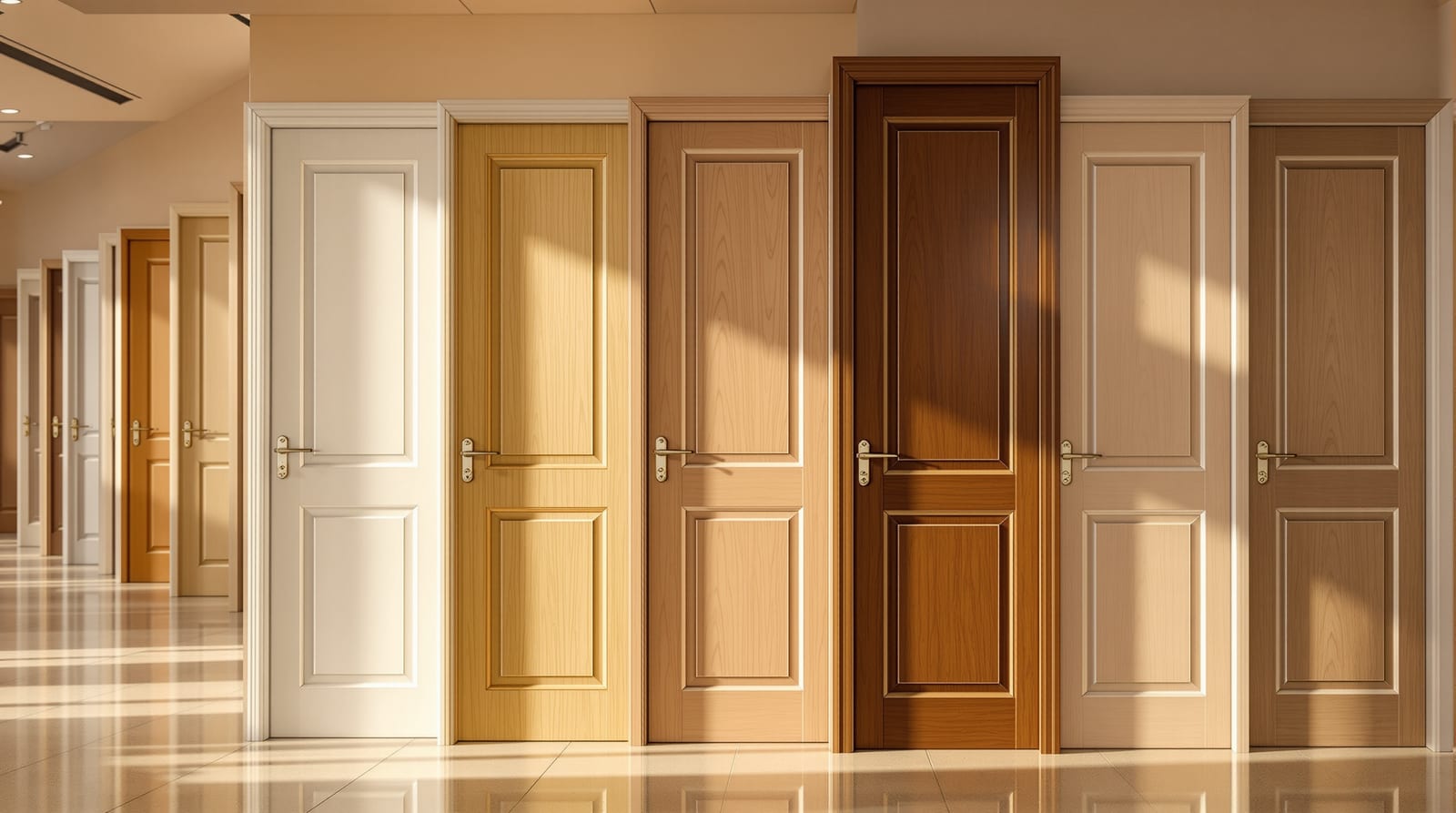
Flush Door Price in India 2026: Per-Shutter Cost by Grade, Plus Frame, Hardware & Installed Total
A focused 2026 price guide for flush doors in India — ₹ per shutter for MR, BWR/BWP, laminated, veneered and designer flush doors, the effect of thickness, core and ISI/brand premium, plus two worked installed-cost examples.
Ask any Indian carpenter or plywood dealer "what does a flush door cost?" and the honest answer is another question: which grade, what size, plain or laminated, with frame or without, fitted or just supplied? A flush door is not one product — it is a family of shutters that runs from a ₹1,200 commercial internal door to a ₹9,000 double-side veneered statement door, before you have spent a rupee on the frame, the hinges or the carpenter. This guide breaks the number down the way a quotation actually adds up, so you can read a shop bill, spot a padded one, and budget the full installed cost rather than just the shutter.
For how flush doors are built and which grade suits which room, read the flush doors in India guide; for the wider price picture across every door type, see the master door cost benchmark for 2026. This page zooms in on the flush-door rupees only. All figures are indicative for 2026 and vary by city, brand and vendor.
What you are actually paying for
A flush door is a plywood or MDF skin pressed over a wooden frame (the stiles and rails) with a core in between. The price moves on five levers, and almost every quotation difference traces back to one of them:
- Grade of the skin / glue — MR (moisture-resistant, interior), BWR or BWP (boiling-water-resistant / proof, for bathrooms and damp walls). Glue grade is the single biggest honest cost driver.
- Surface finish — plain (to be painted), pre-laminated, veneered, or designer double-side. The finish can double the shutter price.
- Core — solid core (block board or particle, heavy, sturdy) vs hollow/semi-solid core (lighter, cheaper, more drum-like).
- Thickness — 30mm and 32mm are common for internal doors; 35mm and 40mm for sturdier or external-leaning use.
- Brand and ISI mark — an IS 2202 ISI-marked door from a known brand costs more than an unbranded local-press door of the same nominal spec, and the gap usually buys you honest glue and a flatter, warp-resistant shutter.
Everything else on the bill — frame, hinges, lock, handle, fitting labour, GST — sits on top of the shutter price. Budgeting only the shutter is the classic mistake that leaves the final bill 60-100% higher than expected.
Flush door price by grade and finish (per shutter)
These are typical 2026 rates for a standard internal shutter (about 3' x 7', 32mm). Larger or thicker shutters cost more; see the size section below. Prices exclude frame, hardware and GST unless stated.
| Flush door type / grade | What it is | Typical price per shutter (₹) | Best for |
|---|---|---|---|
| Commercial / MR-grade plain flush | Moisture-resistant glue, to be painted | 1,200 - 2,200 | Bedrooms, store rooms, dry internal openings |
| BWR-grade plain flush | Boiling-water-resistant glue | 2,000 - 3,200 | Kitchens, semi-damp areas |
| BWP / marine-grade plain flush | Boiling-water-proof (IS 710 type glue) | 2,800 - 4,500 | Bathrooms, utility, walls prone to damp |
| Pre-laminated flush (single side) | Factory laminate one face | 2,200 - 4,000 | Budget finished bedroom / internal doors |
| Laminated flush (both sides) | Decorative laminate both faces, sealed edges | 3,000 - 5,500 | Bedrooms, living-area internal doors |
| Veneered flush (single side) | Natural wood veneer one face | 4,000 - 6,500 | Feature internal doors, study, master bedroom |
| Veneered / designer flush (double side, polished) | Veneer both sides, PU/melamine polish, grooves | 5,500 - 9,000+ | Statement bedroom and pooja-area doors |
Two practical points. First, the BWR/BWP premium is real value, not a markup — a BWP shutter in a bathroom resists the daily steam and splash swelling that destroys an MR door within a few monsoons, and IS 710 marine glue is genuinely costlier to make. Second, "laminated" on a quotation can mean a thin paper laminate or a 1mm decorative high-pressure laminate; ask which, because the price gap is justified by durability at the handle edge.
How size, thickness and core change the price
A flush door is often quoted per shutter for standard sizes and per square foot for non-standard ones. Understanding both stops a vendor from rounding a 3' door up to a 4' price.
| Factor | Standard / cheaper | Premium / costlier | Rough effect on price |
|---|---|---|---|
| Width x height | 3' x 7' bedroom (≈ 900 x 2100 mm) | 4' x 7' main-ish or custom oversize | +15% to +40% |
| Thickness | 30 / 32 mm internal | 35 / 40 mm sturdy or external-leaning | +10% to +25% |
| Core | Hollow / semi-solid (lighter) | Solid block-board core (heavy, no drum sound) | +15% to +35% |
| Edge | Plain pressed edge | Lipping / sealed hardwood edge band | +5% to +12% |
| Brand / ISI | Local unbranded press | IS 2202 ISI-marked national brand | +20% to +40% |
A solid-core door feels reassuringly heavy and does not sound hollow when knocked, which most homeowners prefer for bedrooms and any door that needs a touch of sound privacy; a hollow-core door is fine for a store room or a low-traffic internal opening where weight and cost matter more. For the full trade-off, see solid vs hollow core doors in India. For how a 32mm door reads against thicker leaves, the anatomy diagram below shows where the rupees sit.
The full installed cost — not just the shutter
The shutter is roughly half to two-thirds of the finished cost of a flush door. The rest is the frame (chowkat), the hardware and the carpenter. Here is how a quotation builds up, with indicative 2026 ranges.
| Line item | What it covers | Indicative cost (₹) |
|---|---|---|
| Flush shutter | The door leaf itself (see grade table) | 1,200 - 9,000 |
| Frame / chowkat | Sal/teak ~₹350-900 per running foot, or readymade WPC ₹1,500-3,500 | 2,500 - 6,000 |
| Hinges | 3-4 SS or brass hinges | 200 - 800 |
| Mortise lock / latch | Cylindrical latch to mortise lock set | 800 - 4,000 |
| Handle / pull | Aluminium to designer SS/brass | 300 - 2,500 |
| Door stopper, tower bolt, eyehole | Sundries | 200 - 800 |
| Fitting / carpenter labour | Hang shutter, fix frame, cut mortise | 800 - 3,000 |
| GST | ~18% on materials (labour may differ) | add ~18% |
So a finished internal flush door very rarely lands at the shutter price. Two worked examples make this concrete.
Worked example 1 — a basic internal door (store room / spare bedroom)
A no-frills painted door where cost matters more than looks.
- MR-grade plain flush shutter, 3' x 7', 30mm, hollow core: ₹1,800
- Sal frame, ~17 running ft at ₹400/ft: ₹6,800 (or a readymade WPC frame ~₹2,500 if you prefer)
- Hinges + tower bolt + basic latch: ₹900
- Aluminium handle: ₹350
- Carpenter fitting: ₹1,000
- Subtotal: ₹10,850, plus painting/primer ~₹1,200 and roughly 18% GST on materials → about ₹13,000-13,500 installed
Swap the sal frame for a readymade WPC frame and this drops to roughly ₹9,500-10,500 installed — one reason WPC frames are eating into the budget end of the market. Compare WPC economics in the WPC door price guide.
Worked example 2 — a laminated bedroom door
A finished, good-looking master-bedroom door.
- Laminated flush shutter (both sides), 3' x 7', 32mm, solid core, ISI-marked: ₹4,200
- Teak frame, ~17 running ft at ₹700/ft: ₹11,900
- 4 SS hinges + mortise lock set + designer handle: ₹3,800
- Door stopper + eyehole + tower bolt: ₹600
- Carpenter fitting: ₹1,500
- Subtotal: ₹22,000, plus ~18% GST on materials → about ₹25,000-26,000 installed
A veneered or designer double-side shutter in the same opening pushes the installed total past ₹30,000-35,000, mostly on the shutter and the polish. For finish ideas at this tier, see laminate doors in India and door laminate designs; the cheaper painted route is covered in plywood doors in India.
To model your own door quickly, plug your sizes and grades into the door cost calculator, then sanity-check the shutter rate against the grade table above.
Where the money is well spent — and where it is not
A few honest calls for an Indian home:
- Spend up on glue grade for wet rooms. A BWP/marine shutter for a bathroom or a kitchen-utility door is worth the ₹1,000-1,500 premium; an MR door there is a false economy that swells and delaminates in a couple of monsoons.
- Spend up on solid core for bedrooms. The heavier feel and quieter close are noticeable every day; hollow core is fine for store rooms and low-use openings.
- Insist on the ISI / IS 2202 mark for any door you cannot easily replace. Unbranded press doors can warp; the brand premium largely buys flatness and honest glue.
- Do not over-spend on the frame for internal doors. A readymade WPC frame is uniform, termite-proof and often cheaper than a custom teak chowkat for a plain internal opening.
- Watch the GST and "fitting" lines. Some quotations bury labour and sundries; ask for shutter, frame, hardware and labour as separate lines so you can compare across vendors.
For grade-by-grade build detail rather than price, flush doors in India is the companion read; for the laminate and veneer finishes that drive the top of the table, see veneer doors in India. And remember the headline caveat throughout: these are indicative 2026 figures and the actual number depends on your city, brand and vendor.
Frequently asked questions
What is the cheapest flush door price in India in 2026?
A plain MR-grade commercial flush shutter (3' x 7', hollow core, unbranded) typically starts around ₹1,200-1,800 per shutter. Add a frame, hinges, a latch and carpenter labour and the finished, painted internal door usually lands around ₹10,000-13,500 — or noticeably less with a readymade WPC frame. Figures are indicative and vary by city and vendor.
Why is a laminated flush door so much more expensive than a plain one?
You are paying for the decorative laminate on one or both faces, the sealed edges, usually a solid core, and often an ISI-marked brand. A plain flush door still needs painting (an extra labour and material cost), while a laminated door arrives finished. A both-sides laminated shutter typically runs ₹3,000-5,500 versus ₹1,200-2,200 for a plain MR shutter.
Does GST apply to flush doors, and at what rate?
Yes — flush doors and the plywood/laminate they are made from typically attract about 18% GST on the material component. Pure fitting labour from a local carpenter may be billed differently or informally. Always ask whether a quoted shutter price is inclusive or exclusive of GST, since 18% on a ₹4,000 shutter is a meaningful ₹720.
Is a 35mm flush door worth the extra cost over a 32mm one?
For most internal bedroom and store doors, 30-32mm is perfectly adequate and cheaper. A 35-40mm shutter — and a solid core — is worth it for heavier-traffic doors, doors you want to feel more substantial, or openings leaning towards external/semi-exposed use. Expect roughly a 10-25% price step for the extra thickness plus the core upgrade.
How much should I budget for the frame and fitting on top of the shutter?
Plan for the frame and hardware to roughly match or exceed the shutter price on a finished door. A timber chowkat runs about ₹350-900 per running foot (≈ ₹2,500-6,000 for a standard door), hinges and a mortise lock set add ₹1,500-8,000 depending on quality, and carpenter fitting is ₹800-3,000. A readymade WPC frame at ₹1,500-3,500 is often the budget-friendly choice. See the door cost benchmark for the wider picture.
Export this guide
Related Guides — Deep-dive reading
Door Installation Cost in India 2026: Fitting Labour ₹ Per Door + Hardware, City Variance & GST
A focused 2026 guide to what it actually costs to fit a door in India — carpenter labour per door for flush, panel, heavy main and sliding shutters, plus hinges, mortise lock, tower bolt and closer hardware ₹ ranges, with worked bedroom and main-door totals.
Home Doors & EntrancesDoor Frame Cost in India 2026: Chowkat ₹/Running Foot by Material, Quantity Calc & Installed Total
A focused 2026 cost guide for the door frame (chowkat / chaukhat) — ₹ per running foot for sal, teak, hardwood, rubberwood, WPC, steel (IS 4351), RCC and granite frames, how to calculate frame quantity from the opening perimeter, readymade vs site-made, fitting labour and a worked 3'×7' example.
Home Doors & EntrancesGuest Room Door in India: Privacy, Quiet and Smart Picks Without Overspending (2026)
How to choose a guest bedroom door for an Indian home - privacy and acoustics so visitors feel comfortable, but budget-sensible for a room used only now and then: solid-core flush for quiet, panel or laminate for looks, the right privacy lock, simple soundproofing, and a finish that matches the rest of your doors - with picks ranked and indicative rupee costs.
Home Doors & EntrancesRelated Tools — Try Free
Door Cost Calculator
Estimate the all-in cost of a door — leaf, frame, hardware, fitting and GST — by type, material and size.
Door CalculatorDoor Frame Cost Calculator
Estimate door frame (chowkat) cost from the opening size and frame material — sal, teak, WPC, steel, RCC or granite.
Door CalculatorMaterial Comparison Sheet
India's interior material cheatsheet — plywood, finishes, hardware, countertops, paints, waterproofing.
Reference Guide