
Epoxy Grout vs Cement Grout for Tiles in India: Which to Specify (2026)
A plain-English guide to tile grouts for Indian homes: what grout does, how cementitious grout compares with epoxy grout on cost, stain and water resistance, hygiene and durability, and exactly where each one belongs - kitchens, bathrooms, pools, dry rooms and more.
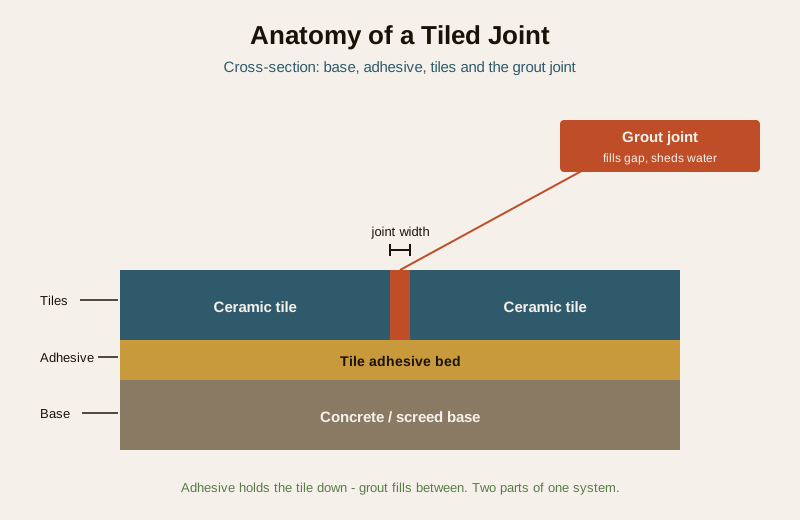
Look closely at any tiled floor or wall and the tiles are only half the story. The thin lines between them - the grout - are what turn a field of loose tiles into one continuous, water-shedding, easy-to-clean surface. Grout fills the joints, locks the tiles into a grid, cushions small movements and keeps water, dirt and grime from creeping underneath. Choose it well and a bathroom stays crisp for years; choose it badly and you get the familiar Indian sight of blackened, crumbling, mould-streaked joints within a couple of monsoons. The single biggest choice you will make is between ordinary cementitious grout and epoxy grout - and this guide helps you specify the right one, room by room.
This guide sits inside our wider construction chemicals guide, which maps adhesives, sealants, admixtures and grouts as a family. Grout is the partner of tile adhesive: the adhesive holds the tile down, the grout fills between - see our tile adhesives guide for the other half of the system.
Scope and safety: This is a selection guide to help you choose and specify grout. Costs and performance figures are indicative only - brand, joint width, tile type and site conditions swing them widely, so get local quotes and product datasheets. Grouting itself - mixing epoxy to ratio, timing the clean-off, filling deep or structural joints - is skilled work for a qualified tiler or applicator. Nothing here replaces the relevant IS/BIS standards, the NBC (SP 7:2026) provisions, or a professional on site.
What grout actually does
Grout is not glue and it is not decoration - it is a working part of the tiled surface. A good grout joint does five jobs at once:
- Fills the gap between tiles so nothing collects dirt or harbours water.
- Locks the tiles into a rigid, load-sharing field so individual tiles cannot rock or lift.
- Sheds water at the surface, keeping it out of the bed below - critical in wet areas.
- Absorbs small movement and dimensional tolerance between tiles that are never perfectly identical.
- Defines the look - joint colour and width are a major part of how the finished surface reads.
Because grout lines are the lowest, most exposed, most scrubbed part of a tiled surface, they are where failure shows first. That is why the material you fill them with matters far more than its small quantity suggests.
The two main choices
Cementitious grout - cheap, easy, porous
Cementitious grout is a dry powder of cement, fine graded fillers and pigments, mixed on site with water (or sometimes a latex additive) to a paste. It is the default grout in most Indian homes because it is inexpensive, forgiving to apply, easy to clean off during work, and available in every hardware shop.
Its weakness is built into its chemistry: cement sets into a porous solid. That porosity means a cement grout joint absorbs water, tea, coffee, oil and dirt; stains and darkens over time; can grow mould and mildew in damp areas; may develop hairline cracks and can slowly wash out or powder under constant wetting and scrubbing. Better grades add polymer to reduce this, and a penetrating grout sealer applied after curing helps - but sealer wears off and needs reapplying. Cementitious grout is honest value where conditions are gentle, and a maintenance chore where they are not.
Epoxy grout - waterproof, tough, hygienic
Epoxy grout is a completely different material. It is a two-part (sometimes three-part) system: an epoxy resin and a hardener, plus fine silica filler and pigment, that you mix immediately before use. The two parts react and cure into a dense, non-porous plastic-like solid that is bonded chemically rather than merely set.
That non-porous cure gives epoxy grout its headline properties: it is effectively waterproof, highly stain resistant (it does not soak up spills), chemical resistant against household acids, alkalis and cleaners, mechanically strong and abrasion resistant, and hygienic because it does not harbour mould or bacteria and wipes clean. Its colour is stable and consistent because the pigment is locked in resin, not sitting in absorbent cement. It never needs sealing.
The trade-offs are real: epoxy grout costs several times more than cement grout, and it is far less forgiving to apply. It has a short pot life once mixed, sets fast, and any residue left on the tile face hazes into a stubborn film if not cleaned off promptly. That makes it firmly a job for a skilled tiler who has worked with it before.
Cement grout vs epoxy grout - the comparison
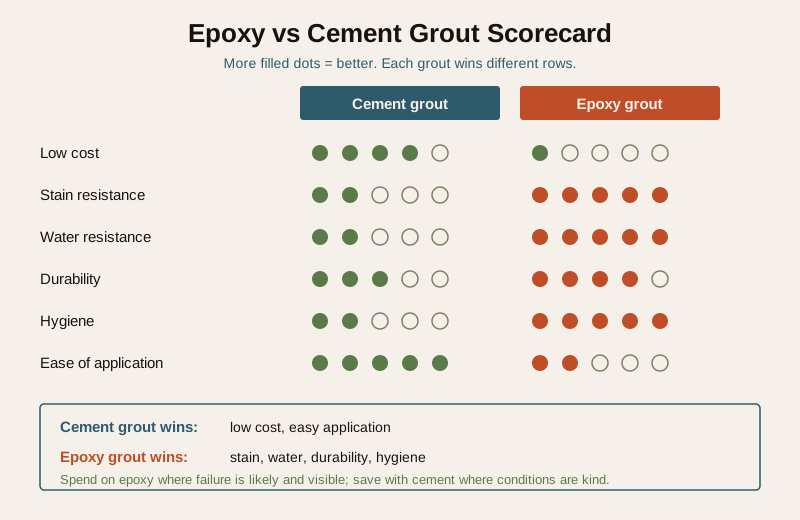
The two materials are not really rivals to be ranked but tools for different jobs. This table lays out the decision honestly.
| Property | Cementitious grout | Epoxy grout |
|---|---|---|
| What it is | Cement + fillers + pigment, mixed with water | Resin + hardener + silica filler + pigment |
| Indicative cost | Low - roughly Rs 20 to 60 per kg | High - roughly Rs 250 to 600+ per kg |
| Water resistance | Porous, absorbs water | Effectively waterproof |
| Stain resistance | Poor - stains and darkens; sealing helps | Excellent - does not absorb spills |
| Chemical resistance | Weak against acids and harsh cleaners | Strong against household acids, alkalis, cleaners |
| Durability | Can crack, powder or wash out over time | Tough, abrasion resistant, long lasting |
| Hygiene | Can harbour mould and mildew when damp | Non-porous, resists mould and bacteria |
| Colour stability | Can blotch, fade and darken | Consistent and stable, pigment locked in |
| Needs sealing | Yes, and periodic resealing | No |
| Workability | Easy, forgiving, slow to clean off | Skilled, fast setting, must clean off promptly |
| Best used | Dry, low-traffic, budget areas | Wet, high-traffic, hygienic, chemical-exposed areas |
The short version: cementitious grout wins on cost and ease; epoxy grout wins on performance and longevity. In a wet or heavily used area the extra spend on epoxy usually pays for itself in years of clean joints and no resealing.
Where each one wins
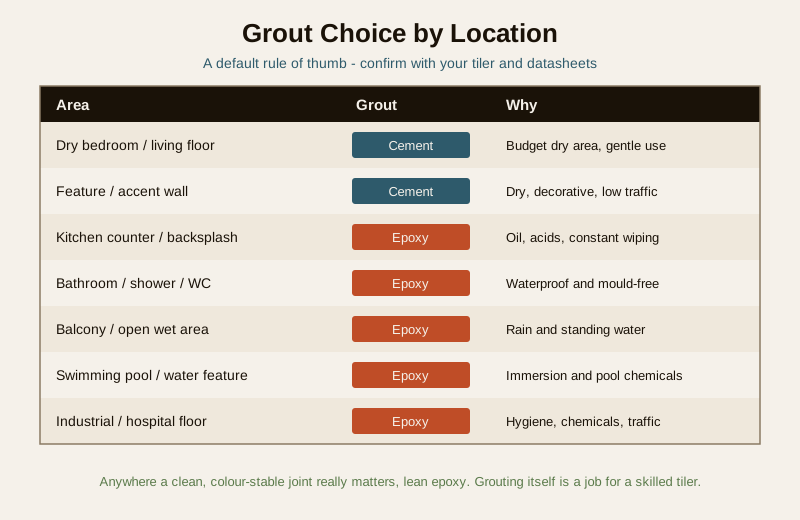
Matching grout to location is the whole skill of specifying it. Use this as your default logic.
Choose cementitious grout for dry, low-traffic, budget-driven areas: bedroom and living-room floors, feature walls, low balconies, utility spaces, and anywhere joints stay dry and are not scrubbed hard. It is also the practical choice on very large tiling jobs where an all-epoxy budget is out of reach - reserve epoxy for the wet rooms and use good polymer-modified cement grout elsewhere.
Choose epoxy grout for anywhere water, stains, chemicals or hygiene matter:
- Kitchens - countertops, backsplashes and floors that meet oil, turmeric, acids and constant wiping.
- Bathrooms, showers and WCs - the classic case; epoxy keeps joints clean, mould-free and waterproof through monsoon after monsoon.
- Wet areas and balconies - open-to-rain surfaces, wash areas and service zones.
- Swimming pools and water features - constant immersion and pool chemicals demand epoxy.
- Commercial, industrial and hospital floors - hygiene, chemical spills and heavy traffic.
- Anywhere a clean, sharp, colour-stable joint matters - premium interiors, dark grout with light tiles, or thin designer joints where staining would be glaring.
The cost logic is simple: spend on epoxy where failure is likely and visible; save with cement where conditions are kind. For the broader wet-area picture, see our flooring hub and bathrooms and wet-area guidance.
Joint width, and a note on structural grout
Two more specifics decide which product and grade you order.
Narrow versus wide joints. Grouts are formulated for a joint-width range. Narrow joints (roughly 1 to 3 mm, typical of rectified vitrified tiles) need a fine, sanded-free or fine-silica grout that flows into a tight gap - epoxy suits these well and gives a razor-clean line. Wide joints (say 3 to 12 mm, common with natural stone, terracotta or rustic tiles) need a sanded or wide-joint grade with enough filler to fill the gap without slumping or cracking. Using a narrow-joint grout in a wide joint invites shrinkage cracks, and vice versa. Always match the grout's stated joint range to your tile layout - your tiler will advise.
Non-shrink structural grout is a different product. The word "grout" also names a family of flowable, high-strength, non-shrink cementitious or epoxy grouts used to fill under machine base plates, anchor bolts, precast joints and bearing pads - a structural, load-transfer material, not a tile joint filler. Do not confuse it with tile grout: it is specified by a structural engineer for load-bearing gaps and belongs to that discipline. We mention it only so the shared word does not mislead you at the counter.
Application - leave it to a skilled tiler
Grouting is where good products fail in unskilled hands, and this is squarely execution we defer to a professional. A few things to understand as the person specifying the job:
- Timing. Grout goes in only after the tile adhesive has cured and the tiles are firm - rushing this pulls tiles loose.
- Mixing. Epoxy must be mixed to the exact resin-to-hardener ratio and used within its short pot life; a wrong ratio or a slow hand ruins the batch. This precise, time-critical mixing is exactly why epoxy is a specialist job.
- Clean-off. Epoxy sets fast and must be cleaned off the tile face promptly, while workable, or it hazes into a film that is very hard to remove later. Cement grout is more forgiving but still needs a timely wipe.
- Curing and use. Both grouts need their stated cure time before the surface takes water or traffic.
- Sealing. Cement grout benefits from a penetrating sealer after curing, reapplied periodically; epoxy needs none.
Hire a tiler experienced with epoxy specifically - it is a genuinely different skill from cement grouting, and a cheap crew learning on your bathroom is a false economy. For joints at changes of plane, around fittings and at wall-floor junctions, a flexible sealant - not grout - is the correct material, since those junctions move.
Indicative cost
Grout is a small fraction of a tiling budget, which is why upgrading to epoxy in the rooms that matter is usually worth it. Treat these as rough and get local quotes.
| Item | Indicative rate | Notes |
|---|---|---|
| Cementitious grout (plain) | Rs 20 to 40 per kg | Basic dry-area joints |
| Polymer-modified cement grout | Rs 40 to 80 per kg | Better stain and crack resistance |
| Epoxy grout | Rs 250 to 600+ per kg | Waterproof, stain-proof, hygienic |
| Grout sealer (for cement grout) | Priced per litre, plus labour | Reapply periodically |
| Skilled epoxy application | Labour premium over cement grouting | Specialist tiler; worth it |
Coverage depends heavily on tile size and joint width - large tiles with thin joints use very little grout per sq ft, small mosaics use a lot. Your tiler can estimate quantity from the tile schedule; our tile adhesive calculator helps you scope the companion adhesive.
Key takeaways
- Grout fills the joints between tiles and does real work - locking tiles, shedding water, defining the look. The material you choose matters far more than its small quantity suggests.
- Cementitious grout is cheap, easy and everywhere, but porous - it stains, can grow mould, may crack or wash out, and needs sealing. Best for dry, low-traffic, budget areas.
- Epoxy grout (resin plus hardener) cures non-porous: waterproof, stain and chemical resistant, strong, hygienic and colour-stable, never needs sealing - but costs several times more and demands skilled, fast application.
- Specify epoxy for kitchens, bathrooms, wet areas, pools, industrial and hospital floors, and anywhere a clean joint matters; use good cement grout for dry rooms and to stretch a large budget.
- Match the grout to the joint width, keep non-shrink structural grout (a separate, engineer-specified product) distinct from tile grout, and leave the grouting itself to a skilled tiler - especially with fast-setting epoxy.
References
- Bureau of Indian Standards - relevant standards for tile grouts, cementitious and reaction-resin (epoxy) grouts, and ceramic tiling systems; consult current editions for classifications and test requirements.
- National Building Code of India (SP 7:2026) - provisions on finishes, wet areas and building services relevant to tiled surfaces.
- Manufacturer technical datasheets - for pot life, joint-width range, coverage, cure time and chemical-resistance data specific to each product.
- Studio Matrx guides: construction chemicals guide, tile adhesives guide, sealants guide, the flooring hub, the materials and finishes library and the complete building materials guide.
Export this guide
Related Guides — Deep-dive reading
Tile Grouting Guide India: Cement vs Epoxy Grout, Joint Width, Mixing, Curing and Sealing
How to grout tile floors properly in Indian homes: choosing cement versus stain-proof epoxy grout, getting timing and joint width right, floating it in, clearing haze, curing and sealing.
Flooring & SurfacesConstruction Chemicals Guide (India): Admixtures, Adhesives, Sealants, Grouts & More (2026)
The anchor guide to construction chemicals for Indian homes - what these small-dose products do, the main families from concrete admixtures to adhesives, sealants, grouts, waterproofing and curing compounds, and how to buy and use them safely.
Building MaterialsConstruction Aggregates in India: Sizes, Quality & Selection (2026)
What coarse aggregate actually does in concrete, how to pick the right nominal size (10mm, 20mm, 40mm), and the field and lab checks that separate strong stone from a bad load - a specify-and-select guide for Indian homes.
Building MaterialsRelated Tools — Try Free
Grout Quantity Calculator
Estimate grout in kg and cost by tile size, joint width and thickness — cement or epoxy grout.
Flooring CalculatorPool Tile Calculator
Floor, wall and waterline area and the total number of tiles for your pool, with a wastage allowance.
Pool CalculatorSwimming Pool Cost Calculator
Estimate a home pool's build cost by type, size and finish, with an indicative range and a build breakdown.
Pool Calculator