
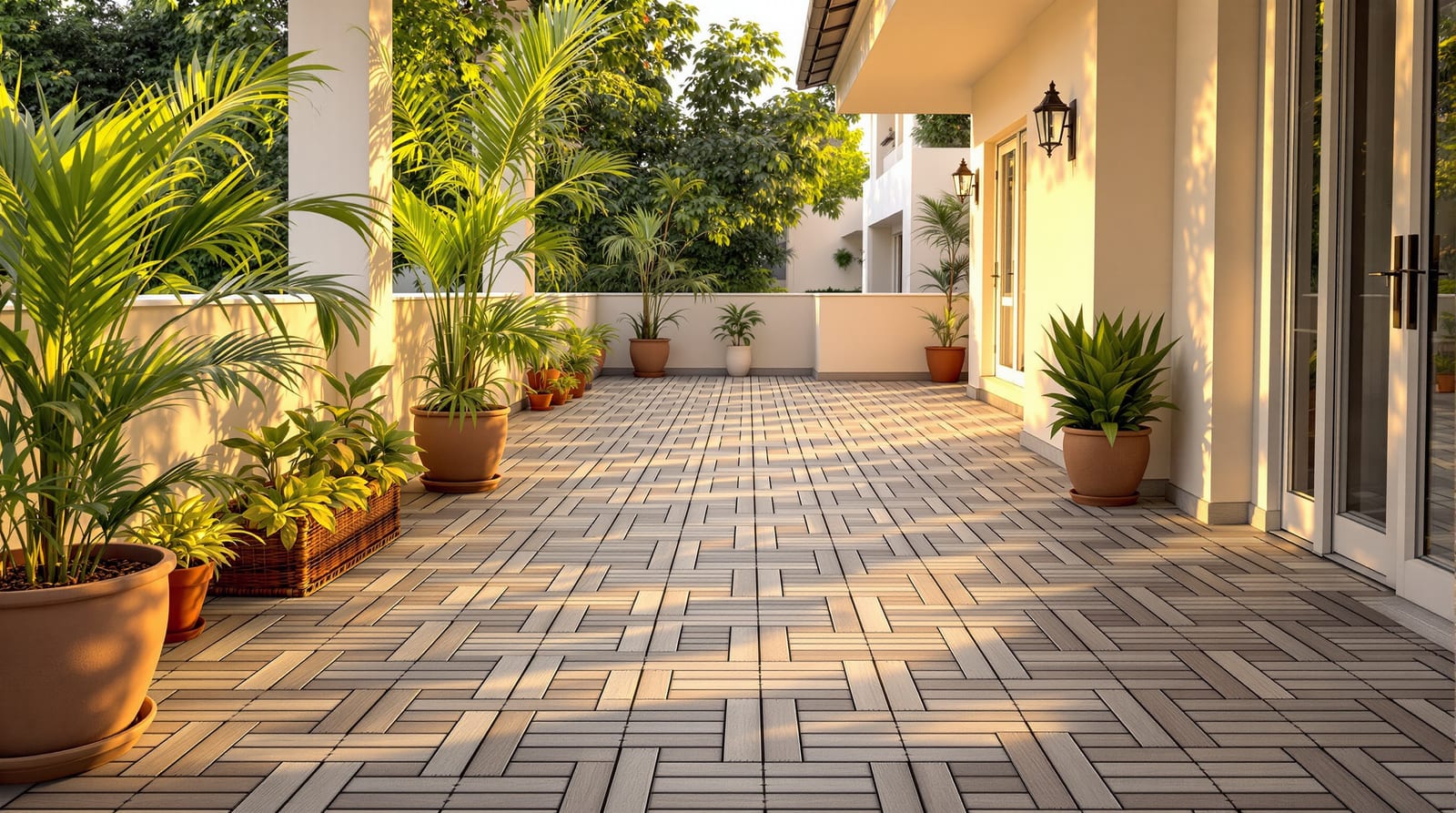
Interlocking Tiles in India: Click-Together Floor Tiles for Terraces, Balconies, Garages & Rented Homes — Types, Cost & DIY Install
Interlocking tiles are the loose-lay, click-together floor tiles you snap down over any flat surface with no glue, no grout and no demolition — at ₹40–150 per sq ft, fully DIY, removable and reusable, ideal for terraces, balconies, utility areas, garages, gyms and rented homes.
Interlocking tiles are the floor you can lay yourself on a Sunday afternoon and take with you when you move. Instead of being cemented down, each tile has toothed edges or a clip-together base that snaps into its neighbour, so the whole floor floats loose-lay over any reasonably flat surface — no glue, no grout, no demolition, no mason. For Indian terraces, balconies, utility yards, garages, home gyms, event spaces and especially rented homes, they are the quickest, least messy and most reversible way to get a real floor down, typically at ₹40–150 per sq ft.
This guide explains the main types of interlocking floor tile sold in India, how the no-glue click system actually works, where it genuinely suits, what it costs, how to lay it, and where it falls short — and how it differs from the two cousins it is most often confused with: solid concrete paver blocks and click-together outdoor deck tiles.
What interlocking tiles are
An interlocking tile is a modular floor unit designed to connect mechanically to the tiles around it rather than being bonded to the surface below. The connection is usually one of two systems: tabbed edges (like jigsaw teeth or dovetails along each side that slot into the matching tile), or a hidden base grid with snap pins and loops that clip the tiles together underneath the wearing surface. Either way the floor becomes one continuous interlocked mat that holds together by its own geometry and weight.
Because the tiles grip each other and not the ground, you lay them straight onto whatever flat surface already exists — an existing terrace screed, old tiles, a balcony slab, a garage floor, even a smooth plywood deck. This is what people mean by "loose-lay" or "floating" flooring: nothing is fixed down, so nothing has to be chipped up later. That single property — reversibility — is the whole reason this category exists, and it is why it has become the default upgrade for tenants and for surfaces nobody wants to commit to permanently.
Studio Matrx groups interlocking tiles with the other modular, paving and resilient floors in the specialty flooring guide, alongside foam interlocking tiles, rubber flooring and click outdoor deck tiles.
How the no-glue click system works
The appeal is in what you do not do. There is no cement mortar bed, no tile adhesive, no grout, no curing time and no waiting. You sweep the surface clean, dry-lay the tiles from one corner, and press or tap each tile so its teeth or clips engage the last. The mat is held flat by its own interlocked perimeter and by the weight of the tiles; a wall or a starter edge strip stops it creeping. To lift it again, you simply unclip from a corner and stack the tiles — they come up clean, leaving the original floor untouched underneath.
That means three things that matter in a real Indian home. First, drainage: most outdoor interlocking tiles have an open or ribbed underside, so monsoon rain and balcony washing water run under the tiles and away to the existing floor drain instead of pooling on top — the floor stays usable in the wet. Second, a raised, ventilated layer sits between your feet and a hot terrace slab, which is more comfortable underfoot than bare concrete. Third, zero damage: because nothing is bonded, a landlord's original floor is preserved exactly, which is the entire point for rented homes.
The main types of interlocking tile in India
"Interlocking tile" is a family, not one product. The four types below cover almost everything sold in India, and they suit very different jobs.
Rubber interlocking tiles
Thick recycled or virgin rubber tiles, usually 15–50 mm, with dovetail or puzzle edges. They are heavy, slip-resistant, shock-absorbing and sound-damping — the workhorse of home gyms, weights areas, kids' zones, garages, utility rooms and rooftop play decks. They take dropped dumbbells without cracking and stay put by their own weight. Closely related to roll-and-tile rubber flooring, but in a click-together modular format.
Plastic / PP interlocking tiles
Lightweight injection-moulded polypropylene or HDPE tiles with a hidden snap-pin grid base and an open or perforated top. Cheap, fully waterproof, fast-draining and very DIY — they are the popular choice for terraces, balconies, washing yards, wet utility areas, temporary event floors and exhibition stalls. Many have a ribbed anti-skid top; some come faux-grass or faux-wood. They cover poor existing tiles instantly and pop apart for storage.
Stone or porcelain-on-tray click tiles
A premium tray system: a thick outdoor porcelain paver, natural stone, or composite slab is pre-mounted on a rigid plastic base with click connectors, so you get a genuine stone or porcelain look and feel with the loose-lay convenience. These overlap with click outdoor deck tiles and are the smartest way to put a real stone/porcelain finish on a terrace or balcony you can still lift later.
Garage PVC interlocking tiles
Rigid PVC floor tiles with peg-and-loop edges, built for vehicle loads, oil and abrasion. Coin, diamond or ribbed top textures; common in home garages, car porches, workshops and showroom display floors. They drive over without shifting and hose clean.
Type, use and cost: the comparison table
The ranges below are indicative, vary by city and vendor, exclude the 18% GST, and are for the tiles themselves — but since this is a DIY loose-lay floor, install labour is usually nil or minimal.
| Type | Typical thickness | Best use | Indicative ₹/sq ft |
|---|---|---|---|
| Plastic / PP interlocking | 12–20 mm | Terraces, balconies, utility yards, events | ₹40–90 |
| Rubber interlocking | 15–50 mm | Home gyms, garages, play areas, utility | ₹80–150 |
| Garage PVC interlocking | 6–12 mm | Garages, car porches, workshops, showrooms | ₹60–140 |
| Stone / porcelain-on-tray click | 20–35 mm (incl. tray) | Terraces, balconies, pool decks (premium look) | ₹120–150+ |
| Faux-grass / faux-wood PP | 12–25 mm | Balcony greenery look, rooftop lounges, events | ₹50–120 |
For comparison, solid concrete paver blocks sit at ₹30–90 per sq ft plus laying on a sand bed, and click outdoor deck tiles run ₹100–400. To budget a full job, sanity-check quantities and rates with the Studio Matrx flooring cost calculator and the tile quantity calculator.
How the interlock works: a look at the click edge and tray
The diagram below shows the two ways these tiles join — the tabbed/toothed edge of a one-piece tile, and the hidden snap-clip base of a stone-or-porcelain-on-tray tile — both floating loose over the existing floor.
Where interlocking tiles suit in India
This is a floor defined by its situations, not its rooms. It earns its place wherever you want a real surface quickly, reversibly and without involving a contractor.
- Rented homes: the headline use. Cover ugly developer tiles or a rough balcony in a rented flat, then unclip and take the whole floor to your next home — the deposit-protecting upgrade.
- Terraces and rooftops: faux-grass or porcelain-on-tray tiles turn a hot bare slab into a usable lounge or party deck, with rain draining underneath. Pair the thinking with terrace flooring and heat-reflective terrace flooring.
- Balconies: instant deck-look or greenery underfoot over a small balcony slab; see balcony flooring.
- Garages and car porches: rigid PVC garage tiles take vehicle weight, oil and grit, and hose clean.
- Home gyms and play areas: rubber interlocking tiles cushion drops and joints and absorb sound.
- Utility and washing yards: plastic interlocking tiles give an anti-skid, fast-draining surface over a wet floor — relevant alongside anti-slip flooring for wet areas.
- Events, exhibitions and quick makeovers: lay a floor for a weekend, then lift and store it.
How to lay interlocking tiles
The whole attraction is that an ordinary homeowner can do this without tools beyond a rubber mallet and a utility knife or jigsaw.
1. Check the base. It must be reasonably flat, firm and clean — sweep off grit and let any washing water dry. The tiles forgive minor unevenness but not large dips, debris or a crumbling surface.
2. Plan the layout. Measure the area, decide your starting corner (usually the most visible straight edge), and dry-lay a row to see how the cut tiles fall at the far wall. Aim to avoid thin sliver cuts at edges.
3. Lay from a corner. Snap or tap each tile into the last along its toothed or clip edge, working in an L outward. Keep the joints tight and the rows square.
4. Cut the edges. Trim border tiles to fit with a utility knife (plastic/rubber) or a jigsaw (rigid PVC/tray tiles). Many systems sell matching edge ramps and corner pieces for a finished perimeter and a trip-free transition.
5. Settle it. Walk the floor, re-seat any proud joints, and let the mat self-weight down. No curing, no waiting — it is usable immediately.
Because nothing is bonded, mistakes cost nothing: unclip and relay. This contrasts sharply with bonded paving, where you would consult how to lay floor tiles and lay a screed or mortar bed.
Care and maintenance
Maintenance is mostly sweeping and washing. Hose or mop the top; for plastic and rubber tiles you can lift sections occasionally to clean trapped leaves, grit or standing water underneath — a real advantage over bonded floors, where dirt under the tile is permanent. Rubber tiles take a mild detergent; avoid harsh solvents that can degrade them. Porcelain-on-tray tiles clean like any vitrified tile. In strong, direct rooftop sun, choose UV-stabilised plastic, as cheap unstabilised PP can fade or grow brittle over a few seasons. Because the floor is modular, a damaged tile is a two-minute swap, not a repair — keep a few spares from the original lot.
Pros and cons
Pros
- Truly DIY — no mason, no adhesive, no grout, no skill; laid in hours with a mallet and a knife.
- Removable and reusable — unclip and take it with you; the dream upgrade for rented homes, and the original floor underneath is untouched.
- No demolition, no mess — lays straight over existing tiles or screed; nothing is chipped up.
- Drainage and ventilation — open or raised undersides let monsoon rain and washing water drain away, keeping terraces and balconies usable in the wet.
- Fast and reversible — usable immediately, no curing; mistakes cost nothing because you simply relay.
- Modular repair — swap a single damaged tile instead of repairing a whole floor.
Cons
- Looks and visible joins — even good tiles read as modular, with a grid of seams; they rarely match the seamless luxury of bonded stone or large-format porcelain.
- Can shift or lift — a loose-lay mat without a fixed perimeter or under heavy point loads can creep, gap or pop up at edges; it needs a confining wall or edge strips.
- Not permanent — this is a removable, semi-temporary floor by design, not a 30-year fixed surface; the cheaper plastic grades have a limited outdoor life.
- Base-dependent — a badly uneven or crumbling base telegraphs through and lets tiles rock.
- UV and quality spread — cheap unstabilised plastic fades and embrittles in harsh Indian sun; quality varies enormously between vendors, so buy a known grade.
How it differs from paver blocks and deck tiles
These three get confused constantly, but they are different floors for different jobs.
| Floor | What it is | How it is laid | Best for |
|---|---|---|---|
| Interlocking tiles | Modular rubber/plastic/tray click tiles | Loose-lay, no glue, removable | Terraces, balconies, garages, gyms, rented homes |
| Paver BLOCKS | Solid precast concrete units | Bedded on compacted sand/base, semi-permanent | Driveways, footpaths, parking, heavy load |
| Outdoor DECK tiles | WPC/wood/porcelain on pedestals or grids | Click loose-lay on pedestals, removable | Terraces, pool decks, premium balcony decks |
In short: choose interlocking tiles when you want the cheapest, fastest, fully reversible loose-lay floor and do not mind a modular look. Choose paver blocks when you need a tough, permanent paved surface for vehicles or footpaths. Choose outdoor deck tiles when you want a premium, level deck on adjustable pedestals over an uneven or sloping terrace.
Cross-links and where this fits
This guide sits in the Studio Matrx flooring cluster. For the full map of alternative, modular and specialty floors, start with the specialty flooring guide. To weigh the close relatives, compare outdoor deck tiles, paver blocks, rubber flooring and, for small outdoor spaces, balcony flooring. To plan quantities and budget, use the tile quantity calculator and the flooring cost calculator.
Frequently asked questions
Can I use interlocking tiles in a rented house?
Yes — this is their flagship use. Because the tiles lock to each other and not to the floor, nothing is glued or grouted, so you lay them straight over the existing developer tiles and unclip the whole floor when you move out, leaving the original surface untouched and your deposit safe. Keep the box and a few spares for the next home.
Are interlocking tiles waterproof and good for terraces?
Plastic and porcelain-on-tray interlocking tiles are well suited to terraces and balconies because their open or raised undersides let monsoon rain and washing water drain away beneath them to the existing floor drain, so the top stays usable. For harsh, direct rooftop sun, insist on UV-stabilised tiles, as cheap unstabilised plastic can fade and turn brittle over a few seasons.
How much do interlocking tiles cost in India?
Indicatively ₹40–150 per sq ft plus 18% GST. Plastic and PP tiles are cheapest at ₹40–90, garage PVC tiles around ₹60–140, rubber interlocking tiles ₹80–150, and premium porcelain or stone-on-tray click tiles from ₹120–150 upward. Since it is a DIY loose-lay floor, install labour is usually nil, which keeps the all-in cost low.
Will interlocking tiles shift or come apart?
A properly interlocked mat held by a confining wall or edge strips stays put under normal foot traffic. Without a fixed perimeter, or under heavy point loads, a loose-lay floor can creep, gap or lift at the edges over time. Choosing the right grade and weight for the use — rubber for gyms, rigid PVC for garages — and using the matching edge ramps keeps it stable.
What is the difference between interlocking tiles and paver blocks?
Interlocking tiles are modular rubber, plastic or tray click tiles that loose-lay over an existing surface with no glue and lift up again — a removable, semi-temporary floor. Paver blocks are solid precast concrete units bedded on compacted sand for a tough, semi-permanent paved surface that takes vehicles and footpath traffic. One is reversible and DIY; the other is heavy-duty and meant to stay.
Export this guide
Related Guides — Deep-dive reading
Deck Tiles in India: Click-Together Outdoor Floor Tiles for Terraces, Balconies, Rooftops & Pool Decks — Materials, Cost & How They Work
Deck tiles are the click-together outdoor floor tiles — WPC and wood-look composite, real teak, 20 mm porcelain pavers or stone on a backing tray — that snap onto a terrace, balcony, rooftop or pool deck over the existing waterproofing, giving an instant, removable, no-demolition makeover at ₹100–400 per sq ft.
Flooring & SurfacesPatio Flooring in India: Best Decks & Outdoor-Seating Floors for Weather, Grip & Looks
How to floor a patio, deck or outdoor lounge in India so it shrugs off UV and monsoon, grips wet feet, stays barefoot-friendly and still looks like a place you want to entertain.
Flooring & SurfacesRubber Flooring in India: Rolls, Tiles & Interlocking Mats for Gyms, Play Areas, Clinics & Garages — Types, Cost & Care
Rubber flooring — supplied as rolls, tiles or interlocking mats in recycled SBR or virgin EPDM — is the tough, slip-resistant, cushioned and sound-absorbing floor for gyms, play areas, hospitals, clinics, garages, balconies and utility zones. Here are the types, thickness by use, costs of ₹80–400 per sq ft, install methods, pros, cons and care.
Flooring & SurfacesRelated Tools — Try Free
Flooring Cost Calculator
Estimate the all-in cost of a floor — material, laying, wastage, skirting and GST — by area and material.
Flooring CalculatorMonsoon-Readiness Checklist
Pre-rain home audit across 9 categories — terrace, drains, waterproofing, electrical, HVAC, pest, vehicles, documents.
Seasonal AuditCross-Ventilation Analyzer
Estimate airflow and air changes per hour (ACH) from room size, window areas, layout, and local wind — with NBC 2016 Part 8 compliance check.
Ventilation Calculator