
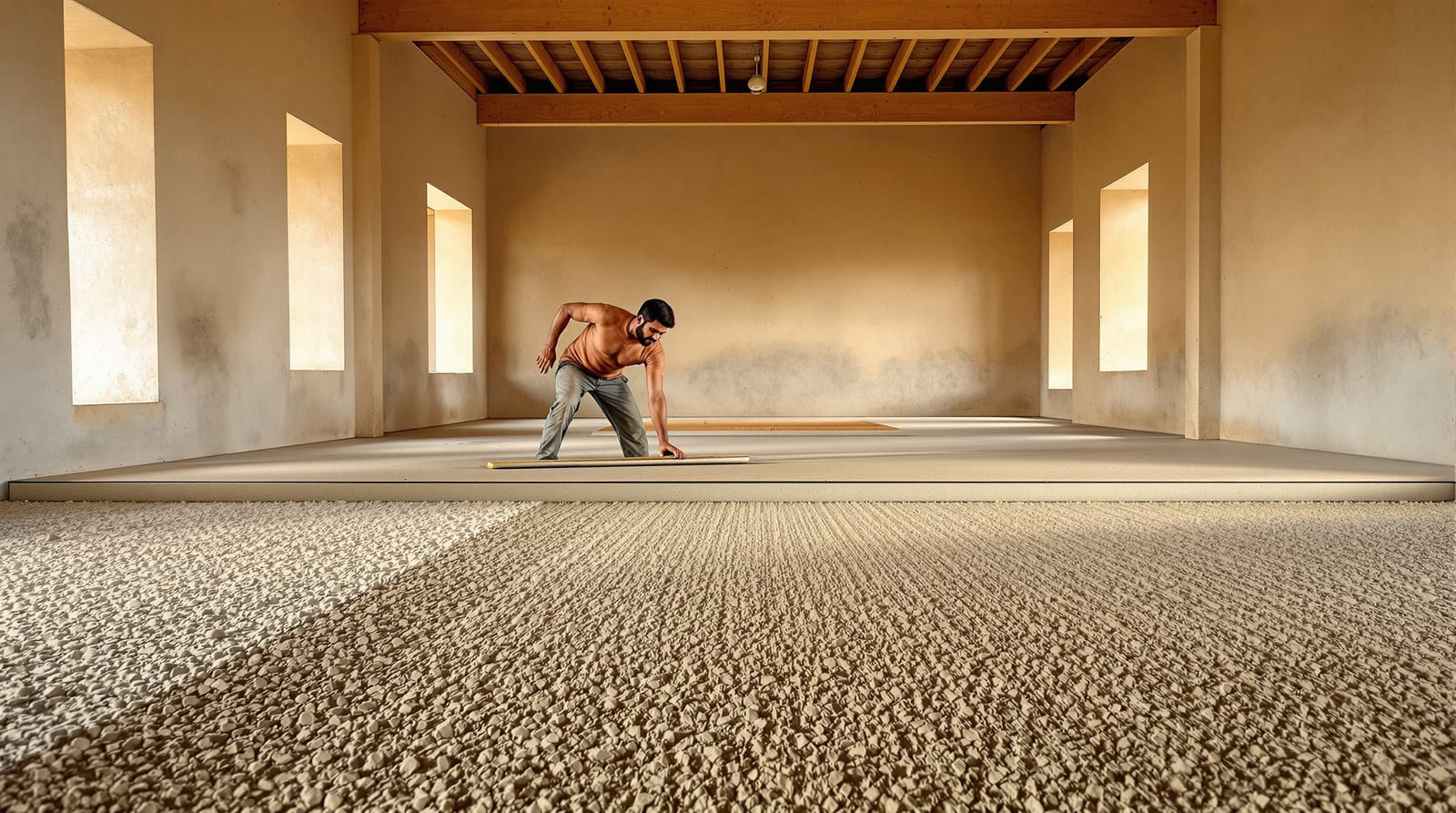
Floor Screed and Mortar Bed in India: Ratios, Thickness, Slopes and Curing
A specifier-grade guide to cement-sand screed and mortar bedding for Indian floors — bonded vs unbonded vs floating, 1:4 to 1:6 mixes, 25-75 mm thickness, falls to drains, mixing, curing and defect control.
The floor you walk on is rarely the floor that was cast. Between the rough structural slab and the finished tile, stone or wood sits a quiet, load-bearing layer that decides whether your finish lies flat, drains properly and stays bonded for decades: the screed and mortar bed. Get the ratio, thickness and curing right and the finish is forgotten in a good way. Get them wrong and you inherit hollow tiles, hairline cracks, ponding bathrooms and call-backs. This guide explains, for Indian site conditions, exactly how a cement-sand screed and mortar bed should be specified, mixed, laid, sloped and cured.
What a screed is, and why floors need one
A screed is a layer of cement-sand mortar applied over a base slab to create a smooth, level, correctly-sloped surface to receive the floor finish. It is not a structural element and it is not a finish in itself (unless deliberately power-floated and sealed as a wearing screed). Its jobs are simple but non-negotiable:
- Level and plane — the raw RCC slab from formwork is rarely flat enough; the screed corrects undulations so a thin-set tile or rigid plank does not rock or crack.
- Falls and slope — wet areas need a controlled gradient to drains; the screed builds this fall, not the finish.
- Cover and protection — it encases conduits, plumbing chases and waterproofing membranes.
- A uniform bonding plane — a consistent, sound surface for tile adhesive, mortar bed, or self-leveling compound.
In Indian practice the words "screed" and "mortar bed" overlap. A traditional floor is often laid on a thick cement-sand mortar bed (the bed and the leveling layer are one and the same), with tiles or stone pressed in wet on a neat cement slurry. A modern thin-set floor instead uses a screed to level first, then bonds the tile with adhesive on top. Both are cement-sand layers; the difference is whether the finish is bedded wet into it or fixed on top after it cures.
Where you only need to correct a few millimetres of unevenness, a cement-sand screed is the wrong tool — that is the job of a pumpable self-leveling compound. See our companion guide on the self-leveling-compound-india for thin sub-10 mm correction, and subfloor-preparation-india for getting the base sound before any leveling layer goes down.
Bonded, unbonded and floating screeds
How the screed connects to the base below changes its minimum thickness, its crack risk and its detailing. Choose the type before you choose the thickness.
| Screed type | Bond to base | Typical thickness | When to use | Watch-outs |
|---|---|---|---|---|
| Bonded | Bonded directly to slab via slurry / bonding agent | 25-40 mm | Thin leveling on a sound, clean slab; most interior floors | Base must be clean, sound and primed; debonding if dusty or laitance left on |
| Unbonded | Laid over a separating membrane (PE sheet / DPM) | 50-75 mm | Over waterproofing membranes, fresh slabs, where slab cracks should not transfer up | Needs more thickness to resist curling and cracking |
| Floating | Over insulation / acoustic / underfloor-heating layer | 65-75 mm (often reinforced) | Underfloor heating, acoustic separation (rare in plains India, common in hill homes) | Reinforce with mesh; honour heating-pipe cover |
A bonded screed is the workhorse for ordinary Indian interiors because the structural slab is doing the load-spreading and the screed is just there to plane and level. The moment a waterproofing membrane or a damp-proof membrane enters the build-up — almost always in bathrooms, balconies, terraces and ground-bearing slabs in humid zones — the screed becomes unbonded over that membrane and you must increase thickness accordingly. For waterproofing detailing in wet areas, IS 2645 covers integral waterproofing admixtures commonly dosed into the screed and plaster mortar.
Cement-sand ratio: 1:4 to 1:6
The mix ratio is the single most argued number on a slab edge. Richer (more cement) is stronger but shrinks and cracks more; leaner is weaker and dusts. For floor screeds and mortar beds in India the working band is 1:4 to 1:6 (cement:sand by volume), chosen by duty and thickness.
| Application | Cement:sand ratio | Notes |
|---|---|---|
| Bonded leveling screed, normal interior | 1:4 | Strong, good for thin 25-40 mm bonded layers and tile mortar beds |
| Thick mortar bed for stone / tile (thick-bed) | 1:4 to 1:5 | Forgiving on uneven base; richer end for heavy stone like granite/Kota |
| General floor screed, unbonded | 1:5 | Balanced strength and shrinkage for 50-75 mm |
| Sloping / falls layer to drains | 1:4 to 1:5 | Slightly richer holds shape on a gradient |
| Lean leveling fill under thick build-up | 1:6 | Only for bulk fill where strength demand is low; never as the final bonding plane |
Use clean, well-graded sharp/river sand (not silty plastering sand) for screed and bedding mortar; excess silt and clay drive shrinkage cracking and weak, dusty surfaces. Keep the mix as dry as workability allows — a "semi-dry" earth-moist consistency that holds a ball when squeezed but is not soupy. Excess water is the number-one cause of shrinkage cracking and a weak, hollow screed. A common professional addition is an SBR latex or acrylic bonding admixture into the slurry coat (and sometimes the mix) to improve adhesion and reduce cracking on bonded screeds.
Thickness: 25 to 75 mm
Thickness follows screed type, span between supports and the depth needed to bury the falls.
| Situation | Screed thickness |
|---|---|
| Bonded leveling screed (sound slab) | 25-40 mm |
| Unbonded over membrane / DPM | 50-65 mm |
| Floating (insulation / acoustic / UFH) | 65-75 mm |
| Thick mortar bed for natural stone | 25-50 mm |
| Falls layer in wet areas (at thinnest point) | 25 mm minimum, increasing up-slope |
Two rules carry most of the field practice. First, a bonded screed can go thin (down to ~25 mm) because the slab supports it, but below ~25 mm it tends to debond and curl — switch to a self-leveling compound instead. Second, an unbonded or floating screed needs body (50-75 mm) so it does not curl at edges or crack mid-span, and floating screeds over heating or insulation should carry a light welded mesh or fibre reinforcement.
Levels, falls and slope to drains
Set your finished floor level (FFL) first, work back through finish + adhesive/bed thickness, and that fixes the screed's top level. In wet areas the screed also builds the fall so water runs to the drain and never ponds. Indian wet-area practice uses a gradient of 1:80 to 1:100 — that is 10 to 12.5 mm of drop per metre of run toward the floor trap. Below 1:80 (steeper) feels noticeably tilted underfoot; flatter than 1:100 risks standing water, especially on textured anti-skid tiles. The slope is set in the screed, never faked in the tile bed, and the screed sits over the waterproofing membrane with the drain flange dressed into the membrane.
The diagram below shows a wet-area build-up: structural slab, waterproofing membrane turned up at the perimeter, the sloping screed falling to the drain, and the tile finish on top.
Mixing and laying
Good screed is as much method as material. The semi-dry mortar-bed method dominates Indian sites and tolerates an uneven base, which is why masons reach for it.
1. Prepare the base. Clean off dust, laitance, oil and loose material. For a bonded screed, hack/roughen a smooth slab, soak it to a saturated-surface-dry state, and apply a neat cement slurry (often with SBR latex) immediately before laying — lay the screed into the wet slurry. For unbonded work, lay the separating/waterproofing membrane first.
2. Set datums and falls. Establish FFL with a water level or laser, then set screed rails, dots or guide bands (mortar pads) to the correct levels and the planned fall. The whole quality of the floor is decided here.
3. Mix. Batch by volume to the chosen ratio (gauge boxes, not shovel-counts), mix dry first, then add minimum water to a semi-dry consistency. Mix only what can be laid before initial set (roughly 30-45 minutes in warm weather).
4. Lay and compact. Spread between the guide bands, compact firmly (semi-dry screed must be tamped/rammed, not just floated, to avoid voids), then strike off with a straightedge across the rails.
5. Float and finish. Wood-float for a tile substrate (a slightly open texture aids adhesive grip); steel-trowel only if the screed is the wearing surface. For a wet mortar bed receiving stone, broadcast neat cement and bed the slab while green.
6. Protect. Keep traffic off until set; cover from direct sun, wind and rain that cause rapid, uneven drying.
Curing
Curing is the step most often skimped, and it directly causes the cracking and weakness blamed on "bad mix". Cement hydration needs moisture and time. Keep the screed continuously moist — ponding, wet hessian/gunny bags, or a covering membrane — for a minimum of 7 days, and ideally toward 10-14 days in hot, dry, windy conditions (Rajasthan, Delhi summers). Do not flood-cure a screed laid over an underfloor-heating loop until cleared, and never switch heating on during early cure.
Allow time before loading the screed: light foot traffic typically after ~24-48 hours, but do not tile or fix finishes until the screed has cured and dried adequately — laying on green or damp screed traps moisture, weakens the bond and, under wood, causes cupping. A safe rule of thumb for tiling on cement-sand screed is at least 7 days of cure plus drying; rigid and moisture-sensitive finishes (wood, vinyl) need the slab/screed dry to spec moisture before they go down.
Common defects and how to avoid them
| Defect | Cause | Prevention / fix |
|---|---|---|
| Shrinkage cracking | Too much water; over-rich mix; silty sand; no curing; too thick in one pour | Semi-dry mix, clean sharp sand, 1:4-1:5, cure 7+ days; cut/honour movement joints |
| Hollow / drummy screed | Poor bond to base (dust, laitance, no slurry); voids from poor compaction | Clean and prime base, lay into wet slurry, compact (tamp) semi-dry screed fully |
| Weak, dusty surface | Lean/over-sanded mix, excess water bleeding fines, no curing | Correct ratio, minimum water, cure; surface-harden or re-do if severe |
| Curling at edges | Unbonded/thin screed drying faster at top; uneven drying | Adequate thickness (50-75 mm unbonded), even curing, reinforce floating screeds |
| Ponding in wet areas | No fall or fall too flat; high spots near drain | Build 1:80-1:100 fall in the screed; flood-test before tiling |
| Debonding from slab | Bonded screed too thin or base unsound | Min ~25 mm bonded; primer/SBR slurry; switch to SLC for very thin correction |
For wider build-quality pitfalls across the whole laying process, see flooring-installation-mistakes-india, and for joint placement that lets a large floor move without cracking the finish, floor-expansion-joints-india.
Cost in India
Screed and mortar-bed work is priced as part of the flooring labour package or separately as a leveling item. As an indicative 2026 range (varies by city, vendor and access; add 18% GST on materials):
| Item | Indicative rate |
|---|---|
| Cement-sand leveling screed (material + labour) | ₹40-90 per sq ft, by thickness |
| Thick mortar-bed laying labour (part of stone/tile work) | ₹25-60 per sq ft |
| Falls / slope-building screed in wet areas | ₹50-100 per sq ft (small areas, fiddly) |
| SBR / bonding admixture | ₹150-350 per litre |
Thicker screeds, wet-area falls and small fragmented areas push toward the upper end. For a quick materials and quantity estimate, use the subfloor-screed-calculator, and price the finish that sits on top with the flooring-cost-calculator.
Screed versus self-leveling compound — pick the right layer
A cement-sand screed builds depth (25-75 mm), corrects falls and tolerates a rough base, but it is hand-laid, slow to cure and only as flat as the mason's straightedge. A self-leveling compound flows to a near-perfect plane in thin lifts (typically under 10 mm) and cures fast, but it cannot build slopes, cannot go thick economically, and demands a sound, primed base. The professional workflow on demanding floors is often both: a cement-sand screed for the bulk depth and falls, then a thin SLC skim for a dead-flat finish under large-format PGVT or rigid planks. Then bond the finish per tile-laying-methods-india.
Frequently asked questions
What cement-sand ratio should I use for a floor screed?
For most Indian interior floor screeds and mortar beds, 1:4 to 1:5 (cement:sand by volume) is the standard band — 1:4 for thin bonded leveling and stone mortar beds, 1:5 for general unbonded screeds. Use 1:6 only as a lean bulk fill, never as the final bonding surface. Always use clean, sharp, low-silt sand and the minimum water that gives a workable semi-dry mix.
How thick should a floor screed be?
A bonded screed on a sound slab can be 25-40 mm. An unbonded screed over a waterproofing or damp-proof membrane needs 50-65 mm, and a floating screed over insulation or underfloor heating 65-75 mm with reinforcement. Below about 25 mm a cement-sand screed tends to debond and curl — use a self-leveling compound for very thin correction instead.
What slope should a bathroom or balcony floor screed have?
Build a fall of 1:80 to 1:100 in the screed toward the floor drain — roughly 10 to 12.5 mm of drop per metre. The slope is set in the screed over the waterproofing membrane, not faked in the tile bed, and you should flood-test before tiling to confirm water runs to the drain with no ponding.
Why is my screed cracking or sounding hollow?
Cracking usually means too much water, an over-rich mix, silty sand, or skipped curing. A hollow or drummy screed means it failed to bond — a dusty base, no slurry coat, or poor compaction of a semi-dry mix. Prevent both by using a clean primed base with an SBR slurry, a correct semi-dry 1:4-1:5 mix, full tamping, and at least 7 days of moist curing.
How long before I can tile on a new screed?
Keep light traffic off for 24-48 hours and do not fix tiles or finishes until the screed has cured and dried adequately — at least 7 days of moist curing plus drying for cement-sand screed. Moisture-sensitive finishes like wood and vinyl need the screed dry to their specified moisture limit, which can take considerably longer in humid weather.
Export this guide
Related Guides — Deep-dive reading
Subfloor Preparation in India: Get the Base Right Before Any Floor
Why the slab below decides whether your tiles go hollow or your wood cups — assessing, cleaning, repairing, leveling, moisture-testing, priming, screeding and laying over old tiles.
Flooring & SurfacesEpoxy Floor Application in India: Substrate Prep, Coats and Curing Step-by-Step
How a resin epoxy floor is actually laid in India — moisture testing and mechanical grinding, crack repair, primer, self-leveling vs broadcast vs coating systems, mixing ratios, pot life, coats and a full 7-day cure.
Flooring & SurfacesTile Adhesive Guide India: Types, IS 15477 Grades & How to Choose (2026)
A specifier's guide to tile adhesive (thin-set) for Indian homes - why it beats the traditional cement-sand mortar bed for vitrified, porcelain and large-format tiles, the IS 15477 types C1, C2 and C2-improved plus epoxy, and how to pick the right one for every substrate and location.
Building MaterialsRelated Tools — Try Free
Bathroom Waterproofing Calculator
Work out waterproofing material (kg/L) and cost for a bathroom by area, wall band, system type and coats — cementitious, acrylic, PU or SBR.
Bathroom CalculatorBathroom Floor Slope Calculator
Work out the floor fall to the drain and screed depth from the run and slope ratio — with a drains-properly verdict.
Bathroom CalculatorTile Adhesive Calculator
Estimate tile adhesive bags and cost by area and bed thickness, for floor or wall tiling jobs.
Flooring Calculator