
HVAC Sensors & IoT: The Data Layer Beneath Smart Cooling
You can't control what you don't measure — the sensors that let HVAC see (temperature, humidity, CO₂, occupancy, air quality, pressure), how IoT connectivity turns them into data, and why this sensing layer is the foundation every smart and AI HVAC system is built on.
Every smart or AI HVAC system rests on a simple truth: you can't control what you can't measure. Before any clever scheduling, prediction or optimisation is possible, something has to sense the building — its temperature, humidity, air quality, and whether anyone's even in the room. That sensing layer, connected by IoT, is the unglamorous foundation the whole smart-HVAC pyramid stands on. Understanding sensors explains how HVAC becomes responsive, efficient and intelligent — and why the data layer, not the app, is where smart cooling really begins. This guide covers it.
It builds on the Smart HVAC Guide, part of the HVAC Knowledge Hub.
Scope. This explains the sensing layer to inform understanding and specification. Sensor selection, placement, networking and integration are qualified controls/MEP engineering work.
The sensors that let HVAC see
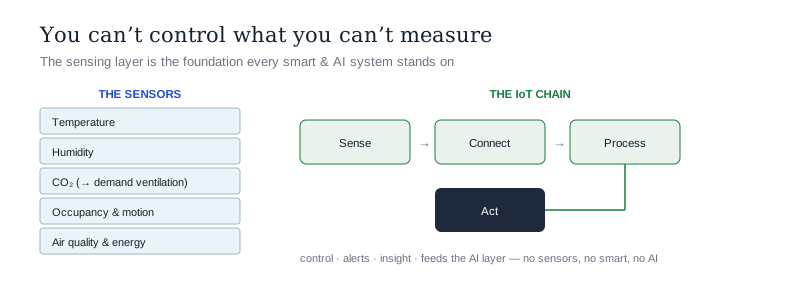
HVAC senses a space through a handful of measurements — each unlocking a control decision:
- Temperature — the basic input for every thermostat and controller.
- Humidity — essential in India, where moisture matters as much as temperature for comfort.
- CO₂ — a proxy for occupancy and fresh-air need; rising CO₂ means more people and stale air, enabling demand-controlled ventilation (bring in fresh air only when needed — a big energy saver; see ventilation).
- Occupancy / motion — whether a space is used, so HVAC conditions it only when occupied.
- Air quality (PM2.5, VOCs) — driving filtration and ventilation response (see IAQ).
- Pressure & airflow — for duct/plant control and filter-status monitoring.
- Energy/power — metering what the HVAC actually consumes, the basis of analytics.
Each sensor turns a physical condition into a number a controller can act on — the raw material of all "smart" behaviour.
How IoT turns sensors into intelligence
Sensors alone are just gauges; IoT (Internet of Things) connectivity is what makes them a system:
- Connectivity — sensors report over Wi-Fi, Zigbee, BACnet, Modbus, LoRa or wired links to a controller or gateway.
- Aggregation — a gateway or BAS collects readings from across the building into one data stream.
- Cloud & edge — data is processed locally (edge) for fast control and/or in the cloud for storage, analytics and remote access.
- Action — the processed data drives control (open a damper, stage a chiller), alerts (filter dirty, fault detected), and insight (energy dashboards) — and feeds any AI layer.
This chain — sense → connect → process → act — is what turns raw measurements into responsive, efficient, and eventually intelligent HVAC.
Why the sensing layer is the foundation
- Smart control needs data — a smart thermostat is only as good as its temperature (and ideally occupancy and humidity) sensing; add sensors and control gets smarter.
- AI needs even more data — machine learning (AI HVAC) is impossible without rich, reliable sensor streams to learn from. No sensors, no AI.
- Demand-controlled everything — CO₂ and occupancy sensing let ventilation and cooling follow real demand instead of running on fixed schedules — often the single biggest efficiency gain in a commercial building.
- You can't manage what you don't measure — energy and fault analytics all begin with metering and sensing.
Build the sensing layer well and everything above it — smart control, analytics, AI — becomes possible; skimp on it and the clever layers have nothing solid to stand on.
Getting it right
- Measure what drives decisions — temperature and occupancy almost always; humidity and CO₂ in most Indian applications; air quality where it matters.
- Placement matters — a sensor in the wrong spot (in a draft, in sun, behind furniture) gives misleading data and bad control.
- Reliability & calibration — sensors drift; they need occasional calibration, or the "smart" decisions built on them go wrong.
- Open protocols — prefer BACnet/Modbus/open standards to avoid lock-in and ease integration (as with the BAS).
- Privacy & security — connected sensors are a data and cybersecurity consideration; secure the network.
The one-line answer
Every smart or AI HVAC system rests on sensing — you can't control what you can't measure — so the data layer, not the app, is where smart cooling really begins. HVAC sees a space through temperature, humidity (vital in India), CO₂ (a proxy for occupancy and fresh-air need that enables energy-saving demand-controlled ventilation), occupancy/motion, air quality, pressure/airflow and energy sensors — each turning a physical condition into a number a controller can act on. IoT connectivity then turns those gauges into a system through the chain sense → connect → process → act: sensors report over Wi-Fi/BACnet/Modbus/LoRa to a gateway or BAS, data is processed at the edge or in the cloud, and it drives control, alerts and insight — and feeds any AI layer. This sensing layer is the foundation: smart control needs data, AI needs rich data (no sensors, no AI), and demand-controlled ventilation and energy analytics all start here. Get it right — measure what drives decisions, place and calibrate sensors properly, use open protocols, and secure the network — and everything above it becomes possible.
Where to go next
- What it enables: Smart HVAC Guide · AI in HVAC Guide.
- Where the data goes: Building Automation System Guide.
- Keeping systems healthy: HVAC Predictive Maintenance.
- What CO₂ sensing serves: Mechanical Ventilation Guide · Indoor Air Quality Guide.
References
- ASHRAE — sensing & demand-controlled ventilation guidance (Standard 62.1); BACnet (ASHRAE 135) & Modbus for sensor integration.
- ISHRAE — building sensing & controls; Bureau of Energy Efficiency (BEE) — metering & analytics: https://beeindia.gov.in/
- Industry literature on IoT connectivity (Zigbee, LoRa, Wi-Fi) and sensor calibration for buildings.
This guide informs understanding and specification. Sensor selection, placement, networking and integration are qualified controls/MEP engineering work.
Export this guide
Related Guides — Deep-dive reading
The Complete Guide to Smart Home Security in India
The umbrella guide to smart home security for Indian homes — what it really is (convenience, remote awareness and automation layered onto real security, not a replacement for it), the five layers of a system mapped to the whole library, and the two layers people skip: privacy and cybersecurity.
SecuritySmart Water Infrastructure & the Modern STP: A Practical Guide
How sensors, smart metering and automated control are turning the sewage treatment plant from a noisy basement box into a data-driven asset — and what that actually means for developers, owners and RWAs in India today.
Sewage Treatment PlantsHow to Choose a Security System (2026): The Master Buying Guide for Indian Homes and Buildings
The mental model that ties the whole buying decision together: start from your own risk, not a product; build the layers your situation actually needs; make the big architecture choices (wired vs wireless, local vs cloud, DIY vs professional); tell real product quality from marketing; and choose a vendor you can trust.
SecurityRelated Tools — Try Free
Cross-Ventilation Analyzer
Estimate airflow and air changes per hour (ACH) from room size, window areas, layout, and local wind — with NBC 2016 Part 8 compliance check.
Ventilation CalculatorAccess-Control Schedule Generator
Build the time schedules that decide when each access group can enter — an editable list for your integrator.
Time SchedulesAI Measurement Tool
Measure your room using voice, photos, or video sweep — no tape measure needed.
DesignAI