

AI in HVAC: Real Optimisation, Honest Hype, and What It Delivers
Machine learning is genuinely changing how large HVAC systems run — predictive control, fault detection and diagnostics, occupancy and weather prediction, and digital twins. A clear-eyed look at what AI actually does for HVAC, where it pays, and where it's just a label.
"AI" is the buzzword of the decade, and HVAC marketing has embraced it enthusiastically — often meaninglessly. But underneath the hype, machine learning is genuinely improving how large HVAC systems run: predicting demand, catching faults before they cause failures, and squeezing out energy that rule-based controls leave on the table. The trick is telling the real capability from the label. This guide gives a clear-eyed account of what AI actually does for HVAC, where it earns its keep, and where "AI mode" is just a sticker.
It builds on the Smart HVAC Guide and Building Automation System Guide, part of the HVAC Knowledge Hub.
Scope. This explains AI-in-HVAC concepts to inform evaluation. Designing and deploying such systems is specialist controls/data engineering work.
What AI actually does for HVAC
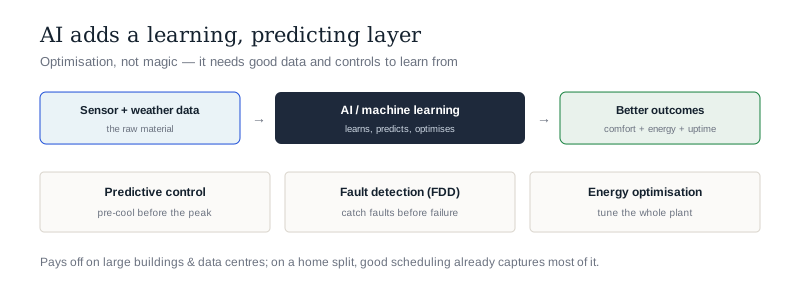
Stripped of hype, AI/ML adds a learning, predicting layer on top of conventional controls. The genuinely valuable applications:
- Predictive control — instead of only reacting to the current temperature, the system predicts load from weather forecasts, occupancy patterns and thermal behaviour, and pre-positions the plant (pre-cooling before a hot afternoon, easing off before people leave). This beats reactive control on both comfort and energy.
- Fault Detection & Diagnostics (FDD) — ML spots when equipment is drifting from normal — a fouling coil, a stuck damper, a failing sensor — often before it causes a breakdown or a comfort complaint, and points at the likely cause.
- Energy optimisation — continuously tuning setpoints, chiller sequencing, and airflows across a complex plant to minimise energy while holding comfort — a high-dimensional problem where ML can beat fixed rules.
- Occupancy & demand prediction — learning a building's rhythms to condition spaces just in time, not on a crude fixed schedule.
The common thread: learning from data to predict and optimise, where a human or a fixed rule can't keep up with the complexity.
Digital twins and analytics
Two related ideas often bundled with AI HVAC:
- Digital twin — a live virtual model of the building and its HVAC, fed by real sensor data, used to simulate "what if," test control strategies, and spot inefficiencies without touching the real plant.
- Analytics platforms — cloud services that ingest BAS and IoT sensor data to surface energy waste, benchmark performance and flag faults — sometimes AI-driven, sometimes just good dashboards.
Both are most valuable on large, complex, data-rich buildings where the savings justify the setup.
Where AI pays — and where it doesn't
- Pays off — large commercial buildings, campuses, data centres and chiller plants with big energy bills, many zones, and rich sensor data. Here, a few percent of continuous optimisation and early fault-catching is real money and real uptime.
- Marginal — a single home split AC. A good smart controller with sensible scheduling captures nearly all the achievable saving; a home rarely has the complexity or data for ML to add much beyond that.
- Just a label — "AI mode" on a consumer AC with no explanation of what it learns or does. Treat unexplained "AI" claims with healthy scepticism.
- The prerequisite — AI needs data and good controls first. Without solid sensing (IoT) and a working BAS, there's nothing for AI to learn from — you build the foundation before the intelligence.
Honest expectations
- It's optimisation, not magic — AI trims and predicts; it doesn't overcome an oversized chiller, a leaky envelope or bad ductwork. Fundamentals first (right-sizing, efficiency, envelope), then AI on top.
- Savings are real but modest per-percent — meaningful at scale (a big building's bill), small on a single home.
- Watch the dependencies — cloud reliance, data privacy, and vendor lock-in are real considerations for any AI HVAC platform.
- In India — most promising for the growing stock of large commercial buildings and data centres; for homes, disciplined smart scheduling is where the value is today.
The one-line answer
Beneath the hype, AI genuinely helps HVAC by adding a learning, predicting layer on top of conventional controls: predictive control (using weather forecasts and occupancy patterns to pre-cool and pre-position the plant rather than just react), fault detection & diagnostics (spotting a fouling coil or failing sensor before it breaks and pointing at the cause), and energy optimisation (continuously tuning setpoints, chiller sequencing and airflows across a complex plant) — often supported by digital twins and analytics platforms. But it pays off mainly on large, data-rich buildings — campuses, data centres, chiller plants — where a few percent of continuous optimisation is real money and uptime; on a single home split, a good smart controller with sensible scheduling already captures nearly all the saving, and unexplained "AI mode" labels deserve scepticism. Crucially, AI is optimisation, not magic: it needs good sensing and a working automation system to learn from, and it can't fix an oversized chiller or a leaky envelope — so get the fundamentals right first, then let AI trim what's left, most valuably in India's growing commercial and data-centre stock.
Where to go next
- The connected foundation: Smart HVAC Guide.
- What AI runs on top of: Building Automation System Guide.
- The data it needs: HVAC IoT & Sensors Guide · HVAC Predictive Maintenance.
- Fundamentals first: HVAC Energy Efficiency Guide.
References
- ASHRAE — Guideline 36 (high-performance sequences of operation) & research on FDD and predictive control; ISHRAE — smart-building guidance.
- Bureau of Energy Efficiency (BEE) — building energy optimisation & analytics: https://beeindia.gov.in/
- Industry literature on digital twins, fault-detection-and-diagnostics and ML-based HVAC optimisation.
This guide informs evaluation of AI-in-HVAC. Designing and deploying such systems is specialist controls/data-engineering work.
Export this guide
Related Guides — Deep-dive reading
AI in STP Operations: What Actually Works Today (and What Doesn't)
A practical, honest look at how AI and machine learning are used to run sewage treatment plants — optimising aeration and energy, predicting effluent quality, catching faults early, and easing operator dependence — with a clear-eyed view of what is mature and what is still marketing.
Sewage Treatment PlantsHVAC Predictive Maintenance: Catching Faults Before They Become Failures
The shift from fixing HVAC after it breaks to predicting problems before they happen — how connected sensors, remote monitoring and analytics catch a failing part early, the payoff in uptime and energy, and where it fits from data centres to smart homes.
HVAC & CoolingPredictive Home Automation India: Homes That Anticipate You
A reactive home waits for a command. A predictive home learns your rhythm and acts a step ahead — cooling the bedroom before you reach home, lighting the hallway before you stumble. Here is how anticipatory automation really works in an Indian home, what it needs, and how to start building it today.
Smart HomeRelated Tools — Try Free
Before & After Studio
Generate AI before-and-after renders to preview how your redesign could look.
DesignAIWindow Energy Savings Calculator
Compare standard glazing vs Low-E and DGU windows — annual cooling savings, 10-year savings and payback.
Window CalculatorConcept Generator
Get 3 AI-generated design concepts for any room with style, materials, and cost estimate.
DesignAI