

Air, Airflow & CFM: How Cooling Actually Travels Through a Building
Air is the delivery medium of comfort — this guide covers what air can carry, the airflow-to-cooling relationship (CFM and the sensible-heat equation), static pressure and why fans work harder than you'd think, and how airflow ties tonnage to duct size.
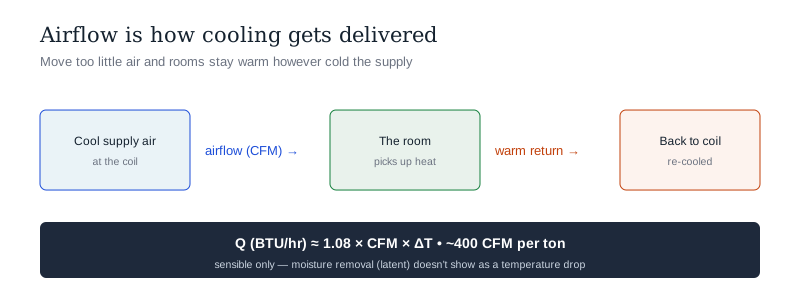
In most buildings, air is how cooling gets delivered — conditioned at a coil, then moved to where people are. So the amount of air a system moves is just as important as how cold that air is. Move too little and rooms stay warm however cold the supply; move it badly and you get noise, drafts and wasted fan energy. This guide covers air as the working medium of HVAC: what it can carry, the simple relationship between airflow and cooling, and why moving air costs more effort than intuition suggests.
It builds on HVAC Fundamentals, part of the HVAC Knowledge Hub.
Scope. A conceptual guide. Airflow design, fan selection and balancing are qualified MEP/HVAC engineering work.
What air can carry
Air's ability to carry heat comes from two properties:
- Density — air has mass (about 1.2 kg/m³ at sea level; thinner at altitude, which matters for hill-station design).
- Specific heat — how much energy it takes to warm a given mass of air by one degree.
Together these set how much heat a stream of air can pick up or drop off. Because air isn't very dense, you need to move a lot of it to shift meaningful heat — which is why ducts and fans are large, and why airflow is a first-order design quantity, not an afterthought.
The airflow-to-cooling relationship
The workhorse relationship every HVAC practitioner knows links airflow, temperature change and sensible cooling:
- In imperial units: Q (BTU/hr) ≈ 1.08 × CFM × ΔT, where CFM is airflow and ΔT is the temperature drop across the coil (the 1.08 bundles air's density and specific heat).
- Read it two ways: for a given cooling job you can move more air with a smaller temperature drop, or less air with a bigger drop — a real design trade-off (more airflow = better mixing and comfort but bigger ducts/fans).
- The rule of thumb: roughly 400 CFM per ton of cooling is a common design airflow for comfort air conditioning — which is exactly the link the duct size calculator and AC capacity calculator rest on.
- Latent caveat: this equation is sensible only. Moisture removal (latent) doesn't show up as a temperature drop — another reason humid-climate design can't be done on temperature alone (see psychrometrics).
This is why "tonnage," "airflow" and "duct size" are three views of one system: the load sets the tons, the tons set the airflow, and the airflow sets the ducts.
Static pressure — why fans work hard
Moving air isn't free — the air resists being pushed:
- Static pressure — the resistance the fan must overcome, built up from every duct, bend, filter, coil, damper and diffuser in the path.
- It compounds — long runs, tight bends, dirty filters and undersized ducts all raise it, and the fan must work harder (using more energy, making more noise) to deliver the same air.
- Fan power rises steeply — pushing more air, or the same air against higher resistance, costs disproportionately more energy (fan power climbs roughly with the cube of airflow). This is why oversized airflow and restrictive ductwork are expensive forever, and why variable-speed fans save so much at part load.
- Practical signs — weak airflow at far rooms, a straining blower, or high bills often trace to static pressure: a clogged filter, crushed flexible duct, or ducts too small (see duct design).
Air movement and comfort
Airflow isn't only about heat delivery — it's a comfort factor in its own right:
- Gentle movement helps — it aids evaporation and mixing, letting you feel comfortable a degree or two warmer (the reason a fan works).
- Too much is a draft — cold, fast air on the neck is uncomfortable; diffusers are placed and sized to throw air so it mixes before reaching people.
- Stagnant air feels stuffy — even at the right temperature, still air reads as oppressive.
Good design delivers enough air, well-mixed, without drafts — a balance of quantity, velocity and placement.
The one-line answer
Air is the medium that delivers cooling, so how much a system moves matters as much as how cold it is. Air carries heat through its density and specific heat, but because it isn't dense you must move a lot of it — which is why the workhorse relationship Q ≈ 1.08 × CFM × ΔT links airflow and temperature drop to sensible cooling, with roughly 400 CFM per ton as a common design airflow (tying load → tonnage → airflow → duct size into one system). That equation is sensible only — moisture removal doesn't appear as a temperature drop, so humid-climate design still needs psychrometrics. Moving air costs real effort: static pressure (the resistance from ducts, bends, filters and coils) makes fans work harder, and fan power rises steeply with airflow — so oversized airflow, dirty filters and undersized ducts are expensive forever, while variable-speed fans save at part load. Finally, air movement is itself a comfort factor: gentle, well-mixed airflow lets you feel comfortable warmer, while drafts and stagnant air both read as uncomfortable.
Where to go next
- The physics context: HVAC Fundamentals Guide.
- Size the ducts: Duct Size Calculator · HVAC Duct Design Guide.
- Why sensible-only isn't enough: Psychrometrics Guide.
- The comfort side: Thermal Comfort Guide.
References
- ASHRAE Handbook — Fundamentals (Psychrometrics; Duct Design; the sensible-heat airflow relationship) and Standard 90.1 (fan power).
- ISHRAE — airflow & air distribution design guidance; Bureau of Energy Efficiency (BEE) — ECBC fan-energy provisions: https://beeindia.gov.in/
- National Building Code of India, SP 7 (Part 8 — Building Services; verify current edition), Bureau of Indian Standards.
A conceptual guide. Airflow design, fan selection and balancing are qualified MEP/HVAC engineering work. Verify any standard's current status via the BIS catalogue before relying on it.
Export this guide
Related Guides — Deep-dive reading
HVAC Fundamentals: The Physics Behind Comfort
The ideas underneath every system — the four things HVAC actually controls (temperature, humidity, air movement and air quality), how heat moves, the difference between sensible and latent heat, and why a cooling load is more than just 'how hot it is', for the Indian climate.
HVAC & CoolingFlooring Thermal Comfort in India: How Your Floor Affects Heat, Cold and Energy Bills
The physics of why stone and tile feel cool while wood, cork and carpet feel warm, and how to match the floor to your climate zone so the surface under your feet works with the weather instead of against it.
Flooring & SurfacesEnergy-Efficient Facades in India: How the Building Skin Cuts Your Cooling, Heating & Lighting Bills
How a building facade drives cooling, heating and lighting energy in India, the three levers of solar-heat-gain control, insulation and daylighting, U-value, SHGC, VLT and WWR in plain terms, ECBC and Eco-Niwas expectations, and real Indian green buildings.
Building FacadesRelated Tools — Try Free
AC Capacity Calculator
Find the right air-conditioner tonnage for a room — from area, sun, floor, occupancy and climate. Right-sized, not oversized.
HVACBrise-Soleil Visualizer
Interactive horizontal-louvre cut-off angle calculator — sun altitude, louvre depth, and spacing inputs with a live shadow preview. Computes θ = arctan(spacing/depth) for façade shading, ECBC envelope compliance, hospital daylight design, and tropical sun-control detailing.
Sun Shading ToolBefore & After Studio
Generate AI before-and-after renders to preview how your redesign could look.
DesignAI