
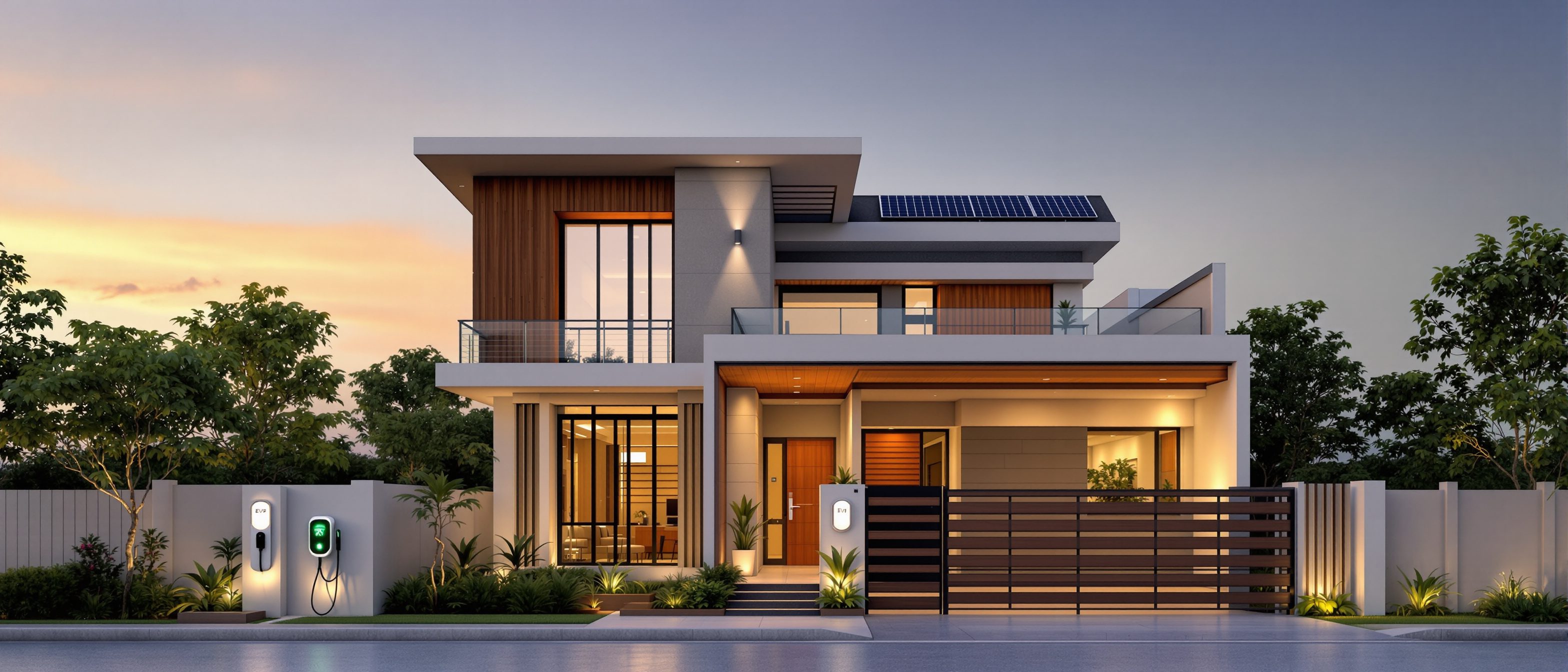
Designing for Future Resale Value
Which design choices hold and grow your home's value to 2035 and beyond
Most people building a home in 2026 are not thinking about 2035. They are thinking about the next eighteen months: the slab, the brickwork, the kitchen, the housewarming. That is natural. But somewhere in that home is a decision worth several lakh rupees that nobody will notice until the day you decide to sell or that decision will appear as a quiet line item in the buyer's head, a number they subtract from your asking price without ever saying it out loud.
A buyer in 2035 walks through your house in about eleven minutes. In those eleven minutes they form a price. They notice the light, the smell of damp or its absence, whether the rooms feel generous or mean, whether the kitchen looks like 2026 or like 2018, whether there is a place to charge a car and work from home, and whether the paperwork is clean. They are not appraisers. They are reacting to design decisions you made today, years before they arrived.
You cannot control your home's location, and location dominates price more than anything else. You cannot control whether the metro line gets extended or the city's job market booms. What you can control is whether your home is the best or the worst version of itself within the price band that its location allows. That margin where design protects and nudges value is entirely yours to win or lose.
A home's resale value is set mostly by location and market, but design decides where you land inside that band and a handful of cheap, deliberate choices made before the drawings are frozen are what separate a home that holds and grows value from one that quietly bleeds it.
This guide is the financial lens over the whole Future-Ready Homes cluster. It does not teach you how to build a solar-ready roof or an income unit the sibling guides do that. It tells you which of those choices actually compound in value, which destroy it, and how to run every big decision through a resale lens before you commit. For the design philosophy behind it all, start with the pillar, designing homes for 2040.
1. Location dominates — but design is the margin you own
Let us be honest from the first paragraph, because honesty is what makes the rest of this guide trustworthy. In Indian residential resale, location, connectivity, and the wider market cycle explain the large majority of what a home sells for. Two identical homes one in a well-connected, high-demand pocket of Pune and one in a fringe layout an hour out will fetch wildly different prices no matter how cleverly either is designed. No amount of good planning beats a bad location.
So why does design matter at all? Because within a given location, there is a real spread typically a band of fifteen to twenty-five percent between the best-presented, best-planned, best-documented home and the tired, awkward, paperwork-troubled one next door. That band is the margin design controls. You will not move the floor of your price band; you decide whether you sit at the top of it or the bottom.
Treat location as the price band you are born into, and design as the position you earn inside it. You cannot change the band. You can absolutely change where you sit.
The rest of this guide is about winning that margin and, just as importantly, not throwing it away through avoidable mistakes.
2. The durable value drivers you actually control
Some design qualities have held their value through every fashion cycle of the last forty years and will hold it through the next fifteen. They are unglamorous, which is exactly why they are reliable. A buyer cannot always articulate them, but they feel them in those first eleven minutes.
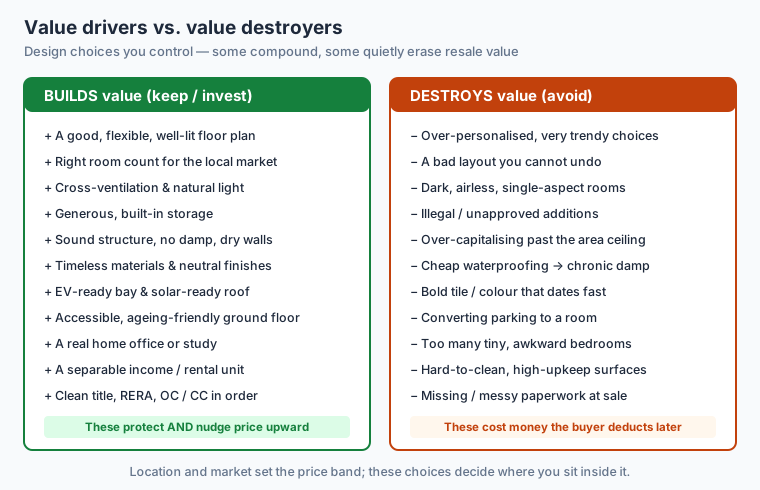
Figure 1: The choices you control split cleanly into value drivers that compound and value destroyers that the next buyer silently deducts from your price.
The durable drivers are these. A good, flexible, well-lit floor plan a layout that feels generous, where rooms connect sensibly and can change use without demolition. The right room count and mix for the local market: in most Indian cities a well-planned 3BHK is the broadest, most liquid product, while a quirky 5BHK or a one-room oddity narrows your buyer pool sharply. Quality of light and cross-ventilation, which no buyer ignores and no later owner can easily add. Generous, built-in storage, which Indian families never have enough of. A sound structure with no damp and dry, crack-free walls the single thing that, when absent, kills deals outright. And timeless, neutral materials that read as current rather than dated.
These drivers share one property: they are almost impossible to retrofit. You cannot add good light to a deep, single-aspect room after the fact. You cannot un-build a cramped layout. This is why the cluster's signature idea provisioning, laying cheap groundwork now so an expensive upgrade later is plug-and-play applies to value too. The cheapest time to buy resale value is during design. Everything after is retrofit, at retrofit prices.
3. The future-buyer premium: features 2035 buyers will pay for
Beyond the timeless drivers, a newer category is emerging: features that command little or no premium today but that the 2035 buyer will actively pay extra for, because by then they will have shifted from luxury to expectation. These are the features the rest of this cluster teaches you to build and they are precisely the ones that compound in value.
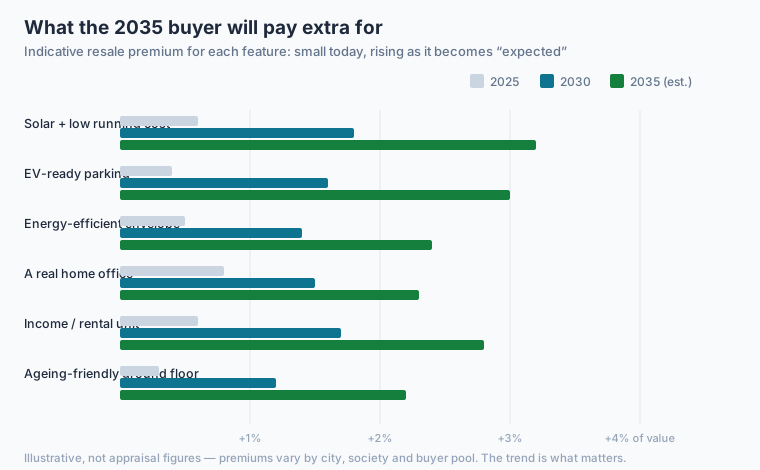
Figure 2: The resale premium for future-ready features is small today and rising. Provision for them now, when it is cheap, and you sell into a market that has learned to demand them.
Consider what is changing. An EV-ready parking bay is a curiosity in 2026; by 2035, with India's electric-vehicle share climbing fast, a buyer who already owns or plans to own an EV will treat its absence as a problem to solve a deduction. A solar-ready roof and low running costs speak directly to a buyer's monthly bills, and a home that costs less to run is worth more to own; the logic of net-zero energy homes and naturally energy-efficient design is becoming a resale argument, not just a green one. An accessible, ageing-friendly ground floor widens your buyer pool to include India's fast-growing population of older homeowners and the multi-generational families who increasingly plan for parents. A proper home office became non-negotiable for a large slice of buyers after 2020 and is not going back. And a separable income or rental unit turns a home into a partly self-funding asset run the numbers on what that rent is worth with the rental yield calculator.
The key insight is timing. Each of these is cheap to provision during construction a stubbed circuit, a roof oriented for panels, a separable entry, a wider door and expensive or impossible to retrofit. You are not paying for the feature today; you are paying a few thousand rupees to keep the option open, then selling into a 2035 market that prices the feature as standard. That is the cleanest value arbitrage in homebuilding.
| Future-ready feature | Provision now (during build) | Retrofit later (finished home) | Why the 2035 buyer pays for it |
|---|---|---|---|
| EV-ready parking | Spare circuit + conduit to bay, ~₹8,000–15,000 | Wall-chase a new line, ₹30,000–60,000+ | EV ownership mainstream; no charging point is a deduction |
| Solar-ready roof | Orientation + cable route + roof allowance, ~₹10,000–20,000 | Structural and wiring rework, often 2–3× | Lower monthly bills read straight into willingness to pay |
| Income / rental unit | Separable entry + a stubbed kitchen point, ~₹40,000–80,000 | Re-plan and re-route services, often not feasible | A part-self-funding home is worth more than the sum of its rooms |
| Ageing-friendly ground floor | Step-free entry, wider doors, blocking in walls, ~₹15,000–30,000 | Demolish and rebuild thresholds and bathrooms | Older buyers and multi-gen families are a growing share of demand |
4. The value destroyers — what quietly erases your margin
For every driver that builds value, there is a destroyer that erases it, often invisibly, until the day a buyer's offer comes in lower than you expected. These are the choices to catch before they are built.
The first and largest is over-personalisation and trend-chasing. The bold feature wall, the jet-black kitchen, the heavily themed pooja room, the swimming-pool-blue bathroom tiles all of it reads as your taste, not the buyer's, and taste is the fastest thing to date. A buyer mentally prices the cost of ripping it out. Neutral does not mean boring; it means the buyer can imagine themselves living there without a renovation budget.
The second is a layout you cannot undo. Trendy finishes can be repainted; a badly planned home cannot. A dark core, a kitchen with no natural light, bedrooms you can only reach by walking through another bedroom, a single bathroom for four bedrooms these are permanent deductions. The third is illegal or unapproved additions: the covered terrace, the extra floor, the parking converted to a room. These do not add value; in a careful transaction they subtract it, because the buyer inherits the risk of demolition or regularisation. The fourth is over-capitalising past the locality ceiling. Every area has a price beyond which buyers simply will not go, regardless of how much you spent. Italian marble and imported fittings in a tier-2 layout do not return their cost; you are gifting that money to the next owner.
| Value destroyer | Why it hurts at resale | Cheaper alternative that protects value |
|---|---|---|
| Very trendy tile, colour, theming | Reads dated fast; buyer prices removal | Neutral palette; express taste in movable decor |
| Bad layout (dark, awkward, no flow) | Permanent; cannot be repainted away | Get the plan right with the layout planner before building |
| Illegal / unapproved additions | Transfers demolition risk to buyer | Build to the sanctioned plan; regularise before sale |
| Over-capitalising past area ceiling | Spend does not return; gifted to buyer | Benchmark spend with the cost calculator |
| Cheap waterproofing | Damp kills deals outright | Spend on the structure and waterproofing, not the show |
5. Timeless versus trendy: a material strategy that ages well
The simplest rule for materials is to spend permanence money on permanent things and fashion money on movable things. The floor, the structural finishes, the bathroom tiling, the kitchen carcass these are expensive and disruptive to change, so they should be quiet, neutral, and durable. The cushions, the curtains, the light fittings, the decor these are cheap and easy to change, so this is where your personality belongs.
Put your money where it cannot move and your taste where it can. A neutral floor with a bold rug lets the next owner keep the floor and roll up the rug.
Timeless materials in the Indian context tend to be: large-format neutral vitrified tiles or natural stone in restrained tones, matte and satin finishes rather than high-gloss that dates, warm wood tones over ultra-trendy colours, and a coherent, limited palette rather than a different statement in every room. The low-maintenance kitchen guide and modern construction materials guide go deeper on durable specifications. The test is simple: would this material choice look deliberate, not dated, to a buyer fifteen years from now? If you are choosing it because it is the look of this year, that is a warning sign.
6. Storage, light and the things buyers feel but cannot name
Two qualities punch far above their weight at resale precisely because buyers respond to them emotionally before they reason about them: storage and natural light. Neither shows up as a line on a brochure, yet both shape the offer.
Storage is the perennial Indian shortfall. Built-in wardrobes, a utility area, a loft, a store room, kitchen cabinetry that actually holds a family's vessels these read as a home that works. A home short on storage feels cramped even when it is large, and the buyer feels it without knowing why. Light and cross-ventilation do the same in reverse: a bright, airy home feels larger, healthier, and more valuable than its square footage alone, and an Indian buyer who has lived through power cuts and humid summers instinctively values a home that is comfortable without the air conditioner running. This is the same logic that drives climate-adaptive and passive design and it converts directly into resale appeal, because a home that is cheap and pleasant to live in is a home buyers compete for.
7. Documentation and approvals are resale value, not paperwork
Here is a truth that surprises first-time sellers: a sizeable part of your home's resale value lives in a folder, not in the walls. Clean, complete documentation is one of the cheapest forms of value to protect and one of the most expensive to recover once it has lapsed.
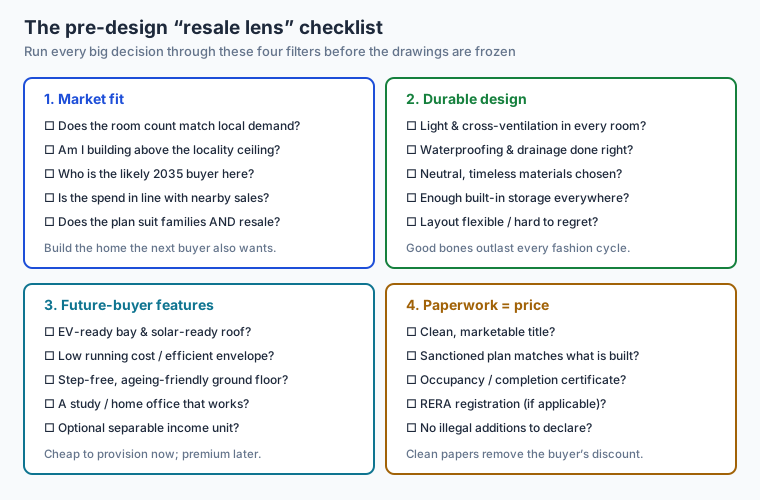
Figure 3: The resale lens. Run every major decision through these four filters market fit, durable design, future-buyer features, and paperwork before the drawings are frozen.
A buyer or, more pointedly, a buyer's bank pays full price only for a home with clean, marketable title, a sanctioned plan that matches what is actually built, and an occupancy or completion certificate. Where it applies, RERA registration adds a layer of trust; the RERA guide explains what buyers and their lawyers will check. A home where the built reality has drifted from the sanctioned plan an extra room here, a covered balcony there forces the buyer to choose between walking away, demanding a discount, or financing a risk. Every one of those outcomes costs you money.
In a resale, missing paperwork is not a delay. It is a discount. The buyer prices the uncertainty, and the bank may refuse the loan entirely.
The design lesson is to build to the sanctioned plan in the first place, keep the as-built honest, and treat the approvals folder as part of the asset. It is far cheaper to keep documentation clean than to regularise an addition years later under pressure of a sale.
8. Don't over-build: the locality ceiling and the cost calculator
Over-capitalising deserves its own section because it is the most common way well-meaning, well-funded owners lose money. Every locality has a ceiling a price beyond which buyers will not pay, set by the area's character and comparable sales, not by your invoices. Spend below that ceiling and your improvements largely return. Spend above it and the excess does not come back; you have effectively pre-paid the next owner's luxuries.
The discipline is to benchmark. Before you specify imported fittings or a third extra bathroom, look at what comparable homes in your pocket actually sell for, and where the marginal rupee stops returning value. The cost calculator helps you sanity-check your build spend against realistic per-square-foot norms, and the EMI calculator helps you see the true financing cost of any over-spend. The goal is not to build cheaply it is to build appropriately, putting money where it returns (structure, light, storage, future-ready provisioning) and holding back where it does not (showy finishes past the ceiling).
9. The resale lens: a pre-design checklist
Bring it together as a habit. Before the drawings are frozen and again at every major decision run the choice through four filters. This is the resale lens, and it costs nothing to apply.
Market fit. Does the room count and mix match local demand? Am I building above the locality ceiling? Who is the likely 2035 buyer in this pocket, and does this plan suit them as well as it suits me? A well-planned 3BHK is liquid; an idiosyncratic layout narrows your buyers.
Durable design. Does every room have light and cross-ventilation? Is the structure sound and the waterproofing properly done? Are materials neutral and timeless? Is there enough built-in storage? Is the layout flexible enough that I will not regret it the flexible homes guide is the companion here.
Future-buyer features. Have I provisioned an EV bay and a solar-ready roof? Is the ground floor step-free and ageing-friendly? Is there a workable home office? Have I kept the option of a separable income unit open? Each of these is cheap now and a premium later.
Paperwork equals price. Is the title clean? Does the sanctioned plan match what I am building? Will I have an OC or CC? Is RERA handled where it applies? Are there any unapproved additions I would have to declare?
If a decision passes all four filters, it is almost certainly building value. If it fails any of them, you are likely creating a future deduction and the time to catch it is now, on paper, not in eleven minutes of a stranger's walkthrough in 2035. Design cannot beat location. But within your band, this is how you sell at the top of it instead of the bottom.
Sources & further reading
- Real Estate (Regulation and Development) Act, 2016 (RERA) and respective State RERA portals registration, sanctioned-plan and disclosure norms relevant to resale.
- National Building Code of India (NBC) 2016, Bureau of Indian Standards parts on residential planning, lighting, and ventilation (SP 7).
- Bureau of Energy Efficiency (BEE), Eco Niwas Samhita (ENS) 2018 residential energy-efficiency code informing the "low running cost" buyer premium.
- Ministry of New and Renewable Energy (MNRE) and PM Surya Ghar: Muft Bijli Yojana rooftop-solar context for the solar-ready resale argument.
- Local municipal building bye-laws and the relevant Development Control Regulations occupancy/completion certificate and as-built compliance requirements.
- Ernst Neufert, Architects' Data room-sizing, circulation and storage benchmarks behind durable plan quality.
Pairs with the pillar designing homes for 2040, and with income-ready home design and net-zero energy homes the future-ready features that compound in value.
Export this guide
Related Guides — Deep-dive reading
Designing a Naturally Energy-Efficient Indian Home
Comfort first, gadgets last — passive design, orientation, insulation, ventilation and the climate wisdom that cuts Indian energy bills
SustainabilityThe Trade-Offs Every Homeowner Has to Make
No one gets everything — every home is a stack of compromises. This is about the sacrifices: the cost-quality-time triangle, the recurring homeowner trades, and how to make your cuts on purpose instead of having them forced by a blown budget.
Planning Your ProjectFuture-Proof Home Design for Indian Families
Designing today for the family you will be in 10–20 years — flexibility, services and adaptability
Home PlanningRelated Tools — Try Free
Cross-Ventilation Analyzer
Estimate airflow and air changes per hour (ACH) from room size, window areas, layout, and local wind — with NBC 2016 Part 8 compliance check.
Ventilation CalculatorBathroom Renovation Cost Calculator
Cost to renovate an existing bathroom with a replace-vs-keep model — demolition, re-waterproofing, tiles, fittings and the money saved by keeping items.
Bathroom CalculatorHome Building & Interior Cost Calculator — 20 Cities
Construction + interior costs for 20 Indian cities across kitchen, wardrobes, flooring, painting, ceiling.
Cost Calculator