
Net-Zero Energy Homes in India
Designing a home where annual energy made matches energy used
Walk onto almost any new rooftop in Pune, Coimbatore or Ahmedabad today and you will find solar panels. That is the easy, visible part. The harder, invisible question is the one your electricity bill answers every month: across a whole year, did your home make as much energy as it used? Most solar homes never ask it. They bolt on a 3 kW array, watch the bill drop, and stop there, never realising they are still importing two-thirds of their power from the grid.
Net-zero is the discipline of actually closing that gap. It is not a gadget you buy; it is a design target that touches your walls, your windows, your appliances, your roof and your meter at once. And in India, with a coal-heavy grid, a brutal cooling season and a monsoon that flattens solar output for eight weeks, the honest version of net-zero is more demanding, and more interesting, than the brochures suggest.
The good news is that you do not have to reach net-zero on the day you move in. You have to provision for it: orient the house right, build a roof that can carry a full array, run a conduit and leave meter and panel headroom, so the path to net-zero stays open and cheap. Hit it in year one if you can; if not, you have left the door unlocked instead of welded shut.
Net-zero is not a product you install but a balance you design for: cut the demand first, generate to meet the smaller load, store and offset the rest, and provision the bones of the house so the target stays reachable for the next fifteen years.
1. What net-zero actually means (and the honest caveats)
Strip away the marketing and there are three related targets, in rising order of ambition:
- Nearly-zero / energy-efficient: the home is designed so its energy demand is very low to begin with, even before any solar. This is what India's residential energy code, the Eco Niwas Samhita, pushes toward. It is the foundation, not the finish line.
- Net-zero energy: over a full year, the energy your home generates on-site (almost always rooftop solar) is equal to or greater than the energy it consumes. You still draw from the grid at night and in the monsoon, and you still push surplus back on sunny winter mornings, but the annual books balance to roughly zero.
- Energy-positive: the home generates more than it uses across the year, exporting a genuine surplus, often to charge an EV or feed a second meter.
The critical word in net-zero is annual. No grid-connected Indian home is independent of the grid hour to hour. At 11 pm in July your panels are dark and you are running on imported power; at 10 am in January you are exporting hard. Net-metering is the accounting trick that lets a sunny month's surplus pay for a cloudy month's deficit. So a net-zero home in India is almost never an off-grid home, it is a grid-tied home whose meter nets out to zero over twelve months.
Two caveats worth saying plainly. First, net-zero on electricity is not the same as net-zero on carbon: if you export solar at noon and import coal power at night, your kWh balance can be zero while your home still leans on a fossil grid for its night load. Second, the balance is sensitive to what you count. A home that looks net-zero on paper can quietly slip into deficit the year you add an EV, a second AC or a home office. Design for the load you will have in five years, not the one you have today.
Eco Niwas Samhita 2018 (Part I, building envelope) and 2021 (Part II, electro-mechanical systems) together form India's residential energy code, now folded into ECBC-R. The headline metric is the Residential Envelope Transmittance Value (RETV) for the building skin, capped at 15 W/m2 across most climate zones. A low RETV is the cheapest route to a low cooling load, which is the cheapest route to net-zero.
2. The order of operations: reduce, generate, store, offset
The single most expensive mistake in net-zero is doing it backwards: sizing a giant solar array to feed a wasteful house. The right sequence runs the other way, and every rupee you spend low on the ladder shrinks what you must spend higher up.
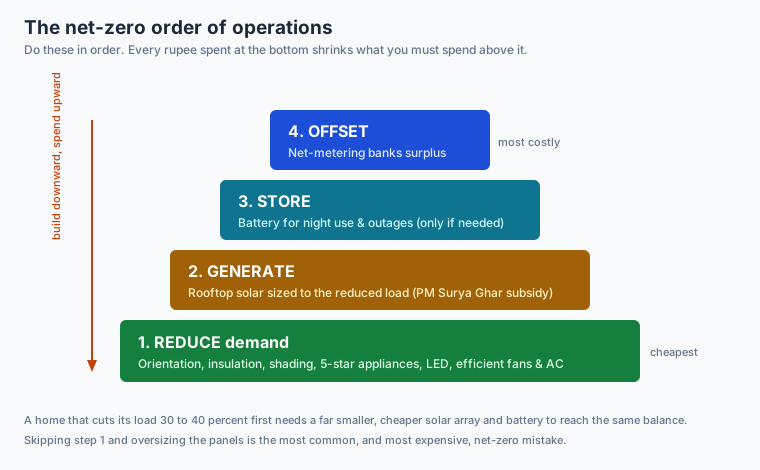
Figure 1: Build downward, spend upward. A home that cuts its load 30 to 40 percent first needs a far smaller, cheaper array and battery to reach the same balance.
Reduce first. Orientation, shading, insulation and a tight envelope cut your cooling load, which is the largest single slice of an Indian home's energy. Then efficient appliances: a 5-star inverter AC, a 5-star fridge, LED lighting, BLDC ceiling fans, a heat-pump or solar water heater instead of an electric geyser. None of this generates a watt, but it can erase 30 to 40 percent of your demand before a single panel goes up. We do not re-teach the envelope here; the passive playbook lives in passive design for India's climate zones and the appliance-and-habit layer in the naturally energy-efficient Indian home.
Generate second. Now, and only now, size your rooftop solar to the reduced load. A home that did its envelope homework might need a 4 kW array where a careless neighbour needs 7 kW for the same comfort. The structural and orientation groundwork for that array, roof tilt, load rating, shadow-free zones, conduit, is its own topic: see designing a solar-ready home, and for install economics and payback, solar power for Indian homes.
Store third, and only if you need to. A battery does not get you to net-zero on its own, net-metering already banks your surplus. A battery buys you night-time self-consumption and outage backup, which matters more in states with weak net-metering terms or frequent cuts. Sizing and economics are covered in home battery backup power; do not buy storage to chase net-zero when the grid will store your surplus for free.
Offset last. Net-metering is the meter-level accounting that nets your annual import against your export. It is the cheapest storage you will ever have, but its rules are set by your DISCOM and they change. We come back to it in section 6.
3. The energy-balance arithmetic: a worked example
Net-zero stops being abstract the moment you put numbers to it. Here is a worked balance for a mid-size urban Indian home, the kind of 3BHK independent house or large apartment a serious homeowner is building in 2026.
Start with consumption. A reasonably efficient such home, after the reduce step, runs around 4,500 kWh per year, roughly 375 units a month on average, swinging from 250 in mild months to 550 in peak summer. Where it goes:
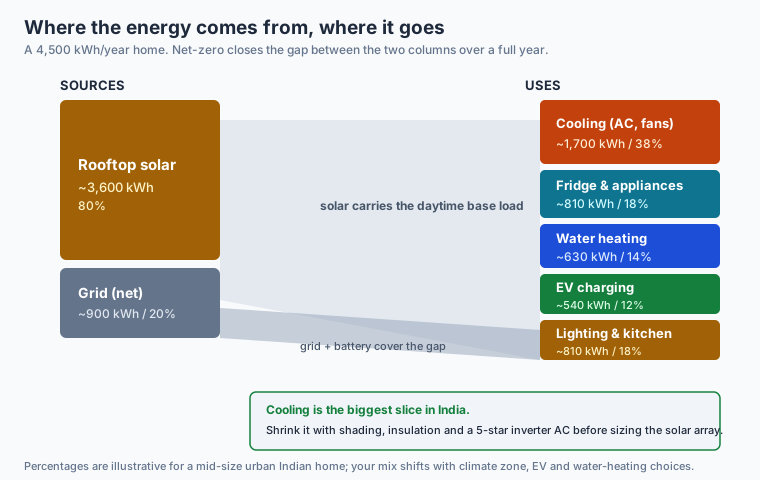
Figure 2: Cooling is the biggest slice in India. Shrink it before sizing the array, not after.
Now generation. In most of India a rooftop array produces about 1,400 to 1,600 kWh per year for every 1 kW installed, the higher end in the sunny north-west and Deccan, the lower end in the cloudier east and the Western Ghats. Take 1,500 kWh/kW as a working figure. To generate 4,500 kWh on-site you need roughly 3 kW of panels, which is about 18 to 20 sq m of shadow-free roof. Many homes oversize slightly to 4 kW to cover an EV or future load and tip into energy-positive.
| Item | Annual figure | Notes |
|---|---|---|
| Household consumption (post-reduce) | 4,500 kWh | 5-star AC, fridge, BLDC fans, LED, solar water heater |
| Specific yield | 1,500 kWh / kW / year | Pan-India average; higher in Rajasthan/Gujarat |
| Array to reach net-zero | 3.0 kW | ~18 sq m unshaded roof |
| Generation from 3 kW | 4,500 kWh | Books balance over the year |
| Summer import (Apr to Sep) | ~1,100 kWh | AC peak, monsoon dip, drawn from grid |
| Winter/cool export (Oct to Mar) | ~1,100 kWh | Surplus banked via net-metering |
| Net annual grid balance | ~0 kWh | Net-zero achieved |
The seasonal swing is the part people miss. Your panels make the most in clear, cool months (October to March) when you use the least, and the least in the cloudy monsoon when, in much of India, your AC is also running hard. The annual total can balance to zero while individual months are deep in import or export.
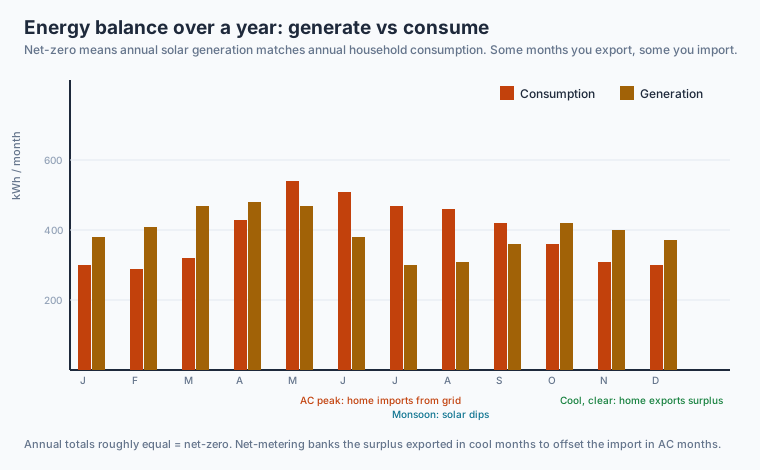
Figure 3: Generation and consumption rarely match month to month. Net-metering is what banks the cool-season surplus to pay for the summer deficit.
A quick way to scope your own numbers without a consultant: pull twelve months of electricity bills, total the units, and divide by 1,500 to get the array size in kW. Want to put that against the rest of your build budget? The home cost calculator and, for the connected-load side, the smart home cost calculator help you sanity-check where the money goes.
4. The envelope and the code: where net-zero is won
If cooling is the biggest slice of the pie, the building envelope is where you shrink it, and it is the part you can never retrofit cheaply. A wall is a wall for the life of the house. This is why net-zero is designed in, not bolted on.
The Eco Niwas Samhita gives homeowners a usable target even without an engineer: keep the envelope's heat transmittance low. In practice that means external walls with a cavity, AAC block or insulation rather than bare 9-inch brick; a roof with insulation or a reflective finish (the roof is the single hottest surface on an Indian home); windows shaded by chajjas or fins so they admit light but not the high summer sun; and a window-to-wall ratio that is generous on the north and restrained on the west. None of this is exotic, and most of it costs little at construction and a fortune later.
This is the cluster's signature provisioning logic applied to energy. Consider what a single decision costs at the two stages:
| Measure | Cost to provision at construction | Cost to retrofit later | Net-zero payoff |
|---|---|---|---|
| South-facing, unshaded roof for solar | Free (a siting decision) | Often impossible | Largest single lever |
| Roof slab rated for full future array | ~₹15,000 to 30,000 extra rebar/design | Structural strengthening, ₹1 to 2 lakh+ | Lets you scale solar to full load |
| Wall insulation / cavity / AAC | ₹40,000 to 1,20,000 over plain brick | Re-cladding, internal loss, ₹3 lakh+ | Cuts cooling load 20 to 30% |
| Spare conduit roof-to-meter + DB headroom | ₹3,000 to 8,000 | Chasing walls, ₹40,000+ | Plug-and-play solar/battery/EV |
| Net-meter-ready board with export space | A few thousand | DB rework + DISCOM revisit | Smooth net-metering sanction |
The pattern is the same every row: the future-ready move is cheap as foresight and brutal as hindsight. A home built to the envelope code with a solar-ready roof and a conduit run is already most of the way to net-zero even if you install nothing on day one. That is the whole point of provisioning, you are buying the option, not the obligation.
5. Appliances, the BEE star, and the load you forget
Once the envelope is sorted, the meter is filled by what you plug in. India's BEE star-rating label is the cheapest decision-support tool a homeowner has: a 5-star inverter AC uses 25 to 30 percent less power than a 3-star unit for the same cooling, and the gap compounds over the 10-to-15-year life of the machine. The same logic runs through fridges, washing machines and ceiling fans, a BLDC fan draws about 28 W against an old fan's 75 W, and you may run a dozen of them.
The load people forget is hot water. An electric geyser is one of the heaviest single draws in an Indian home; swapping it for a solar water heater or a heat-pump geyser can erase 10 to 15 percent of your annual consumption outright, often the difference between net-zero and a stubborn deficit. The kitchen is the other quiet creep, induction cooking is efficient but adds electrical load if you are moving off LPG, and an EV is the single largest new load most homes will ever add. A car charged at home can add 1,500 to 3,000 kWh a year by itself, which can blow a net-zero balance wide open unless you sized the array for it. Provision the EV point and the array headroom now; the full playbook is in the EV-ready home, and the wiring that carries all of it in future-proof wiring systems.
6. Net-metering: the meter that makes it work
Net-metering is the single policy that turns rooftop solar into net-zero, and it is the one thing not in your control. A bidirectional meter records both the units you draw and the units you push back; at the billing cycle you pay only for the net. Done well, the grid becomes a free, infinite battery.
The catch is that terms vary by state DISCOM and they have been tightening. Watch four things when you apply: the system-size cap (many states limit residential net-metering to a sanctioned-load percentage, often 100 percent, sometimes lower), whether your state offers true net-metering (unit-for-unit) or the less generous net-billing / gross-metering (you sell exports at a low feed-in rate and buy imports at retail), the settlement period (monthly carry-forward of surplus is good; annual is better; loss of unused surplus at year-end is the worst), and the sanctioned-load headroom on your connection. If your array can export more than your DISCOM will net, the extra generation is wasted, which is another reason the reduce-first, right-size approach beats oversizing.
The national subsidy programme, PM Surya Ghar: Muft Bijli Yojana, sharpens the economics for residential rooftop, with central financial assistance scaled by system size up to 3 kW and beyond. Treat the subsidy as a reason to do the array properly, not a reason to oversize past what your meter will net. The install-side economics are detailed in solar power for Indian homes.
A blunt rule for net-metering states: design your array so its annual generation lands close to your annual consumption, not above your monthly export cap. Net-zero is an annual game won with right-sizing, not a monthly game won with oversizing.
7. Solar, battery and EV as one system
The homes that actually reach net-zero, and stay there, stop treating solar, storage and the car as three separate purchases and start treating them as one energy system with a single brain. The array generates, the battery time-shifts, the EV is both a large load and, increasingly, a potential store, and a hybrid inverter coordinates the three against the grid and the meter.
The design decision that matters now, years before you may own all three, is to leave the plumbing for them: a hybrid-inverter-ready DC space, conductor and conduit sized for a battery you may add later, an EV circuit on its own breaker, and a distribution board with spare ways and export capacity. This is exactly the provisioning thread, and it costs a few thousand rupees at construction against tens of thousands in retrofit chasing. The broader infrastructure choreography sits in smart infrastructure planning, and storage specifics in home battery backup power.
Monitoring closes the loop. A net-zero home that nobody watches drifts into deficit silently. A simple energy monitor or the inverter's own app, showing daily generation against consumption, turns net-zero from a one-time sanction into a habit, you notice the month the new AC pushed you into import and you respond. What gets measured gets balanced.
8. The realistic 2026 to 2040 trajectory
The reason net-zero belongs in a future-ready guide rather than a green-living one is that the trend lines all point the same way. Solar module prices keep falling; battery cost-per-kWh is dropping faster still; EVs are crossing into the mainstream of Indian car-buying; and the residential energy code is moving from voluntary to, in more and more states, mandatory for larger buildings. A home designed to net-zero logic in 2026 is not early, it is on the leading edge of where the rules and the market are both heading.
That is why the provision-now call is so strong here. You may not install the battery or the EV charger in 2026. But the home you build this year will still be standing in 2040, when grid power may cost far more, when net-metering terms may have shifted again, and when an EV in the porch is the default rather than the exception. The orientation you chose, the roof you rated, the conduit you ran and the DB headroom you left are the cheap insurance that lets your house keep pace, plug-and-play, instead of forcing a demolition. Reach net-zero on day one if the numbers work; if not, leave every door to it unlocked. That is the future-ready bet, and it is mostly free.
For the wider picture of how energy fits alongside water, flexibility and resale across the next fifteen years, return to the pillar, designing homes for 2040, and for the broader green frame, sustainable home design in India.
Sources & further reading
- Bureau of Energy Efficiency (BEE), Eco Niwas Samhita 2018 (Part I: Building Envelope) and 2021 (Part II: Electro-mechanical systems), India's residential energy code (ECBC-R), including the RETV envelope metric.
- BEE Standards & Labelling Programme, star-rating methodology for air-conditioners, refrigerators, ceiling fans and water heaters.
- Ministry of New and Renewable Energy (MNRE), PM Surya Ghar: Muft Bijli Yojana, residential rooftop solar subsidy framework and central financial assistance slabs.
- Central Electricity Authority (CEA) and state DISCOM net-metering / net-billing regulations (system-size caps, settlement periods, feed-in terms vary by state).
- National Institute of Solar Energy (NISE) / MNRE solar resource data for India (specific yield by region, typically 1,400 to 1,600 kWh/kW/year).
- National Building Code of India (NBC 2016), Part 11 (Approach to Sustainability) and Part 8 (Building Services) for structural and electrical provisioning context.
- Bureau of Indian Standards, relevant IS codes for rooftop loading and electrical installation safety.
Pairs with designing homes for 2040, the solar-ready home and home battery backup power.
Export this guide
Related Guides — Deep-dive reading
Designing a Naturally Energy-Efficient Indian Home
Comfort first, gadgets last — passive design, orientation, insulation, ventilation and the climate wisdom that cuts Indian energy bills
SustainabilityEnergy-Efficient Facades in India: How the Building Skin Cuts Your Cooling, Heating & Lighting Bills
How a building facade drives cooling, heating and lighting energy in India, the three levers of solar-heat-gain control, insulation and daylighting, U-value, SHGC, VLT and WWR in plain terms, ECBC and Eco-Niwas expectations, and real Indian green buildings.
Building FacadesWhy Sustainable Buildings Cost Less Over Time
The lifecycle-cost case for green homes in India, explained in plain money for ordinary homeowners
SustainabilityRelated Tools — Try Free
Cross-Ventilation Analyzer
Estimate airflow and air changes per hour (ACH) from room size, window areas, layout, and local wind — with NBC 2016 Part 8 compliance check.
Ventilation CalculatorBrise-Soleil Visualizer
Interactive horizontal-louvre cut-off angle calculator — sun altitude, louvre depth, and spacing inputs with a live shadow preview. Computes θ = arctan(spacing/depth) for façade shading, ECBC envelope compliance, hospital daylight design, and tropical sun-control detailing.
Sun Shading ToolRainwater Tank Sizer
How big should your rainwater tank be? Computes annual harvest, recommended tank capacity in litres, water-bill savings, and payback — for 10 Indian cities.
RWH Calculator