
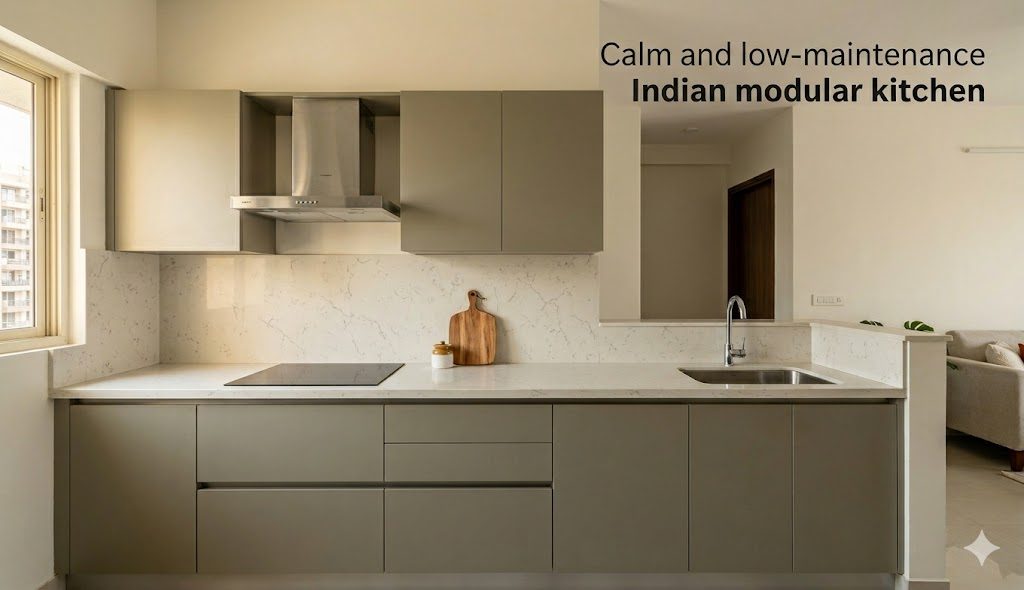
How to Design a Low-Maintenance Kitchen
The finishes, joinery and hardware that survive Indian cooking with the least weekly attention
A low-maintenance kitchen is not the one that gets cleaned the most. It is the one that needs the least cleaning to look the same. Two kitchens of identical cost, built in the same flat, can end the decade with radically different upkeep bills — and the difference is decisions taken at the planning stage. Glossy white acrylic on every shutter or matte mid-tone laminate. Granite or quartz. Gas or induction. Recessed handles or J-pull handle-less. Each pair has the same install cost; the cleaning budget over ten years is a factor of two apart.
This guide quantifies the maintenance budget an Indian kitchen actually demands — weekly, monthly, annually and at the 5-year refresh — then walks through the planning decisions that bring each line down. It is a deep-dive companion to our best modular kitchen layout for Indian cooking.
The maintenance budget you actually pay
A kitchen does not have one maintenance cost; it has four, on different cycles. Most homeowners only ever cost the weekly. The monthly, annual and five-year line items are the ones that decide whether the kitchen looks the same in 2036 as it did in 2026.
| Cycle | What it covers | Typical hours / year | Typical rupee cost / year |
|---|---|---|---|
| Weekly | Wipe shutters, clean counter, mop floor | 52–104 | nil (in-house labour) |
| Monthly | Hood baffle wash, hardware quick check, descale tap | 12–24 | ₹500–1,500 |
| Annual | Reseal joints, deep degrease, hinge oil, granite seal (if natural stone) | 4–8 | ₹3,000–8,000 |
| 5-year | Re-laminate worn shutters, replace fatigued hardware, repaint walls | 24–40 | ₹25,000–80,000 |
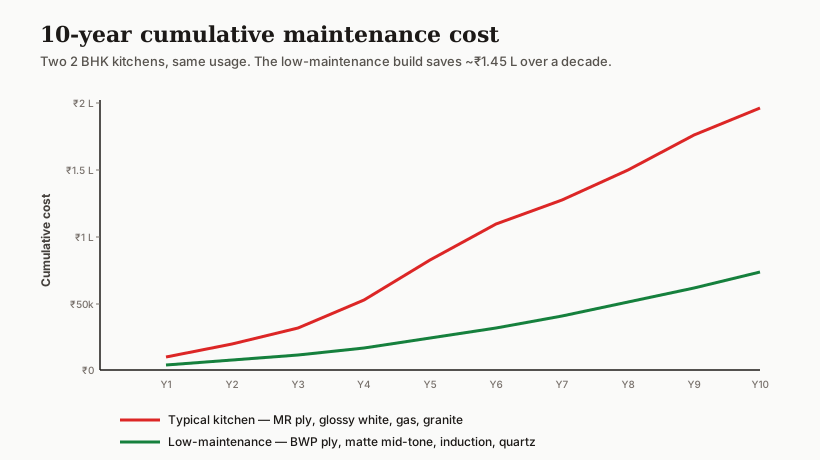
Multiply across ten years and the cumulative cost of an unplanned kitchen runs to ₹1.8 to ₹2.2 lakh; a well-planned low-maintenance kitchen runs to ₹50 to ₹70 thousand. The gap — roughly ₹1.45 lakh — pays for the entire chimney and oven on day one.
The maintenance-effort matrix
The matrix below scores six surface choices against the five zones of a typical Indian kitchen. Green is low-effort, amber is medium, red is high. Read it as a buying guide.
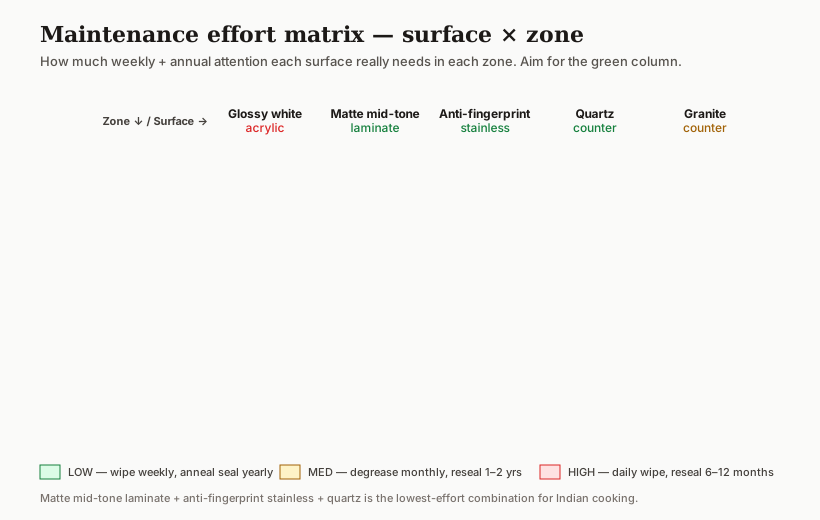
| Surface | Hob / splashback | Counter | Sink base | Shutters | Pantry |
|---|---|---|---|---|---|
| Glossy white acrylic | HIGH | MED | HIGH | HIGH | MED |
| Matte mid-tone laminate | MED | LOW | MED | LOW | LOW |
| Anti-fingerprint stainless | LOW | LOW | LOW | LOW | LOW |
| Quartz counter | LOW | LOW | LOW | — | — |
| Granite counter | MED | MED | MED | — | — |
| Handle-less J-pull | n/a | n/a | n/a | LOW | LOW |
A few entries are worth the slow read.
Glossy white acrylic shutters are sold as premium and are uniquely badly suited to Indian cooking. Every fingerprint, every micro-droplet of oil, every smudge of haldi shows. They demand a wipe-down a day to look like the catalogue and dull anyway by year three. Matte mid-tone laminate in a warm grey-green or terracotta hides splatter, fingerprint and dust simultaneously and reads as more sophisticated. The matte mid-tone column is almost entirely green for a reason.
Granite counter is a strong choice if you commit to the annual sealing. If you do not, the sealer ablates, the stone takes oil stains, and the counter starts to look tired by year five. Quartz removes the variable — it is non-porous, never needs sealing, resists turmeric and tomato better than any natural stone, and costs roughly 20 per cent more than mid-range granite at install. Across a decade the quartz costs less because there is no annual sealing line.
Anti-fingerprint stainless is now standard on every tier-1 Indian chimney (Faber, Glen, Elica, Hindware), and is worth specifying on the hood, the sink and the dishwasher front. It is not literally fingerprint-proof — it is a textured or PVD-coated finish that hides what regular satin stainless reveals.
The choices that cut each maintenance line
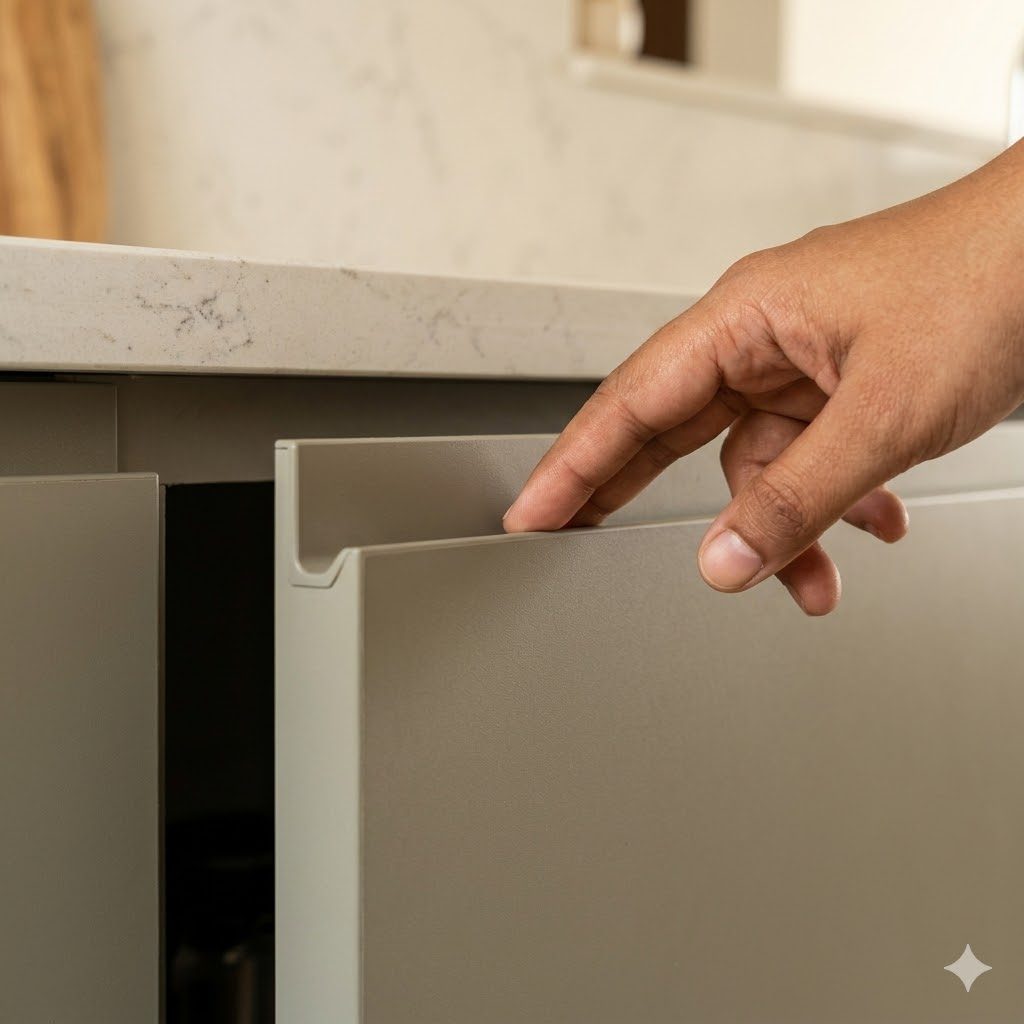
Weekly wipe-down is cut most by handle-less shutters and matte mid-tone finishes. A J-pull or push-to-open shutter has no handle profile to trap atta dust, oil and finger-grease. The cleaning task drops from "wipe shutter, scrub handle, dry handle" to "wipe shutter". Multiply by every shutter, every day, across ten years.
Monthly hood cleaning is cut by specifying a hood with dishwasher-safe baffle filters and a hood cabinet that does not block filter removal. A baffle filter pops out in 10 seconds, goes into the dishwasher with the day's plates, comes back clean. A cassette filter — fitted to many budget hoods — has to be replaced, not washed, and most homes simply do not.
Annual sealing is cut to zero by quartz over granite, and cut significantly by silicone joints and BWP ply in wet zones. A sink base built in IS 710 BWP ply with edge banding and a stainless drip tray does not need an annual carcase inspection because there is nothing to inspect — water cannot get in.
Five-year refresh is cut most by hardware specification. A tier-1 hinge (Hettich, Hafele, Blum) rated for 80,000 to 200,000 cycles will not be the reason for the refresh. A budget hinge rated for 50,000 cycles is. Spend the 600 rupees per hinge upgrade and you push the first refresh from year five to year ten.
The induction question
Gas is the Indian default. Induction is rare. For maintenance, induction is the bigger upgrade.
The flat ceramic top of an induction hob wipes clean with a single pass of a damp cloth. There is no trivet, no grate, no burner ring, no spilled-over rice catching in the assembly. There is no exposed flame to deposit unburned fuel on the underside of the chimney baffle, so the hood stays cleaner for longer. There is no continuous low-grade humidity from combustion adding to ambient damp. The cleaning saving per year is roughly 20 hours.
Induction is not the choice for everyone — some Indian cooking technique relies on flame contact, and Indian-grid power quality affects induction unit life. But for maintenance burden alone, induction wins, and a dual-fuel layout (one induction zone, one gas hob, separately ducted) gives most households both options.
The low-maintenance zoning plan
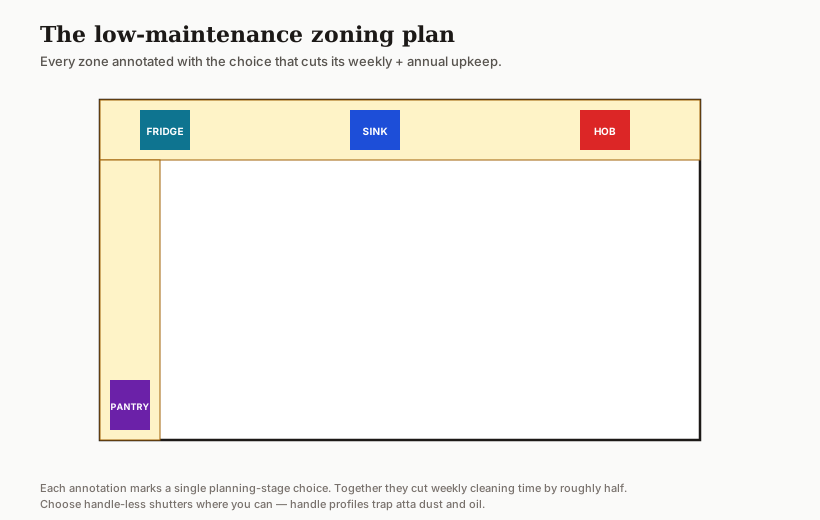
When the matrix is collapsed into a single plan, the lowest-effort Indian kitchen has a specific shape:
- Hood: wall-mount with dishwasher-safe baffle filter, anti-fingerprint stainless finish, accessible cabinet for filter removal.
- Hob: induction (or dual-fuel with induction primary), flat black ceramic top, no trivet.
- Counter: quartz, single slab where possible, food-grade silicone at every joint.
- Sink: stainless single-bowl with anti-fingerprint finish; deep enough that the tap does not splash the dado.
- Sink base: IS 710 BWP ply, 2 mm PVC edge banding, removable stainless drip tray.
- Shutters: handle-less matte mid-tone laminate (warm grey-green, terracotta or charcoal), no glossy white, no high-detail mouldings.
- Pantry: sealed glass-jar storage in tandem pull-outs; nothing in open shelves to catch dust.
- Hardware: tier-1 European concealed hinges (80k+ cycles), full-extension soft-close drawer slides.
- Walls: mineral or silicate paint behind the hob and dado; tile-clad backsplash with epoxy grout, not cement grout.
This is the configuration that costs at most 5–8 per cent more at install than a default catalogue kitchen and delivers, on a conservative estimate, half the cumulative maintenance burden over a decade.
A low-maintenance kitchen is the one that needs the least cleaning to look the same — the difference is decisions taken at the planning stage, not the cleaning habit afterwards.
The fix, in order
1. Handle-less J-pull or push-to-open shutters — kill the daily handle wipe.
2. Matte mid-tone laminate over glossy white — hide oil and fingerprint by design.
3. Quartz counter over granite — no annual sealing line.
4. Induction or dual-fuel hob — kill the trivet and the spill assembly.
5. Dishwasher-safe baffle hood with anti-fingerprint stainless — make monthly cleaning automatic.
6. IS 710 BWP ply at the sink base with edge banding and a drip tray — kill the worst rework cost.
7. Tier-1 hinges, soft-close, full-extension slides — push the first refresh from year 5 to year 10.
Prevent it / Plan it: Compare surface-by-surface trade-offs with the material decision framework, verify your BOQ against the material quality checklist, and read the companion guides on the modular kitchen guide, interior choices that age poorly, sustainable interiors for India, and the pillar best modular kitchen layout for Indian cooking.
References
- Bureau of Indian Standards (1989, reaffirmed 2018) IS 303: Plywood for General Purposes — Specification. New Delhi: BIS.
- Bureau of Indian Standards (2010, reaffirmed 2020) IS 710: Marine Plywood — Specification. New Delhi: BIS.
- National Kitchen and Bath Association (2016) Kitchen and Bathroom Planning Guidelines with Access Standards. Hoboken, NJ: John Wiley & Sons.
- Grandjean, E. (1973) Ergonomics of the Home. London: Taylor & Francis.
- Bureau of Indian Standards (2016) National Building Code of India 2016, Part 8: Building Services. New Delhi: BIS.
Part of the Studio Matrx Kitchen Design series.
Export this guide
Related Guides — Deep-dive reading
Smart Storage Interiors — A 2026 Working Reference for Indian Homes
Inventory-driven · Floor-to-ceiling · Hardware-engineered · Zone-mapped
Room PlanningComplete Guide to Interior Hardware
The 8–12% of the interior budget that decides whether everything else works
Materials & FinishesHow to Clean Bathroom Tiles (India): Shine, Hard-Water Film & Soap Scum
A practical, India-first routine for cleaning bathroom tiles and keeping them glossy — the daily squeegee habit, weekly wash, monthly deep clean, and the safe cleaner for each tile type, including the golden rule that natural stone must never meet acid.
BathroomsRelated Tools — Try Free
Interior Layout Planner — Printable Graph Grid
Printable graph grid to sketch room layouts to scale before committing to furniture placement.
Layout ToolCross-Ventilation Analyzer
Estimate airflow and air changes per hour (ACH) from room size, window areas, layout, and local wind — with NBC 2016 Part 8 compliance check.
Ventilation CalculatorMaterial Comparison Sheet
India's interior material cheatsheet — plywood, finishes, hardware, countertops, paints, waterproofing.
Reference Guide