
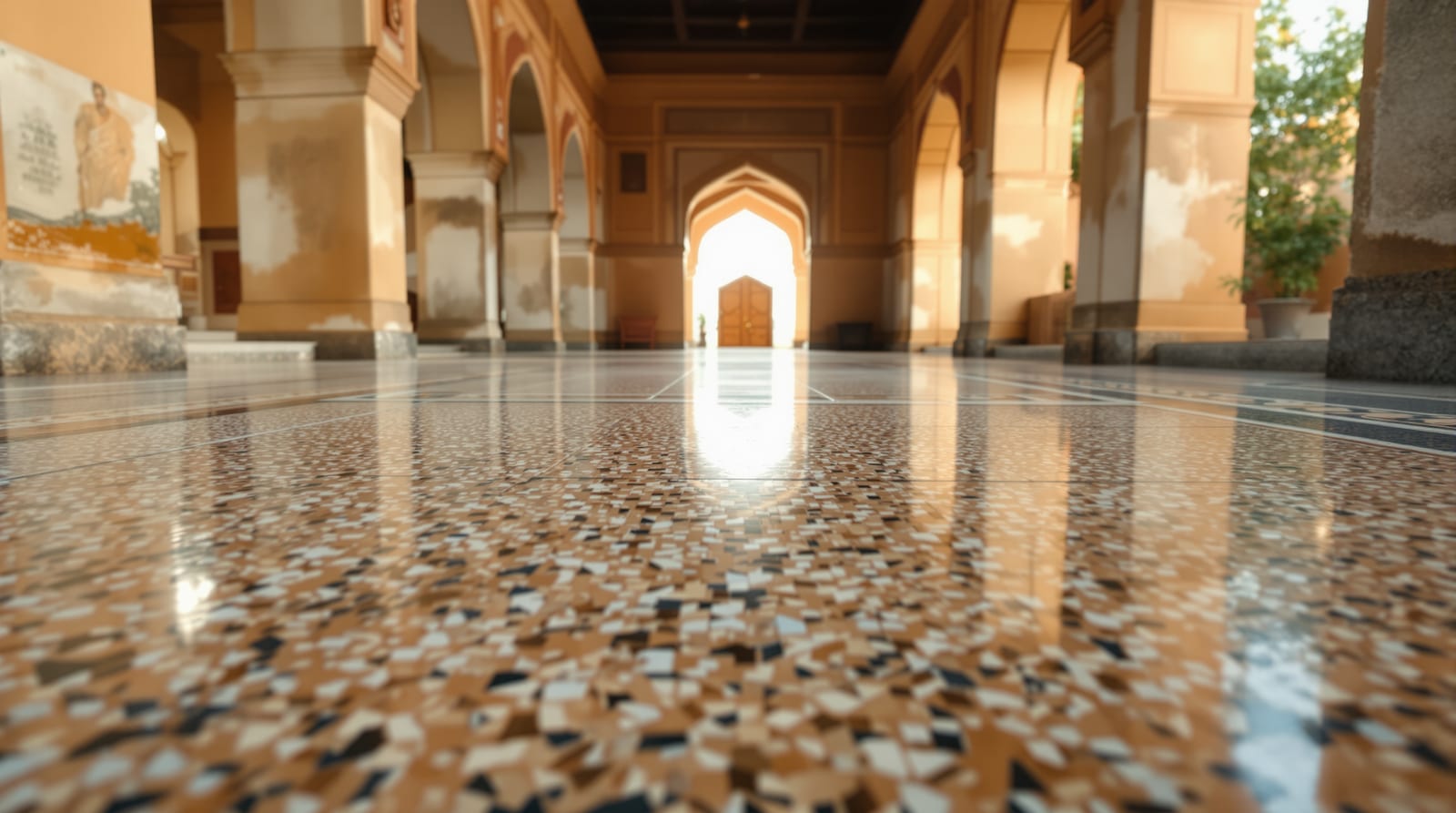
Mosaic Flooring in India: In-Situ Marble-Chip Mosaic, Glass & Tile Mosaic, Cost and Care
Mosaic flooring spans two worlds — the traditional in-situ marble-chip mosaic that paved old Indian homes and became the precursor to terrazzo, and decorative glass, ceramic and stone mosaic mats used for borders, bathrooms, pools and feature zones; here is what each is, how in-situ mosaic is laid, ground and polished, where each suits, and costs of ₹60–180 per sq ft.
Walk into almost any house built in India between the 1940s and the 1980s and you are probably standing on mosaic flooring — a smooth, cool, speckled surface of marble chips set in cement and ground flat. It is one of the most quietly durable floors ever laid in this country, and it is the direct ancestor of modern terrazzo. But "mosaic flooring" means a second thing too: the small glass, ceramic and stone tiles, sold on mesh mats, that we use today for bathroom borders, pool linings, backsplashes and feature panels. This guide untangles the two, shows how in-situ mosaic is laid, ground and polished, what each costs at ₹60–180 per sq ft, where each belongs, and how to care for and restore the retro charm of an old mosaic floor.
Two very different things called "mosaic flooring"
The word "mosaic" carries two meanings in Indian flooring, and confusing them leads to the wrong quote and the wrong floor.
The first is traditional in-situ marble-chip mosaic — a poured, ground and polished cement floor studded with marble (and sometimes coloured stone) chips. It is laid wet on site by skilled masons, then mechanically ground flat and polished to a sheen. This is the floor of old Indian homes, schools, courts and government quarters. Technically it is the precursor to, and very close cousin of, terrazzo: when the chips are larger, more colourful and graded into deliberate patterns, the same floor is usually called terrazzo. We cover the modern poured version in detail in our terrazzo-flooring-india guide and the precast tile version in terrazzo-tiles-india — this page focuses on the heritage mosaic floor and its restoration.
The second is decorative tile mosaic — small pieces of glass, ceramic, porcelain, or natural stone (typically 10–50 mm), pre-mounted on flexible mesh sheets, that you lay like tiles. This is what most tile shops mean today when they say "mosaic". It is rarely a whole-floor material; instead it shines as borders, bathroom and pool linings, shower floors, niches and feature zones.
Both belong to the wider family of alternative and craft floors mapped in our specialty-flooring-guide-india pillar. The rest of this guide treats each in turn.
Traditional in-situ marble-chip mosaic
In-situ marble-chip mosaic is a true terrazzo-family floor. A base coat of cement mortar is laid over the structural slab, then a topping of cement, marble powder, pigment and marble chips (the "mosaic" aggregate) is spread, compacted and floated. After the floor has cured enough to take grinding — usually a few days — it is mechanically ground with progressively finer abrasive stones, the tiny pits are filled with a matching cement slurry, ground again, and finally polished. The result is a dense, seamless, mirror-cool surface with marble chips showing as a fine speckle.
This is the floor our grandparents swept and swabbed daily. It is governed in Indian practice by IS 1237 (cement concrete flooring tiles, including terrazzo and mosaic) for precast tiles, and IS 2114 (laying in-situ terrazzo) and IS 1443 (laying and finishing cement concrete flooring) for the poured work. Done well, it lasts fifty years and more — which is exactly why so much of it survives in old homes today.
How in-situ mosaic is laid, ground and polished
The sequence a mason follows is broadly:
First, the base: a 20–40 mm cement-mortar bed is laid to level over the slab, with the floor divided into panels using glass, brass, aluminium or PVC divider strips to control shrinkage cracking — the same panelling logic as IPS, covered in ips-flooring-india. Second, the topping: a 6–12 mm layer of cement, marble dust, oxide pigment and marble chips is spread within each panel, then heavily compacted and rolled so chips sit tight and the surface is dense. Third, a cure of several days so the topping is hard enough to grind without plucking chips. Fourth, grinding: a heavy rotary grinder with coarse-to-fine carborundum stones cuts the surface flat, exposing the chips as flush speckle. Fifth, grouting the pinholes: a slurry of matching cement and pigment is rubbed in to fill the tiny voids opened by grinding, then cured. Sixth, fine grinding and polishing to the final sheen, sometimes finished with oxalic acid and wax (older method) or a modern penetrating sealer. The floor is wet for much of this — it is messy, skilled, time-consuming work, which is why poured mosaic is now a craft revival rather than the default.
The retro charm and real durability
There is a reason old-home buyers and restorers prize mosaic floors. They are genuinely cool underfoot, which suits Indian summers; extremely durable, often outlasting two or three generations of furniture; seamless and easy to mop once polished; and they carry a soft, speckled, mid-century character that is impossible to fake with new tile. A well-kept mosaic floor in an old Bengaluru, Mumbai or Chennai home is a feature, not a flaw — and far cheaper to revive than to rip out. The chief drawbacks are that it is cold in winter and in hill stations, can be slippery when wet and freshly polished (a real concern in bathrooms, see anti-slip-flooring-wet-areas-india), and that genuine in-situ laying now needs scarce skilled masons, so new poured mosaic costs more in labour than it once did.
Decorative glass, ceramic and stone mosaic
The second family is the small-tile mosaic you buy today, almost always on flexible mesh sheets roughly 30x30 cm, ready to lay like tile. The material changes the look, price and best use:
Glass mosaic — vivid, translucent, light-catching pieces, the classic choice for swimming pools, water features, bathroom walls and feature bands. Glass is non-porous and essentially waterproof, which is why it dominates pool linings. Ceramic and porcelain mosaic — matte or glazed, the workhorse for bathroom floors and walls, kitchen splashbacks and shower trays; small pieces mean many grout joints, which gives natural grip on shower floors. Natural stone mosaic — marble, slate, pebble or mixed-stone chips on mesh, for an organic, spa-like look (the pebble version overlaps with our pebble-flooring-india guide). Metallic, mother-of-pearl and mixed-art mosaic — premium decorative pieces for murals, accent walls and bespoke art floors, where cost rises well beyond the table below.
Because the pieces are small and mesh-backed, mosaic mats wrap curves, slope into shower drains and turn corners far better than large tiles — which is exactly why they own the bathroom, the pool and the border.
Type, look, cost and best use
The table maps the mosaic family against finish, indicative all-in cost and where each belongs. Costs are 2026 indicative, vary by city and vendor, and exclude 18% GST. In-situ figures include the heavy grinding-and-polishing labour; mat figures are material plus typical laying. Art and bespoke mosaic runs well above these ranges.
| Type | Look | Cost (₹/sq ft) | Best use |
|---|---|---|---|
| In-situ marble-chip mosaic (poured, ground, polished) | Cool, seamless, speckled, retro | 100–180 | Old-home restoration, whole-floor heritage interiors, courtyards |
| Restoration / re-grind of existing mosaic | Revives original floor | 40–90 | Reviving a tired old mosaic floor in situ |
| Ceramic / porcelain mosaic mat | Matte or glazed small tiles, gripped | 60–150 | Bathroom floors and walls, shower trays, splashbacks |
| Glass mosaic mat | Vivid, translucent, waterproof | 80–180 | Swimming pools, water features, feature walls, borders |
| Natural stone / pebble mosaic mat | Organic, spa-like | 90–180 | Shower floors, spa bathrooms, feature zones |
| Art / metallic / mother-of-pearl mosaic | Decorative, bespoke | 200+ | Murals, accent panels, niches, bespoke floors |
For where this sits against the rest of the cluster, in-situ mosaic shares a craft-labour bracket with terrazzo-flooring-india and athangudi-style craft floors, while it is dearer than a plain IPS or cement floor. To convert ₹/sq ft into a real total for your area, use our /utilities/flooring-cost-calculator, and size grinding-and-polishing work with /utilities/floor-polishing-cost-calculator.
Where each kind of mosaic suits
In-situ marble-chip mosaic belongs in heritage and old-home settings: restoring an existing floor, or laying a new poured mosaic where you want a genuinely cool, seamless, low-maintenance whole-floor surface with mid-century character. It works across living rooms, bedrooms, verandahs and courtyards. It is less suited to cold hill-station homes, where its coolness becomes a drawback, and it demands skilled masons, so it is a deliberate choice, not a default — see how it compares to other floors in flooring-materials-explained-india.
Decorative tile mosaic is a feature material, not usually a whole floor. Use glass mosaic for swimming pools, water features and bathroom feature walls; ceramic or porcelain mosaic for bathroom floors, shower trays and kitchen splashbacks, where the dense grid of grout joints adds welcome grip in wet areas (pair with bathroom-flooring-india); stone and pebble mosaic for spa-style showers; and any of them as a border or band to frame a larger tile or stone field, in entrances, around a rug zone, or along a corridor. As a decorative accent, mosaic plays the same role that a patterned cement-tiles-india band or an inlay does — a small area of craft that lifts a plainer floor.
Mosaic vs terrazzo — the family link
This trips up most people, so it is worth being precise. In-situ marble-chip mosaic and in-situ terrazzo are the same family of floor — cement matrix, marble (or other stone) chips, ground and polished in place. The practical distinctions used on Indian sites are loose: "mosaic" tends to mean smaller, finer chips in a more uniform, traditional speckle (the old-home look), while "terrazzo" tends to mean larger, more colourful, deliberately graded chips and bolder modern patterns, often with brass or metal dividers as a design feature. The standards overlap too — IS 1237 covers both as precast tiles, and IS 2114 covers laying in-situ terrazzo. If you want the bigger-chip, designer, contemporary version, read terrazzo-flooring-india for the poured floor and terrazzo-tiles-india for the precast tiles; if you want the fine-speckle heritage floor or to restore one, stay here. Either way it is one continuous craft, not two unrelated materials.
Care, polishing and restoration
A polished in-situ mosaic floor is among the easiest floors to live with. Daily care is a simple swab with water and a mild, pH-neutral cleaner — avoid acidic cleaners (lemon, vinegar, strong toilet cleaners), which etch the marble chips and cement matrix, exactly as they do on marble; see floor-cleaning-guide-india. Sealing is sensible: a penetrating sealer or periodic wax keeps the surface stain-resistant and deepens the colour, and our floor-resealing-guide-india covers the schedule.
The real magic is restoration. A tired old mosaic floor — dull, scratched, patchy — almost never needs replacing. A grinding-and-polishing crew can re-grind and re-polish it in situ: a fresh cut with diamond or carborundum pads removes the worn surface, exposes clean chips, and a final polish brings back the original cool sheen, often for ₹40–90 per sq ft against the cost and dust of ripping it out. This is one of the best-value moves in old-home renovation in India, and it is why we steer owners of period homes to revive rather than replace. For decorative mosaic mats, care follows the tile material: glass and porcelain are wiped clean and the grout is sealed and occasionally regrouted; the many joints mean grout maintenance matters most, so keep it sealed against mould in monsoon humidity.
Frequently asked questions
What is the difference between mosaic flooring and terrazzo?
They are essentially the same family of in-situ floor — marble chips set in pigmented cement, ground and polished in place. On Indian sites "mosaic" usually means finer, more uniform chips in the traditional old-home speckle, while "terrazzo" means larger, more colourful, deliberately patterned chips and a bolder modern look. The standards (IS 1237, IS 2114) cover both. See our terrazzo-flooring-india and terrazzo-tiles-india guides for the contemporary versions.
How much does mosaic flooring cost per sq ft in India?
Indicatively, new poured-and-polished in-situ marble-chip mosaic runs ₹100–180 per sq ft, restoring an existing mosaic floor in place is ₹40–90, ceramic and glass mosaic mats are ₹60–180, and art or mother-of-pearl mosaic runs ₹200 and up — all before 18% GST. Grinding and polishing labour is a big part of in-situ cost. Use the Studio Matrx /utilities/flooring-cost-calculator and /utilities/floor-polishing-cost-calculator to size it for your area.
Can I restore an old mosaic floor instead of replacing it?
Almost always, yes — and it is one of the best-value moves in old-home renovation. A grinding crew re-grinds the floor with diamond or carborundum pads to expose fresh chips, fills pinholes, and re-polishes to the original cool sheen, typically for ₹40–90 per sq ft. That avoids the cost, dust and waste of demolition, and an original mosaic floor is usually a feature worth keeping rather than a flaw.
Is mosaic flooring slippery, and is it good for bathrooms?
A freshly polished in-situ mosaic floor can be slippery when wet, so for bathrooms an anti-skid treatment helps — see anti-slip-flooring-wet-areas-india. Decorative ceramic and stone mosaic mats, on the other hand, are excellent for bathroom and shower floors precisely because the many small grout joints give grip; glass mosaic suits walls and pools. Match the type to the wet-area need described in our bathroom-flooring-india guide.
Is glass mosaic only for pools?
No, though pools are its classic home because glass is non-porous and waterproof. Glass mosaic also works beautifully on bathroom feature walls, water features, backsplashes and decorative borders, where its translucence catches light. For floors, ceramic, porcelain or stone mosaic is usually the better, more slip-resistant choice; glass is best kept to walls, pools and accents.
Export this guide
Related Guides — Deep-dive reading
Epoxy Grout vs Cement Grout for Tiles in India: Which to Specify (2026)
A plain-English guide to tile grouts for Indian homes: what grout does, how cementitious grout compares with epoxy grout on cost, stain and water resistance, hygiene and durability, and exactly where each one belongs - kitchens, bathrooms, pools, dry rooms and more.
Building MaterialsMosaic Bathroom Flooring in India: Glass, Ceramic, Stone & Pebble Mosaics
Small-format mosaic tiles turn more grout lines into more grip — which is exactly what a wet Indian shower floor wants. A brand-neutral guide to glass, ceramic, stone and pebble mosaics: sheets vs loose, grout choice and sealing, decorative use, cost and maintenance.
BathroomsAnti Slip Flooring for Bathroom and Wet Areas in India: R-Ratings, Finishes and Genuinely Safe Tile Choices
How to choose genuinely safe flooring for bathrooms, kitchens, balconies, pools, entrances and elderly- or child-friendly homes — the R-rating system, finishes that grip wet feet, anti-skid natural stone, slope to drains and the tiles to avoid.
Flooring & SurfacesRelated Tools — Try Free
Full-Room BOQ — Living, Bedroom, Kitchen, Bath
Room-wise BOQ across living, bedrooms, kitchen, utility, and bathrooms with line-item pricing.
Full-Room BOQPool Tile Calculator
Floor, wall and waterline area and the total number of tiles for your pool, with a wastage allowance.
Pool CalculatorHome Building & Interior Cost Calculator — 20 Cities
Construction + interior costs for 20 Indian cities across kitchen, wardrobes, flooring, painting, ceiling.
Cost Calculator