
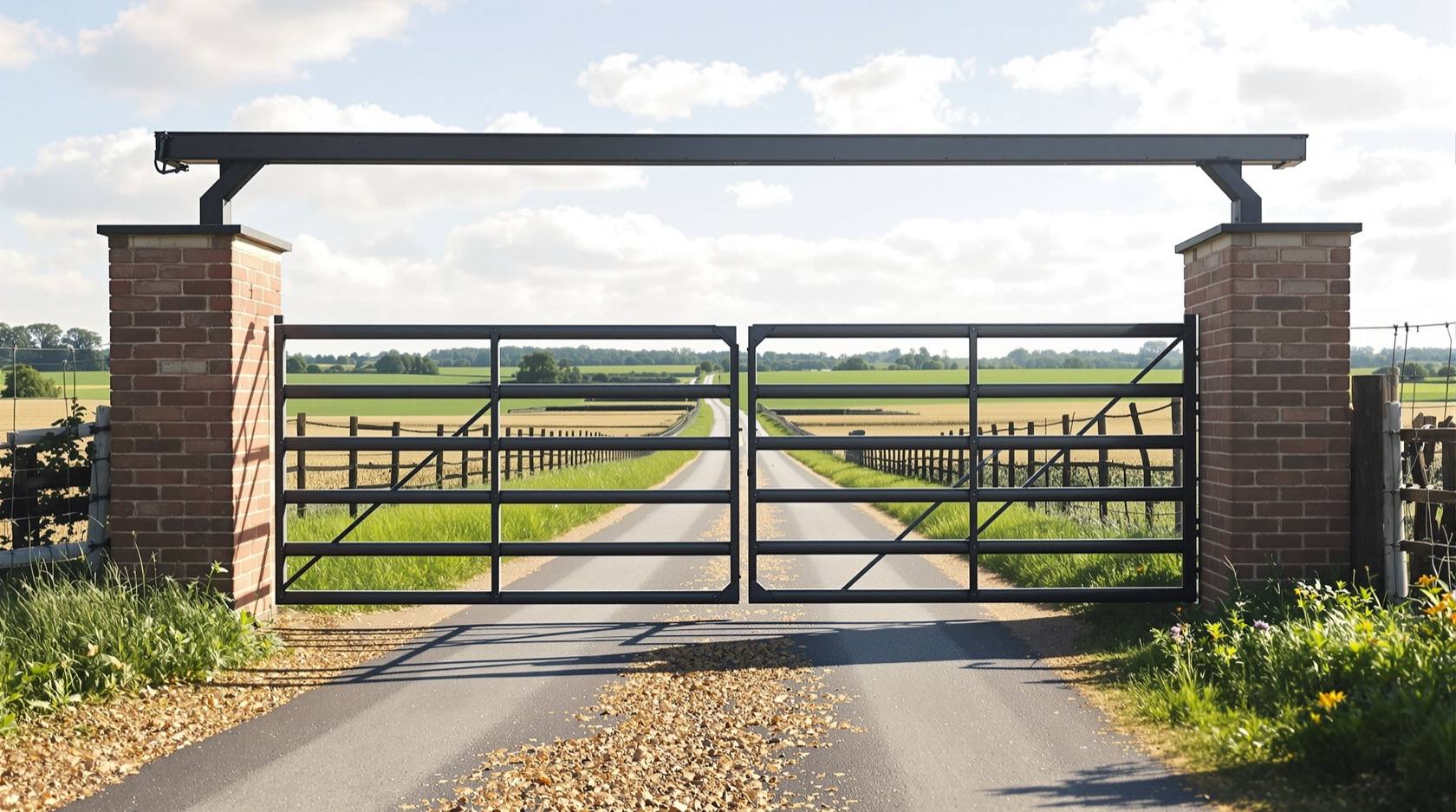
Farm and Industrial Gates in India: Heavy-Duty, Estate and Large-Span (2026)
A plain, India-grounded guide to the big gates — wide farm and estate entries for tractors and trucks, and heavy factory and warehouse gates that span twelve metres and run all day. How the type, material, size and footing are decided, and why a large heavy gate is a real structural and fabrication job, not a hardware-shop purchase.
Most gate guidance is written for a house — a two-leaf gate a car drives through. This one is about the big gates: the wide field or estate entry a tractor and a loaded truck have to clear, and the heavy factory or warehouse gate that spans far more than a domestic opening and opens and closes all day. These are a different animal. A large, heavy gate is a serious structural and fabrication job — big posts on real footings, a heavy mild-steel frame, and real wind on a big leaf — and it is designed and built by a competent fabricator or engineer, not bought off a shelf.
This is the heavy-duty chapter of the Compound Walls and Gates hub. It builds on the type decision in swing vs sliding vs cantilever gates and the sizing rules in gate size and width, and it pairs with the commercial compound walls guide because a big gate and the wall it hangs on are one system. What this guide does not do is teach you to secure or automate the gate — most large industrial gates are motorised, and that, along with locks and access, lives in its own hub.
Scope & how to read this. This is a design-and-selection guide — how to choose the type, material and size of a large gate and get its posts and footings right. It is not a security or automation guide: motorising a heavy gate lives in motorised gate automation, and making it the strong point (locks, anti-lift, access) lives in gate security and gate access control — that work is covered there, not rebuilt here. Every width, span and post figure is typical and indicative to help you plan — confirm the exact specification with your fabricator and a structural engineer, and against local bye-laws. A big heavy gate and its posts are engineer-led: a large leaf is a sail in the wind and a heavy leaf rips out a weak post, so the footings and steel are designed, not guessed.
What makes a "heavy" gate different
A domestic gate and a farm or factory gate look like the same idea scaled up, but scale changes the physics. Three things separate a heavy gate from a house gate:
- Span. A house opening is roughly 3 to 4.5 m. A farm entry has to pass a tractor with an implement or a tipper, and a factory entry has to pass an articulated truck or trailer — so clear openings of 5, 8, even 12 m are normal. Beyond a certain width a single swing leaf is simply too long to hang, which is why big entries go sliding, cantilever or telescopic (see the type comparison).
- Weight and duty. A large mild-steel leaf is heavy, and a factory gate may cycle dozens of times a day for years. That means a stiffer frame, heavier rollers or a cantilever track, and — almost always at industrial scale — a motor sized for the duty, which is an automation decision, not a gate decision.
- Wind. A big leaf is a sail. A wide, tall, sheeted gate can catch serious wind load, which pushes back into the posts and the operator. This is exactly why a large gate is engineered: the leaf is often infilled with tube or mesh rather than solid sheet to let wind through, and the posts are sized for the push.
Get those three right and the rest is detailing. Get them wrong and the gate sags, jams, or tears its post out of the ground in the first storm.
Farm and estate gates
Farm and estate gates solve a different problem from factory gates. The runs are long, the openings are wide, the traffic is tractors, trucks, livestock and the occasional car, and the priority is a robust, low-maintenance, repairable gate — not a polished architectural statement.
The classic wide tubular field gate
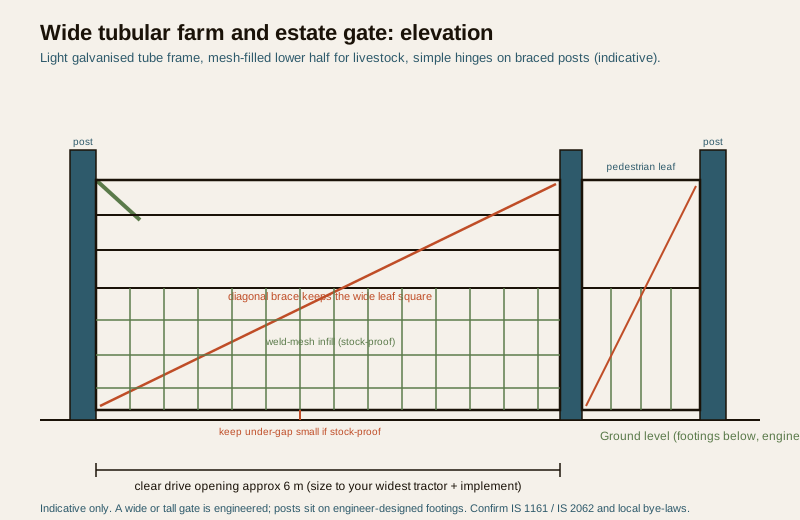
The workhorse of rural India is a light, wide tubular gate — a welded frame of galvanised or mild-steel tube, either open (horizontal rails, like a farm five-bar) or mesh-filled (weld-mesh or chain-link infill to keep stock in and stray animals out). It is light for its width, so it can span a wide field entry on simple, robust hinges without a heavy foundation, and if a tractor clips it, a fabricator can straighten or reweld it on site. For material trade-offs — tube vs solid, galvanising vs powder-coat — see the gate materials guide.
Key points for a farm gate:
- Width first. Size the opening to your widest vehicle plus its implement, not to the car. A tractor with a trailer or a harvester needs generous clearance; the gate size and width guide and the gate width calculator help you set it.
- Keep it light. A tubular or mesh-filled leaf catches less wind and loads the posts less than a solid-sheet gate — which matters on a long, exposed rural boundary.
- Livestock and gaps. If the gate is also stock-proof, mind the gap under the leaf and the mesh size so animals cannot push under or through, and think about a self-closing latch.
- Rural fencing context. A farm gate usually sits in a run of fencing (chain-link, barbed or field wire on posts), not a masonry wall, so the gate posts often do double duty as the strainer posts that tension the fence.
Estate and farmhouse entries
An estate or farmhouse entry is a farm gate with more manners. The span is still wide and the duty still robust, but the look matters more — often a taller, part-solid or ornamental leaf at the drive with a matching pedestrian gate, in wrought iron or heavier tube, frequently automated for a long private driveway. The engineering is the same story as any big gate: wider and heavier means bigger posts and real footings, and if it is automated, the automation guide governs the motor and safety.
Industrial gates: factory and warehouse
Industrial gates are about throughput and durability. A factory or warehouse entry has to pass loaded trucks and trailers, take heavy daily use, and usually automate so a guard or driver operates it without leaving the cab. Because the openings are so wide, they are almost never simple swing gates.
The large-span types
- Sliding (tracked) gates roll on a bottom rail. Simple and strong, but they need a level track kept clear of grit and a straight run-back beside the opening as long as the gate.
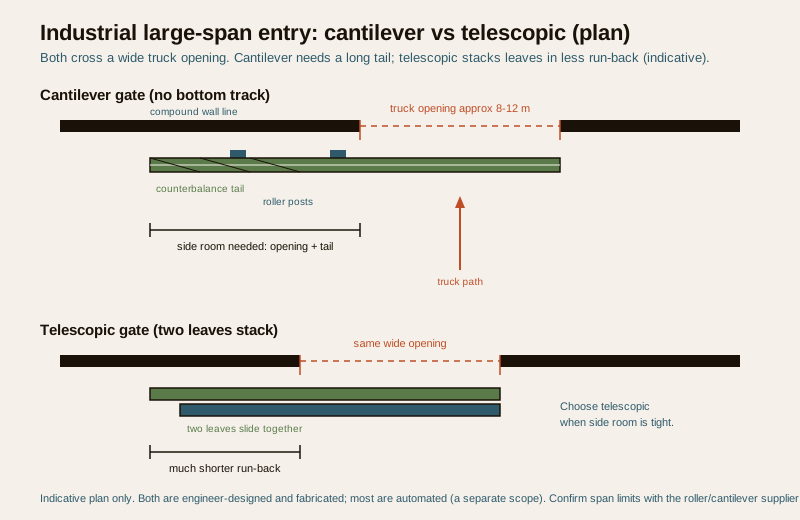
- Cantilever gates carry the leaf on rollers set beside the opening, so the gate hangs over the opening with no bottom track — ideal where the ground is uneven, floods, or must stay clear for drainage and trucks. The trade-off is a counterbalance tail that runs back well past the opening, so you need side room.
- Telescopic gates stack two or three leaves that slide together, so a very wide opening needs far less run-back than a single sliding leaf — the answer when the opening is huge but the side room is tight. The mechanism is covered in folding and telescopic gates.
Which one fits is a space-and-ground question answered in swing vs sliding vs cantilever gates; at industrial spans, cantilever and telescopic dominate.
Heavy frame, high duty
An industrial gate is a fabricated steel structure. The frame is heavy mild-steel section (angle, box or tube to IS 2062 / IS 1161, named generally), often infilled with weld-mesh or vertical bars rather than solid sheet so wind passes through a large leaf. It is hot-dip galvanised or heavily powder-coated for a long outdoor life — the finishes and rust-prevention guide covers how a big gate is protected. And it is sized for its duty cycle: heavier rollers, a stronger track or cantilever beam, and a motor rated for the number of daily openings. That motor, its sensors and safety edges are an automation matter; the access side — RFID, intercom, boom barriers for a separate car lane — is access control. Parking and boom-barrier entries are a Security-hub topic — see the Perimeter Security library — so this guide points there rather than rebuilding it.
The engineering reality: posts, footings and wind
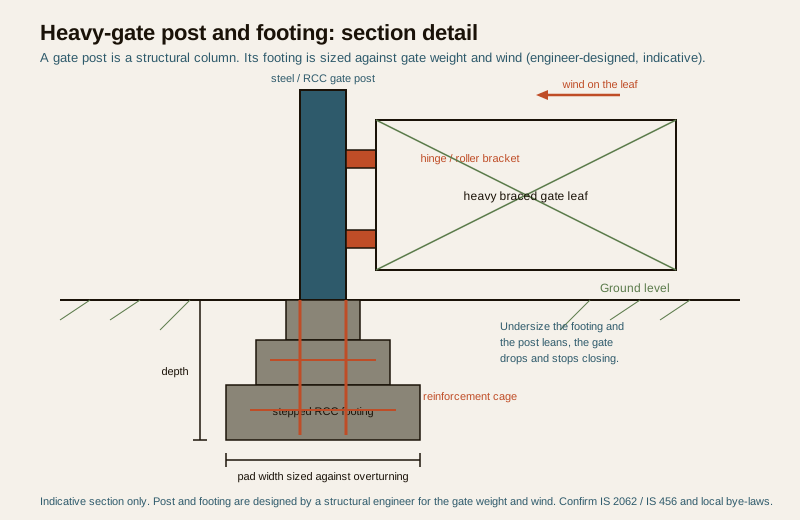
This is the part people skip and regret. A large heavy gate concentrates its whole weight and every gust of wind into two posts (or the roller posts of a sliding gate). Those posts are structural columns, and they are only as good as the footings under them.
- Big posts, real footings. A heavy gate post is a proper steel or RCC column on an engineer-designed footing, sized so the gate's weight and wind cannot lever it out of the ground. Undersize the footing and the post leans, the gate drops, and it stops closing. Footing design lives in the compound wall foundation guide.
- Wind on a big leaf. A wide, tall, solid leaf is a sail; the wind load it collects is real and is one reason big gates are infilled with mesh or bars, not sheet. The engineer sizes the frame and posts for the leaf you actually build.
- It is a fabrication job. A large gate is cut, welded and braced to a drawing by a competent fabricator, with diagonal bracing so the leaf stays square and does not sag over its span. Getting the steel right up front — the steel quantity calculator gives an early weight and cost sense — is cheaper than rehanging a sagged gate later.
- The wall it hangs on. A big gate and the commercial compound wall it sits in are one system: the wall's end piers often double as the gate posts, so they are designed together.
Put simply: for anything large and heavy, the type and look are your choice, but the structure is engineer-led — non-negotiable.
Matching the gate to the context
Different sites need different gates. This table maps the common heavy-gate contexts to the type that usually fits, the one thing that most governs it, and who designs and builds it. Read it as a starting point to discuss with your fabricator, not a specification.
| Context | Typical gate | Key requirement | Who designs / builds |
|---|---|---|---|
| Wide field / farm entry | Light tubular or mesh-filled wide leaf on simple hinges | Width for the widest vehicle + implement; keep it light | Fabricator (fence contractor); engineer if very wide/tall |
| Farmhouse / estate drive | Taller part-solid or ornamental swing/sliding, often automated | Look + robust duty; automation for a long driveway | Fabricator + automation installer; engineer for posts |
| Factory / warehouse truck entry | Large-span sliding, cantilever or telescopic, automated | Truck clearance, high duty cycle, wind-through infill | Structural engineer + fabricator + automation installer |
| Uneven / flood-prone industrial ground | Cantilever (no bottom track) | Side room for the counterbalance tail | Structural engineer + fabricator |
| Very wide opening, tight side room | Telescopic (multi-leaf) | Reduced run-back; more mechanism to maintain | Structural engineer + fabricator |
| Livestock boundary | Mesh-filled field gate with self-latch | Stock-proof: gap under leaf, mesh size | Fence contractor / fabricator |
| Estate boundary in fencing (not wall) | Tubular gate on strainer posts | Posts double as fence-tensioning strainers | Fence contractor / fabricator |
What to specify: heavy-gate checklist
When you brief a fabricator or engineer for a large gate, these are the items to pin down. Missing one is how gates come back wrong.
| Item to specify | Why it matters | Set with / confirm against |
|---|---|---|
| Clear opening width | Must pass your widest vehicle + implement with margin | Widest truck/tractor; gate size and width, gate width calculator |
| Gate type | Swing rarely works at big spans; sliding/cantilever/telescopic do | swing vs sliding vs cantilever; site side room |
| Leaf infill | Mesh/bars let wind through a big leaf; solid sheet is a sail | Wind exposure; engineer's leaf design |
| Frame section & steel | Heavy leaf needs a stiff, braced frame | Fabricator to IS 2062 / IS 1161 (named generally) |
| Post size & footing | Posts are structural columns; a weak footing fails | Structural engineer; compound wall foundation |
| Finish / protection | Big outdoor gate must resist rust for years | Hot-dip galvanising or heavy powder-coat; finishes guide |
| Automation & duty cycle | Motor sized for daily openings and gate weight | motorised gate automation (separate scope) |
| Security & access | Lock, anti-lift, RFID/intercom, separate boom lane | gate security, gate access control (separate scope) |
| Relative cost band | Big fabricated gates vary widely; plan before you quote | compound wall cost calculator + local quotes |
How it connects
- Sits under the Compound Walls and Gates hub and builds on swing vs sliding vs cantilever gates, gate size and width, folding and telescopic gates and gate materials.
- Structure and fit: the posts sit on an engineer-designed footing, and a big gate pairs with the commercial compound wall it hangs in.
- Automation and security are covered elsewhere, not here: motorised gate automation, gate security, gate access control, and boom-barrier / parking-lane entries in the Perimeter Security library.
- Plan the numbers with the gate width calculator, the steel quantity calculator and the compound wall cost calculator.
Key takeaways
- A large farm or industrial gate is a structural and fabrication job, not a shelf purchase — big posts on engineer-designed footings, a braced heavy frame, and a leaf sized for wind.
- Farm and estate gates favour wide, light, tubular or mesh-filled leaves on simple robust hinges over long fencing runs — sized to the widest vehicle plus implement, and stock-proof where livestock matters.
- Industrial gates favour large-span sliding, cantilever or telescopic types for trucks, in heavy mild steel, at high duty cycle — cantilever where the ground is uneven, telescopic where side room is tight.
- A big leaf is a sail: infill with mesh or bars, not solid sheet, and let the engineer size the frame and posts for the leaf you actually build.
- Automation and security are a separate scope — link to the automation and security hubs; boom barriers and parking lanes are a Perimeter Security topic, not rebuilt here.
- Every width, span and post figure is indicative — confirm with your fabricator and structural engineer, against IS 2062 / IS 1161, NBC (SP 7:2026) and local bye-laws, and get local quotes.
References
- IS 2062, Bureau of Indian Standards — hot-rolled medium and high-tensile structural steel (gate frames and posts; named generally).
- IS 1161, Bureau of Indian Standards — steel tubes for structural purposes (tubular gate frames; named generally).
- National Building Code of India, NBC (SP 7:2026), Bureau of Indian Standards — general structural-safety, wind-load and materials provisions relevant to large gates and their posts.
- Gate hardware, roller and cantilever-system manufacturer catalogues — duty ratings, span limits and installation data for heavy sliding and cantilever gear (product-specific).
- Local fabricator and structural-engineer drawings and quotations — the governing design for a specific large gate, its posts and footings, and current steel and fabrication rates.
- Local municipal bye-laws and development-control regulations — gate location, opening, setback and boundary requirements (city-specific; these govern approval).
All widths, spans, post sizes and gate comparisons here are indicative planning aids only; confirm the governing design with your fabricator and a licensed structural engineer, and against IS 2062 / IS 1161, NBC (SP 7:2026) and your local municipal bye-laws. A large or heavy gate must be engineered and fabricated to a drawing; automation and security are covered in the Security and automation hubs, not here.
Export this guide
Related Guides — Deep-dive reading
Compound Gate Design in India: Types, Materials and Sizing (2026)
The start-here guide to the gate as the moving part of your boundary wall — how it opens (swing, sliding, cantilever, folding, telescopic), what it is made of (MS, wrought iron, stainless, aluminium, wood), how wide it needs to be for your vehicle, how it is finished against rust, and the posts and footing that carry it. Decisions in order, with automation and security cross-linked, not rebuilt.
Compound WallsSwing vs Sliding vs Cantilever Gates in India: Which to Choose (2026)
The how-it-opens selection guide for your compound gate — swing on hinges, sliding on a ground track, or cantilever carried on a counterbalance tail with no track — compared on the one thing that actually decides it: the space each one needs beside or in front of your opening, plus slope, width, budget and fit.
Compound WallsCompound Wall Piers and Columns in India: Spacing, Reinforcement and Stability (2026)
Why a long, free-standing boundary wall needs intermediate piers or RCC columns to stay up — the physics of overturning in plain terms, thickened masonry piers vs reinforced-concrete columns on footings, indicative spacing that an engineer sets to your height and wind zone, the coping or tie beam that braces the top, and where to break a long run with movement joints.
Compound WallsRelated Tools — Try Free
Gate Access Planner
Size a vehicle gate or boom barrier — lanes needed at peak and the right credential speed (RFID, ANPR, manual).
Gate FlowWindow Hardware Cost Calculator
Estimate window hardware cost — hinges, handles, locks, rollers and multipoint gears.
Window CalculatorMaterial Comparison Sheet
India's interior material cheatsheet — plywood, finishes, hardware, countertops, paints, waterproofing.
Reference Guide