
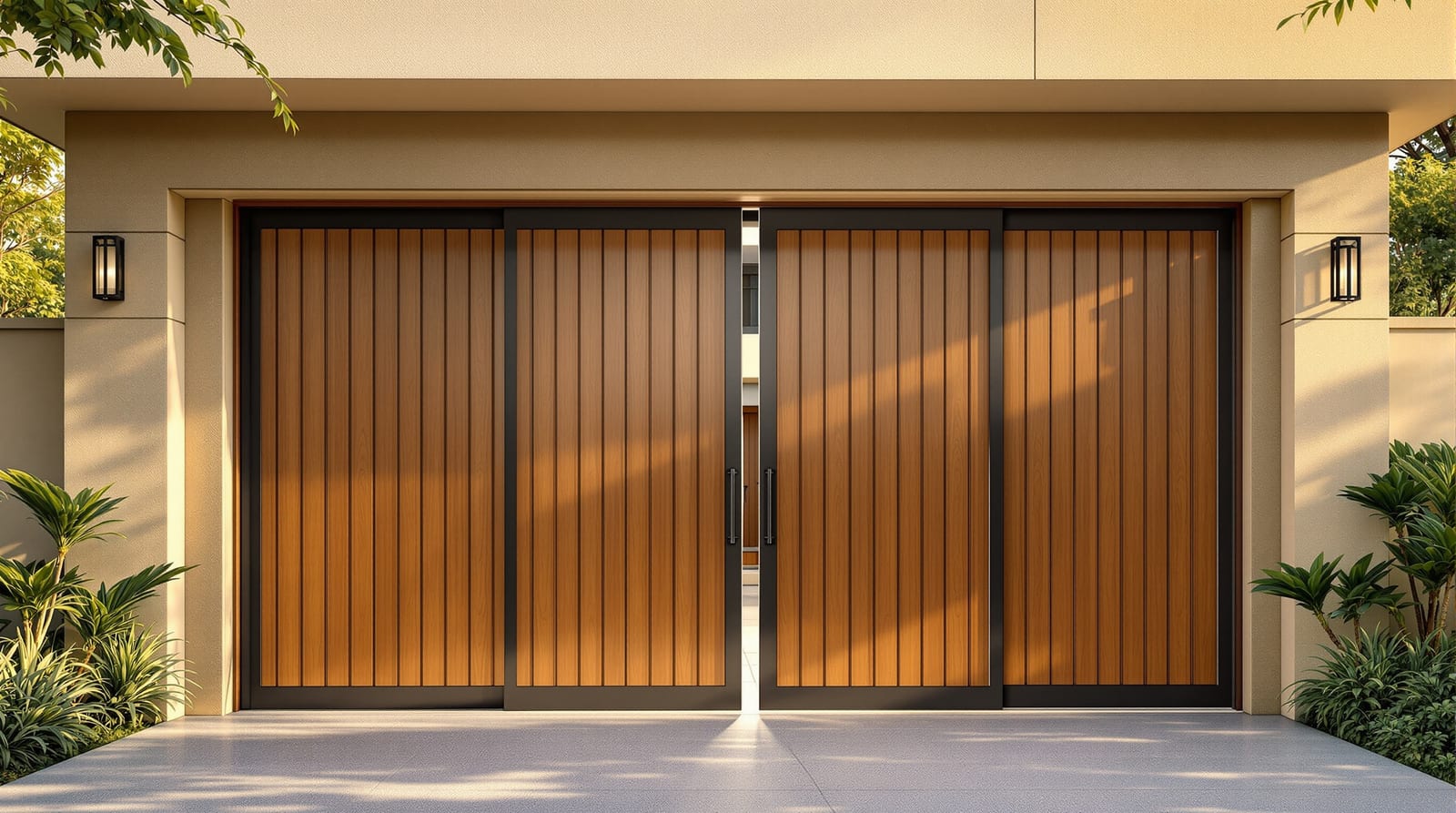
Gate Automation in India: Motorised Swing & Sliding Gate Guide (2026)
How to automate your existing MS swing or sliding gate with the right motor, controls, safety sensors and backup — with realistic Indian costs.
You arrive home in the monsoon, headlights on, rain sheeting across the windscreen, and the compound gate slides open before you have touched the door handle. That convenience is the headline, but gate automation is really about three quieter things: not stepping out into the rain or the road to wrestle a heavy MS gate, controlling who gets onto your plot, and doing both reliably when the power is out. The good news for most Indian homes is that you rarely need a new gate — a competent installer can motorise the heavy mild-steel swing or sliding gate you already have, provided the gate runs true and the structure can take the load.
This guide walks through the two motor families (swing and sliding), how each mounts on an existing gate, the controls you can layer on (remote, app, keypad, RFID), the safety and backup that separate a safe install from a dangerous one, and realistic ₹ for the operator kit plus fitting. Costs here are indicative for 2026 and vary by city, gate weight and brand.
Swing gate vs sliding gate: which automation suits your gate
The first question is not which brand — it is which kind of gate you have. The motor type follows from that.
A swing gate has one or two leaves hinged on the pillars that arc open like a door. To automate it you fit an operator to each leaf. There are two sub-types:
- Articulated (knuckle) arm operators — a jointed arm bolts to the pillar and pushes the leaf open. Forgiving on alignment, easy to retrofit onto existing MS gates where the hinge sits proud of the pillar. The most common choice for Indian residential swing gates.
- Linear (worm-screw) ram operators — a straight piston-style actuator between pillar and leaf. Neater and stronger for heavy or long leaves, but needs the hinge close to the pillar face, so it suits gates designed with that geometry.
- Underground (below-ground) operators — the motor sits in a sealed box buried under the pivot, invisible from outside. The premium, architectural option for villa entrances where you want nothing on the pillar — but it needs the box cast into the ground, so it is far easier on a new gate than a retrofit, and waterproofing matters in monsoon and coastal sites.
A sliding gate runs sideways on a bottom track (or, for cantilever gates, on rollers with no ground track). It is automated with a rack-and-pinion motor: a toothed gear (pinion) on the motor meshes with a toothed bar (the rack) bolted along the bottom rail of the gate, and as the pinion turns the gate slides. This is the workhorse of Indian villa and farmhouse automation because sliding gates handle wide openings and the motor sits compactly beside the gate.
A simple rule of thumb: wide opening or limited swing space → sliding gate + rack-and-pinion motor; existing hinged gate with room to swing → swing operators. If you are choosing the gate itself, see our companion notes on collapsible / sliding gate doors and safety grill gate doors.
Load and weight ratings — the number that decides everything
A gate operator is rated for a maximum gate weight (and, for sliding gates, often a maximum gate length; for swing gates, a maximum leaf width and weight). Pick a motor that comfortably exceeds your gate — running a motor near its limit on a heavy MS gate is the single most common cause of premature failure and burnt motors in Indian conditions.
Get your gate weighed or estimated honestly. A typical full-height MS sliding gate for a single-car opening runs roughly 150-400 kg; large double-leaf villa gates and ornamental cast designs go heavier. Rough tiers:
- Sliding, residential up to ~600 kg — most homes; the common 600-800 kg class motors give headroom.
- Sliding, 800-1200 kg+ — long farmhouse / industrial-style gates; heavier-duty motors.
- Swing, leaf up to ~2.5 m / ~250-300 kg — standard residential leaves.
- Swing, leaf 3-5 m / heavier — long ornamental leaves need stronger linear or hydraulic arms.
Also confirm duty cycle (how many open/close operations per hour the motor tolerates) — fine for a home, important for a shared society gate that cycles constantly. And confirm the supply: most residential operators are 230 V single-phase; low-voltage (24 V DC) motors are valued for safer, smoother control and easier battery backup.
Retrofitting onto an existing MS gate
You usually do not need a new gate. A good installer will check:
1. The gate runs true. A sliding gate must roll freely by hand end to end without binding or jumping the track; a swing leaf must not sag on its hinges. Automate a misbehaving gate and you automate the problem — the motor strains and fails. Fix sag, worn rollers and bent tracks first (our notes on fixing a sagging door share the same logic for hinged leaves).
2. The structure can take the load. Sliding-gate racks bolt or weld to the bottom rail; the motor sits on a small concrete foundation pad beside the pillar. Swing operators bolt to the pillar — a thin or hollow pillar may need a bracket plate or strengthening.
3. The track and stops are sound. Reliable open/close limits (mechanical or magnetic) need solid end stops.
4. Power and earthing are available at the pillar — a dedicated, properly earthed point, ideally on the same circuit you can back up.
For a steel gate, also keep an eye on rust at the rack and roller path; coastal homes especially should specify galvanised or stainless rack and hardware, since salt air eats fittings fast — the same corrosion concern behind safety grill gate doors.
Controls: remote, app, keypad and RFID
The operator is the muscle; the controls decide who triggers it and how. You can mix several:
- RF remote (transmitter) — the default. Rolling-code remotes (not fixed-code) resist code-grabbing. Programme several handsets for the family.
- Smartphone app / Wi-Fi module — open from your phone, get arrival notifications, grant temporary access, and integrate with home automation. Many kits add this through an add-on Wi-Fi module. This is the same control layer behind modern access devices — see door access control.
- Keypad — a wall- or pillar-mounted PIN pad; good for staff and guests without a remote, and codes can be changed.
- RFID card / tag reader — tap a card or fob; popular for gated societies and homes with regular staff because you can issue and revoke individual tags.
- Intercom / video integration — link the gate to a video door phone or video door system so you can see and buzz in a visitor from inside.
For full driveway automation many homes pair the gate with automatic sliding doors or a sensor-driven porch entry, so the journey from road to door is hands-free.
Safety: photocells, edges and the manual release
Automated gates move with real force and can injure people, pets and vehicles. Treat these as non-negotiable, not extras:
- Photocells (safety beams) — an infrared beam across the opening; if anything breaks the beam while the gate is closing, it stops and reverses. Fit them.
- Safety edges — a pressure-sensitive rubber strip on the leading edge that reverses the gate on contact. Recommended on heavy gates and where children are around.
- Force/obstacle sensing — the controller detects abnormal resistance and stops; check this is set correctly during commissioning.
- Flashing warning light / beep on movement — alerts people the gate is about to move.
- Manual release (declutch) on power cut — the most important feature in India. Every operator has a key-operated or lever release that disengages the motor so you can push the gate open or shut by hand. Know where the release key is, keep a spare, and test it — because the power will go out, and you do not want to be locked in or out.
Backup power: battery and inverter
Indian power is the design constraint. A gate that only works on grid power is a gate you will be hand-cranking weekly. Two approaches:
- Built-in battery backup — many 24 V DC operators accept a small backup battery in the motor housing, giving a number of open/close cycles during an outage. The cleanest solution; specify it at purchase.
- Inverter / UPS connection — wire the operator's mains point to your home inverter line so it runs on the inverter during a cut. Confirm the inverter's wattage and waveform suit the motor (pure sine wave is safer for electronics).
Even with backup, the manual release stays your fail-safe for a flat battery or extended outage.
Indicative costs: gate type × motor × ₹
Costs below are for the operator kit plus standard installation (motor, control board, a couple of remotes, photocells and commissioning), 2026, indicative and varying by city, gate weight, brand and site work. Rack, foundation pad, electrical point, and any gate repair are usually extra.
| Gate type | Motor type | Typical gate spec | Operator kit (motor + board + remotes + photocells), ₹ | Fitting + accessories (rack/pad/wiring), ₹ | Notes |
|---|---|---|---|---|---|
| Sliding | Rack-and-pinion, residential | Up to ~600 kg | 18,000 - 35,000 | 4,000 - 12,000 | Most homes; +18% GST |
| Sliding | Rack-and-pinion, heavy | 800-1200 kg+ | 35,000 - 70,000+ | 8,000 - 20,000 | Farmhouse / long gates |
| Swing (single leaf) | Articulated arm | Leaf up to ~2.5 m | 16,000 - 35,000 | 3,000 - 9,000 | Easiest MS retrofit |
| Swing (double leaf) | Articulated / linear arm pair | 2 leaves, up to ~3 m each | 28,000 - 60,000 | 5,000 - 15,000 | Two operators |
| Swing (premium) | Underground operator | Architectural villa gate | 50,000 - 1,20,000+ | 15,000 - 40,000 | Cast-in box; best on new gate |
Add-ons (indicative): Wi-Fi / app module ₹3,000-8,000; keypad ₹2,000-6,000; RFID reader + tags ₹4,000-12,000; safety edge ₹2,500-6,000; backup battery ₹3,000-8,000; extra remote ₹800-2,500.
Brands you will see in India
- BFT and Came and Nice — established European automation brands, widely installed in Indian villas; strong dealer/spares networks in metros.
- Roger Technology — Italian operators favoured for heavy and underground applications.
- Ozone — an India-strong brand carrying gate operators alongside its locks and door hardware, often easier to service in smaller cities.
Choose on local dealer support and spares availability as much as on the badge — an orphaned motor with no spare board is an expensive paperweight.
FAQ
Can I automate my existing mild-steel gate, or do I need a new one?
Usually you can automate the existing gate. The installer checks that the gate runs true (slides or swings freely by hand without binding or sagging) and that the pillar and rail can take the motor and rack. Fix sag, worn rollers or a bent track first — automating a faulty gate just breaks the motor faster.
What happens to an automatic gate during a power cut?
Every operator has a manual release (declutch) — a key or lever that disengages the motor so you can push the gate by hand. For convenience, specify a built-in backup battery or wire the motor to your home inverter so it keeps working through routine cuts. Keep the release key handy and test it occasionally.
Are automatic gates safe with children and pets around?
They are if installed properly. Insist on photocell safety beams that stop and reverse the gate if something crosses while it closes, add a pressure-sensitive safety edge on heavy gates, and confirm obstacle/force sensing is set during commissioning. A flashing warning light helps too. Never let children play on or near a powered gate.
How do I control who can open the gate?
Layer the controls to suit your household: rolling-code RF remotes for family, a keypad PIN for guests and staff, RFID cards or tags you can issue and revoke individually, and a Wi-Fi app for remote opening and arrival alerts. Linking the gate to a video door phone lets you see and buzz in visitors before opening.
What is the difference between swing and sliding gate motors?
Swing gates use operators (articulated arms, linear rams, or buried underground units) that push each hinged leaf open. Sliding gates use a rack-and-pinion motor — a gear on the motor meshes with a toothed bar along the gate's bottom rail to drive it sideways. Sliding suits wide openings or tight swing space; swing operators suit existing hinged gates with room to arc open.
Export this guide
Related Guides — Deep-dive reading
Smart Garage Doors & Openers for Indian Homes (2026 Guide)
A garage door is the largest moving object in most homes, and a heavy one. This guide covers smart garage doors and openers for Indian homes end to end — motorised sectional, roller and sliding doors; what a smart opener actually adds; retrofit controllers versus smart openers; the safety sensors you must never skip; rolling-code security; the manual release for power cuts; integration with cameras and your wider smart home; and real brands with ₹ prices.
Smart HomeGate Automation Maintenance in India (2026): Keep a Sliding or Swing Gate Working and Safe
A homeowner's upkeep guide for an automatic sliding or swing gate — clearing the track, lubricating rollers and hinges, testing the safety photocells and manual release, caring for the controller and its backup battery, and knowing exactly where the DIY line stops and a qualified technician begins.
SecurityAutomatic Swing Door Operators: Retrofit Guide India 2026
How to retrofit a normal hinged door to open by itself — full-energy vs low-energy operators, activation, safety and cost for Indian buildings.
Home Doors & EntrancesRelated Tools — Try Free
Access-Control Battery-Backup Calculator
Size the standby battery so an access system keeps running through a power cut, with an egress life-safety note.
Battery BackupApartment Video Door System Planner
Enter flats, entrances, floors and guard desk for a first-pass building intercom plan — door stations, indoor monitors, guard station, the right architecture and an indicative cost band.
Building PlannerElectrical Safety & Load Audit
Home electrical audit — 10 categories, 65+ checkpoints across earthing, RCCB, MCB, wiring, switchboards, appliance circuits, DG/inverter backup.
Safety Audit